GRADE 10 LENS, HUMAN EYES AND DISPERSION
Presentation
•
Physics
•
10th Grade
•
Medium
Physics Physics
Used 3+ times
FREE Resource
14 Slides • 26 Questions
1
Lens
By Physics GRADE 10
2
Multiple Choice
The above lens is a type of ___.
diverging lens
converging lens
divergent lens
convergent lens
3
Multiple Choice
Which lens represents the path light takes through a diverging lens?
4
Multiple Choice
Which figure represents the path light takes through a converging lens?
5
Multiple Choice
Which diagram shows how an image of an object is formed on a screen by a converging lens?
A
B
C
D
6
Multiple Choice
A real image...
is produced by virtual rays and can be projected on a screen
is produced by real rays and cannot be projected on a screen
is produced by virtual images and cannot be projected on a screen
is produced by real rays and can be projected on a screen
7
Multiple Choice
A virtual image is formed by...
the actual intersection of light rays, cannot be formed on a screen
the apparent intersection of light rays, cannot be formed on a screen
the actual intersection of light rays, can be formed on a screen
the apparent intersection of light rays, can be formed on a screen
8
Multiple Choice
if the object is beyond C (2F)
image is real, diminished and upright
image is real, diminished and inverted
image is virtual, diminished and inverted
image is real, enlarged and upright
9
Multiple Choice
What kind of image is always formed in a diverging (concave) lens?
Virtual image
Real image
10
Multiple Choice
An object is placed in front of a converging lens. The lens has a focal length f. The lens produces a real, enlarged image of the object. In which labelled position is the object placed?
A
B
C
D
11
Multiple Choice
When an object is placed between the focus and the convex lens, the image produced is ___.
real, diminished, and inverted
real, magnified, and inverted
virtual, magnified, and upright
virtual, diminished, and upright
12
13
14
15
16
17
18
19
20
21
22
Multiple Select
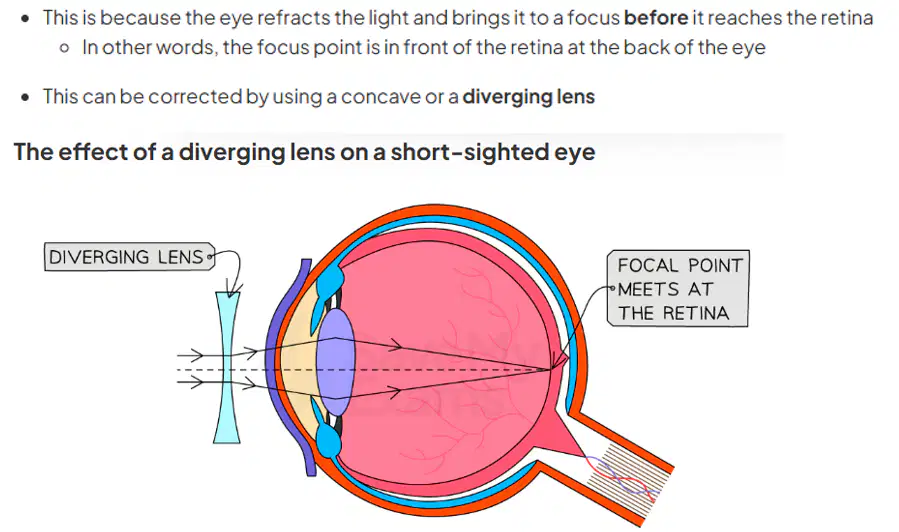
An image is formed on
Iris
Pupil
Retina
Cornea
23
Multiple Select
The shape of eye-ball is nearly _________________
Elliptical
Oval
Circular
Spherical
24
Multiple Choice
Following controls and regulates the amount of light entering the eye
Iris
Pupil
Retina
Corena
25
Multiple Select
_________________ send signals to the brain
Optical nerve
Aqueous Humour
Viterous humour
Eye lens
26
Multiple Choice
The image formed by retina of human eye is
Real and inverted
Virtual and inverted
Virtual and erect
Real and erect
27
Multiple Choice
The defect of the eye in which the eyeball becomes too long is
hypermetropia
myopia
cataract
presbyopia
28
Multiple Select
The defect of vision in which the person is able to see distant object distinctly but cannot see nearby objects clearly is called
far-sightedness
near-sightedness
presbyopia
All of above
29
Multiple Select
Following is true for Hypermetropia
It can be corrected by using a convex lens
It may arise when focal length of eye lens is too long
it may arise when eyeball has become too small
all of above
30
Multiple Choice
Myopia or short sightedness can be corrected using
convex lens
multifocal lens
concave lens
focal lens
31
Drag and Drop
To correct the inability of seeing
32
DISPERSION OF LIGHT
33
White is not actually a specific color - it is made of ALL colors mixed together
A PRISM (a piece of glass or crystal, often triangular in shape) can be used to split a beam of white light into the RAINBOW it is made from through a process called DISPERSION.
What is the wavelength of white light?
34
When white light passes through a prism, the different WAVELENGTHS of light that make it up bend slightly different amounts.
The LONGER the wavelength, the LESS the wave bends.
RED bends LESS than VIOLET because it has a LONGER wavelength.
Dispersion through a prism
35
Multiple Choice
The splitting of white light into the seven colors when it passes through a transparent material is called
Refractrion
Dispersion
Reflection
Diffraction
36
Multiple Choice
When white light passes through a prism,
red bends more, violet bends least
red bends least, violet bends most
dispersion doesn't occur
refraction doesn't occur
37
Multiple Choice
When white light enters a prism, it gets split into its constituent colours. This is due to
different refractive index for different wavelength of each colour
each colours has same velocity in the prism.
prism material have high density.
Scattering of light
38
Multiple Choice
The colored light that refracts most while passing through a prism is
Red
Yellow
Blue
Violet
39
Multiple Choice
A ray of white light enters the raindrop and undergoes __________ and __________ to form a spectrum.
refraction; dispersion
reflection; dispersion
dispersion; diffraction
scattering; dispersion
40
Multiple Choice
A compact disc is held with its mirror face facing the light source. A coloured pattern is formed on the disc. Which phenomenon is responsible for the pattern?
reflection
refraction
polarisation
dispersion
Lens
By Physics GRADE 10
Show answer
Auto Play
Slide 1 / 40
SLIDE

Similar Resources on Wayground
33 questions
Subroutines
Presentation
•
10th Grade
36 questions
Electromagnet Summary
Presentation
•
10th Grade
36 questions
Research Questions
Presentation
•
9th - 10th Grade
36 questions
ACT Math Prep and Tips
Presentation
•
10th Grade
34 questions
Passé Composé Review (avoir)
Presentation
•
9th - 10th Grade
34 questions
Lesson: Types of Chemical Reactions
Presentation
•
10th Grade
37 questions
Neolithic Revolution
Presentation
•
9th Grade
36 questions
CƠ NĂNG. VẬT LÍ 10
Presentation
•
10th Grade
Popular Resources on Wayground
11 questions
Hallway & Bathroom Expectations
Quiz
•
6th - 8th Grade
10 questions
HCS SCI 03 Summer School Assessment 2
Quiz
•
3rd Grade
11 questions
Home Scope
Quiz
•
7th - 8th Grade
12 questions
2026 TAP Technology in the Classroom
Presentation
•
Professional Development
15 questions
HCS SCI 05 Summer School Assessment 2 Review
Quiz
•
5th Grade
15 questions
HCS SCI 04 Summer School Review 2
Quiz
•
4th Grade
59 questions
Geometry Unit 3 Review
Quiz
•
9th - 12th Grade
14 questions
FAST ELA READING SMAPLE TEST MATERIALS
Passage
•
3rd Grade