

The prince and the pauper HMH

Presentation
•
English
•
6th Grade
•
Medium

Arne Engelbrecht
Used 3+ times
FREE Resource
16 Slides • 23 Questions
1

2
Multiple Choice
Why do you think some characters are given names and surnames and other are not?
Some characters are given names and surnames to show they are important, while others are not to highlight their symbolic or functional roles.
3

4

5
Multiple Choice
What do we learn about Tom's character here?
He isn't trying to act like royalty. He is still himself.
6
Multiple Choice
Do you think Tom knows the importance of the Great Seal? What theme does his actions suggest?
No, Tom does not know the importance of the Great Seal.
Tom is indifferent to the Great Seal's significance. This suggest a theme of power.
Tom believes the Great Seal is just a item. This suggest that objects are thing humans give value to.
7

8
Multiple Select
What is the purpose of scene 2? Select two answers.
It shows that Tom was telling the truth about his father being abusive.
It shows that the prince's feelings about wanting a different life is changing.
9
Open Ended
Describe what kind of person Miles Hendon is. What possible themes are introduced by his character?
10
Open Ended
Describe how Miles treats the prince. Have his feelings changed, if so, how?
11

12
Multiple Choice
What elements of drama moves help develop the plot in paragraph 113?
Stage directions and dialogue drives the plot forward.
Character development, conflict.
13
Open Ended
How is the relationship between Miles and the Prince changing?
14

15
16

17
18
19

20

21

22

23

24
25
Multiple Choice
How do the stage directions in paragraph 26 reveal information about the characters?
F They show what the prince is willing to do to experience something new.
G They explain why Tom is so nervous around the prince.
H They help the audience see what emotional turmoil the prince feels in his role.
J They describe how desperate Tom is to become the new prince.
26
Multiple Choice
What does the Prince’s dialogue in paragraph 8 suggest about him?
A He is rushed.
B He is suspicious.
C He is kindhearted.
D He is easily angered.
27
Multiple Choice
Read about the origin of the word beckoning. Closely related to the word beacon, which is a “sign or lighthouse” This information helps the reader understand that beckoning in paragraph 42 means —
A yelling at
B waving over
C putting away
D hiding out
28
Multiple Choice
The playwright wants to add a sentence of dialogue after the dialogue in paragraph 111. Which of the following could correctly be added?
F “I’m going to sleep on that bed.”
G “I’m going to sleep at that bed.”
H “I’m going to sleep over that bed.”
J “I’m going to sleep beside that bed.”
29
Multiple Select
What connections can you make between Scene 6 and your own experiences or knowledge? Select all of the connections that would apply.
I have read about other courtroom scenes and seen them in movies and on television.
While I am reading Scene 6, I can use what I know about those courtroom-like settings to picture what is happening.
The setting description says it is the Office of the Justice with a high bench.
I picture a courtroom because the woman is accusing the Prince of stealing her pig. There’s also a constable, which is like a police officer.
All of these details are familiar to me and help me connect to the scene.
30
Multiple Choice
Read the dictionary entry below for the word sly. sly \slī\ adj 1. acting in an unauthorized way 2. showing that you are deceitful 3. doing something playfully 4. having a clever nature Which definition best matches the meaning of slyly as it is used in paragraph 151?
F Definition 1
G Definition 2
H Definition 3
J Definition 4
31
Multiple Choice
The playwright wants to add stage directions about the setting to Scene 7 to help the reader better visualize the scene. Which of the following could correctly be added?
A There is dirt deep inside the floor.
B There is dirt scattered across the floor.
C There is dirt lying next to the floor.
D There is dirt hanging above the floor.
32
Multiple Select
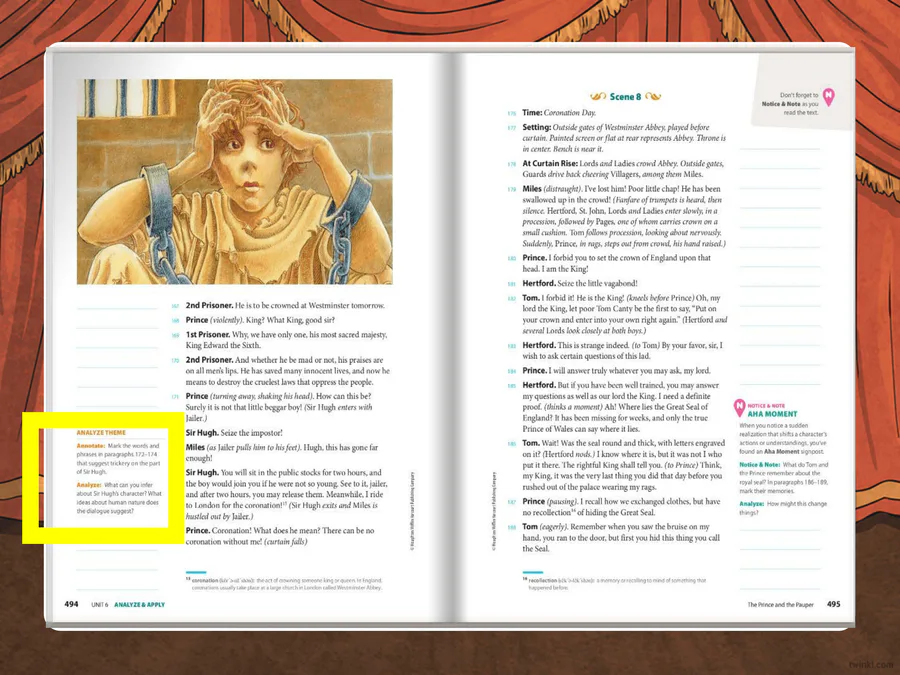
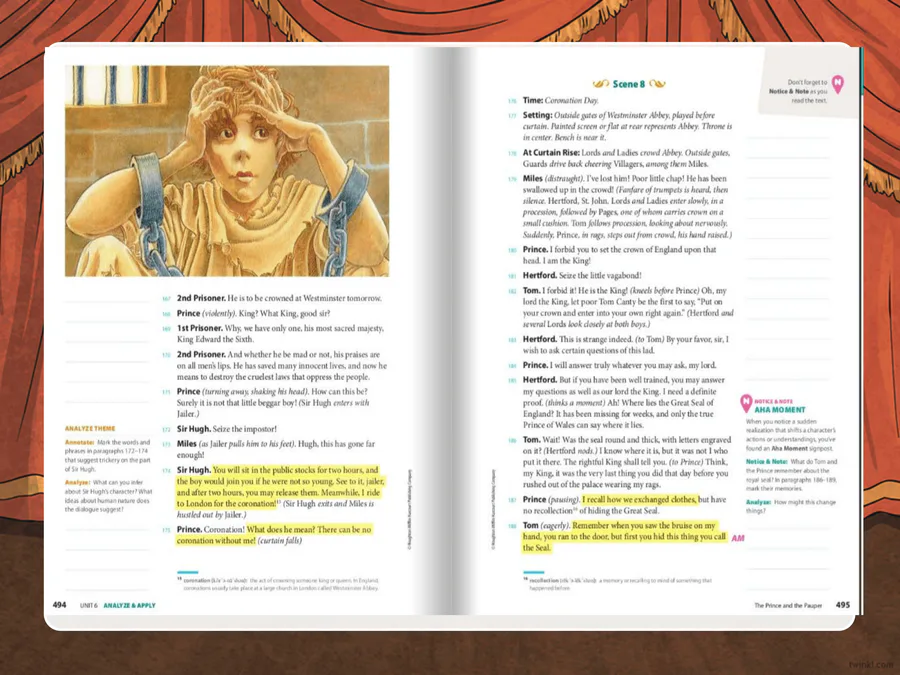
Explain how and why Hertford’s dialogue toward the Prince changes in Scene 8. Which pieces of evidence from the play supports this answer?
Scene 8 is when Hertford realizes that the pauper is really the Prince.
At first he says, “Seize the little vagabond!” to the guards to capture the Prince in disguise.
Then he begins to think that maybe the boy really is the Prince.
His dialogue becomes kinder, and he asks about the location of the Great Seal as final proof.
33
Multiple Choice
The playwright’s use of figurative language in paragraph 179 is intended to help the reader understand how —
A many people are outside of the palace gates
B hungry the people in the village are
C loud the crowd is getting at the coronation
D tall the people in the crowd are
34
Multiple Choice
The stage direction in paragraph 182 helps the reader understand the scene by having —
F Hertford act upset by the news of the switch
G Hertford inspect the boys to discover the truth
H Hertford act like he is embarrassed by his actions
J Hertford appear to be surprised he had not noticed the difference
35
Multiple Select
Which two sentences show that the character Miles is devoted to the Prince, despite not knowing his true identity?
A I was not thinking.
B My father is a baronet.
C Well, I will be his friend and watch over him.
D Trust in me and all shall go well.
E Now I am free, and I am returning home.
36
Multiple Choice
"Tom takes off the cape."
Mark whether or not this detail helps the reader to imagine the moment when the people recognize the real Prince.
Yes, it helps the reader imagine the moment when the people recognize the real Prince.
No, it does not help the reader imagine the moment when the people recognize the real Prince.
37
Multiple Choice
"Tom throws the cape over the Prince."
Mark whether or not this detail helps the reader to imagine the moment when the people recognize the real Prince.
Yes, it helps the reader imagine the moment when the people recognize the real Prince.
No, it does not help the reader imagine the moment when the people recognize the real Prince.
38
Multiple Choice
"The Prince is wearing rags."
Mark whether or not this detail helps the reader to imagine the moment when the people recognize the real Prince.
Yes, it helps the reader imagine the moment when the people recognize the real Prince.
No, it does not help the reader imagine the moment when the people recognize the real Prince.
39
Multiple Choice
"Trumpet fanfare sounds."
Mark whether or not this detail helps the reader to imagine the moment when the people recognize the real Prince.
Yes, it helps the reader imagine the moment when the people recognize the real Prince.
No, it does not help the reader imagine the moment when the people recognize the real Prince.
Show answer
Auto Play
Slide 1 / 39
SLIDE
Similar Resources on Wayground

33 questions
Story Elements
Presentation
•
6th Grade
35 questions
Nonfiction Terms
Presentation
•
6th Grade
36 questions
Characterization
Presentation
•
6th Grade
37 questions
Argument Essay
Presentation
•
6th Grade
30 questions
Elements of Fiction
Presentation
•
7th Grade
35 questions
Water in the Atmosphere
Presentation
•
6th Grade
35 questions
Fiction STAAR Vocabulary 6th grade
Presentation
•
6th Grade
33 questions
Setting and Mood Review
Presentation
•
6th Grade
Popular Resources on Wayground
10 questions
How much do you know about our Portrait of an Eagle?

Quiz
•
10th Grade
10 questions
Fast Food Slogans
Quiz
•
6th - 8th Grade
21 questions
Continents and Oceans
Quiz
•
6th Grade
20 questions
Parts of Speech
Quiz
•
5th Grade
16 questions
Subject & Predicate
Quiz
•
5th Grade
25 questions
Multiplication Facts
Quiz
•
5th Grade
12 questions
Map Skills
Quiz
•
3rd Grade
22 questions
Continents and Oceans
Quiz
•
5th Grade
Discover more resources for English
20 questions
Context Clues
Quiz
•
6th Grade
20 questions
Types of sentences
Quiz
•
6th Grade
25 questions
Making Inferences
Quiz
•
6th - 8th Grade
20 questions
Figurative Language Review
Quiz
•
6th Grade
15 questions
Plot Elements
Quiz
•
6th Grade
18 questions
Main Idea
Quiz
•
4th - 6th Grade
10 questions
Main Idea and Supporting Details
Quiz
•
3rd - 6th Grade
20 questions
Theme vs. Main Idea
Quiz
•
6th Grade