

2.1.2 Earth's Structure

Presentation
•
Other
•
11th Grade
•
Practice Problem
•
Easy

Caitlin Ford
Used 3+ times
FREE Resource
11 Slides • 6 Questions
1
2.1.2
By Caitlin Ford
2
Objectives
- describe different layers of the Earth and their composition
- explain how the structure of Earth is the cause of volcanoes and earthquakes
3
Open Ended

Describe what you see in this picture.
4
Felix Baumgartner
A lot of you might think this photo is of an astronaut in space. That is incorrect!
Felix Baumgartner's famous 2012 jump took place from the stratosphere, not from space. He was 24 miles above sea level (space begins 62 miles up!) and performed the highest skydive and fastest freefall ever recorded.

5
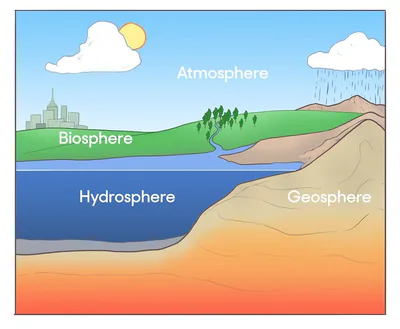
The 4 Spheres of the Earth
Lithosphere/Geosphere - made of rocks, the crust, and upper mantle
Hydrosphere - all the water on Earth
Biosphere - all life on Earth
Atmosphere - the layer of gases that surrounds Earth
6
Labeling
Please label the spheres of the Earth.
hydrosphere
atmosphere
biosphere
lithosphere
7
The Crust
Crust - the outermost layer, the layer we live on, the most studied, 1% of the total volume of Earth, consists of continental crust and oceanic crust

8
Tectonic Plates
The crust is made up of tectonic plates - massive slabs of rock that move due to convection currents in the mantle.
There are 3 types of plate boundaries:
divergent boundaries - plates are moving away from each other
convergent boundaries - plates are coming together and one is being pushed down beneath the other
transform boundaries - plates slide past each other
The grinding of these plates can cause earthquakes.
9
Match
Identify the tectonic plate boundaries.
divergent plate boundary
convergent plate boundary
transform plate boundary
divergent plate boundary
convergent plate boundary
transform plate boundary
10
The Mantle
Mantle - lies between the crust and core, makes up 84% of Earth's volume and 67% of its mass
Divided into upper mantle (part of the lithosphere) and the lower mantle.
As the plates move, molten material from the mantle pushes upward through cracks and forms a volcano.

11
The Core
Core - made of the inner core (solid) and outer core (liquid), the heaviest metals are found here, the hottest part of the planet.
Why is it hot? - primordial heat from Earth's formation, radioactive elements release heat, and radioactive decay
Generates the magnetosphere - protects Earth from dangerous radiation from space
12

13
Multiple Choice
What causes the heat in Earth's core?
nuclear fission
the decay of radioactive elements
pressure exerted by the other layers
nuclear fusion
14
The Atmosphere
Gravity keeps the atmosphere close to Earth's surface.
Critical component of what makes Earth habitable.
Importance - contains oxygen for living things, protects from harmful radiation, traps the heat of the sun
15
Labeling
Label the layers of the Earth.
mantle
outer core
crust
inner core
16
Categorize
Weather
Ozone Layer
Wind
Volcanoes
Soil
Rocks
Trees
Cows
Flowers
Rivers
Oceans
Glaciers
Sort each item into the correct Earth sphere.
17
Great Job!
Today, you learned:
- different layers of the Earth and their composition
- how the structure of Earth is the cause of volcanoes and earthquakes
2.1.2
By Caitlin Ford
Show answer
Auto Play
Slide 1 / 17
SLIDE
Similar Resources on Wayground

15 questions
4.01 Diagnostic & Therapeutic Services
Presentation
•
10th - 12th Grade
11 questions
EMPOWERMENT TECHNOLOGIES
Presentation
•
11th Grade
13 questions
Proses Bisnis Industri Kuliner
Presentation
•
University
11 questions
Type of insurances (Medicare, Medicaid, CHIP)
Presentation
•
11th Grade
15 questions
SSS and SAS
Presentation
•
11th Grade
11 questions
Renewable and Nonrenewable Resources
Presentation
•
11th Grade
14 questions
formal invitation (XI SMK)
Presentation
•
11th Grade
Popular Resources on Wayground
10 questions
Safety Day 2026 – Student Review

Quiz
•
9th Grade
21 questions
Continents and Oceans
Quiz
•
6th Grade
20 questions
Parts of Speech
Quiz
•
5th Grade
16 questions
Subject & Predicate
Quiz
•
5th Grade
25 questions
Multiplication Facts
Quiz
•
5th Grade
12 questions
Map Skills
Quiz
•
3rd Grade
22 questions
Continents and Oceans
Quiz
•
5th Grade
15 questions
Rounding Decimals
Quiz
•
5th Grade
Discover more resources for Other
26 questions
SLIME!!!!!
Quiz
•
KG - 12th Grade
20 questions
Cell Transport
Quiz
•
9th - 12th Grade
20 questions
Budgeting
Quiz
•
9th - 12th Grade
20 questions
Investing
Quiz
•
9th - 12th Grade
8 questions
DNA vs. RNA
Presentation
•
9th - 12th Grade
12 questions
Identify Rigid Transformations
Quiz
•
8th - 12th Grade
10 questions
Complementary, Supplementary, Vertical, and Linear Pairs
Quiz
•
9th - 12th Grade
20 questions
Managing Credit
Quiz
•
9th - 12th Grade