LEAP 2025 Session 2 Review
Presentation
•
Science
•
10th Grade
•
Practice Problem
•
Hard
Tyler Ussery
Used 1+ times
FREE Resource
2 Slides • 11 Questions
1
LEAP 2025 Session 2 Review
By Tyler Ussery
2
Banded Snails
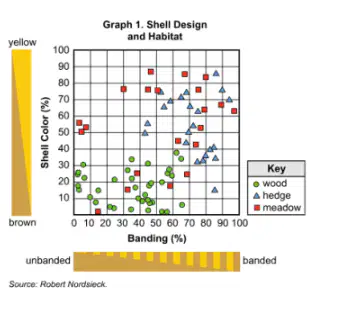
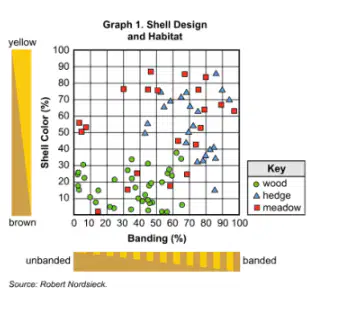
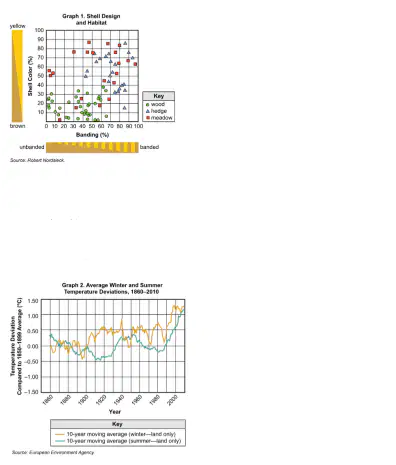
Banded snails, found in Central Europe, are small- to medium-sized snails that are members of the Helicidae family. Their shells are found in a range of colors and patterns, from yellow to dark brown and from no bands (or stripes) to five bands. Image 1 shows an example of a banded snail with five bands. Banded snails are prey to several bird species, including the song thrush. The color and pattern of the bands are based on genetics and heredity, and follow the Mendelian rules of inheritance. In addition, snails with lighter-colored shells have a lower body temperature than those with darker-colored shells. In some areas, snails with many different colors and band patterns are found. In other areas, certain shell colors or patterns are more common. Graph 1 shows the percentages of snails with different shell colors and band patterns found in different habitats.
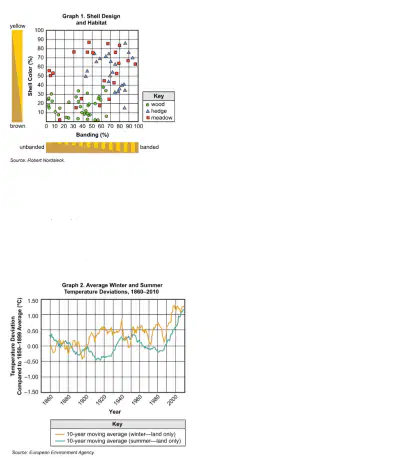
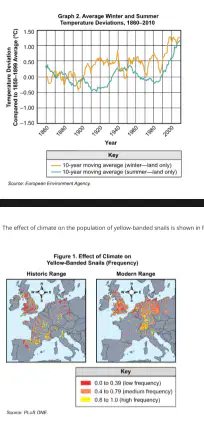
Climate can play a significant role in the survival advantages of each color and banding pattern. Snails with darker-colored shells tend to be found living farther north than those with lighter-colored shells. Scientists have observed that the climate in Central Europe is changing faster than in other areas. This impacts not only the local organisms, but migratory species of birds and animals as well. Graph 2 shows how the average winter and summer temperature deviations in Central Europe have changed over time.
The effect of climate on the population of yellow-banded snails is shown in Figure 1.
Use the information about banded snails and your knowledge of science to answer the questions.
3
Multiple Choice
Which claim is supported by evidence from Graph 1?
Snails with yellow shells live in all three habitats, but those with banding have a survival advantage in hedge
habitats.
Snails with yellow shells and banding are less able to survive in wood habitats.
Snails with brown shells live in all three habitats, but they have a survival advantage in meadow habitats.
Snails with brown shells and no banding are most often found in meadow habitats.
4
Multiple Choice
Use Graph 2 and Figure 1 to answer the question.
Part A
Which statement best predicts how yellow-banded snails will be affected if the trends shown in Graph 2 continue?
Yellow-banded snails will migrate from higher elevations to lower elevations.
Yellow-banded snails will migrate from northern regions to southern regions.
Yellow-banded snails will become more common in areas that have historically cooler temperatures.
Yellow-banded snails will be found in a much wider range than the region in which they were historically
found.
5
Multiple Choice
Part B
Which statement supports your prediction from Part A?
Yellow-banded snails are able to live in all environments, but predation rates were historically higher in certain
areas prior to climate change.
Yellow-banded snails in cooler areas will become extinct because they are unable to adapt to changing
conditions.
Yellow-banded snails will move to areas where there are fewer migratory predators.
Yellow-banded snails are better suited to live in warmer climates than snails with other-colored shells.
6
Multiple Select
As the climate in northern regions changes, the population of snails with darker-colored shells will likely (A)___________ because
they have (B)______________ than snails with lighter-colored shells.
(A)increase
(A)decrease
(B)better camouflage
(B)higher body temperatures
(B)lower rates of predation
7
Draw
Match the following Effects to the correct Cause by drawing the letter in the corresponding box
(A) Only snails with a lighter shell color and banding are able to
survive in the new environment.
(B) Dark-colored banded snails become more common than
yellow-colored banded snails.
(C)Snails of any color with the most banding survive better than
snails with any color and no banding.
(D)Snails with a darker shell color are less likely to survive and
reproduce to pass traits on to offspring.
8
Open Ended
As you respond to Part A, Part B, and Part C, follow the directions below.
Address all of the instructions in each prompt.
Use the evidence from the information provided and your own knowledge of science to support your responses.
Part A
Based on the information in Graph 1, explain the relationships between shell color, presence of banding, and habitat. Use the evidence
from the graph to support your answer.
9
Open Ended
Part B
The characteristics of two snail populations are shown.
Population 1: high degree of genetic variation among snails living in a wood environment at higher elevations
Population 2: all snails have the same traits specialized for a hedge environment that is found in warmer locations
Explain how each snail population will likely be affected if the trend shown in Graph 2 continues. Use evidence from Graph 1 and Graph 2,
to support your explanation.
10
Open Ended
Part C
Describe the snail color that will offer the greatest selective advantage if the trends shown in Graph 2 continue. Use evidence from the
information on banded snails to support your claim.
11
Multiple Select
Use the information and your knowledge of science to answer the question.
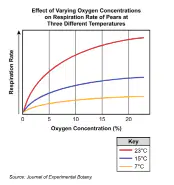
Like all fruit, pears continue to undergo cellular respiration after they are harvested. As pears ripen, they begin respiration, and carbohydrates in the fruit are converted to other forms. If enough time goes by, the fruit may begin to rot. Growers want to keep the pears unripe for as long as possible, and ripen the fruit just before sending them to the supermarket. For this reason, growers have investigated storing pears under different conditions. The graph shows the results of one investigation.
Select the correct answers to complete the sentences related to cellular respiration in pears.
For long-term storage of pears, the oxygen concentration should be_______ and the temperature should be _______. This will result in the least amount of energy being used by the pears.
7 Degrees Celsius
15 Degrees Celsius
5% O2
10% O2
23% O2
12
Multiple Choice
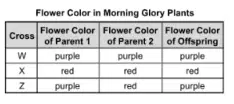
A scientist crosses morning glory plants of different flower colors to determine how flower color is passed on to offspring. The results of three crosses are shown in the table.
The scientist crosses an offspring from cross X with an offspring from cross Z. What are the expected results of this
cross?
100% of plants with red flowers
100% of plants with purple flowers
50% of plants with red flowers, 50% of plants with purple flowers
75% of plants with purple flowers, 25% of plants with red flowers
13
Multiple Select
Which statements describe steps in photosynthesis?
Select the three correct answers.
Glucose is broken down into carbon dioxide and water.
Light energy is absorbed by chlorophyll.
Organic matter and oxygen combine to break molecules into smaller parts.
Energy is used to convert carbon dioxide and water into sugar.
Water is broken apart to produce oxygen.
LEAP 2025 Session 2 Review
By Tyler Ussery
Show answer
Auto Play
Slide 1 / 13
SLIDE

Similar Resources on Wayground
9 questions
Momentum and Impulse
Presentation
•
10th Grade
11 questions
PSAT Orientation
Presentation
•
10th Grade
13 questions
Speed v. Velocity
Presentation
•
8th Grade
10 questions
Cellular Respiration
Presentation
•
9th - 10th Grade
10 questions
Genetic Engineering
Presentation
•
10th - 11th Grade
10 questions
MATERI 6 : Modal in English
Presentation
•
10th Grade
9 questions
Arts and Crafts
Presentation
•
KG - 10th Grade
9 questions
Paper vs. Steel Wool
Presentation
•
10th Grade
Popular Resources on Wayground
16 questions
Grade 3 Simulation Assessment 2
Quiz
•
3rd Grade
19 questions
HCS Grade 5 Simulation Assessment_1 2526sy
Quiz
•
5th Grade
10 questions
Cinco de Mayo Trivia Questions
Interactive video
•
3rd - 5th Grade
17 questions
HCS Grade 4 Simulation Assessment_2 2526sy
Quiz
•
4th Grade
24 questions
HCS Grade 5 Simulation Assessment_2 2526sy
Quiz
•
5th Grade
13 questions
Cinco de mayo
Interactive video
•
6th - 8th Grade
20 questions
Math Review
Quiz
•
3rd Grade
30 questions
GVMS House Trivia 2026
Quiz
•
6th - 8th Grade
Discover more resources for Science
100 questions
Biology EOC Review
Quiz
•
9th - 12th Grade
38 questions
Biology EOC Review Game
Quiz
•
10th Grade
25 questions
Biology EOC review Quiz
Quiz
•
9th - 12th Grade
11 questions
EOC Domain 1: Cells
Presentation
•
9th - 10th Grade
14 questions
EOC Domain 2: Genetics
Presentation
•
9th - 10th Grade
10 questions
Exploring the Human Respiratory System
Interactive video
•
6th - 10th Grade
10 questions
Exploring Newton's Laws of Motion
Interactive video
•
6th - 10th Grade
10 questions
Exploring the Formation of the Solar System
Interactive video
•
6th - 10th Grade