

Overview of European Economic Integration

Presentation
•
Social Studies
•
2nd Grade
•
Practice Problem
•
Medium

Humanities YHKCC
Used 3+ times
FREE Resource
9 Slides • 39 Questions
1
Replace this text with your title
2
European Economic Integration
By Humanities YHKCC
3
Overview of the Economic Integration
4
Fill in the Blanks
5
Reorder
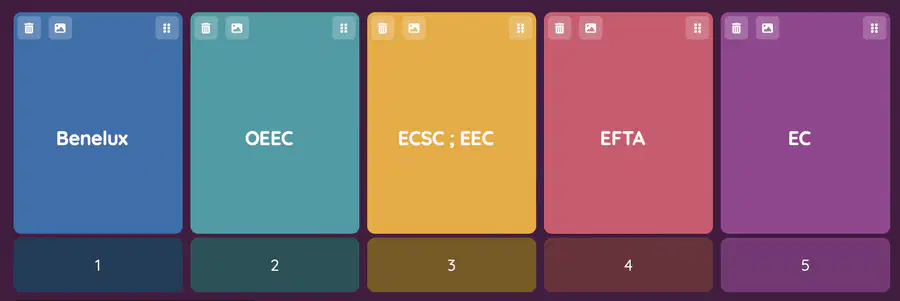
Reorder the Timeline of European Economic Integration of Western Europe
Benelux
OEEC
ECSC ; EEC
EFTA
EC
6
Multiple Select
Which of the following are correct about Benelux
Netherlands, Belgium, and Luxembourg
France, West Germany, Belgium,
France, West Germany, Belgium, Netherlands, Luxembourg, and Italy
to promote the free movement of goods, capital, and people.
7
Fill in the Blanks
8
Fill in the Blanks
9
Multiple Select
Which of the following are correct about ECSC
Netherlands, Belgium, and Luxembourg
France, West Germany, Belgium, Netherlands, Luxembourg, and Italy
Formed to remove restrictions on trade in coal, iron, and steel
Aimed to abolish tariffs and promote the movement of goods, capital, and labor among members.
10
Multiple Select
Which of the following are correct about EEC
Netherlands, Belgium, and Luxembourg
France, West Germany, Belgium, Netherlands, Luxembourg, and Italy
Formed to remove restrictions on trade in coal, iron, and steel
Aimed to abolish tariffs and promote the movement of goods, capital, and labor among members.
11
Categorize
Netherlands, Belgium, and Luxembourg
to promote the free movement of goods, capital, and people.
Formed to allocate the economic aid of $13 billion from the Marshall Plan
France, West Germany, Belgium, Netherlands, Luxembourg, and Italy
Formed to remove restrictions on trade in coal, iron, and steel.
Aimed to abolish tariffs and promote the movement of goods, capital, and labor among members.
by Inner Six
Organize these options into the right categories
12
Fill in the Blanks
13
Fill in the Blanks
14
Fill in the Blanks
15
Fill in the Blanks
16
Multiple Choice
Only Western Europe europe have the Economic Integration
True
False
17
Fill in the Blanks
18
Economic Integration in Eastern Europe
COMECON
Period of Stalin
period of Khrushchev
period of Leonid Brezhnev
Period Gorbachev
19
Fill in the Blanks
20
Drag and Drop
Introduced to fully remove
and
A single
21
Fill in the Blanks
22
Key point 1 : Causes of European Economic Integration
23
Dropdown
The Second World War caused severe
24
Dropdown
Industrial production dramatically decreased due to the loss of
25
Open Ended
What is the reason 1 and reason 2 related to Post-War Economic situation Causes the European Economic Integration
26
Dropdown
Following the horrific experiences of WWII, European countries were
27
Dropdown
Political: Impact of the Cold War
The war led to the rise of the
28
Open Ended
What is reason 3 and reason 4 related to the political situation after WWII Causes the European Economic Integration
29
Dropdown
Post-war destruction led to the
30
Reorder
Reorder the following
Benelux
OEEC
ECSC ; EEC
EFTA
EC
31
Key point 2 :Causes of Expansion of European Integration
32
Dropdown
Reason 1: Economic: Effectiveness of European Integration
The economic benefits of integration encouraged
33
Dropdown
Initially hesitant to join the EEC due to concerns about
34
Dropdown
Political: End of the Cold War
The end of the Cold War facilitated cooperation between
35
Open Ended
Causes of Expansion of European Integration
36
Key Point 3:
Rule of US and USSR
37
Role of US

Replace this with a sub-header that can be in multiple lines.
38
Multiple Select
Which of the following of US are correct ?
Trade within COMECON grew significantly, from RUB 3 billion in 1950 to RUB 23 billion in 1964, reaching RUB 36 billion by 1971.
COMECON introduced the concept of a single economic entity in 1962 to promote integration further.
A resolution passed in 1971 mandated that member states achieve integration in stages over 15 to 20 years, covering production, technology, foreign trade, and currency.
Soviet leader Stalin shifted COMECON's focus from industrial collaboration to technological cooperation. like computer technology, atomic energy, and biotechnology. in 1980s
the USSR introduced the Molotov Plan to provide financial aid to Eastern Europe, aiming to counter the Marshall Plan and expand its influence.
39
Word Cloud
What kind of Role ( er ) do you think US have ?
US have done the following including :
introduced the Marshall Plan in 1947 to provide economic aid
The plan lasted for four financial periods and totaled USD 13 billion.
The US also formed the Organization for European Economic Cooperation (OEEC) with Western European nations to manage the distribution of this aid.
40
Word Cloud
What kind of Role ( er ) do you think US have ?
when The US also signed the General Agreement on Tariffs and Trade (GATT) in 1947,
also The Marshall Plan required recipient nations to import a specified amount of American products, leading to significant exports of items like Boeing aircraft, IBM equipment, and General Electric household products to Western Europe.
41
Multiple Select
Which of the following of US are correct ?
the UN established major economic organizations like the IMF (International Monetary Fund) and the World Bank to provide financial assistance. For instance, the World Bank loaned USD 25 million to France.
OEEC in 1948,offering valuable experience for future integrations like the European Coal and Steel Community (ECSC) in 1952.
The OEEC and the Marshall Plan significantly contributed to Western Europe's post-war recovery,
Member industrial production in 1952 exceeding 40% of pre-WWII levels.
The OEEC and the Marshall Plan significantly contributed to Western Europe's post-war recovery,
Doubling of trade among member states within six years.
The OEEC and the Marshall Plan significantly contributed to Western Europe's post-war recovery,
Reduction of German unemployment from 10% in 1950 to 1.8% in 1960.
42
Word Cloud
What kind of Role ( er ) do you think US have ?
when The US played a crucial role in establishing the OEEC in 1948, which offering valuable experience for future integrations like the European Coal and Steel Community (ECSC) in 1952.
43
Role of USSR
Replace this with a sub-header that can be in multiple lines.
44
Multiple Select
Which of the following of USSR are correct ?
the USSR introduced the Molotov Plan to provide financial aid to Eastern Europe,
e USSR established COMECON to enhance economic cooperation with Eastern Europe and improve internal trade. T
Trade within COMECON grew significantly, from RUB 3 billion in 1950 to RUB 23 billion in 1964, reaching RUB 36 billion by 1971.
COMECON introduced the concept of a single economic entity in 1962 to promote integration further.
The International Bank for Economic Cooperation was established in 1964 to provide financial assistance for integration efforts.
45
Word Cloud
What kind of role of USSR
when the USSR introduced the Molotov Plan to provide financial aid to Eastern Europe,
and
The USSR supplied raw materials to Eastern Europe for production in the post-war period. In return, Eastern European countries exported low-cost industrial products to the Soviet Union,
46
Word Cloud
What kind of role of USSR when
1.the USSR established COMECON
to enhance economic cooperation with Eastern Europe
2.COMECON introduced the concept of a single economic entity in 1962 to promote integration further.
3.A resolution passed in 1971 mandated that member states achieve integration in stages over 15 to 20 years, covering production, technology, foreign trade, and currency.
4.The International Bank for Economic Cooperation was established in 1964 to provide financial assistance for integration efforts.
47
Multiple Select
Which of the following of US are correct ?
the UN established major economic organizations like the IMF (International Monetary Fund) and the World Bank to provide financial assistance. For instance, the World Bank loaned USD 25 million to France.
OEEC in 1948,offering valuable experience for future integrations like the European Coal and Steel Community (ECSC) in 1952.
The OEEC and the Marshall Plan significantly contributed to Western Europe's post-war recovery,
Member industrial production in 1952 exceeding 40% of pre-WWII levels.
The OEEC and the Marshall Plan significantly contributed to Western Europe's post-war recovery,
Doubling of trade among member states within six years.
A resolution passed in 1985 emphasized the need for tighter cooperation in areas like computer technology, atomic energy, and biotechnology.
48
Word Cloud
Lastly, what USSR also have the role when ...
1.The USSR operated under a planned economy model within COMECON,
2.A 1971 resolution outlined a phased approach for achieving deeper integration across various sectors.
3.Soviet leader Mikhail Gorbachev shifted COMECON's focus from industrial collaboration to technological cooperation.
4.A resolution passed in 1985 emphasized the need for tighter cooperation in areas like computer technology, atomic energy, and biotechnology.
Replace this text with your title
Show answer
Auto Play
Slide 1 / 48
SLIDE
Similar Resources on Wayground

43 questions
Fraction
Presentation
•
3rd Grade
40 questions
Place Value
Presentation
•
1st - 2nd Grade
44 questions
Lesson 7: Nutrients
Presentation
•
2nd Grade
43 questions
Quarter 4: English: Week 5: Preposition
Presentation
•
2nd Grade
43 questions
CKLA 2nd Domain 7 Lesson 4
Presentation
•
2nd Grade
43 questions
2nd CKLA Domain 3 Lesson 5
Presentation
•
2nd Grade
46 questions
CKLA 2nd Domain 7 Lesson 2
Presentation
•
2nd Grade
43 questions
Logarithmic Functions
Presentation
•
3rd Grade
Popular Resources on Wayground
11 questions
Hallway & Bathroom Expectations

Quiz
•
6th - 8th Grade
10 questions
HCS SCI 03 Summer School Assessment 2
Quiz
•
3rd Grade
11 questions
Home Scope
Quiz
•
7th - 8th Grade
12 questions
2026 TAP Technology in the Classroom
Presentation
•
Professional Development
15 questions
HCS SCI 05 Summer School Assessment 2 Review
Quiz
•
5th Grade
15 questions
HCS SCI 04 Summer School Review 2
Quiz
•
4th Grade
59 questions
Geometry Unit 3 Review
Quiz
•
9th - 12th Grade
14 questions
FAST ELA READING SMAPLE TEST MATERIALS

Passage
•
3rd Grade