form 5 waves
Presentation
•
Physics
•
11th Grade
•
Practice Problem
•
Medium
Justice Howard
Used 1+ times
FREE Resource
11 Slides • 16 Questions
1
2
Multiple Choice
Which of the following is an example of a wave that you encounter in everyday life?
Sound from a speaker
A moving car
A falling apple
A burning candle
3
Open Ended
Why do you think understanding the properties of waves is important in our daily lives?
4
5
6
7
Multiple Choice
Which of the following best describes wave motion?
The transfer of energy from one point to another without actual movement of matter.
The movement of matter from one point to another.
The transfer of heat from one point to another.
The transfer of particles from one point to another.
8
9
Multiple Select
Select all the terms that are properties of wave motion.
Amplitude
Wavelength
Frequency
Density
10
Open Ended
Define the following terms as used in wave motion: amplitude, wavelength, frequency, time period, and wave front.
11
12
Multiple Choice
Which of the following statements about amplitude is correct?
Amplitude is the maximum or minimum displacement from the undisturbed position.
Amplitude is the distance between two crests.
Amplitude is the number of waves passing a point per second.
Amplitude is the distance from one trough to the next trough.
13
14
Open Ended
Based on the diagrams and definitions provided, explain how amplitude and wavelength are different properties of a wave.
15
Fill in the Blanks
Type answer...
16
17
Multiple Choice
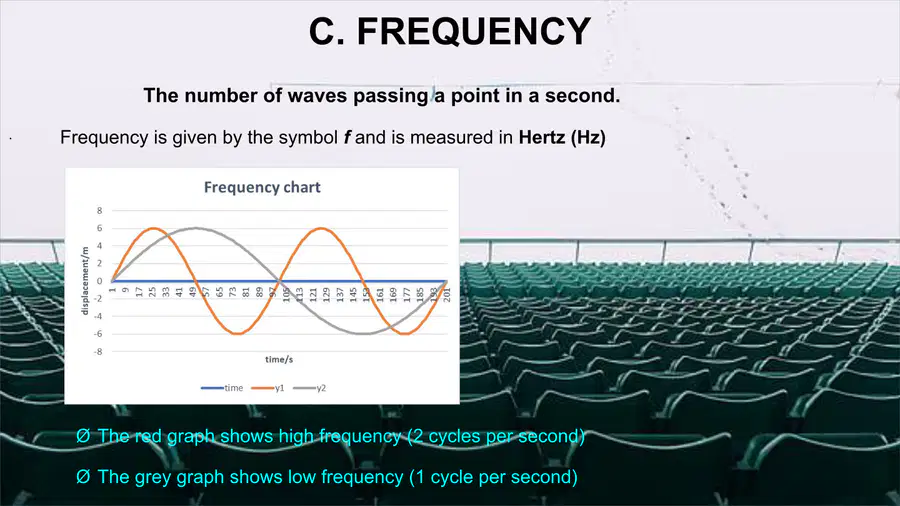
If the red graph in the frequency chart shows 2 cycles per second and the grey graph shows 1 cycle per second, what is the frequency of each wave in Hertz (Hz)?
Red: 2 Hz, Grey: 1 Hz
Red: 1 Hz, Grey: 2 Hz
Red: 2 Hz, Grey: 2 Hz
Red: 1 Hz, Grey: 1 Hz
18
Fill in the Blanks
19
20
Open Ended
Explain the difference between frequency and time period of a wave, and how they are related.
21
22
Multiple Select
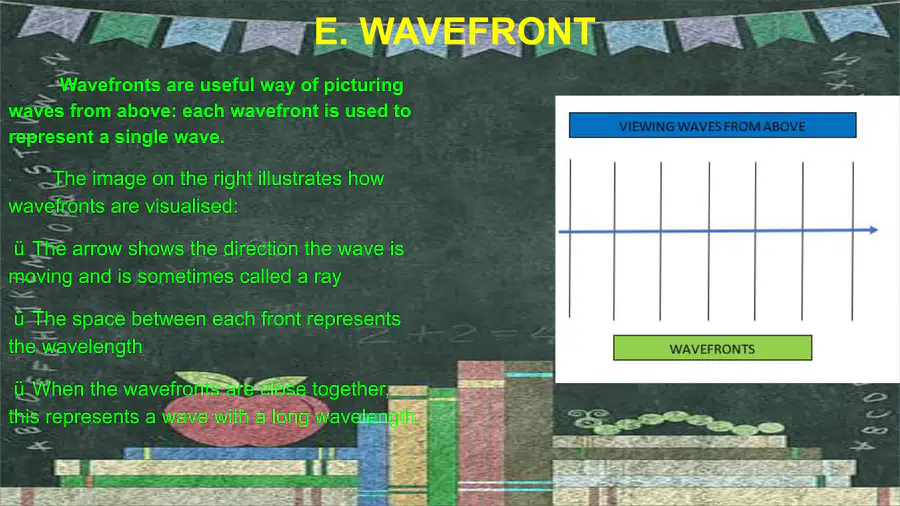
Which of the following statements about wavefronts is/are correct?
Wavefronts represent single waves when viewed from above.
The arrow shows the direction the wave is moving.
The space between wavefronts represents amplitude.
When wavefronts are close together, it represents a wave with a long wavelength.
23
Multiple Select
Select all the correct statements about wavefronts:
Wavefronts represent single waves when viewed from above.
The space between wavefronts represents the wavelength.
The arrow shows the direction the wave is moving.
Wavefronts are always curved.
24
Multiple Choice
Which of the following is NOT a property of waves discussed in this lesson?
Frequency
Amplitude
Velocity
Density
25
Open Ended
What are some key properties of waves that you learned about in this lesson?
26
27
Multiple Choice
What do waves transfer?
Energy
Matter
Both energy and matter
Neither energy nor matter
Show answer
Auto Play
Slide 1 / 27
SLIDE

Similar Resources on Wayground
20 questions
Biology EOC Category 5 (Cont)
Presentation
•
11th Grade
22 questions
Organizing Literary Analysis Writing
Presentation
•
11th Grade
22 questions
IELTS Writing Task 1
Presentation
•
11th Grade
22 questions
Endocrine System (Hormone)
Presentation
•
11th Grade
20 questions
Work, Power and Energy
Presentation
•
12th Grade
21 questions
English 11 - Review Unit 1+2
Presentation
•
11th Grade
20 questions
Introduction to Cardiovascular System
Presentation
•
11th Grade
20 questions
Road Signs #4
Presentation
•
11th Grade
Popular Resources on Wayground
6 questions
Secondary Safety Quiz
Presentation
•
9th - 12th Grade
10 questions
MyPath Diagnostic Overview
Presentation
•
6th - 8th Grade
20 questions
Lab Safety Quiz
Quiz
•
6th Grade
21 questions
Continents and Oceans
Quiz
•
6th Grade
20 questions
Adding and Subtracting Decimals
Quiz
•
5th Grade
20 questions
Parts of Speech
Quiz
•
5th Grade
16 questions
Subject & Predicate
Quiz
•
5th Grade
21 questions
Lab Safety
Quiz
•
10th Grade