


Unit 14 Redox Part 1
Presentation
•
Chemistry
•
11th Grade
•
Practice Problem
•
Easy
Michael Leonard
Used 17+ times
FREE Resource
35 Slides • 33 Questions
1
2
3
4
Multiple Choice
Which of the following best describes valence electrons?
Electrons in the highest occupied energy level
Electrons in the nucleus
Electrons in the lowest energy level
Electrons shared between atoms
5
6
Match
Match the elements to the correct number of valencce electrons
Rubidium
Germanium
Helium
Tellurium
Krytpton
1
4
2
6
8
1
4
2
6
8
7
8
Fill in the Blanks
9
Fill in the Blanks
10
11
Multiple Choice
What is the octet rule?
In forming compounds, atoms tend to achieve an electron configuration of noble gases
In forming compounds, atoms tend to achieve an electron configuration of halogens
In forming compounds, atoms tend to achieve an electron configuration of alkali metals
In forming compounds, atoms tend to achieve an electron configuration of alkaline earth metals
In forming compounds, atoms tend to achieve an electron configuration of metalloids
12
Multiple Select
Atoms of nonmetals to tend to do what with there electrons to get to octet?
13
Multiple Choice
Atoms of metals to tend to do what with there electrons to get to octet?
14
15
16
Fill in the Blanks
17
Fill in the Blanks
18
19
20
Match
Match the group of elements with there corresponding charges?
Group 1 (1A) elements
Group 2 (2A) elements
Group 16 (6A) elements
group 17 (7A) elements
Group 15 (5A) elements
+1 charge
+2 charge
-2 charge
-1 charge
-3 charge
+1 charge
+2 charge
-2 charge
-1 charge
-3 charge
21
Multiple Choice
Which group of elements in the periodic table in general can have more than one charge?
Alkali Metals
Alkaline Earth Metals
Halogens
Transition elements
Noble Gases
22
23
Multiple Choice
What does conductivity mean?
24
Multiple Choice
What does malleable mean?
25
Multiple Choice
What does ductile mean?
26
27
Categorize
Molybdenum
Lanthanum
Iodine
Argon
Sulfur
Antimony
Americium
Silicon
Germanium
Classify the elements as beign either metal, nonmetal, or metalloid.
28
29
30
Match
Match the sublevels to their corresponds sections in the periodic table?
s sublevel
p sublevel
d sublevel
f sublevel
Group 1-2
Group 13-18
Group 3-12
Lanthanide and Actinide Series
Group 1-2
Group 13-18
Group 3-12
Lanthanide and Actinide Series
31
Match
Based on how many groups are in each section of the sublevels how many electrons can each sublevel hold?
s sublevel
p sublevel
d sublevel
f sublevel
2
6
10
14
2
6
10
14
32
33
34
35
Match
Match the orbital shape to the correct sublevel.
s sublevel
p sublevel
d sublevel
f sublevel
sphere
dumbbell
daisy
funky
sphere
dumbbell
daisy
funky
36
37
Drag and Drop
Alkali Metals:
Alkaline Earth Metals:
Halogens:
Inner Transition Metals:
Noble Gases
38
Drag and Drop
Metalloids:
Metals:
Nonmetals:
Transition Metals:
39
40
Open Ended
List the names of all the elements that exist as diatomic molecules in nature.
(Spelling counts)
41
42
43
44
45
46
47
48
49
50
51
Multiple Select
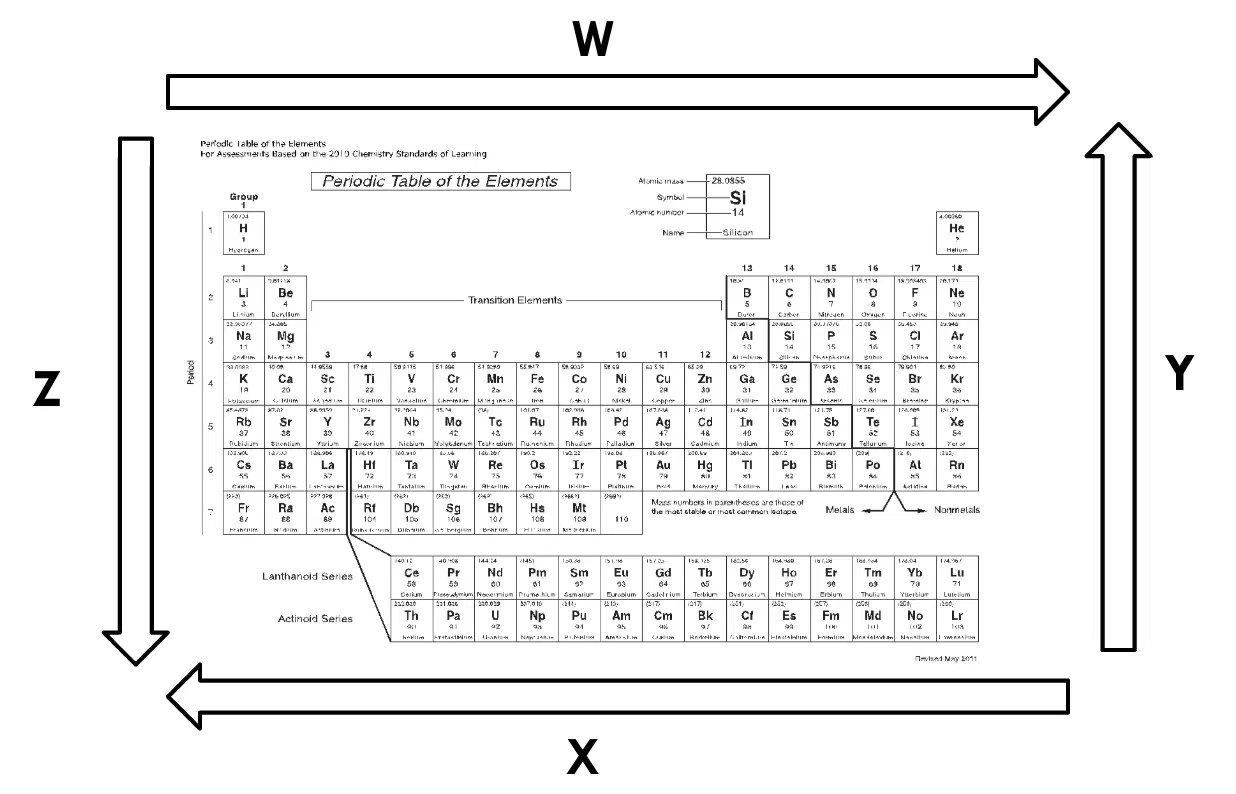
Select the two letters that shows a decrease in
the size of cation
W
X
Y
Z
52
Multiple Select
Select the two letters that show an increase in electronegativity
W
X
Y
Z
53
Multiple Select
Select the two letters that show an decrease in ionization energy
W
X
Y
Z
54
Multiple Select
Select the two letters that show an increase in atomic radius
W
X
Y
Z
55
56
57
Multiple Choice
What is the formula for copper (II) nitrate?
Cu2NO3
CuNO3
58
Multiple Choice
What is the formula for calcium fluoride?
Ca2F2
59
60
Multiple Choice
What is the name of CuCl?
Chloride copper
Chlorine copperide
61
Multiple Choice
What is the name of Cr(OH)3?
chromium(I) hydroxide
62
63
64
Multiple Choice
What is the name of SF6?
Sulfur heptafluoride
65
Multiple Choice
What is the name of Cl2O8?
octochlorine dioxide
dichlorine octoxygen
dichlorine octooxygen
dichlorine octooxide
dichlorine octoxide
66
67
Multiple Choice
What is the fomrula for diphoshorus pentachloride?
68
Multiple Choice
What is the formula for Silicon dioxide?
Show answer
Auto Play
Slide 1 / 68
SLIDE

Similar Resources on Wayground
61 questions
Unit 5 Review
Presentation
•
12th Grade
65 questions
Foundations of Atomic Theory
Presentation
•
10th - 12th Grade
64 questions
Modals of ability and possibility - Teens 12
Presentation
•
KG
64 questions
Modals of Ability
Presentation
•
KG
65 questions
L06 GDP
Presentation
•
KG
65 questions
MATH TIME: Functions and Operations on Functions
Presentation
•
11th Grade
65 questions
If clauses review
Presentation
•
11th Grade
64 questions
Quantum Model of the Atom
Presentation
•
10th Grade
Popular Resources on Wayground
6 questions
Secondary Safety Quiz
Presentation
•
9th - 12th Grade
10 questions
Afterschool Activities & Sports
Quiz
•
6th - 8th Grade
19 questions
ROAR Week 2026
Quiz
•
9th - 12th Grade
20 questions
Lab Safety Quiz
Quiz
•
6th Grade
15 questions
Cool Tool:Chromebook
Quiz
•
6th - 8th Grade
22 questions
would you rather
Quiz
•
3rd - 11th Grade
21 questions
Continents and Oceans
Quiz
•
6th Grade
20 questions
Parts of Speech
Quiz
•
5th Grade
Discover more resources for Chemistry
20 questions
Scientific Method
Quiz
•
10th - 12th Grade
20 questions
Metric Conversions
Quiz
•
11th Grade
12 questions
Significant figures
Quiz
•
9th - 12th Grade
20 questions
Lab Safety
Quiz
•
9th - 12th Grade
20 questions
Lab Safety and Lab Equipment
Quiz
•
9th - 12th Grade
15 questions
Exploring the Unique Properties of Water
Interactive video
•
9th - 12th Grade
11 questions
Scientific Method
Presentation
•
9th - 11th Grade
20 questions
Atomic Theory and Atomic Structure
Quiz
•
9th - 12th Grade