
ecosystem SMP

Presentation
•
Science
•
7th Grade
•
Medium

BUDI SUCIPTO
Used 1+ times
FREE Resource
6 Slides • 20 Questions
1
By BUDI SUCIPTO
2
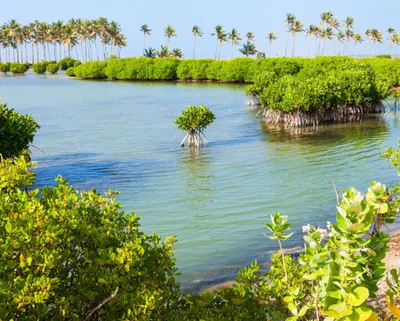
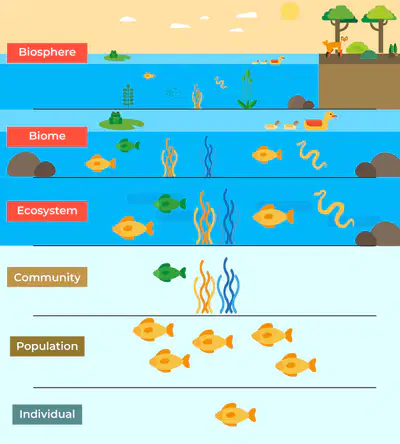
Organism, A single individual living thing (e.g., one deer, one tree, one fish)
Population, A group of the same species living in the same area (e.g., a herd of deer in a forest).
Community, All the different populations (species) living and interacting in one area (e.g., deer, trees, birds, and insects in the same forest).
Ecosystem, A community plus its non-living (abiotic) environment (e.g., forest community + soil, sunlight, and rainfall).
Biome, A large area with similar climate, plants, and animals (e.g., tropical rainforest, desert, tundra).
Biosphere, The global sum of all ecosystems; the part of Earth where life exists (land, water, and atmosphere).
hierarchy of ecosystem
3
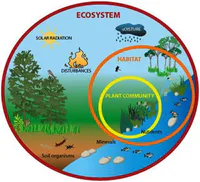
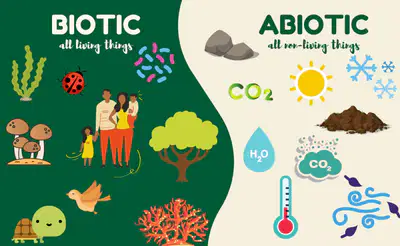
An ecosystem is a community of living organisms (like plants, animals, and microorganisms) that interact with each other and with their non-living environment (such as air, water, and soil) in a specific area. These interactions create a system where each component depends on and affects the others.
So,
ECOSYSTEM = Living things + Non-living things + Interactions
ECOSYSTEM
4
Multiple Choice
What is an ecosystem?
A group of the same species living together
an Interaction only beetwen plants and water in an area
5
Reorder
Arrange the ecosystem hierarchy from smallest to largest..
organism
population
community
ecosystem
biome
6
Multiple Choice
Which of the following is a biotic component of an ecosystem?
soil
bacteria
7
Multiple Choice
Why is sunlight important to an ecosystem?
8
Multiple Choice
Seorang petani berencana membersihkan semua jenis tumbuhan liar di sekitar sawahnya agar tanaman padinya tumbuh lebih optimal. Sebagai siswa yang memahami keseimbangan ekosistem, apa saran terbaik yang dapat kamu berikan?
9
Multiple Choice
which picture is a community
10
Multiple Choice
Compare a desert ecosystem and a rainforest ecosystem. What is the main difference?
11
A food chain is a linear sequence that shows how energy moves from one organism to another as one eats the other.
A food web is a network of interconnected food chains in an ecosystem. It shows how multiple food chains overlap, because most organisms eat more than one type of food.
FOOD CHAIN AND FOOD WEB

12
PREDATION
One organism (predator) hunts and eats another organism (prey).
🦅 Eagle eats 🐍 snake
COMPETITION
Organisms compete for the same resources (like food, water, space, or mates).
🌿 Trees compete for sunlight in a dense forest.
SYMBIOSIS
Mutualism (Win-Win)
Both organisms benefit from the interaction.
🐝 Bee gets nectar from a 🌸 flower, and the flower gets pollinated.
Commensalism (Win-Okay)
One organism benefits, the other is not affected.
🕊️ Bird builds a nest on a 🌳 tree — the tree is not harmed or helped.
Parasitism (Win-Lose)
One organism (parasite) benefits, the other (host) is harmed.
🪱 Tapeworm inside a human — the worm gets food, the human loses nutrients.
type of interaction between organisms where one organism produces substances that harm or inhibit the growth of another. It is commonly found in microorganisms such as fungi and bacteria.
ANTIBIOSIS
13
Multiple Choice
Apa yang akan terjadi jika jumlah konsumen primer pada ekosistem bertambah banyak?
Ekosistem menjadi stabil
Konsumen sekunder menghilang
Produsen berkurang
Dekomposer bertambah
14
Multiple Choice

Perhatikan jaring-jaring makanan berikut ini. berdasarkan jaring-jaring makanan tersebut. berapakah rantai makanan yang dapat terbentuk?
3
4
5
6
15
Multiple Choice
Perhatikan jaring-jaring makanan berikut ini. Pilih 2 jawaban yang benar. bentuk interaksi kompetisi yang tepat adalah
deer and snake
mouse and grasshopper
mouse and frog
deer and mouse
16
Multiple Choice
Perhatikan jaring-jaring makanan berikut ini. jika katak banyak diburu oleh manusia, kemungkinan hal yang paling tepat terjadi adalah
tikus bertambah banyak karena tidak memiliki saingan dalam makanan
belalang meningkat pesat, tanaman akan rusak
jumlah elang meningkat karena tikus sumber makanan yang banyak
jumlah ular meningkat
17
Multiple Choice
Analyze this food chain: Grass → Grasshopper → Frog → Snake → Eagle
If frogs were removed, what would likely happen to the snake population?
18
Multiple Choice
Jika populasi lebah dalam suatu ekosistem menurun drastis, maka dampak yang paling mungkin terjadi terhadap populasi bunga adalah...
Populasi bunga tidak terpengaruh sama sekali karena penyerbukan tidak hanya bergantung pada lebah
19
Multiple Choice
Dalam suatu observasi, ditemukan bahwa burung jalak sering hinggap di punggung kerbau untuk memakan kutu. Namun, burung jalak kadang juga mematuk luka di tubuh kerbau. Hubungan simbiosis yang tepat jika perilaku burung jalak ini berlangsung terus-menerus adalah...
20
Multiple Choice
Observe the following pairs of living organisms!
Bee and flower
Orchid and trees
Clownfish and sea anemone
Starling bird and buffalo
Which of the pairs shows a different type of symbiotic relationship compared to the others?
1
2
3
4
21
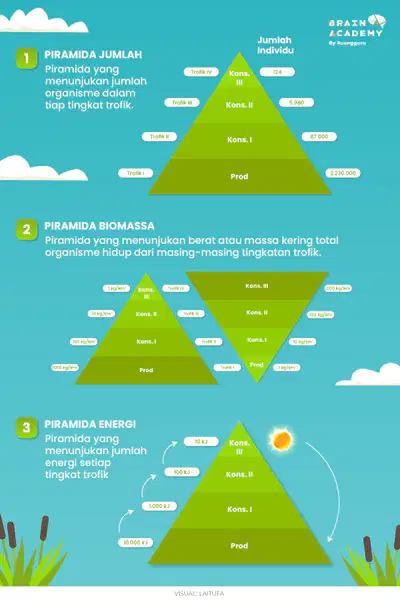
gambaran visual tentang aliran energi dan jumlah organisme pada setiap tingkat trofik dalam suatu ekosistem. Piramida ini membantu kita memahami siapa makan siapa dan bagaimana energi berkurang di setiap tingkatnya. Piramida makanan ada 3 macam yakni piramida jumlah, piramida biomassa dan piramida energi
Piramida Makanan (Food Pyramid)
22
Multiple Choice

See this picture. Which organism has the highest energy level in the energy pyramid?
grasshooper
Plant
snake
Fox
23
Multiple Choice
Dalam piramida biomassa, tingkat trofik manakah yang biasanya memiliki biomassa terkecil?
24
Multiple Choice
See this picture. If the total biomass of grass/ trees in an ecosystem is 1000 kg, what is the possible biomass of primary consumers?
25
Multiple Choice
If the population of primary consumers drops drastically, what is the most likely effect?
26
Multiple Choice
Jika konsumen sekunder dalam suatu ekosistem bertambah secara drastis, kemungkinan yang terjadi pada populasi konsumen primer adalah...
By BUDI SUCIPTO
Show answer
Auto Play
Slide 1 / 26
SLIDE
Similar Resources on Wayground

19 questions
Moon Phases, Eclipses, and Tides
Presentation
•
7th - 8th Grade
19 questions
Ions and Ion Charges
Presentation
•
7th - 8th Grade
18 questions
Human Skin
Presentation
•
7th Grade
20 questions
Scale and Size of the Solar System
Presentation
•
7th Grade
20 questions
PURE SUBSTANCES and MIXTURES
Presentation
•
7th Grade
21 questions
Counting Atoms & Balancing Equations
Presentation
•
7th Grade
20 questions
Earth's Layers
Presentation
•
7th - 8th Grade
21 questions
Chemical Reactions
Presentation
•
7th - 8th Grade
Popular Resources on Wayground
10 questions
Safety Day 2026 – Student Review

Quiz
•
9th Grade
21 questions
Continents and Oceans
Quiz
•
6th Grade
20 questions
Parts of Speech
Quiz
•
5th Grade
16 questions
Subject & Predicate
Quiz
•
5th Grade
25 questions
Multiplication Facts
Quiz
•
5th Grade
12 questions
Map Skills
Quiz
•
3rd Grade
22 questions
Continents and Oceans
Quiz
•
5th Grade
15 questions
Rounding Decimals
Quiz
•
5th Grade
Discover more resources for Science
10 questions
Exploring Chemical and Physical Changes

Interactive video
•
6th - 10th Grade
14 questions
Week 1 Falcon Flex Fast and Curious
Quiz
•
7th Grade
42 questions
Explore Plate Tectonics and Boundaries
Quiz
•
7th Grade
21 questions
Waves and Wave Properties
Quiz
•
6th - 8th Grade
16 questions
Photosynthesis and Cellular Respiration Review
Quiz
•
7th Grade
20 questions
Food Webs + Energy Pyramids
Quiz
•
7th Grade
9 questions
Biology: Cell Structure
Interactive video
•
7th Grade
8 questions
Diffusion and Osmosis Review
Presentation
•
6th - 8th Grade