

Blood Transfusion

Presentation
•
Other
•
University
•
Practice Problem
•
Easy

Ann Campbell
Used 1+ times
FREE Resource
11 Slides • 10 Questions
1

2

3
Multiple Choice
Which of the following conditions is NOT a common indication for blood transfusions?
Sickle cell anemia
Vitamin deficiency
Chronic kidney disease (CKD)
Hypertension
4

5
Multiple Choice
Which of the following is a risk associated with blood transfusions?
Transfusion reaction
Dehydration
Hypertension
Diabetes
6

7
Multiple Choice
A client has refused an ordered blood transfusion, what is the nurse's best response?
"You have the right to refuse, I will notify the provider."
"The transfusion is an important part of your plan of care, can you tell me the reason for your refusal?"
"Without this transfusion, it is likely you will die."
"The provider will fire you as a patient if you refuse her orders."
8

9
Multiple Select
Which of the following actions are part of the nursing process before and during a blood transfusion?
Obtain consent
Check baseline vital signs
Check BP and HR after first 15 minutes
Administer antibiotics
10

11

12
13
Multiple Choice
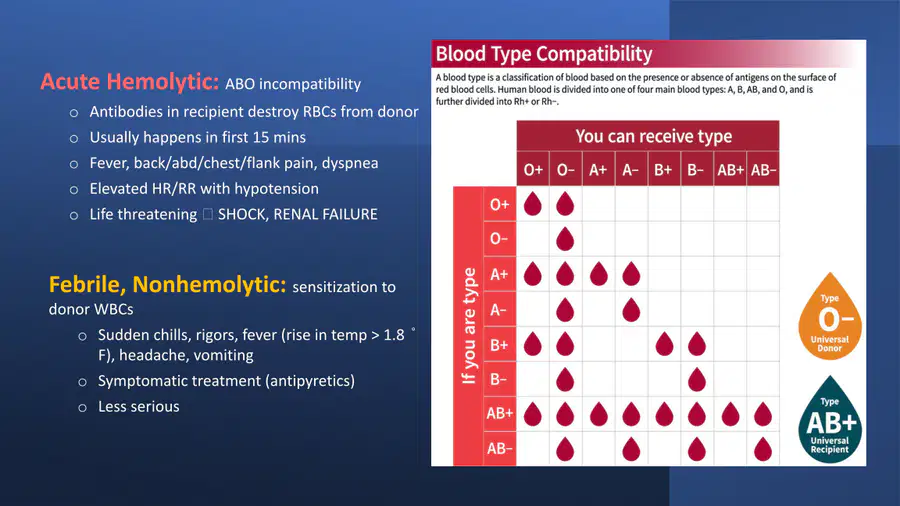
Which blood type can be given to anyone?
O-
O+
AB+
B-
14
Multiple Choice
Which type of acute blood transfusion reaction is the most common?
Acute hemolytic reaction
Febrile, nonhemolytic reaction
Mild allergic reaction
Sepsis
15
Fill in the Blanks
A transfusion reaction that occurs within the first 15 minutes and is due to ABO incompatibility is most likely to be an acute
16

17
Multiple Choice
Which of the following is a key difference between a mild allergic reaction and an anaphylactic reaction to a blood transfusion?
Mild allergic reactions are life threatening, while anaphylactic reactions are not.
Mild allergic reactions can be treated with epinephrine, while anaphylactic reactions cannot.
Anaphylactic reactions are life threatening and require epinephrine, while mild allergic reactions are not life threatening and can be treated with antihistamines and steroids.
Both reactions allow for the transfusion to be restarted after treatment.
18

19
Multiple Select
Which of the following are symptoms of TRALI (Transfusion Related Acute Lung Injury)?
Fever
Noncardiogenic pulmonary edema
Hypoxemia
Abdominal pain
20

21
Multiple Choice
What is the first step in the nursing management that should be taken immediately after a transfusion reaction is suspected.
Administer eprinephrine
Obtain baseline vital signs
Notify the provider
Stop the transfusion
Show answer
Auto Play
Slide 1 / 21
SLIDE
Similar Resources on Wayground

18 questions
Medical Record Report
Presentation
•
12th Grade
14 questions
CC Act I Scene I & II
Presentation
•
KG - Professional Dev...
19 questions
Cardiovascular Conduction
Presentation
•
12th Grade
15 questions
IMPRESSIONISM AND POST IMPRESSIONISM
Presentation
•
University
16 questions
Nutrilite Health Training
Presentation
•
Professional Development
20 questions
Tests on hair and skin
Presentation
•
KG - University
16 questions
BM1004 PASS Wk2
Presentation
•
University
18 questions
Blood Types
Presentation
•
12th Grade - University
Popular Resources on Wayground
10 questions
Safety Day 2026 – Student Review

Quiz
•
9th Grade
21 questions
Continents and Oceans
Quiz
•
6th Grade
20 questions
Parts of Speech
Quiz
•
5th Grade
16 questions
Subject & Predicate
Quiz
•
5th Grade
25 questions
Multiplication Facts
Quiz
•
5th Grade
12 questions
Map Skills
Quiz
•
3rd Grade
22 questions
Continents and Oceans
Quiz
•
5th Grade
15 questions
Rounding Decimals
Quiz
•
5th Grade
Discover more resources for Other
20 questions
Disney Trivia
Quiz
•
University
10 questions
Spanish Greetings and Goodbyes!
Presentation
•
6th Grade - University
20 questions
Physical or Chemical Change/Phases
Quiz
•
8th Grade - University
39 questions
Unit 7 Key Terms
Quiz
•
11th Grade - University
25 questions
SER and Subject Pronouns
Quiz
•
8th Grade - University
38 questions
Unit 6 Key Terms
Quiz
•
11th Grade - University
19 questions
Key Concepts in Buddhism
Quiz
•
University
0 questions
Cell Domain Basic Review (Biology)
Quiz
•
University