

Earth and Human Activity

Presentation
•
Science
•
6th Grade
•
Medium
+5
Standards-aligned

Barbara White
Used 23+ times
FREE Resource
12 Slides • 19 Questions
1

Middle School

2
Describe how human population and resource use have changed over time.
Explain how human activities cause changes to Earth’s air, water, and land.
Analyze how the environment's limits affect population size and our use of resources.
Describe how technology can help reduce the harmful effects of human activities.


3
Key Vocabulary

Population
A population is all the members of a single species living in a specific area.

Natural Resource
A natural resource is any material from the environment that organisms use for their survival.

Per-Capita Consumption
Per-capita consumption is the average amount of a resource used per person in an area.

Carrying Capacity
Carrying capacity is the maximum number of individuals that an environment can support over time.

Age Structure
Age structure describes the breakdown of a population according to different age groups and genders.

Deforestation
Deforestation is the large-scale removal of forests and trees from an area by human activities.
4
Key Vocabulary

Ecological Footprint
The amount of land and water needed to support a person's lifestyle and activities.

Earth's Systems
The four major systems of Earth: the geosphere, hydrosphere, atmosphere, and the biosphere.

Engineered Solution
Technology or a product specifically designed by humans to solve a particular problem for people.
5
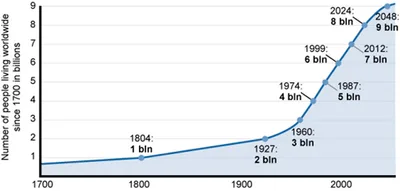
Human Population Growth Over Time
For most of human history, the population grew very slowly.
The greatest increase in population has happened in recent centuries.
Today, the world is home to more than 7.6 billion people.
Better healthcare and clean water help people to live longer lives.

6
Multiple Choice
Which statement best describes how the human population has changed over the course of history?
It has always grown at a rapid and steady rate.
It grew quickly in ancient times and has slowed down recently.
It grew slowly for most of history and then increased rapidly in recent times.
It has remained stable with very little change over centuries.
7
Multiple Choice
What is the primary reason for the significant growth of the human population in recent centuries?
The global population has reached its maximum limit.
People are living longer due to better healthcare and clean water.
There are fewer resources available than in the past.
The number of people moving to new countries has decreased.
8
Multiple Choice
If a large, isolated community suddenly gained access to modern medicine and water filtration systems, what would be the most likely long-term effect?
The population would likely decrease as people move away.
The population would stay the same because of new diseases.
The population would likely increase as people's lifespans get longer.
The population would not change, but people would be healthier.
9
Factors Influencing Population Growth
Population size changes with births, deaths, immigration, and emigration.
A population's age structure is a key predictor of its future growth.
A youthful population grows rapidly, while an older population may shrink.
10
Multiple Choice
What do births, deaths, immigration, and emigration directly determine?
The size of a population
The climate of a habitat
The types of plants available
The number of predators in the area
11
Multiple Choice
What is the relationship between a population's age structure and its future?
It shows the exact current size of the population.
It helps predict if the population will likely grow or shrink.
It explains why animals choose to immigrate or emigrate.
It determines the population's main food source.
12
Multiple Choice
If a population is described as having a 'youthful' age structure, with many more young individuals than old ones, what is the most likely outcome?
The population will likely grow rapidly.
The population will likely shrink.
The population size will stay exactly the same.
The death rate will immediately increase.
13
Population Growth and Resource Limits
As the human population grows, the demand for natural resources also increases.
Carrying capacity is the maximum population Earth's limited resources can support.
When a population exceeds carrying capacity, resources like food and space become scarce.
14
Multiple Choice
What is carrying capacity?
The total number of people on Earth
The speed at which a population increases
The maximum population an environment's resources can support
The amount of space a single person needs
15
Multiple Choice
What is the relationship between the size of the human population and the demand for natural resources?
As the population gets larger, the need for resources increases.
As the population gets larger, the need for resources decreases.
The size of a population does not affect the amount of resources needed.
Resources become unlimited when a population grows.
16
Multiple Choice
What would likely happen if a population grows beyond its environment's carrying capacity?
The carrying capacity would automatically increase.
Resources like food and space would become scarce.
The demand for resources would suddenly decrease.
The population would stop using resources entirely.
17
Human Impact on Earth's Systems

Impact on Geosphere
The growing need for food requires turning natural landscapes into farmlands.
This changes the appearance and structure of the land, or geosphere.
As populations grow, the demand for natural resources also increases steadily.

Impact on Hydrosphere
Farmers often use fertilizers to help their crops grow much faster.
Rain can wash these fertilizers into rivers, polluting the hydrosphere.
This pollution can harm the aquatic plants and the animals living there.

Impact on Atmosphere
Modern farms use machinery like tractors to help with the farm work.
These machines release greenhouse gases, which enter the atmosphere during operation.
This changes the composition of the air and affects our planet's climate.
18
Multiple Choice
What is the primary reason human activities like farming are expanding and altering Earth's systems?
To meet the growing demand for food and resources.
To create more parks and natural landscapes.
To reduce the amount of pollution in the atmosphere.
To help aquatic plants and animals thrive.
19
Multiple Choice
How does the process of farming specifically lead to pollution in the hydrosphere?
Fertilizers can be washed into rivers by rain, harming aquatic life.
Tractors and other machines release greenhouse gases into the water.
Turning landscapes into farms causes the land to absorb more water.
The demand for food causes rivers to dry up from overuse.
20
Multiple Choice
If a community clears a large natural landscape to create a new, modern farm using machinery, what is a probable combination of impacts on the geosphere and atmosphere?
The land's structure will change, and greenhouse gases will be released into the air.
The air will become cleaner, and the rivers will have more fish.
The climate will be unaffected, but the land will look different.
Fertilizer use will decrease, and natural landscapes will be restored.
21
The Ripple Effects of Deforestation
Deforestation is the clearing of forests for farming and building cities.
Without tree roots, rich soil erodes and washes away from the land.
Fewer trees mean more CO2 stays in the air, changing the climate.
It destroys the homes of countless plants and animals, threatening their survival.


22
Multiple Choice
What is the definition of deforestation?
The process of clearing forests for other uses, like farming or cities.
The act of planting new trees in a barren area.
The natural aging and falling of trees in a forest.
The seasonal change in the color of tree leaves.
23
Multiple Choice
What is one way that deforestation affects the land and air?
It causes soil to wash away and increases CO2 in the atmosphere.
It makes the soil richer and cleans the air of CO2.
It creates more habitats for animals and reduces soil erosion.
It leads to cooler temperatures and more stable soil.
24
Multiple Choice
If a construction company clears a large forest to build a new neighborhood, what is the most likely long-term consequence for the local ecosystem?
The loss of soil and animal homes will threaten the survival of local wildlife.
The new buildings will provide better homes for the displaced animals.
The climate in the area will become cooler and wetter.
The soil will become more stable and fertile for new plants.
25
Mitigating Human Impact: Engineered Solutions
Sustainable resource use ensures that future generations will have what they need.
Your ecological footprint measures your total impact on the environment.
Engineered solutions like better irrigation increase food production on less land.
Using renewable energy like wind and solar power reduces our ecological footprint.


26
Multiple Choice
What is the primary purpose of sustainable resource use?
To use up all natural resources as quickly as possible.
To measure the total environmental impact of a person.
To ensure that resources will be available for future generations.
To increase food production by using more land and water.
27
Multiple Choice
What is the relationship between using engineered solutions like renewable energy and having an ecological footprint?
They measure the amount of land needed for food.
They help lower a person's total environmental impact.
They ensure that future generations will have enough food.
They only work in areas with abundant wind and solar power.
28
Multiple Choice
A community needs to increase its food supply while also practicing sustainable resource use. Which of the following strategies would best help them achieve this goal?
Adopting better irrigation techniques to increase crop yield on existing farmland.
Expanding farms by clearing forests to create more space for crops.
Switching to energy sources that are cheaper but less environmentally friendly.
Ignoring the need for food production to focus solely on reducing energy use.
29
Misconception | Correction |
|---|---|
Earth has an infinite supply of natural resources. | Natural resources are limited and can be used up. |
Deforestation only harms local plants and animals. | It affects the entire planet, causing soil erosion and increased CO2. |
Science tells us exactly what to do about environmental problems. | Science explains consequences, but society decides what actions to take. |
Only government actions can help the environment. | Personal choices matter. Many small actions together make a big difference. |
30
Human population has grown rapidly due to technology and medical advances.
Age structure predicts population growth, which is limited by Earth’s carrying capacity.
Increases in population and consumption impact all of Earth’s systems.
Deforestation negatively affects the geosphere, hydrosphere, atmosphere, and biosphere.
We use claims, evidence, and reasoning to explain human impacts on the environment.
We can lessen our environmental impact through sustainable practices and engineered solutions.
31
Poll
On a scale of 1-4, how confident are you about the concepts covered in today's review?
1
2
3
4
Middle School
Show answer
Auto Play
Slide 1 / 31
SLIDE
Similar Resources on Wayground

25 questions
Unit 2 Metals, Nonmetals, and Metalloids Lesson
Presentation
•
6th Grade
26 questions
Forms of Energy Lesson
Presentation
•
6th Grade
23 questions
Asteroids, Meteors, and Comets
Presentation
•
6th Grade
21 questions
Respiratory System
Presentation
•
6th Grade
25 questions
Characteristics and Properties of Waves Review
Presentation
•
6th Grade
22 questions
Respiratory System
Presentation
•
6th - 7th Grade
20 questions
Integumentary System
Presentation
•
6th Grade
25 questions
Erosion and Deposition
Presentation
•
6th Grade
Popular Resources on Wayground
10 questions
Safety Day 2026 – Student Review

Quiz
•
9th Grade
21 questions
Continents and Oceans
Quiz
•
6th Grade
20 questions
Parts of Speech
Quiz
•
5th Grade
16 questions
Subject & Predicate
Quiz
•
5th Grade
25 questions
Multiplication Facts
Quiz
•
5th Grade
12 questions
Map Skills
Quiz
•
3rd Grade
22 questions
Continents and Oceans
Quiz
•
5th Grade
15 questions
Rounding Decimals
Quiz
•
5th Grade
Discover more resources for Science
20 questions
Elements, compounds, and mixtures
Quiz
•
6th Grade
10 questions
6.6D - Relative Density Review
Quiz
•
6th Grade
10 questions
Exploring Chemical and Physical Changes

Interactive video
•
6th - 10th Grade
20 questions
CONDUCTION,CONVECTION AND RADIATION
Quiz
•
6th Grade
20 questions
Rocks and The Rock Cycle
Quiz
•
6th Grade
19 questions
Describing and Classifying Matter
Presentation
•
6th Grade
21 questions
Waves and Wave Properties
Quiz
•
6th - 8th Grade
20 questions
Phases of the Moon
Quiz
•
6th Grade