
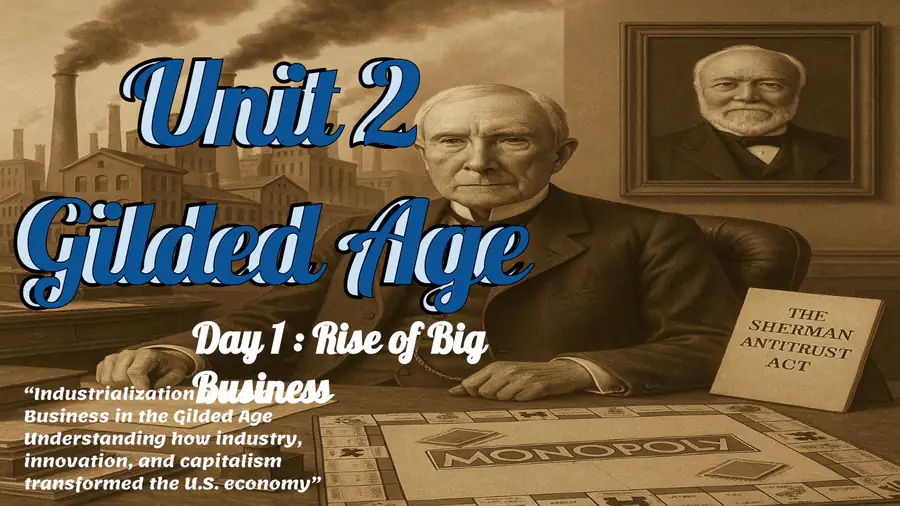
Unit 2 - Day 1: Gilded Age - Rise of Big Business

Presentation
•
Social Studies
•
11th Grade
•
Practice Problem
•
Easy

Rena Raines
Used 14+ times
FREE Resource
12 Slides • 13 Questions
1
2
Multiple Choice
Why was the Gilded Age significant for the development of big business in the United States?
It marked the beginning of the Civil War
It was a period of rapid industrial growth and innovation
It was a time when agriculture dominated the economy
It was a period of economic decline
3
4
Multiple Choice
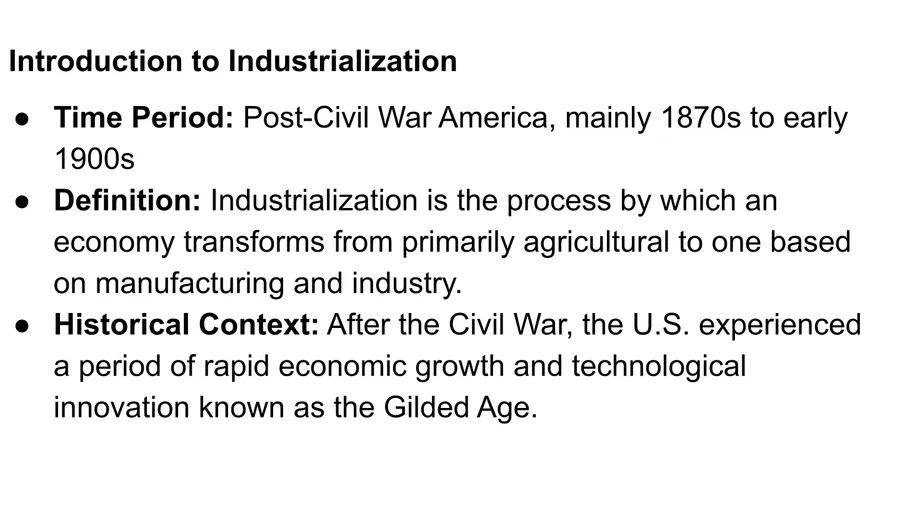
How did industrialization change the U.S. economy after the Civil War?
The U.S. economy changed from agrarian to industrial.
5
6
7
Multiple Choice
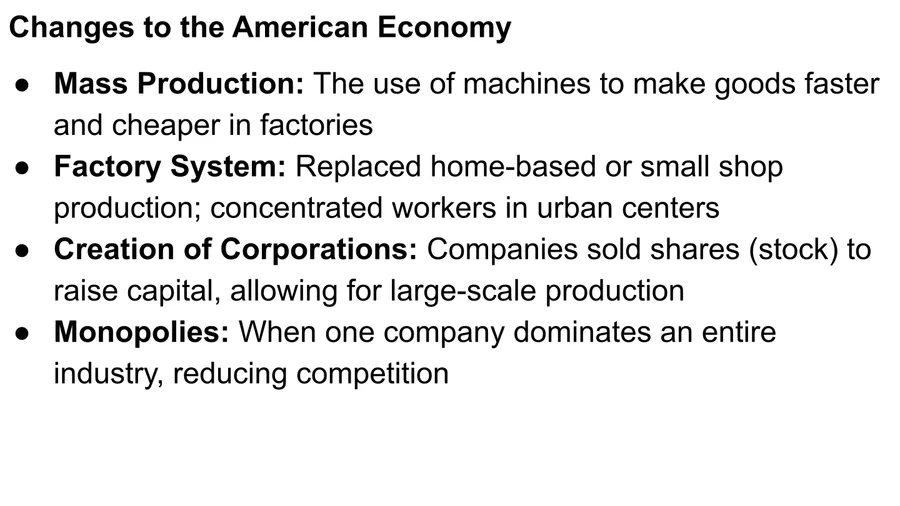
Which of the following best describes the purpose of mass production in the American economy?
To make goods faster and cheaper using machines
To replace corporations with small businesses
To reduce the number of workers in factories
To increase government regulation of factories
8
9
Multiple Choice
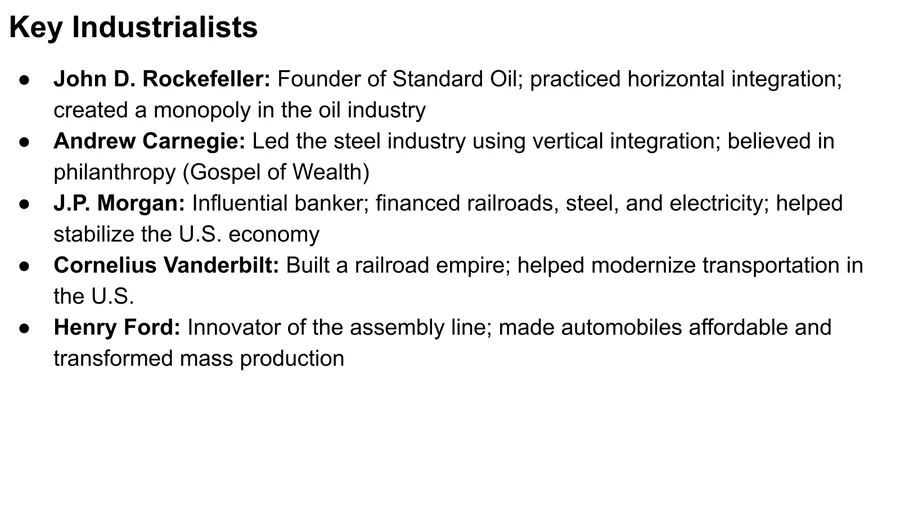
Which of the following was NOT a key industrialists during the rise of American industry?
Thomas Edison
Henry Ford
10
11
Match
Match the following
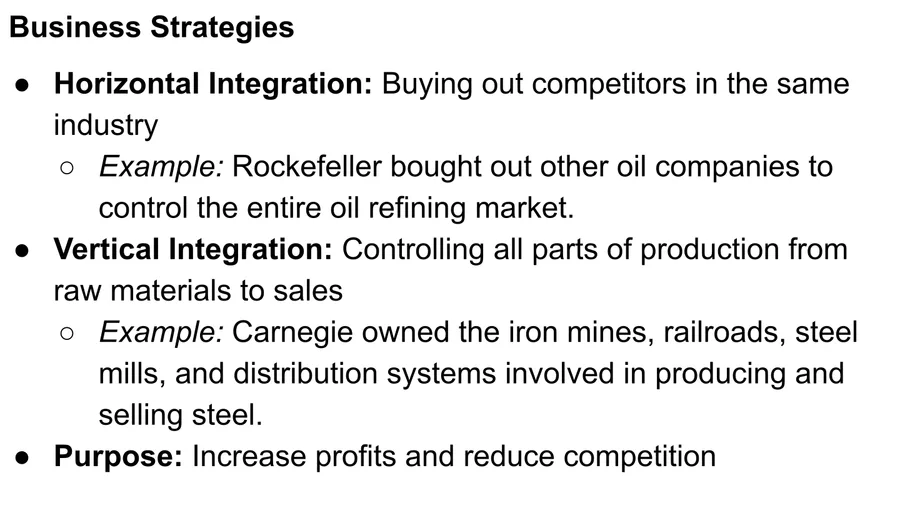
Horizontal Integration
Vertical Integration
Match this one
John D. Rockefeller
Andre Carnegie
With this one
John D. Rockefeller
Andre Carnegie
With this one
12
13
Multiple Choice
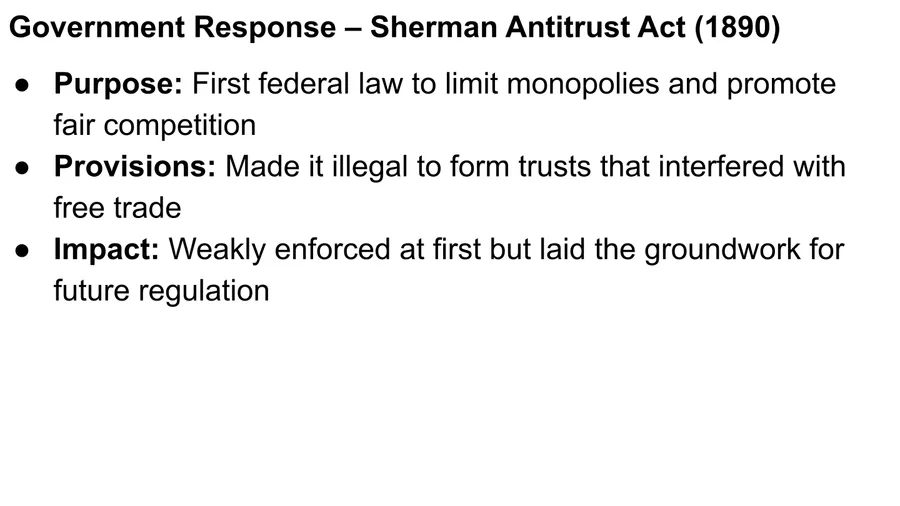
Name of the US's first law passed to take on monopolies?
14
15
Multiple Choice
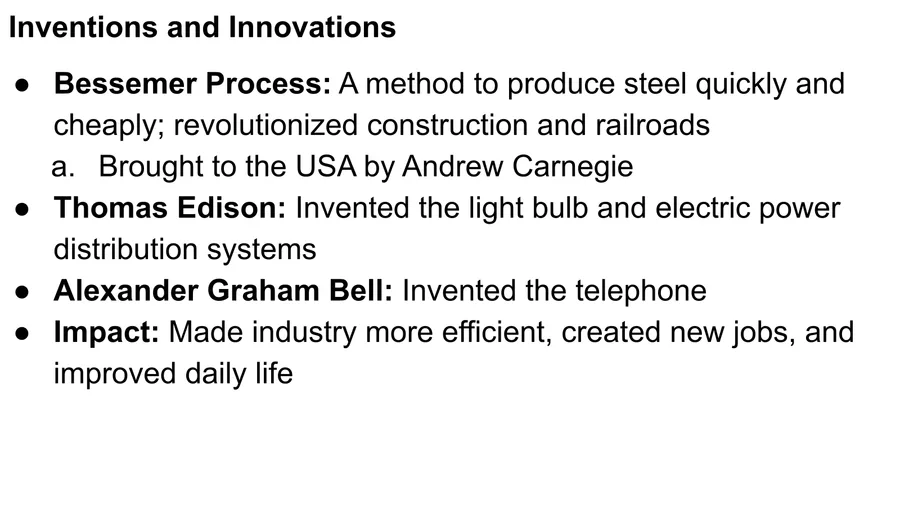
The Bessemer Process revolutionized the production of ___ by making it quicker and cheaper.
16
Match
Match the following people to their invention or innovation
Thomas Edison
Alexander Graham Bell
Andrew Carnegie
Light Bulb/Electricity
Telephone
Bessemer Process
Light Bulb/Electricity
Telephone
Bessemer Process
17
18
Match
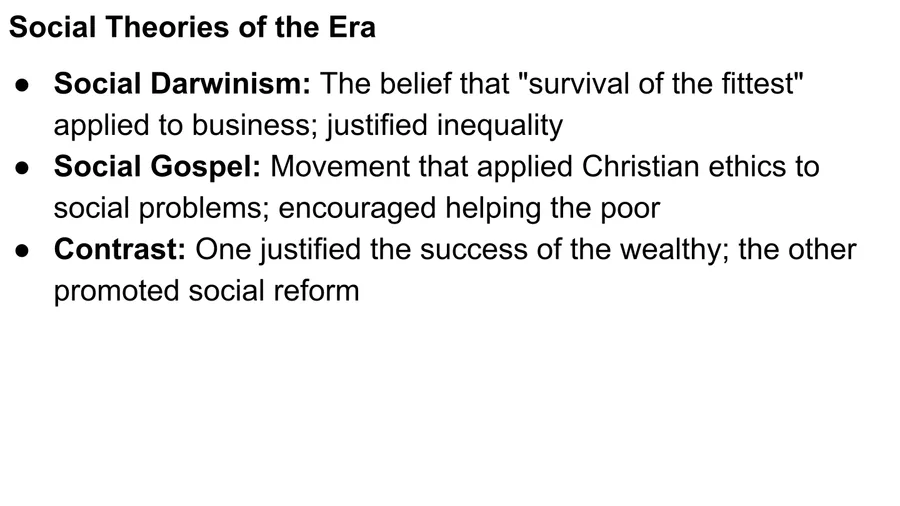
Match the following
Social Darwinism
Social Gospel
Gospel of Wealth
Natural selection applied to society
A movement to improve society through Christian ethics
Philanthropy as a moral obligation of the wealthy
Natural selection applied to society
A movement to improve society through Christian ethics
Philanthropy as a moral obligation of the wealthy
19
20
Multiple Choice
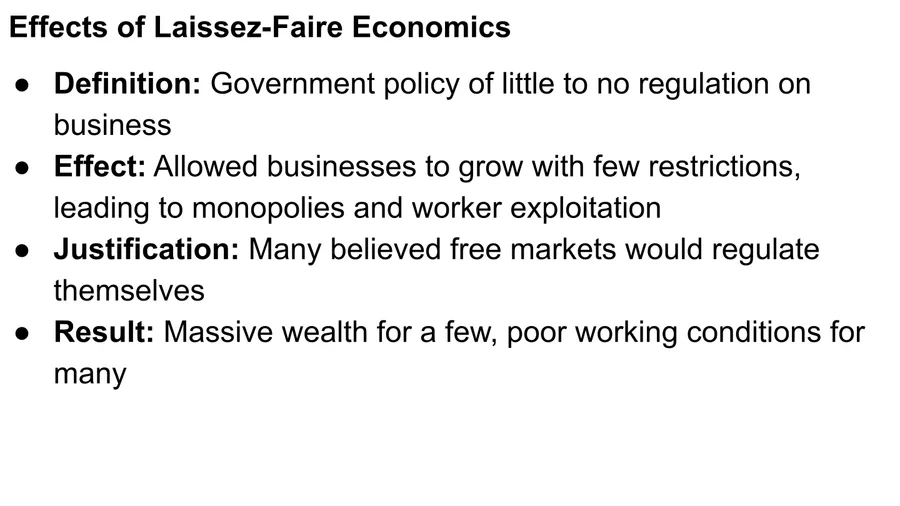
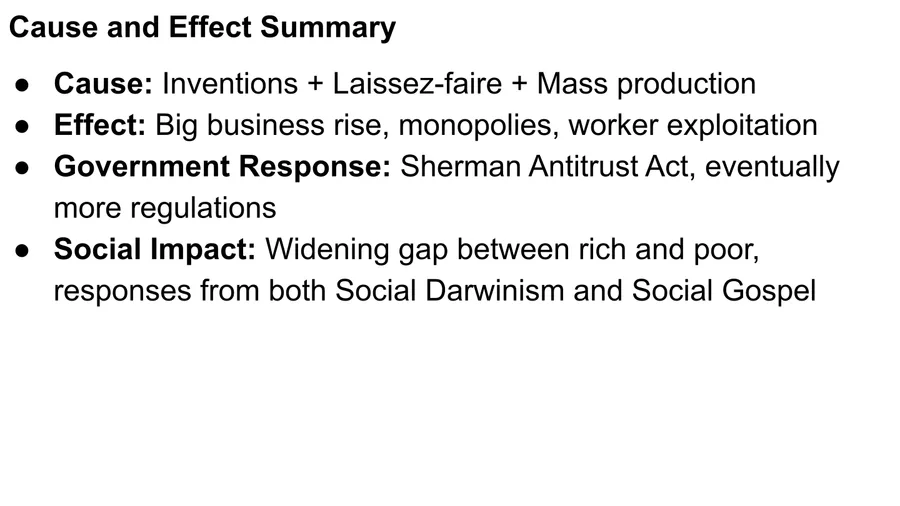
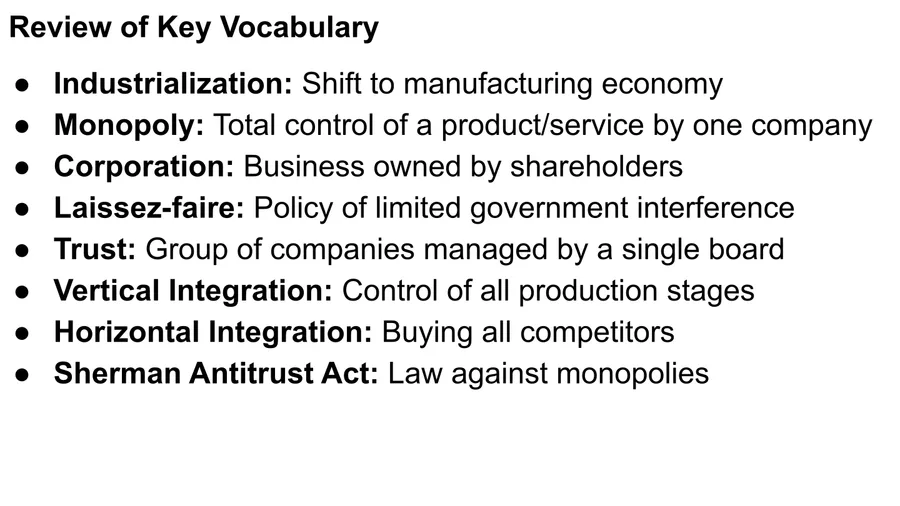
Which best explains the EFFECT of Inventions + Laissez-faire + Mass production
Big business rise, monopolies, worker exploitation
21
22
23
Multiple Choice
Explain how laissez-faire economics contributed to the growth of monopolies and worker exploitation in the late 19th century.
Laissez-faire economics contributed to monopolies and worker exploitation
24
Multiple Choice
What is the main difference between horizontal integration and vertical integration as business strategies?
Horizontal integration involves buying out competitors; vertical integration involves controlling all parts of production.
Horizontal integration involves controlling all parts of production; vertical integration involves buying out competitors.
Both involve government regulation of businesses.
Both are strategies to increase government ownership of companies.
25
Multiple Choice
The Sherman Antitrust Act was the first federal law to limit ___ and promote fair competition.
Show answer
Auto Play
Slide 1 / 25
SLIDE
Similar Resources on Wayground

19 questions
Weaknesses of the Articles
Presentation
•
11th Grade
20 questions
SS 20-2 Chap 1
Presentation
•
11th Grade
19 questions
SSUSH8B: Manifest Destiny
Presentation
•
11th Grade
20 questions
Industrialization
Presentation
•
11th Grade
24 questions
Government Response to the Great Depression
Presentation
•
11th Grade
21 questions
Age of Exploration
Presentation
•
10th - 12th Grade
21 questions
Video Production
Presentation
•
11th Grade
17 questions
Imperialism in India
Presentation
•
10th Grade
Popular Resources on Wayground
10 questions
Safety Day 2026 – Student Review

Quiz
•
9th Grade
21 questions
Continents and Oceans
Quiz
•
6th Grade
20 questions
Parts of Speech
Quiz
•
5th Grade
16 questions
Subject & Predicate
Quiz
•
5th Grade
25 questions
Multiplication Facts
Quiz
•
5th Grade
12 questions
Map Skills
Quiz
•
3rd Grade
22 questions
Continents and Oceans
Quiz
•
5th Grade
15 questions
Rounding Decimals
Quiz
•
5th Grade
Discover more resources for Social Studies
39 questions
Unit 7 Key Terms
Quiz
•
11th Grade - University
38 questions
Unit 6 Key Terms
Quiz
•
11th Grade - University
38 questions
The Progressive Era
Quiz
•
11th Grade
25 questions
Progressive Era
Quiz
•
11th Grade
25 questions
Gilded Age Gallery Walk
Presentation
•
9th - 12th Grade
20 questions
How The Constitution Has Changed
Quiz
•
11th Grade
25 questions
Mastery Quiz SSUSH 11-14
Quiz
•
11th Grade
30 questions
Q1 US History Check
Quiz
•
11th Grade