FTCE Math Lesson with questions Competency 01. 02. & 04
Presentation
•
Mathematics
•
1st - 5th Grade
•
Hard
+8
Standards-aligned
Ana Rosario
FREE Resource
30 Slides • 82 Questions
1
2
3
4
Multiple Choice
Which of the following is NOT included in the FTCE Mathematics Subtest study guide as described in the introduction?
Key concepts
Vocabulary
Practice teaching sessions
Study tips
5
6
Fill in the Blanks
Type answer...
7
Fill in the Blanks
Type answer...
8
Fill in the Blanks
Type answer...
9
Fill in the Blanks
Type answer...
10
Fill in the Blanks
Type answer...
11
Multiple Choice
Which property is used in the following?
7(8 + 2) = 7 x 8 + 7 x 2
12
Multiple Choice
How can we practice subitizing?
Using dice, flashcards, or counting games.
By counting numbers aloud in sequence.
Through solving complex mathematical equations.
By memorizing multiplication tables.
13
14
Multiple Choice
Which of the following competencies involves solving linear equations and identifying patterns?
Competency 01
Competency 02
Competency 03
Competency 04
15
16
Multiple Choice
Which of these is NOT another word for iteration
Repeat
Loop
Repitition
Circulate
17
Multiple Choice
Each number in Set O goes with one number in Set P. What is the pattern?
Subtract 1
Add 1
Subtract 3
Add 3
18
Multiple Choice
8, 10, 12, 14, 16, 18, 20
19
Multiple Choice
What is the 11th term going to be?
circle
heart
A
B
20
Multiple Choice
21
Multiple Choice
Is the pattern below a growing pattern or a repeating pattern?
Repeating because it is an A B C pattern.
Repeating because it uses the same shapes over and over.
Growing because there is a change and it does not repeat.
Shrinking because it gets smaller.
22
Multiple Choice
Are these patterns the same?
Yes, they are both repeating. The core of the pattern is AB.
Yes, both patterns are decreasing. The rule is subtracting by 1.
The patterns are different. Top one is Repeating Core is AB. The bottom one is adding by 1.
The patterns are different because one is shapes and the other is fruit.
23
24
Multiple Choice
How can we practice subitizing?
Using dice, flashcards, or counting games.
By counting numbers aloud in sequence.
Through solving complex mathematical equations.
By memorizing multiplication tables.
25
Multiple Choice
What is an example of subitizing?
Seeing 3 apples on a table and knowing there are 3 without counting.
Counting the number of stars in the sky one by one.
Estimating the number of people in a crowded room.
Recognizing a friend's face in a group of strangers.
26
Multiple Choice
Why is subitizing important?
It helps develop number sense and quick recognition of quantities.
It is a method for teaching complex mathematical concepts.
It focuses on memorizing numbers rather than understanding them.
It is primarily used for teaching reading skills.
27
Multiple Choice
What is subitizing?
The ability to instantly recognize the number of objects in a small group without counting.
A method of counting large groups of objects quickly.
A technique used in mathematics to estimate values.
The process of grouping objects based on their characteristics.
28
Multiple Choice
Iteration is best described as ___ a process or operation.
29
Multiple Choice
Which of the following statements about tiling is correct?
Tiling requires gaps between shapes.
Tiling is used to study tessellations in geometry.
Tiling only uses circles.
Tiling is unrelated to geometry.
30
Multiple Choice
Tiling is used in geometry to study ___.
units
r
31
32
Multiple Choice
33
Multiple Choice
34
Multiple Choice
35
Multiple Choice
Which of the following best describes iteration in mathematics?
Repeating a process or operation
Covering a plane with shapes
Instantly recognizing the number of objects
Evaluating at the end of a unit
36
Multiple Choice
37
Multiple Choice
38
Multiple Choice
39
Multiple Choice
40
Multiple Choice
Formal Assessments...
are spontaneous!
are final exams, tests, and quizzes on subject matter studied.
made at the beginning of the school day.
require you to wear formal attire.
41
Multiple Choice
What is not correct about Informal Assessments?
Notes students facial expressions.
It's homework
Listens to student's explanation of a topic/answer
Occurs during teaching
42
43
Multiple Choice
A history teacher has given a test to their students. The test is twenty questions, each two points. Their grade will represent a percentage. Which form of assessment is this?
Quantitative Assessment
Qualitative Assessment
44
Multiple Choice
Which graph shows −51 ?
45
Multiple Choice
____ is gathering quantitative data of the knowledge and skills students have acquired.
Evaluation
Method
Measurement
Informal Assessment
46
Multiple Select
Select all types of assessments mentioned in the slide.
Summative Assessment
Formative Assessment
Diagnostic Assessment
Norm-Referenced Assessment
47
Multiple Choice
Formative Evaluation
Measure students’ acquirement of knowledge and skills to make decisions about their teaching techniques
Using measurements to decide grades and if the student is ready to move onto next level of education
48
Multiple Choice
Start at -4. Subtract 4.
What is the final position?
-5
-6
-7
-8
49
Multiple Choice
In this type of assessment, a teacher and student discuss progress towards goals, evaluate their work, and reflect on their growth and achievements.
Self-assessment
Formal assessment
Portfolio assessment
Informal assessment
50
Multiple Choice
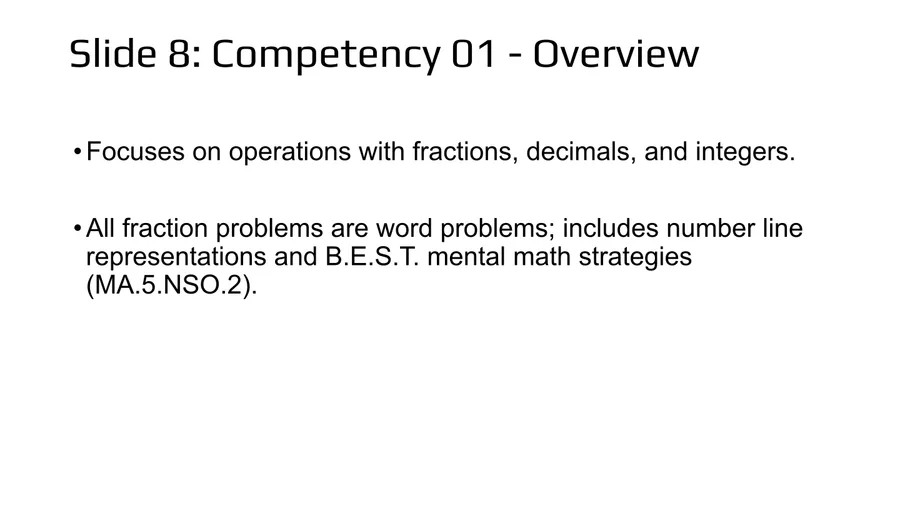
Which of the following is NOT a focus of Competency 01 as described in the overview?
Operations with fractions
Operations with decimals
Operations with percentages
Operations with integers
51
Multiple Choice
Project Based Learning
uses measurements to decide grades and if the student is ready to move onto next level of education.
is a teaching method in which students gain knowledge and skills by working for an extended period of time to investigate and respond to an authentic, engaging, and complex question, problem, or challenge.
makes judgements or assigning a value to measurements of student learning.
assesses what the learner already knows and/or the nature of difficulties that the learner might have, which, if undiagnosed, might limit their engagement in new learning.
52
53
Multiple Choice
Validity
is all about accuracy in your measurements.
determines consistency.
54
Multiple Select
Which of the following are considered non-integers according to the vocabulary presented?
0.5
-2
π (pi)
3
55
Multiple Choice
Norm-referenced assessments
tests and assessments are designed to measure student performance against a fixed set of predetermined criteria or learning standards.
standardized assessment that uses a well-defined reference group to establish performance expectations.
56
57
Multiple Choice
Which of the following operations can be performed on integers, decimals, and fractions as listed in the key concepts?
Addition
Subtraction
Multiplication
All of the above
58
59
Multiplying Fractions by Fractions
60
61
Multiplying Fractions with a Model
62
Multiple Choice
Which model would you use to represent 3/4 as three out of four equal objects?
Linear model
Set model
Area model
Decimal model
63
Multiple Choice
An integer is ...
Any positive number that is NOT a fraction, decimal, or zero
Any positive number, including zero, that is NOT a fraction or a decimal
Any number (positive, negative, or zero) that is NOT a fraction or a decimal
Any number that can be written as a fraction; it can be made by dividing two integers
A real number that goes on FOREVER and DOES NOT REPEAT; because they go on forever and do not repeat, they cannot be written as fractions
64
Multiple Choice
Which problem does the model represent?
51⋅62
31⋅52
52⋅51
52⋅52
65
Multiple Choice
A Natural number is ...
Any positive number that is NOT a fraction, decimal, or zero
Any positive number, including zero, that is NOT a fraction or a decimal
Any number (positive, negative, or zero) that is NOT a fraction or a decimal
Any number that can be written as a fraction; it can be made by dividing two integers
A real number that goes on FOREVER and DOES NOT REPEAT; because they go on forever and do not repeat, they cannot be written as fractions
66
Multiple Select
Select ALL classifications that apply to this number:
10
Real Number
Rational Number
Integer
Whole Number
Natural Number
67
Multiple Choice
Which model would you use to represent 3/4 as 3 out of 4 equal rectangle parts?
Linear model
Set model
Area model
Decimal model
68
Multiple Choice
An Irrational number is ...
Any positive number that is NOT a fraction, decimal, or zero
Any positive number, including zero, that is NOT a fraction or a decimal
Any number (positive, negative, or zero) that is NOT a fraction or a decimal
Any number that can be written as a fraction; it can be made by dividing two integers
A real number that goes on FOREVER and DOES NOT REPEAT; because they go on forever and do not repeat, they cannot be written as fractions
69
Multiple Select
Select ALL classifications that apply to this number:
- 89
Real Number
Rational Number
Integer
Whole Number
Natural Number
70
Multiple Choice
After reviewing the introduction to the FTCE Mathematics Subtest study guide, do you have any questions or areas where you would like additional clarification?
71
Multiple Choice
A Whole number is ...
Any positive number that is NOT a fraction, decimal, or zero
Any positive number, including zero, that is NOT a fraction or a decimal
Any number (positive, negative, or zero) that is NOT a fraction or a decimal
Any number that can be written as a fraction; it can be made by dividing two integers
A real number that goes on FOREVER and DOES NOT REPEAT; because they go on forever and do not repeat, they cannot be written as fractions
72
Multiple Select
Which of the following describe –77?
Select all that apply.
irrational number
rational number
natural number
whole number
integer
73
Multiple Choice
Which model correctly shows the problem 62⋅51 ?
74
Multiple Choice
A Rational number is ...
Any positive number that is NOT a fraction, decimal, or zero
Any positive number, including zero, that is NOT a fraction or a decimal
Any number (positive, negative, or zero) that is NOT a fraction or a decimal
Any number that can be written as a fraction; it can be made by dividing two integers
A real number that goes on FOREVER and DOES NOT REPEAT; because they go on forever and do not repeat, they cannot be written as fractions
75
Multiple Choice
Breaking numbers into place values is a mental math strategy used for ___ .
addition calculations
76
Multiple Choice
Which of the following is an example of a Natural number?
5.24
8
31
0
77
Multiple Choice
What problem is represented by the model?
1/2 * 3/10
3/5 * 9/50
3/5 * 3/10
2/5 * 3/5
78
Multiple Choice
Which of the following is an example of a Whole number?
5.24
8
31
0
79
Multiple Choice
Use the model to find the product.
35/1
2/12
1/6
1/35
80
Multiple Choice
Which of the following is an example of an Integer?
-4
−72
π
6.15
81
Multiple Choice
Explain how you would use benchmarks to estimate the sum of two fractions, such as 5/6 and 1/5.
82
Multiple Choice
Which of the following is an example of a Rational number?
11
π
7.06
e
83
Multiple Choice
Which fraction model shows 2/5 x 2/3?
84
Multiple Choice
Which of the following is an example of a Irrational number?
95.87
43
12
-6
85
86
You can make a friendly number.
34 + 28 =
Take 2 away from the 34 and you get 32.
Add those 2 to the 28 and you get 30.
Add 32 + 30 = 62
87
Topic 2, Lesson 2 Mental Math: Estimate Sums and Differences
88
Multiple Choice
Explain how subitizing can be useful in early mathematics education.
89
Multiple Choice
What is a sum?
The answer to any math problem.
The answer to an addition problem.
The answer to a subtraction problem.
90
Multiple Choice
Label point C on the number line
65
−32
−62
−21
91
Multiple Choice
What is a difference?
The answer to any math problem.
The answer to an addition problem.
The answer to a subtraction problem.
92
The Essential Understanding
of this lesson is:
There is more than one way to estimate a sum or difference. Estimation gives a way to replace numbers with other numbers that are close and easier to compute mentally.
93
Reminder
Mental math is being able to mental math calculations in your head. But it is okay to use paper and pencil and record your thought process to get to the answer!
94
One strategy we can use to add and subtract in our head is to use rounding.
We can ESTIMATE the sums and differences of numbers.
95
Multiple Choice
True or False: You can estimate to any place value.
True, but you should be
precise in your choice.
False, you have to
estimate to the hundreds place.
96
Let's estimate the sum of an addition problem. We will round to the hundred place.
33,498 + 28,609
97
Poll
What is 33,500 + 28,600?
62,000
62,100
62,200
98
This time we will round to the thousand place.
33,498 + 28,609
99
Poll
What is 33,000 + 29,000?
62,000
62,100
62,200
100
This time we will round to the ten thousand place.
33,498 + 28,609
101
Poll
What is 30,000 + 30,000?
62,000
62,100
62,200
60,000
102
Each answer was a little different.
That answer is closer to the actual number based on what place you round to.
This same thing applies to subtraction.
103
Notice the differences when we change the place value to we round to.
104
Open Ended
What do you notice about the sum or difference as you round further away from the ones and tens?
105
Multiple Choice
Estimate the sum, rounding each number to the one thousand place.
5,000 + 2,000 = 7,000
5,000 + 2,600 = 7,600
5,000 + 3,000 = 8,000
106
Multiple Select
To the nearest ten thousand, Calvin estimates the difference of a subtraction problem at 220,000. Select all that could have been Calvin’s original problem.
232,684 - 14,652
238,041 - 19,558
271,982 - 64,780
298,155 - 75,437
242,698 - 18,765
107
Next Steps:
Go to Schoolwork to Open EdPuzzle.
Don't forget to Mark Done when you finish EdPuzzle.
Then Open Keynote Practice Buddy.
Don't forget to Submit when you finish.
108
Multiple Choice
When using benchmarks to estimate the sum of 7/8 and 1/4, what is the approximate answer?
1
1 1/4
2
1 1/8
109
110
Multiple Select
Which of the following are considered non-integers according to the vocabulary presented?
0.5
2
π (pi)
-1
111
Mental Math for Addition

112
You can add the tens, add the ones, and then put them together.
34 + 28 =
30 + 20 = 50
4 + 8 = 12
50 + 12 = 62
Show answer
Auto Play
Slide 1 / 112
SLIDE

Similar Resources on Wayground
107 questions
3rd Grade Winter Break Tutorials
Presentation
•
1st - 5th Grade
108 questions
U3 REVIEW
Presentation
•
KG
109 questions
Mariia - Speakout A2
Presentation
•
1st - 5th Grade
99 questions
Continuity and Unity of Life
Presentation
•
10th - 12th Grade
104 questions
Lesson21 SUSHI NO HOO GA SUKI DESU
Presentation
•
KG
103 questions
Musculoskeletal
Presentation
•
KG
110 questions
TTTT
Presentation
•
KG
103 questions
Copy of G3MTH_SD_11.14_3.5B_3.4K
Presentation
•
1st - 5th Grade
Popular Resources on Wayground
20 questions
"What is the question asking??" Grades 3-5
Quiz
•
1st - 5th Grade
20 questions
“What is the question asking??” Grades 6-8
Quiz
•
6th - 8th Grade
10 questions
Fire Safety Quiz
Quiz
•
12th Grade
20 questions
Equivalent Fractions
Quiz
•
3rd Grade
34 questions
STAAR Review 6th - 8th grade Reading Part 1
Quiz
•
6th - 8th Grade
20 questions
“What is the question asking??” English I-II
Quiz
•
9th - 12th Grade
20 questions
Main Idea and Details
Quiz
•
5th Grade
47 questions
8th Grade Reading STAAR Ultimate Review!
Quiz
•
8th Grade
Discover more resources for Mathematics
20 questions
Equivalent Fractions
Quiz
•
3rd Grade
19 questions
Classifying Quadrilaterals
Quiz
•
3rd Grade
16 questions
Graphing - First Quadrant
Quiz
•
5th Grade
22 questions
fractions
Quiz
•
3rd Grade
20 questions
3rd Grade STAAR Math Review
Quiz
•
3rd Grade
10 questions
Odd and even numbers
Quiz
•
1st - 2nd Grade
15 questions
Rounding to the Nearest Ten and Hundreds
Quiz
•
3rd Grade
17 questions
2nd Grade Graphs (Bar & Picture)
Quiz
•
2nd Grade