

Wednesday_G7SCI_07.16

Presentation
•
Mathematics
•
7th Grade
•
Practice Problem
•
Hard

Randolph Rendon
FREE Resource
24 Slides • 22 Questions
1
2
Open Ended
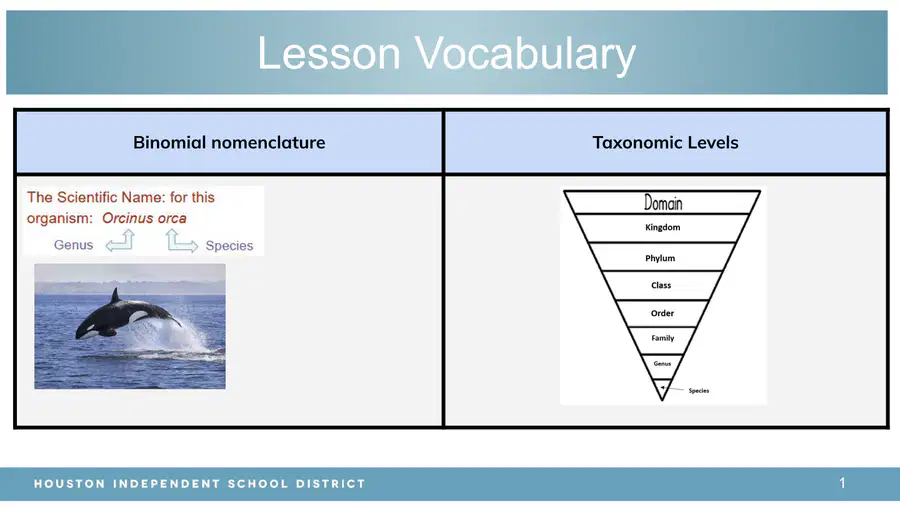
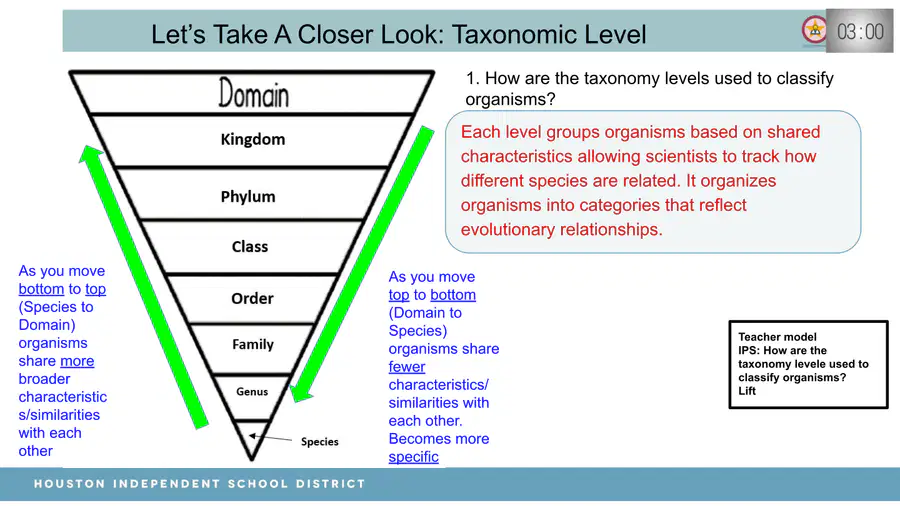
How do taxonomic levels help us understand the relationships between different living organisms?
3
Multiple Choice
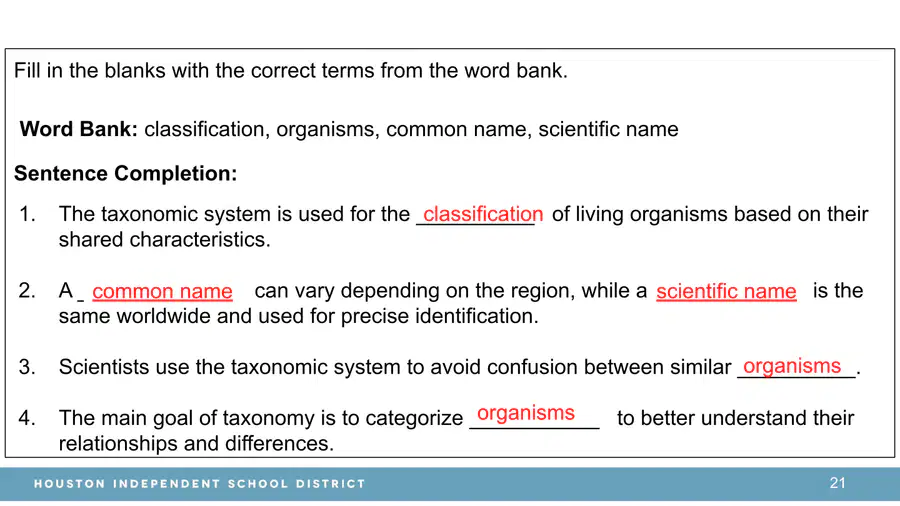
Why is it important for scientists to use binomial nomenclature when naming organisms?
It helps avoid confusion by providing a universal naming system.
It allows scientists to use common names for organisms.
It makes it easier to remember the names of all organisms.
It is required by law in every country.
4
5
6

7
Multiple Choice
Which statement best describes the difference between physical and chemical changes?
Physical changes result in new substances being formed, while chemical changes do not.
Chemical changes are reversible, while physical changes are not.
Physical changes do not create new substances, while chemical changes involve the creation of new substances.
Chemical changes can be observed without a change in the substance's properties.
8
9
Open Ended
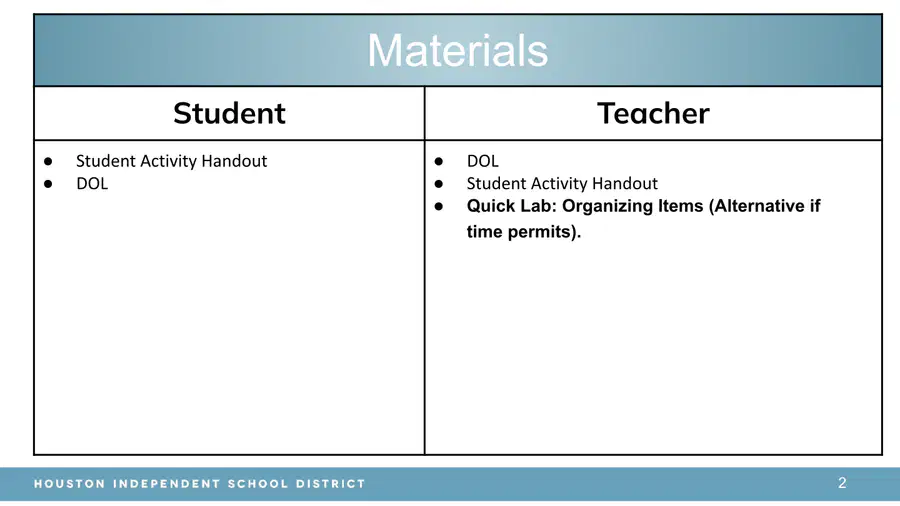
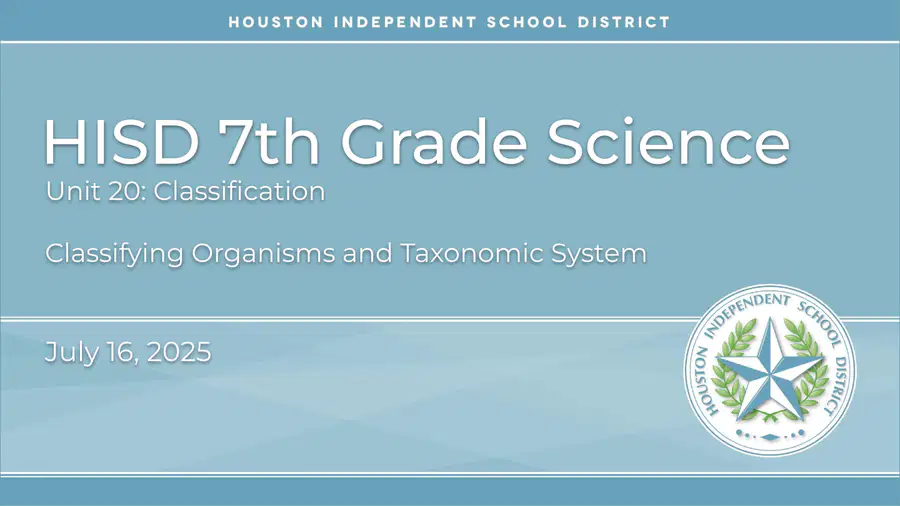
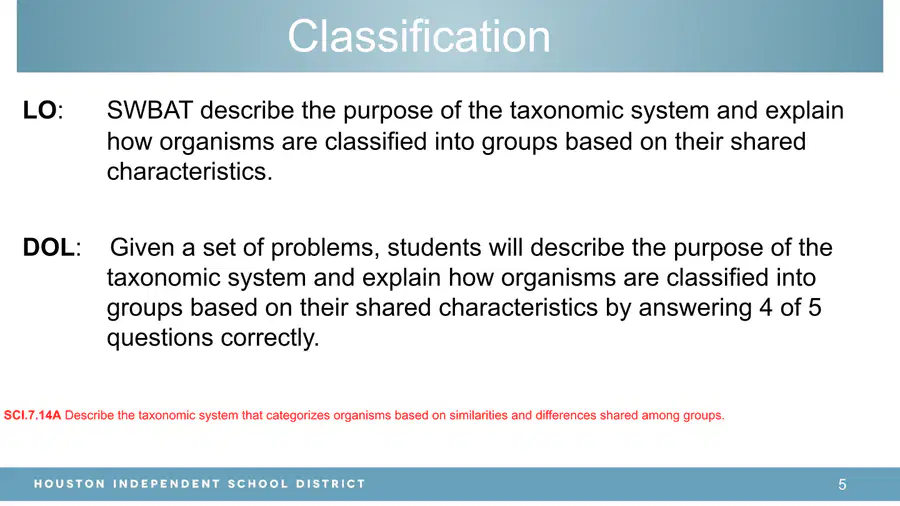
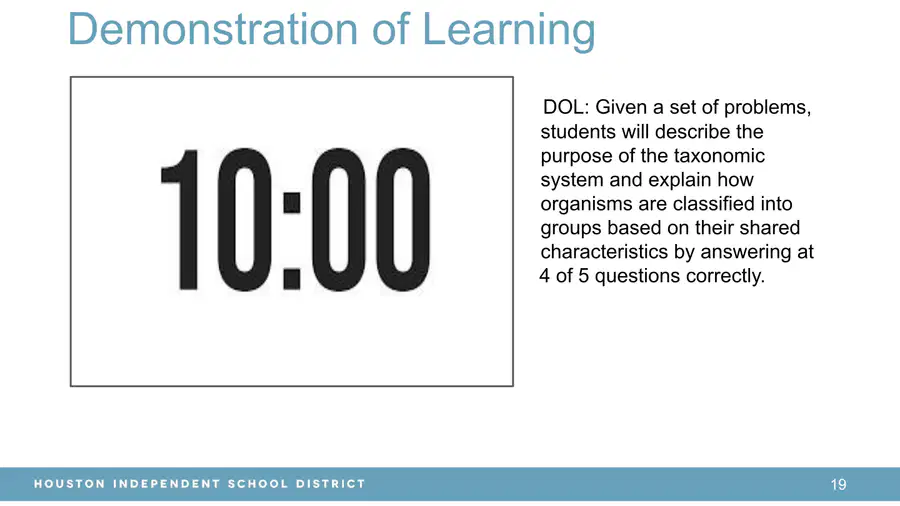
Describe the purpose of the taxonomic system and explain how organisms are classified into groups based on their shared characteristics.
10
11
12
Fill in the Blanks
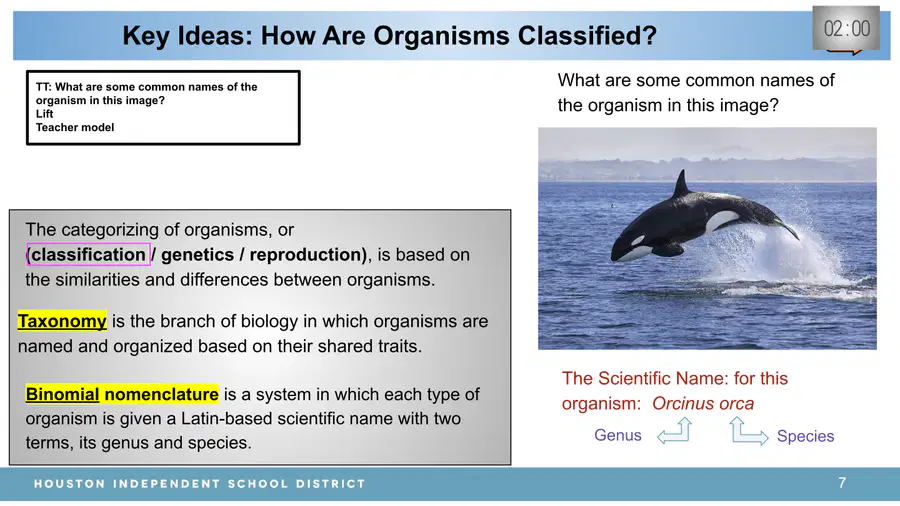
The branch of biology in which organisms are named and organized based on their shared traits is called
Type answer...
13
Multiple Choice
Which of the following best defines binomial nomenclature?
A system for classifying organisms based on their physical appearance.
A system in which each type of organism is given a Latin-based scientific name with two terms: its genus and species.
A method for grouping organisms by their habitat.
A process for naming organisms after their discoverers.
14
15
Open Ended
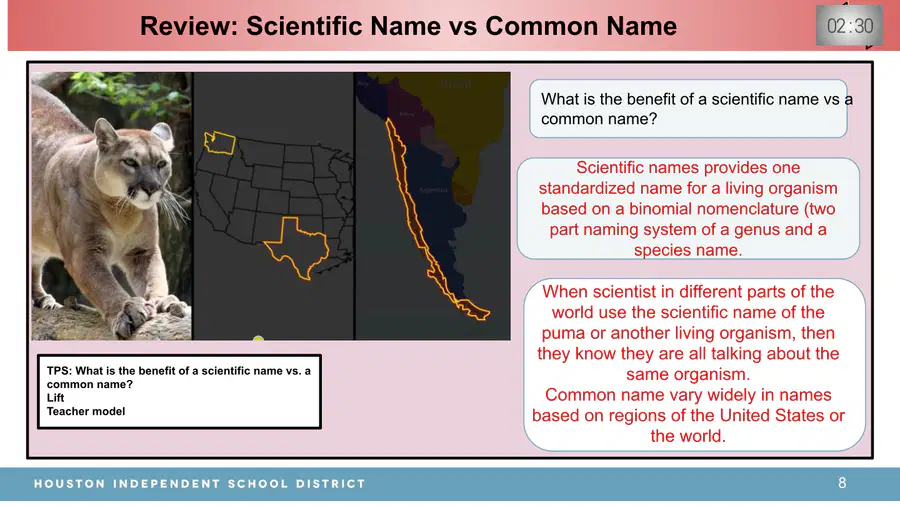
What is the benefit of using a scientific name instead of a common name for an organism?
16
17
18
Fill in the Blanks
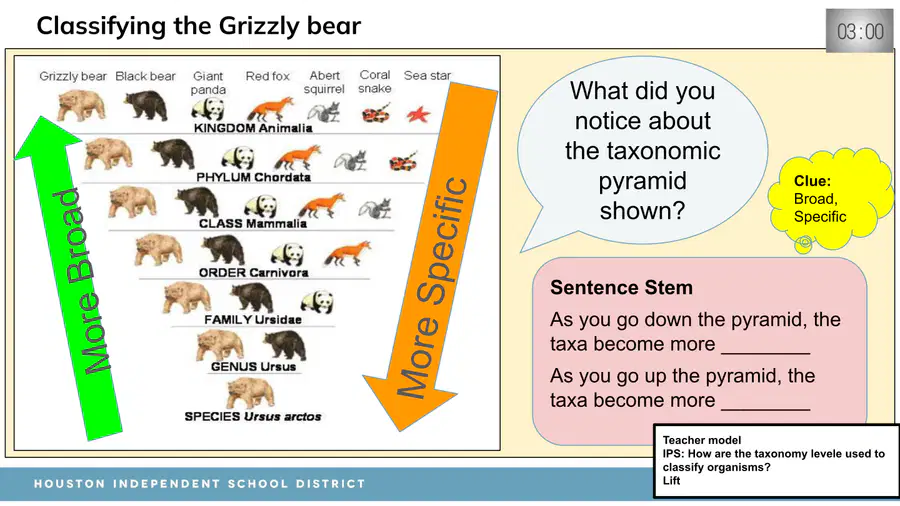
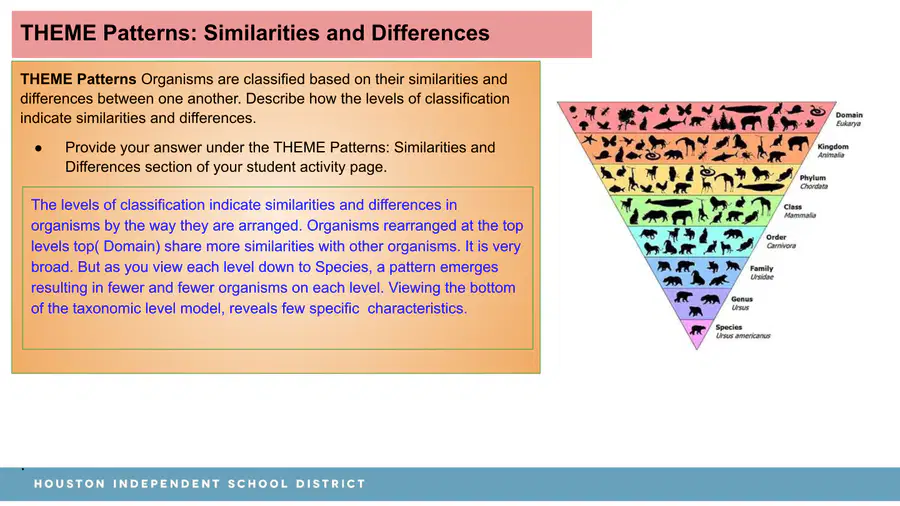
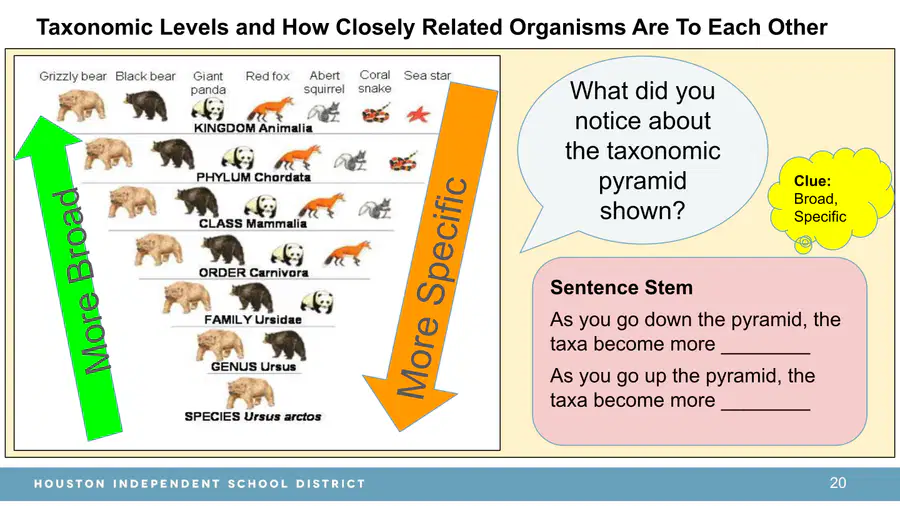
As you go down the pyramid, the taxa become more ____. As you go up the pyramid, the taxa become more _____.
Type answer...
19
20
Multiple Choice
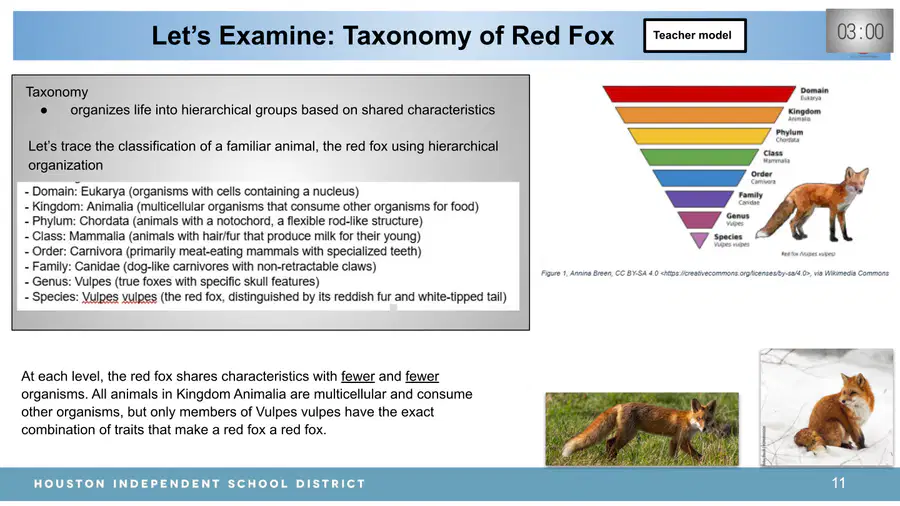
Which of the following is the correct hierarchical order of taxonomic levels from most broad to most specific?
Species, Genus, Family, Order, Class, Phylum, Kingdom, Domain
Domain, Kingdom, Phylum, Class, Order, Family, Genus, Species
Kingdom, Domain, Phylum, Class, Order, Family, Genus, Species
Domain, Kingdom, Class, Phylum, Order, Family, Genus, Species
21

22
Multiple Choice
Which of the following statements best explains why a domestic cat and a puma are classified in the same family?
They both belong to the same genus and species.
They both have identical DNA and reproduce in the same way.
They live in similar environments and share the same diet.
They share common physical characteristics and behaviors that are typical of the Felidae family.
23
24
Open Ended
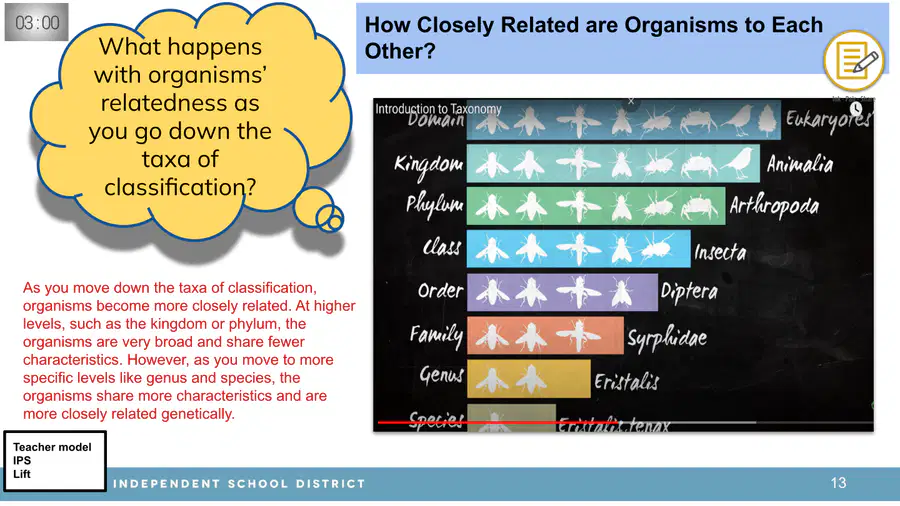
What happens with organisms’ relatedness as you go down the taxa of classification?
25
26
Multiple Choice
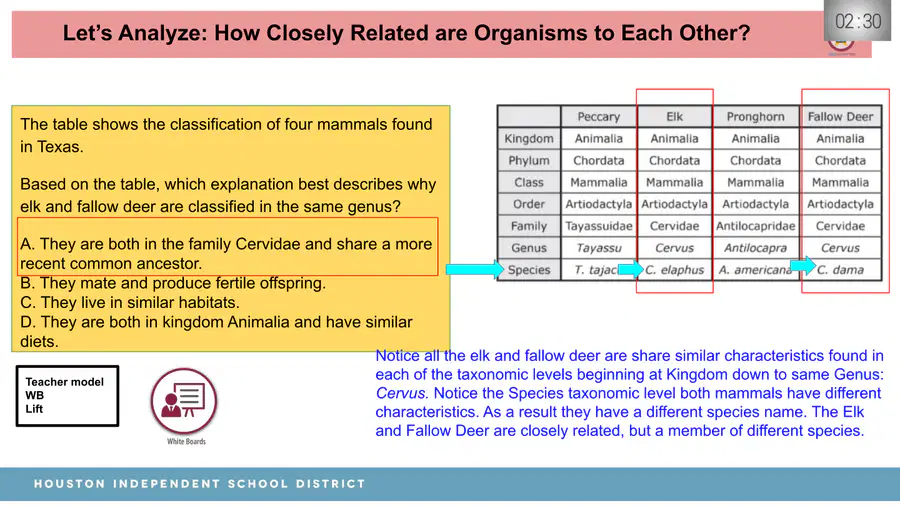
Based on the table, which explanation best describes why elk and fallow deer are classified in the same genus?
They are both in the family Cervidae and share a more recent common ancestor.
They mate and produce fertile offspring.
They live in similar habitats.
They are both in kingdom Animalia and have similar diets.
27
28
Open Ended
Describe how the levels of classification indicate similarities and differences among organisms.
29
30
31
32
Multiple Select
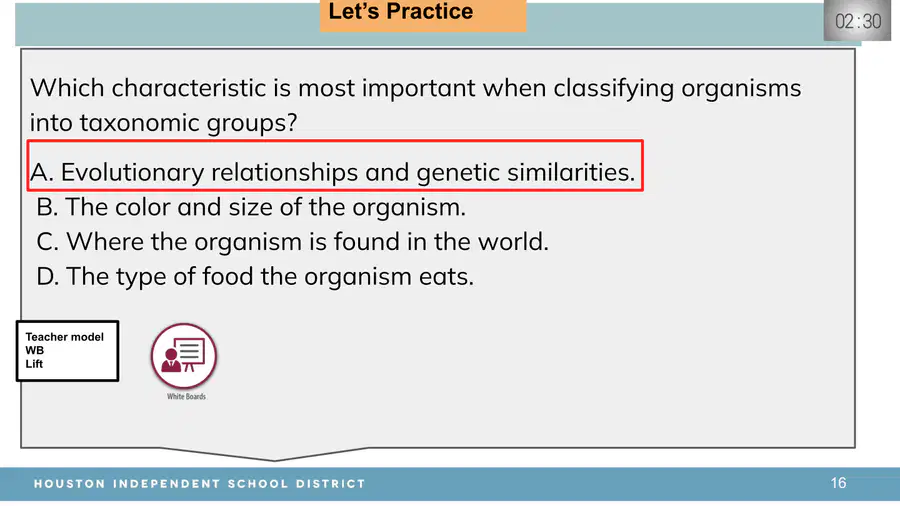
Which of the following are characteristics scientists use to classify organisms into groups?
Physical traits
Behavior
Genetic similarities
Favorite food
33
Open Ended
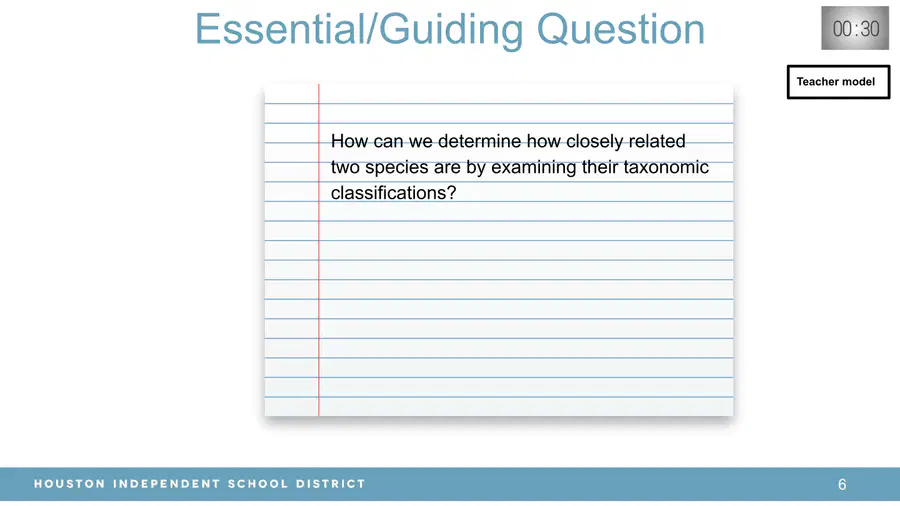
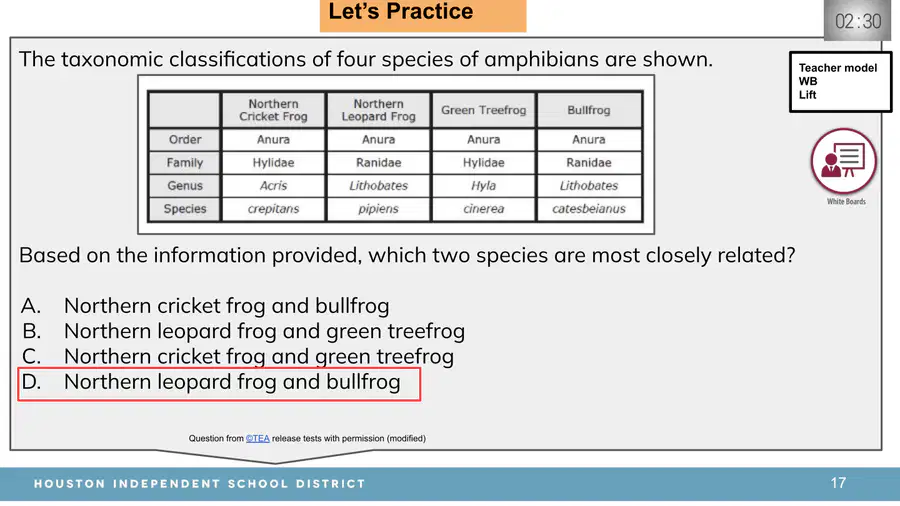
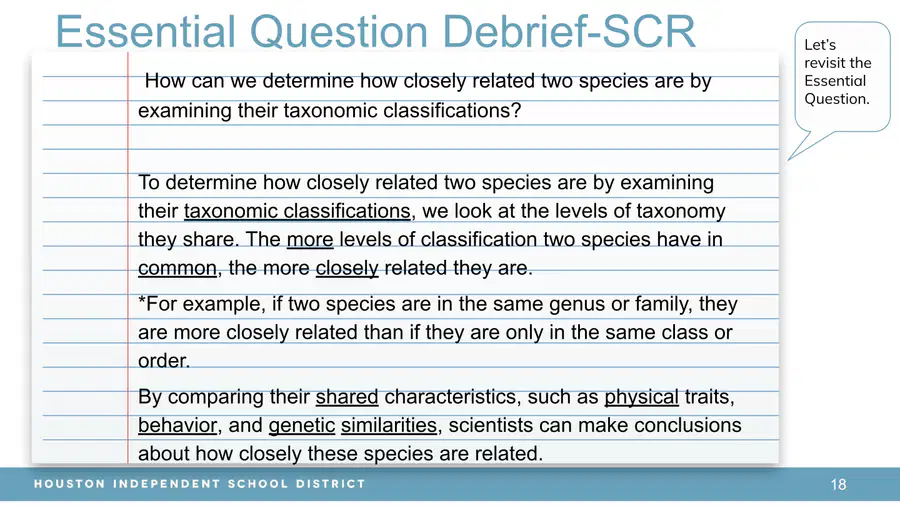
How can we determine how closely related two species are by examining their taxonomic classifications?
34
35
36
Fill in the Blanks
As you go down the taxonomic pyramid, the taxa become more ____. As you go up the pyramid, the taxa become more ____.
Type answer...
37
38
Fill in the Blanks
The main goal of taxonomy is to categorize
Type answer...
39
Open Ended
Explain why scientists use both common names and scientific names when referring to organisms. What are the advantages and disadvantages of each?
40
41
Multiple Choice
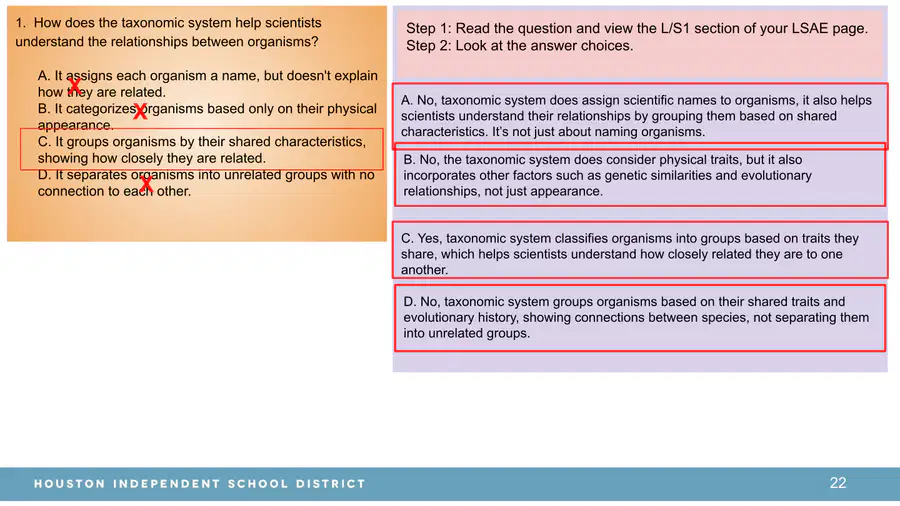
Which of the following best explains how the taxonomic system helps scientists understand the relationships between organisms?
It assigns each organism a name, but doesn't explain how they are related.
It categorizes organisms based only on their physical appearance.
It groups organisms by their shared characteristics, showing how closely they are related.
It separates organisms into unrelated groups with no connection to each other.
42
43
Multiple Choice
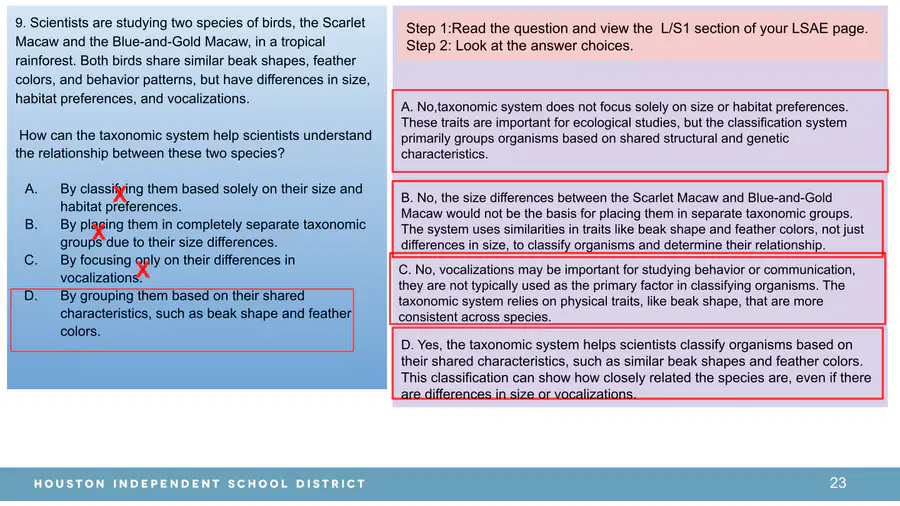
How can the taxonomic system help scientists understand the relationship between two species of birds that have similar beak shapes and feather colors, but differ in size, habitat preferences, and vocalizations?
By classifying them based solely on their size and habitat preferences.
By placing them in completely separate taxonomic groups due to their size differences.
By focusing only on their differences in vocalizations.
By grouping them based on their shared characteristics, such as beak shape and feather colors.
44
45
Open Ended
How do you think understanding taxonomic levels can help scientists communicate about different organisms?
46
Multiple Choice
What are the two parts of a scientific name in binomial nomenclature?
Genus and species
Family and order
Domain and kingdom
Class and phylum
Show answer
Auto Play
Slide 1 / 46
SLIDE
Similar Resources on Wayground

42 questions
Unit 2.2 Legislative Branch
Presentation
•
7th Grade
36 questions
Surface Area and Volume Study Guide
Presentation
•
7th Grade
40 questions
Binary
Presentation
•
7th Grade
41 questions
Cattle Industry
Presentation
•
7th Grade
40 questions
Scientific Method
Presentation
•
7th Grade
39 questions
Identifying Slope and Y-Intercept
Presentation
•
7th - 8th Grade
41 questions
Review for Accentuate the Negative Unit Test (HW#17)
Presentation
•
7th Grade
40 questions
Texas Annexation
Presentation
•
7th Grade
Popular Resources on Wayground
10 questions
How much do you know about our Portrait of an Eagle?

Quiz
•
10th Grade
10 questions
Fast Food Slogans
Quiz
•
6th - 8th Grade
21 questions
Continents and Oceans
Quiz
•
6th Grade
20 questions
Parts of Speech
Quiz
•
5th Grade
16 questions
Subject & Predicate
Quiz
•
5th Grade
25 questions
Multiplication Facts
Quiz
•
5th Grade
12 questions
Map Skills
Quiz
•
3rd Grade
22 questions
Continents and Oceans
Quiz
•
5th Grade
Discover more resources for Mathematics
16 questions
Proportional and Non Proportional Relationships in Tables, Graphs, and Equations
Quiz
•
7th Grade
22 questions
Explore Rational Number Operations and Applications
Quiz
•
7th Grade
20 questions
Add and Subtract Integers
Quiz
•
6th - 8th Grade
20 questions
Graphing Inequalities on a Number Line
Quiz
•
6th - 9th Grade
20 questions
Perfect Squares and Square Roots
Quiz
•
7th Grade
13 questions
Multi Step Solving Equations with Variables on Both Sides
Quiz
•
7th Grade
16 questions
Adding and Subtracting Integers
Quiz
•
7th Grade
22 questions
Adding Integers
Quiz
•
7th - 8th Grade