
6.3 Rotational Dynamics

Presentation
•
Physics
•
12th Grade
•
Practice Problem
•
Hard

NABILAH Moe
FREE Resource
13 Slides • 6 Questions
1
By NABILAH Moe
2
By end of this lesson, students should be able to:
Define the moment of inertia.
State net torque.
3
If you want to rotate something that is at rest initially, is it easy or a bit difficult?
Why?
4
Law of inertia
Tendency of an object to resist any change in its state of rest or motion at a constant velocity. Any object that has mass has this tendency!
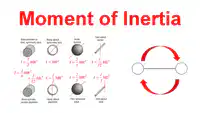
So, for a rotating body which consists of mass in motion, there is resistance to changes from rest or from rotation motion. This resistance to changes is called moment of inertia, I.
5
What factors affect the resistance to changes of a rotating body (moment of inertia)?
6

7

8
Moment of Inertia, I
Since a body is made up of many particles, with masses m1, m2, … at distance r1, r2, … from the axis of rotation, moment of inertia can be defined as the sum of products of the mass of each particle and the square of its respective distance from the rotation axis.


Large I requires more torque to change the body’s because it is harder to rotate!
9

10
11
Before this, you have learned that when a body’s rotational motion is in equilibrium, the body will either be stationary, or rotating at a constant angular velocity (no acceleration). So, the net torque will be zero.
But now, what if a rotating body is NOT in equilibrium?
12
Net torque
A rigid body that experiences a net torque about rotation axis, undergoes an angular acceleration!

The net torque acting on a rigid body is the cause of the body’s angular acceleration.
13
Multiple Choice
What does the moment of inertia of a rigid body depend on?
Only the mass of the body
Only the shape of the body
Mass, shape, and axis of rotation
Only the angular velocity of the body
14
Multiple Choice
Which of the following shapes has the largest moment of inertia, assuming equal mass and radius?
Solid sphere
Solid cylinder
Hoop or ring
Thin rod through center
15
Multiple Choice
What is the SI unit of moment of inertia?
N m
kg m²
rad/s²
J s
16
Multiple Choice
If a net torque is applied to a rigid body, what happens?
The body moves linearly
The body’s angular velocity remains constant
The body undergoes angular acceleration
The moment of inertia changes
17
Multiple Choice
A solid disk and a hoop both have the same mass and radius. Which one is easier to rotate?
The hoop
The disk
Both are equally easy
Depends on the torque applied
18
Multiple Choice
What happens to angular acceleration if the moment of inertia increases while torque remains constant?
It increases
It decreases
It remains unchanged
It becomes zero
19
Summary...
Each airlines share ONE thing you have learned today. Cannot be the same thing!
By NABILAH Moe
Show answer
Auto Play
Slide 1 / 19
SLIDE
Similar Resources on Wayground

15 questions
SWOT Analysis
Presentation
•
12th Grade
14 questions
Beginning Payroll
Presentation
•
12th Grade
12 questions
Anne Frank Character Change
Presentation
•
6th - 9th Grade
16 questions
PPC 6.1 Law of Sines Day 1
Presentation
•
12th Grade
14 questions
GetaraN
Presentation
•
12th Grade
17 questions
Genetics Review Part 2 (Practice)
Presentation
•
6th - 9th Grade
15 questions
Gelombang Elektromagnetik
Presentation
•
12th Grade
15 questions
PAST PERFECT
Presentation
•
12th Grade
Popular Resources on Wayground
10 questions
Safety Day 2026 – Student Review

Quiz
•
9th Grade
21 questions
Continents and Oceans
Quiz
•
6th Grade
20 questions
Parts of Speech
Quiz
•
5th Grade
16 questions
Subject & Predicate
Quiz
•
5th Grade
25 questions
Multiplication Facts
Quiz
•
5th Grade
12 questions
Map Skills
Quiz
•
3rd Grade
22 questions
Continents and Oceans
Quiz
•
5th Grade
15 questions
Rounding Decimals
Quiz
•
5th Grade
