

Man in the Well

Presentation
•
English
•
6th Grade
•
Hard
+4
Standards-aligned

Mary Bischoff
FREE Resource
6 Slides • 43 Questions
1

2
Multiple Choice
What is the significance of the children’s decision not to help the man in the well at the beginning of the story?
It shows their fear and uncertainty about the situation.
It demonstrates their lack of empathy.
It highlights their desire to play games.
It suggests they did not understand the seriousness of the situation.
3
Multiple Choice
When the kids find a man in a well, they…
leave him to play hide and seek.
decide to not go for help.
use a flashlight to see him.
go find an adult who can help.
4
Open Ended
How do the children’s interactions with the man in the well change from the beginning to the middle of the story? Use evidence from the text to support your answer.
5
Multiple Choice
Which of the following best describes a main theme of the The Man in the Well?
Children help others only when they feel fear or embarrassment
People can act in cruel ways when they hold power over others
Anyone can be a hero, but it is a choice people have to make
Distrust of strangers has caused modern society to become less caring
6
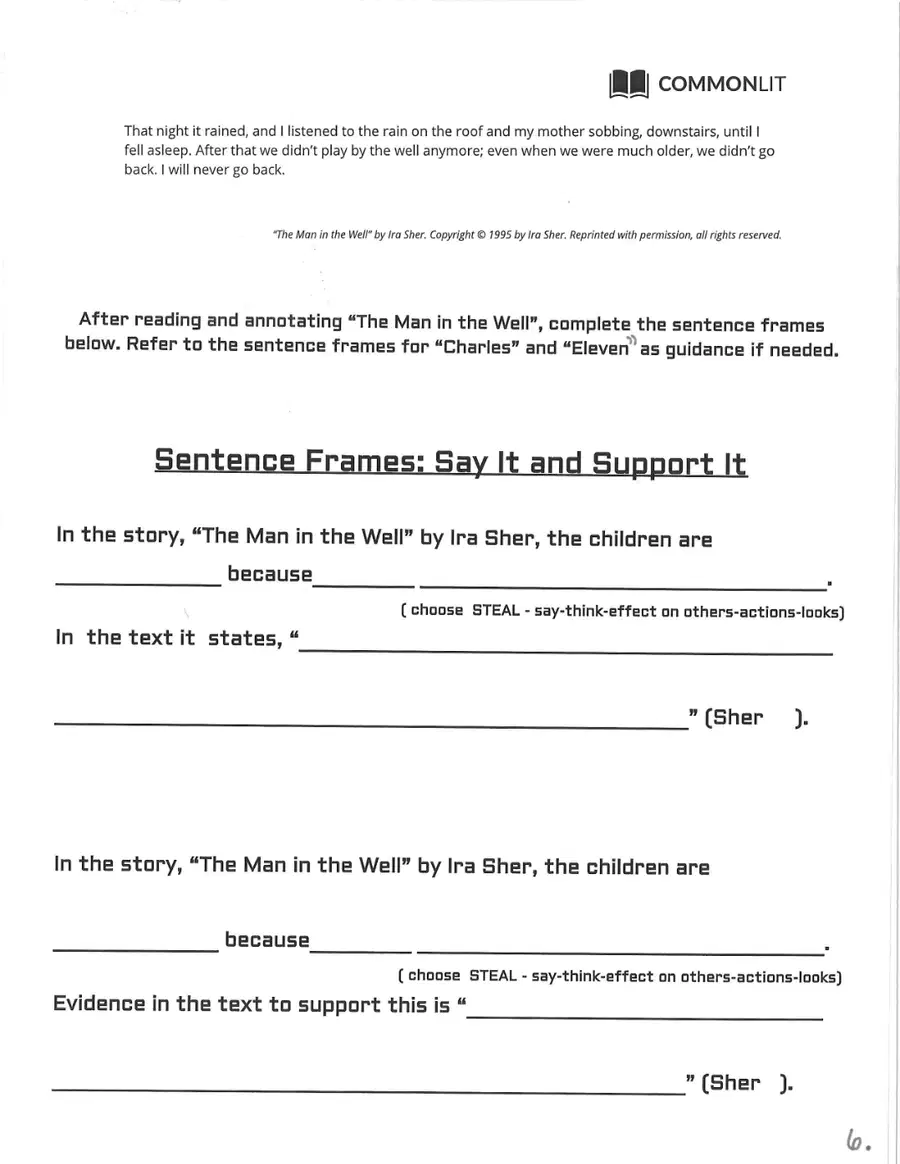
Fill in the Blanks
7
Multiple Choice
Which of the following actions did the children take after the man in the well asked for help?
They immediately went to get help.
They lied to the man and avoided helping him.
They tried to rescue him with a rope.
They ignored him completely.
8
Multiple Choice
Which of the following best describes a main theme of the The Man in the Well?
Children help others only when they feel fear or embarrassment
People can act in cruel ways when they hold power over others
Anyone can be a hero, but it is a choice people have to make
Distrust of strangers has caused modern society to become less caring
9
Multiple Select
Select all the emotions the children might have felt while interacting with the man in the well.
Guilt
Curiosity
Indifference
Fear
10
Fill in the Blanks
Type answer...
11
Fill in the Blanks
Type answer...
12
Open Ended
What questions do you still have about the story, or is there anything you would like to know more about regarding the children’s choices in 'The Man in the Well'?
13
Fill in the Blanks
Type answer...
14
Fill in the Blanks
Type answer...
15
Fill in the Blanks
Type answer...
16
Fill in the Blanks
Type answer...
17
Fill in the Blanks
Type answer...
18
Fill in the Blanks
Type answer...
19
Fill in the Blanks
Type answer...
20
Fill in the Blanks
Type answer...
21
Fill in the Blanks
Type answer...
22
Fill in the Blanks
Type answer...
23
Fill in the Blanks
Type answer...
24
Fill in the Blanks
Type answer...
25
Fill in the Blanks
Type answer...
26
Multiple Choice
How does the narrator's point of view influence how the events are described in the passage?
The narrator is ashamed of what happened and portrays the others as more deserving of blame
The narrator is no longer ashamed of what happened and recounts the events with confidence
The narrator feels shame about what happened but still tries to tell the story in a truthful way
The narrator is an adult now and does not remember all of the details of what happened years ago
27
Multiple Choice
How do the children respond to the man's initial cry for help?
Some children want to play tricks on the man and others go along with it
They made their decision without talking, but why they choose not to help is unclear
They are unable to come to an agreement about how to help, so they decide not to help at all
They want to help him, but too much time passes that they don't want to get in trouble
28
Multiple Choice
Which statement best describes the relationship between the children and the man in the well at the end of the story?
The children hoped the man would be honest with them
The children were embarrassed they treated the man poorly
The children were said they never got to meet the man before he died
The children were annoyed with the man when he started to question their actions
29
Multiple Choice
How old is the narrator when this story takes place?
6
10
7
9
30
Multiple Choice
What type of figurative language is this - "Even when the sun was high up, angling light down the stone slides like golden hair"
metaphor
assonance
simile
alliteration
31
Multiple Choice
Which of this is NOT a name used in the text?
Arthur
Aaron
Asher
Jason
32
Multiple Choice
Based on what we know, did the man in the well ever make it out?
yes
no
33
Multiple Choice
What do the children do with the man in the well?
They ask him whether he needs any water.
They make a plan to get him out of the well.
They ask him a series of questions.
They mock him and tell him they will not help him.
34
Multiple Choice
What do the children do when they return to the well?
They bring the man water and lie about going to the police.
They discover that the well is deeper than it looks.
They finally decide to go to Aaron’s dad for help.
They tell the man their names and give him water.
35
Multiple Choice
Wendy makes the mistake of…
telling the man that they lied about getting help.
revealing one of their names to the man.
leaning too close and letting the man see her face.
revealing that Aaron’s dad is a police officer.
36
Multiple Choice
How do the children react to the man saying Aaron’s name?
They run away from the well.
They are scared by Aaron’s anger.
They continue as usual, unfazed.
They are shocked and embarrassed.
37
Multiple Choice
Why do the children become angry with Aaron?
Aaron tells the man all of their names.
Aaron tells the man the truth about the police.
Aaron knows that the man won’t tell them his name.
Aaron forces the other kids to stay at the well.
38
Multiple Choice
It is implied at the end of the story that…
the children tell their parents about the man.
none of the adults believe the man in the well exists.
the friends remain close because of their secret.
the children leave the man to die in the well.
39
Multiple Choice
Which of the following best describes a main theme of the text?
Children help others only when they feel fear or embarrassment.
People can act in cruel ways when they hold power over others.
Anyone can be a hero, but it is a choice people have to make.
Distrust of strangers has caused modern society to become less caring.
40
Multiple Choice
Which of the following best describes a main theme of the text?
A. Children help others only when they feel fear or embarrassment.
B. People can act in cruel ways when they hold power over others.
C. Anyone can be a hero, but it is a choice people have to make
D. Distrust of strangers has caused modern society to become less caring.
41
Multiple Choice
How does the narrator’s point of view influence how the events are described in the passage?
A. The narrator is ashamed of what happened and portrays the others as more deserving of blame.
B. The narrator is no longer ashamed of what happened and recounts the events with confidence
C. The narrator feels shame about what happened but still tries to tell the story in a truthful way.
D. The narrator is an adult now and does not remember all of the details of what happened years ago
42
Multiple Choice
PART A: How do the children respond to the man’s initial cry for help?
A. Some of the children want to play tricks on the man, and the others go along with it.
B. They make their decision without talking, but why they choose not to help the man is left unclear
C. They are unable to come to an agreement about how to help, so they decide not to help at all.
D. They want to help him, but so much time passes that they fear he will punish them if he ever gets out.
43
Multiple Choice
PART B: Which of the following quotes best supports the answer to Part A?
(PART A: How do the children respond to the man’s initial cry for help?)
A. “Everyone, like myself, was probably on the verge of fetching a rope, or asking where we could find a ladder, but then we looked around at each other and it was decided.” (Paragraph 2)
B. “I remember that we were still full of games and laughter when we called down to him. He heard us shouting while we were playing” (Paragraph 3)
C. “At first afraid to disobey the voice from the man in the well, we turned around and actually began to walk toward the nearest house, which was Arthur’s. But along the way we slowed down” (Paragraph 5)
D. “As we were rising quietly and looking at the dark shadows of the trees we had to move through to reach our homes, he said, ‘Why didn’t you tell anyone?’ He coughed. ‘Didn’t you want to tell anyone?’” (Paragraph 56)
44
Multiple Choice
Which statement best describes the relationship between the children and the man in the well at the end of the story?
A. The children hoped that the man would be honest with them.
B. The children were embarrassed that they had treated the man poorly.
C. The children were sad they never got to know the man before he died.
D. The children became annoyed with the man when he started to question their actions.
45

46

47

48

49
Show answer
Auto Play
Slide 1 / 49
SLIDE
Similar Resources on Wayground

44 questions
Author's Point of View_ELA 6 22-23
Presentation
•
6th Grade
45 questions
Renewable Energy Resources Guided Lesson
Presentation
•
6th Grade
43 questions
Plants and Animals
Presentation
•
6th Grade
43 questions
Landscapes
Presentation
•
6th Grade
46 questions
Heat Transfer Lesson
Presentation
•
6th Grade
45 questions
Will vs. Going To
Presentation
•
6th Grade
44 questions
Ancient Egypt
Presentation
•
6th Grade
44 questions
Living together in the virtual classroom
Presentation
•
6th Grade
Popular Resources on Wayground
6 questions
Secondary Safety Quiz
Presentation
•
9th - 12th Grade
10 questions
MyPath Diagnostic Overview
Presentation
•
6th - 8th Grade
20 questions
Lab Safety Quiz

Quiz
•
6th Grade
21 questions
Continents and Oceans
Quiz
•
6th Grade
20 questions
Adding and Subtracting Decimals
Quiz
•
5th Grade
20 questions
Parts of Speech
Quiz
•
5th Grade
16 questions
Subject & Predicate
Quiz
•
5th Grade
21 questions
Lab Safety
Quiz
•
10th Grade
Discover more resources for English
10 questions
MyPath Diagnostic Overview
Presentation
•
6th - 8th Grade
20 questions
Context Clues
Quiz
•
6th Grade
20 questions
Types of sentences
Quiz
•
6th Grade
20 questions
Figurative Language Review
Quiz
•
6th Grade
18 questions
ADJECTIVES and ADVERBS
Presentation
•
5th - 7th Grade
10 questions
Differentiating Primary and Secondary Sources in History

Interactive video
•
6th - 10th Grade
15 questions
Common and Proper Nouns
Quiz
•
6th Grade
20 questions
Complete Sentence or Fragment
Quiz
•
4th - 6th Grade