LEVELLING CLASS 9° UNIT 1 - 6
Presentation
•
Science
•
9th Grade
•
Medium
+10
Standards-aligned
brayan guilcaso
Used 5+ times
FREE Resource
39 Slides • 51 Questions
1
UNIT 1: UNDERSTANDING LIVING ORGANISM
By Melissa Chasiluisa
2
All living things...
Take in and use energy
Are structurally organized
Grow and develop
Reproduce
Respond to stimuli
Maintain homeostasis
3
Multiple Select
What are the five characteristics of a living organism?
Reproduce
Responds to stimuli
Grow and develop
Made of cells
Use energy
4
Multiple Choice
The process of maintaining a life-supporting internal environment is..
homeostasis
organ system
stimulus
response
5
Multiple Choice
If you have taken 4 years off from lifting weights, but you want to start again. When you lift, you are very sore for multiple workouts. This is ...
Your response to stimuli
Your body saying you are old
Your body telling you to lift heavier weight
Your body telling you you're depleted of energy
6
Multiple Choice
A chicken laying eggs is an example of how living things...
are organized
grow and develop
reproduce
use energy
7
Multiple Choice
Eating when you feel hungry is an example of your response to...
internal stimuli
external stimuli
8
UNIT 2: THE CELL - THE BASIC UNIT OF LIFE
9
10
11
12
Eukaryotic cell:
a cell that has a nucleus surrounded by a membrane.
Prokaryotic cell:
a cell that does not have a nucleus surrounded by a membrane.
Types of Cells:
13
Multiple Choice
14
Multiple Choice
Basic unit of life
Cell
Organ system
Organism
Tissue
15
Multiple Choice
What type of cell is in the photo?
animal cells
eukaryotic cell
prokaryotic cell
plant cell
16
Multiple Choice
Which of the following answer choices is NOT and example of the shape of a prokaryotic cell?
spherical shaped
rod shaped
large and not defined shape
spiral shaped
17
Multiple Choice
Prokaryotes are _______________ and include ______________.
single cells, DNA but not a nucleus.
multiple cells, a nucleus with DNA
18
Multiple Choice
19
Multiple Choice
20
Multiple Choice
The brain of a large animal is like the ____ of a cell.
cytoplasm
nucleus
mitochondira
cell membrane
21
Multiple Choice
The simplest structures that can carry out all of the activities characteristic of life are:
cells
atoms
molecules
crystals
22
Multiple Choice
23
UNIT 3: WELLBEING AND HUMAN REPRODUCTION
24
25
Human Reproduction
Reproductive System
26
Fertilization
is an internal process where the fetus are developing within the female body
27
28
29
30
31
32
33
34
35
Multiple Choice
During fertilization, the male sperm unites with the female egg to form a zygote that develops into a fetus. In which female structure does almost all of fetal development take place?
Ovaries
Fallopian Tube
Uterus
Cervix
36
Multiple Choice
While a woman is pregnant, she will gain weight during the entire nine month period. However, the fetus does not gain weight and increase in length at the same rate throughout this time. At what point does the fetus change the most dramatically in size?
the first week of birth
the first trimester
the second trimester
the third trimester
37
Multiple Choice
The connection between the mother and the embryo that acts as the embryo's organ of respiration, nourishment, and excretion is the
Placenta
amnion
chorion
notochord
38
Multiple Choice
The fetus is connected to the placenta by the
uterus
umbilical cord
chorion
Fallopian tube
39
Multiple Choice
An example of an STD that is caused by a bacterium is
AIDs
genital herpes
chlamydia
hepatitis B
40
Multiple Choice
The phase of the menstrual cycle during which the lining of the uterus thickens is
menstruation
the luteal phase
ovulation
the follicular phase
41
UNIT 4: ECOSYSTEMS AND ENERGY IN NATURE
42
43
Multiple Choice
Is a biome a type of ecosystem?
Yes
No
44
45
46
47
48
49
50
Fill in the Blanks
51
Multiple Choice
Is there a temperate deciduous forest in South America?
Yes
No
52
Multiple Choice
What other name is the taiga known by?
Deciduous forest
Boreal forest
Green forest
53
Multiple Choice
Which land biome is the ground frozen all year round?
Grassland
Taiga
Tundra
Deciduous Forest
54
Multiple Choice
The following animals are common to which land biome? ( scorpion, camel, fennec fox, kangaroo rat, black widow spider, roadrunner, and jackrabbit)
Desert
Tundra
Deciduous Forest
Grassland
55
Multiple Choice
A biome is _______________________________________
all the living things in a small area.
a very large ecosystem.
all the members of one species in an area.
a role/ job of an organism.
56
Multiple Choice
Which of the following is an example of a desert biome plant?
cactus
sunflower
pine tree
fig tree
57
Fill in the Blanks
58
Multiple Select
What are some characteristics of tundra?
permafrost
very cold, low average temperatures
lots of trees
small amount of plants
high amount of rainfall
59
UNIT 5: FORCES AND MOVEMENT IN THE PHYSICAL WORLD
60
Motion
Force can cause a change in an object
Motion is the change in direction, shape or position
Forces change the position of objects
Position describes where the object is in relation to another object
The other object acts as a reference point.
The reference point is used to support a change in position
61
Speed and Velocity
Speed = Distance/Time
When you divide the total distance of a trip by time you get the average speed
Distance and displacement are not the same
Instantaneous Speed is the actual speed at a given moment.
62
Forces
A force is a push or pull, or an action that has the ability to change motion.
There are four fundamental forces - gravity, weak force, electromagnetic and strong nuclear force
63
Multiple Choice
Of the four fundamental forces, which is the weakest?
Strong nuclear force
electromagnetic
weak force
gravitational force
64
Multiple Choice
You can also describe where an object is by its __________ in relation to another object.
position
motion
reference point
force
65
Multiple Choice
When an object changes _______, you know it has ________.
motion, position
reference points, motion
position, motion
reference points, positions
66
Multiple Choice
Motion can also be described by finding an object/s ______, or how fast or slow it moves in a certain amount of time.
direction
motion
speed
velocity
67
Multiple Choice
In addition, you can describe the object's speed and direction together. This is called ________.
constant speed
velocity
instantaneous speed
average speed
68
Multiple Choice
_______ is the act of applying force to move something toward or with you
push
pull
gravity
friction
69
Multiple Choice
_________ is the cause of change in the position and/or motion of an object
motion
force
action
direction
70
Multiple Choice
There are some ways objects in motion are affected. _______, or pushes and pulls, affect the motion of an object.
Forces
Positions
Motions
71
UNIT 6: THE UNIVERSE AND ITS ORIGIN
72
73
74
75
76
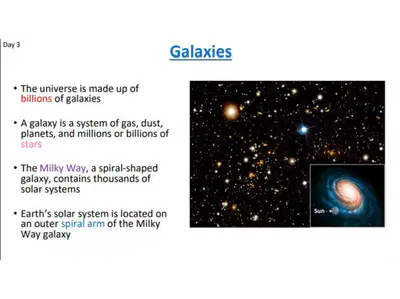
●The universe is made up of billions of
galaxies.
●A galaxy is a system of gas, dust,
planets, and millions or billions of
stars.
●The Milky Way, a spiral-shaped galaxy,
contains thousands of solar systems.
●Earth’s Solar System is located on the
outer spiral arm of the Milky Way
galaxy.
Galaxies
77
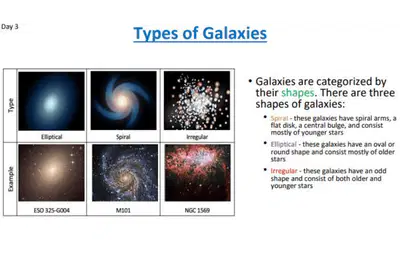
Different types of galaxies
Galaxies are categorized by their
shapes. There are three shapes of
galaxies:
●Spiral- these galaxies have spiral
arms, a flat disk, a central bulge,
and consist mostly of younger
stars.
●Elliptical- these galaxies have an
oval or round shape and consist
mostly of older stars.
●Irregular- These galaxies have an
odd shape and consist of both
older and younger stars.
78
79
Multiple Choice
The age of the universe is probably close to___________________
14 billion years
4 ½ billion years
15 million years
30 billion years
80
Multiple Choice
Which theory is based on the idea that the universe began from the rapid inflation of space from a a single point or singularity?
Steady State
Big Bang
Oscillating
External Inflation
81
Multiple Choice
A random scattered type of galaxy that does not form a distinct shape or pattern.
irregular galaxy
spiral galaxy
elliptical galaxy
random galaxy
82
Multiple Choice
What is the big bang theory?
A theory that states that the universe started in a large mass and then imploded to form everything.
A theory that states that the universe was there, will be and is there. Is homogeneous and isotropic.
A theory that states that the universe is slowly coming back to a center.
A theory that states that the universe started in a small mass and then expanded, the expansion cooled down the temperature and that resulted in the formation of matter, energy, space and time.
83
Multiple Choice
A flat, disk-shaped galaxy with a central bulge and winding "arms" that extend outward.
irregular galaxy
spiral galaxy
elliptical galaxy
random galaxy
84
Multiple Choice
All of space and everything in it.
planet
solar system
galaxy
universe
85
Multiple Choice
The most abundant type of galaxy that has a smooth circular or oval shape.
irregular galaxy
spiral galaxy
elliptical galaxy
random galaxy
86
Multiple Choice
A light year is the measurement of ________ light travels in one year.
time
distance
87
Multiple Choice
The milky way is the ______ galaxy in which we live in.
irregular
spiral
elliptical
88
Multiple Choice
Identify the galaxy in the image.
irregular
spiral
elliptical
none listed
89
Multiple Choice
Identify the galaxy in the image.
irregular
spiral
elliptical
none listed
90
Multiple Choice
Identify the galaxy in the image.
irregular
spiral
elliptical
none listed
UNIT 1: UNDERSTANDING LIVING ORGANISM
By Melissa Chasiluisa
Show answer
Auto Play
Slide 1 / 90
SLIDE

Similar Resources on Wayground
87 questions
8.11A,B,C
Presentation
•
8th Grade
84 questions
Chapter 8 Advanced Theories of Covalent Bonding
Presentation
•
University
82 questions
M11 - Energia cinética e energia potencial
Presentation
•
9th Grade
87 questions
Görög dráma: Szophoklész:Antigoné
Presentation
•
9th Grade
82 questions
Cell Transport EOC Review Lesson
Presentation
•
9th - 10th Grade
85 questions
Lesson: Simple Machines and MA
Presentation
•
9th Grade
87 questions
iCEV Equine 2 - Halter Lesson
Presentation
•
9th Grade
Popular Resources on Wayground
11 questions
Hallway & Bathroom Expectations
Quiz
•
6th - 8th Grade
10 questions
HCS SCI 03 Summer School Assessment 2
Quiz
•
3rd Grade
11 questions
Home Scope
Quiz
•
7th - 8th Grade
12 questions
2026 TAP Technology in the Classroom
Presentation
•
Professional Development
15 questions
HCS SCI 05 Summer School Assessment 2 Review
Quiz
•
5th Grade
15 questions
HCS SCI 04 Summer School Review 2
Quiz
•
4th Grade
59 questions
Geometry Unit 3 Review
Quiz
•
9th - 12th Grade
14 questions
FAST ELA READING SMAPLE TEST MATERIALS
Passage
•
3rd Grade