

4.1.1 How Stars Form

Presentation
•
Other
•
11th Grade
•
Practice Problem
•
Hard

Caitlin Ford
Used 4+ times
FREE Resource
13 Slides • 5 Questions
1
4.1.1
By Caitlin Ford
2
Objectives
- explain how protostars form from nebulae
- explain how a protostar evolves into a star
- identify the different properties of a star
3

4
Nebulae
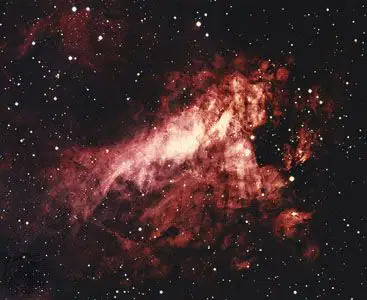
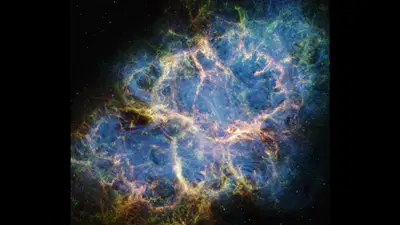
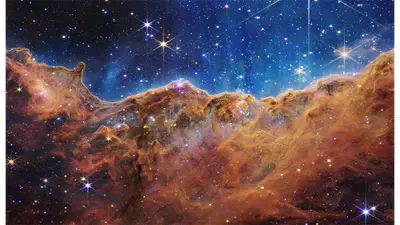
A Nebula is a vast region of gas and dust.
They are enormous, with a single cloud weighing hundreds of thousands of times more than the Sun.
They can be the size of a solar system. Or bigger.
When particles pile up in one area of the nebula, gravity causes them to collapse.
5
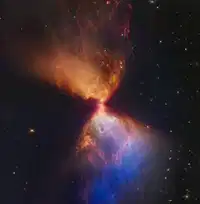
The Collapsing Nebula
Nebula are cold, but when gas and dust clump, they warm up.
When the collapsing region of the nebula becomes 10,000AUs in diameter, it is called a pre-stellar core.
In 50,000 years, it shrinks to 1/10 the size.
As it shrinks, it starts to spin. It becomes a flat disk. Material shoots from the top and bottom. The pre-stellar core becomes a protostar.
6
Multiple Choice
Which force is primarily responsible for causing particles in a nebula to form clumps?
gravitational force
nuclear force
magnetic force
frictional force
7
A Star Forms
A protostar will continue to gather material, growing larger and hotter.
If it gets hot enough for nuclear fusion, it becomes a main-sequence star.
If fusion doesn't start, it becomes a failed star called a brown dwarf.
A star is considered stable when its gravity balances internal core pressure.

8
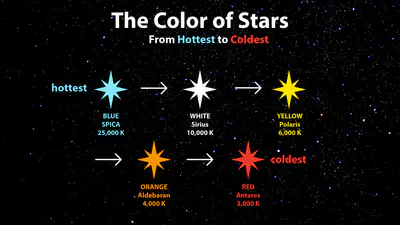
Wein's Law
The wavelength, or color, of light emitted by an object is determined by its temperature.
The light will be bluer if the object is extremely hot. The light will be redder if the object is cooler.
This is Wein's Law!
9
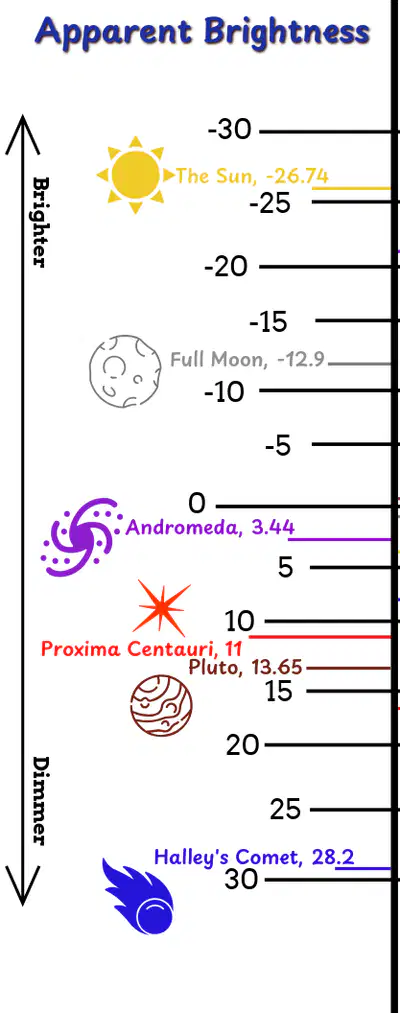
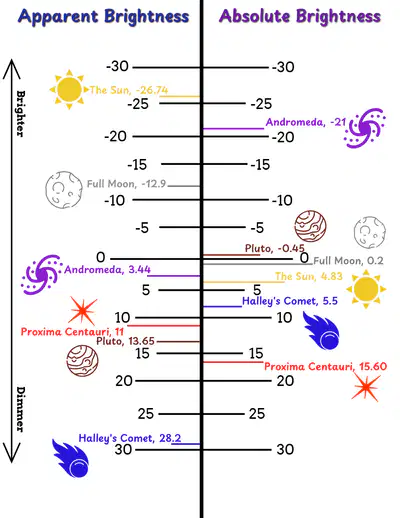
Apparent Brightness
Apparent Brightness - how bright an object appears from Earth
A negative number means brighter. A positive number means dimmer. This number represents the object's magnitude.
10
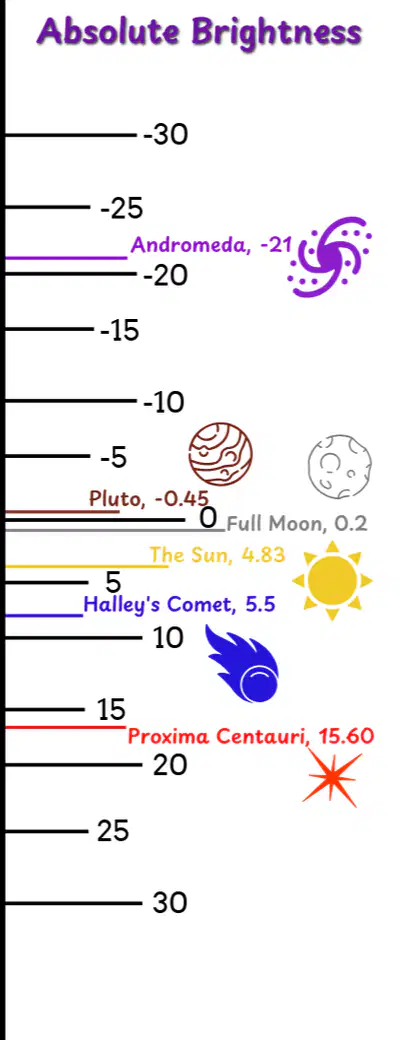
Abolute Brightness
Imagine placing ALL the stars at the same distance from Earth. Which one is the brightest now?
This is absolute brightness, a measure of the true brightness of a star.
The Sun is the brightest object in our sky, but if put at the same distance as every other star, it isn't that bright.
11
12
Hotspot
Which star is the hottest?
13
Luminosity
Luminosity - a measure of the total amount of energy radiated by a star or other celestial object each second
High luminosity stars emit a lot of energy, low luminosity stars emit less energy.
This depends on size and temperature of a star.
14
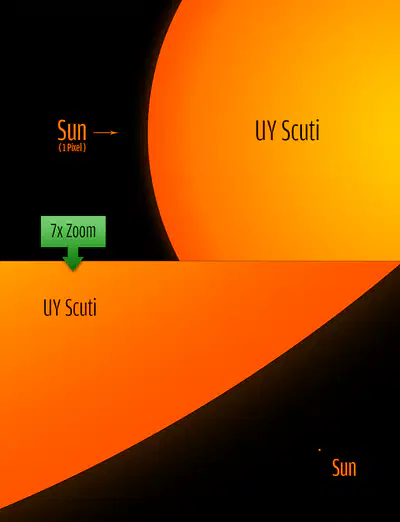
Star Size and Lifespan
Larger stars have shorter lifespans because they burn through their nuclear fuel faster, due to their higher internal temperatures and pressures.
Larger stars have more gravity and hotter cores than smaller stars.
15
Dropdown
16
Hotspot
Which of these objects is the brightest from an observer on Earth's surface?
17
Drag and Drop
If a star has less mass, it will have
18
Great Job!
Today, you learned:
- how protostars form in nebulae
- how a protostar becomes a star
- about the different properties of a star
4.1.1
By Caitlin Ford
Show answer
Auto Play
Slide 1 / 18
SLIDE
Similar Resources on Wayground

13 questions
Health professionals as health educators
Presentation
•
11th Grade
13 questions
Hortatory Exposition Text Bahasa Inggris Peminatan
Presentation
•
11th Grade
12 questions
Levels of Organization
Presentation
•
12th Grade
15 questions
Nature of Inquiry and Research
Presentation
•
11th Grade
11 questions
TIPOS DE TEXTOS
Presentation
•
10th Grade
13 questions
¿Cómo hacer un ensayo?
Presentation
•
11th Grade
14 questions
SUDUT PUSAT DAN SUDUT KELILING
Presentation
•
11th Grade
13 questions
1SpéSES Etude de document Socialisation Sujet 2
Presentation
•
11th Grade
Popular Resources on Wayground
10 questions
Safety Day 2026 – Student Review

Quiz
•
9th Grade
21 questions
Continents and Oceans
Quiz
•
6th Grade
20 questions
Parts of Speech
Quiz
•
5th Grade
16 questions
Subject & Predicate
Quiz
•
5th Grade
25 questions
Multiplication Facts
Quiz
•
5th Grade
12 questions
Map Skills
Quiz
•
3rd Grade
22 questions
Continents and Oceans
Quiz
•
5th Grade
15 questions
Rounding Decimals
Quiz
•
5th Grade
Discover more resources for Other
26 questions
SLIME!!!!!
Quiz
•
KG - 12th Grade
20 questions
Cell Transport
Quiz
•
9th - 12th Grade
20 questions
Budgeting
Quiz
•
9th - 12th Grade
20 questions
Investing
Quiz
•
9th - 12th Grade
8 questions
DNA vs. RNA
Presentation
•
9th - 12th Grade
12 questions
Identify Rigid Transformations
Quiz
•
8th - 12th Grade
10 questions
Complementary, Supplementary, Vertical, and Linear Pairs
Quiz
•
9th - 12th Grade
20 questions
Managing Credit
Quiz
•
9th - 12th Grade