8.2.3.5-Motors vs. Generators
Presentation
•
Science
•
6th - 8th Grade
•
Easy
+26
Standards-aligned
Jessica Freeman
Used 1+ times
FREE Resource
42 Slides • 36 Questions
1
By Jessica Freeman
2
By Rochelle Hogan
Electromagnets - Things we already know...
In Summary: When we change the distance we change the energy between magnets in the magnetic field.
~The bigger the magnet, the stronger the magnetic field around it.
~The shorter the distance between the magnets, the stronger the magnetic field around it.
~The more coils in an electromagnet, the stronger the magnetic field.
~The thicker the coils, the stronger the magnetic field around it.
3
Multiple Choice
Electromagnet
Generator
Electron Magnet
Motor
4
Multiple Choice
Which device converts electrical energy to mechanical energy (could be used to turn in a fan, for instance)?
Generator
Transformer
Motor
5
Generators like the one in the image are used in cars
alternators
provide electrical energy to operate the lights and other things in the car
spark plugs
use electrical energy to ignite the fuel in the cylinders of the engine
Uses for generators...
Once the engine is actually running it provides the mechanical energy to turn the coil in the alternator
6
7
By Rochelle Hogan
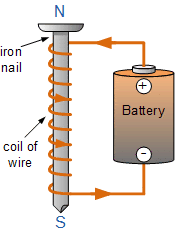
An electromagnet is a type of magnet in which the magnetic field is produced by an electric current. Electromagnets usually consist of wire wound into a coil. The current comes from a battery. The magnetic field disappears when the current is turned off. The strength of an electromagnet changes depending on the size and amount of the attached battery/batteries. A higher voltage battery/batteries will produce a larger current through the same wire. Also, the more batteries, the more power.
8
How can an Electric Current be Produced in a Conductor?
In 1831, scientists discovered that moving a conductor in a magnetic field could induce an electrical current
there is no contact between the wire and the magnets, but the magnetic field starts the current
Electromagnet Induction: generating electric current from the movement of a conductor through a magnetic field
Creates an Inducted Current
9
Induction of Electric Current
Two scientists discovered the process of electric induction
Micheal Faraday and Joseph Henry
Two possible setups can cause electromagnet induction
the Magnet remains still while the conductor moves through the magnetic field
The Conductor remains still while a magnet moves through it
CHANGING the direction of movement CHANGES the direction of the current
10
Multiple Choice
Which fundamental forces govern the behavior of matter and energy?
Gravity and Magnetism
Electricity and Magnetism
Heat and Light
Sound and Friction
11
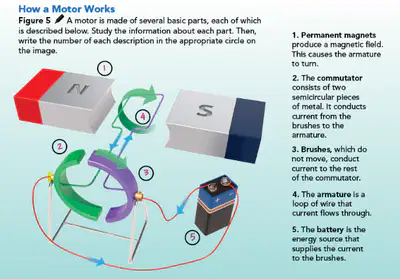
Electrical energy is used to create a current in an armature (the coil)
The armature is in a magnetic field and has its own magnetic field due to the current flowing through it
The armature turns so that its magnetic field lines up with the magnetic field of the magnet
12
13
A moving magnetic field causes a voltage to be created/induced
If there is a complete circuit, this voltage will result in a current flowing
Electromagnetic Induction
14
15
Using a stronger/bigger magnet
Moving the magnetic field faster
More windings/loops in the coil
Induced voltage can be increased by...
16
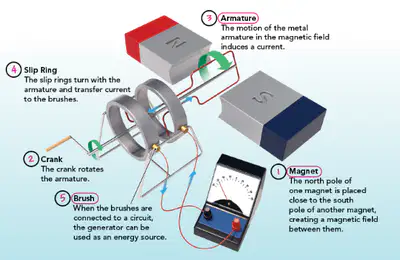
Mechanical energy is used to turn a rotor attached to an armature (coil)
The armature is in a magnetic field
As the wire is turned, it experiences a changing magnetic field
This results in a voltage and current
17
Input: Electrical energy (battery)
Output: Mechanical energy (coil turns)
Motor parts: battery
Motors only
Input: Mechanical energy (turn the coil)
Output: Electrical energy (voltage and current)
Motor parts: device to be powered
Generators only
Parts:
Magnet
Armature
Both
18
Multiple Choice
chemical; mechanical
mechanical; electrical
electrical; mechanical
potential; kinetic
19
Multiple Choice
Electromagnet
Generator
Electron Magnet
Motor
20
Multiple Choice
electrical; mechanical
mechanical; electrical
chemical; potential
mechanical; kinetic
21
Multiple Choice
What two forces are required for generators and electric motors to work?
magnetism and thermal
electricity and thermal
electricity and magnetism
magnetism and radiant
22
Multiple Choice
23
Multiple Choice
Increase the number of coils
Decrease the number of coils
Flip the magnet around
Nothing, the amount of electricity cannot be increased
24
Multiple Select
Select all of the materials that make good insulators.
rubber
steel
copper
wood
plastic
25
Match
If I build electromagnets using nails made of different metals, then I think the copper nail will pick up the most paperclips. Match the experimental variables.
independent variable
dependent variable
constant
nails of different metals
number of paperclips picked up
battery
nails of different metals
number of paperclips picked up
battery
26
Dropdown
27
Reorder
If I build electromagnets using nails made of different metals, then I think the copper nail will pick up the most paperclips.
Put my investigation steps in order.
Using nails made of different metals, wrap each nail with 25 coils of the same wire.
Connect the end of the wire to a battery.
Hold the electromagnet over a pile of paperclips.
Count the number paperclips picked up.
Repeat 3 times with each nail.
28
Multiple Choice
What two forces are required for generators and electric motors to work?
magnetism and thermal
electricity and magnetism
electricity and thermal
magnetism and radiant
29
Multiple Choice
What did Faraday discover about induction?
That a changing magnetic field induces a current in a conductor.
That electricity and magnetism were related when he noticed a current carrying conductor deflected the compass of a needle.
That the Earth's magnetosphere deflected from the Sun known as solar winds.
That alternating current could be manipulated with transformers.
30
Multiple Choice
Motors are devices that convert ____ energy into ____ energy.
electrical; mechanical
chemical; mechanical
mechanical; electrical
potential; kinetic
31
Multiple Select
Choose all of the motors.
32
Multiple Choice
Generators are devices that convert _____ energy into _____ energy.
mechanical; electrical
potential; kinetic
chemical; mechanical
electrical; mechanical
33
Multiple Select
Choose all of the generators.
34
Multiple Choice
A transformer actually transforms
generators into motors
magnetic field lines
voltage
35
Multiple Select
Choose all of the transformers.
36
Multiple Choice
Which best describes how a motor works?
When a fan blows on a wire, it causes it to spin, creating a force.
When a fan blows on a wire, it causes it to spin, creating an electrical current.
When a wire that carries electrical current is placed in zero gravity, the wire experiences a force.
When a wire that carries electrical current is placed in a magnetic field, the wire experiences a force.
37
Multiple Choice
What is produced by moving a permanent magnet through a coil of copper wire?
light
electricity
sound
electromagnet
38
Multiple Choice
In an electric motor, the energy transformation begins as ---
electrical and becomes chemical
mechanical becomes electrical
electrical and becomes mechanical
mechanical and becomes chemical
39
Multiple Choice
What energy do you put IN to a generator?
Thermal
Mechanical
Electrical
Potential
40
Multiple Choice
What type of energy comes OUT of a generator?
Electrical
Potential
Mechanical
Thermal
41
Multiple Choice
Generators are devices that convert _____ energy into _____ energy.
mechanical; electrical
potential; kinetic
chemical; mechanical
electrical; mechanical
42
43
Multiple Choice
What kind of motor does the trolley use?
Magnetic motor
44
Draw
Circle what things are different in these two models.
45
46
47
48
49
50
51
Drag and Drop
52
Open Ended
How do you think an electric motor works?
53
54
55
Multiple Choice
What are the components of an electric motor?
56
Drag and Drop
57
58
59
60
61
62
63
64
65
66
67
68
Multiple Choice
What is a generator?
a device the creates a magnetic field
a device the turns mechanical energy into electrical energy
a device that uses electricity
69
70
71
72
73
Multiple Choice
What is a transformer?
a device that turns energy into magnetism
a device that adjusts the energy by increasing or decreasing the voltage
a device that has mechanical energy
74
Multiple Select
What are the two types of electric transformers?
Step-up transformer
step-down transformer
75
spin
opposite
76
77
78
By Jessica Freeman
Show answer
Auto Play
Slide 1 / 78
SLIDE

Similar Resources on Wayground
71 questions
Benchmark Review Part 1
Presentation
•
KG
74 questions
Eukaryotic vs Prokaryotic
Presentation
•
6th - 8th Grade
71 questions
Abiotic and Biotic Factors
Presentation
•
6th - 8th Grade
71 questions
Characteristics of Life: Abiotic vs Biotic Factors
Presentation
•
6th - 8th Grade
71 questions
Abiotic vs Biotic Lesson
Presentation
•
6th - 8th Grade
67 questions
Physical/Chemical Changes
Presentation
•
6th - 8th Grade
70 questions
Chemical Reactions
Presentation
•
8th Grade
77 questions
ESB Domain 1 Review
Presentation
•
6th - 8th Grade
Popular Resources on Wayground
10 questions
Safety Day 2026 – Student Review
Quiz
•
9th Grade
21 questions
Continents and Oceans
Quiz
•
6th Grade
20 questions
Parts of Speech
Quiz
•
5th Grade
16 questions
Subject & Predicate
Quiz
•
5th Grade
25 questions
Multiplication Facts
Quiz
•
5th Grade
12 questions
Map Skills
Quiz
•
3rd Grade
22 questions
Continents and Oceans
Quiz
•
5th Grade
15 questions
Rounding Decimals
Quiz
•
5th Grade
Discover more resources for Science
20 questions
Newton's Laws of Motion
Quiz
•
8th Grade
20 questions
Elements, compounds, and mixtures
Quiz
•
6th Grade
10 questions
6.6D - Relative Density Review
Quiz
•
6th Grade
15 questions
potential and kinetic energy
Quiz
•
8th Grade
21 questions
Newton's Laws of Motion
Quiz
•
8th Grade
20 questions
Elements, Compounds and Mixtures
Quiz
•
8th Grade
10 questions
Exploring Chemical and Physical Changes
Interactive video
•
6th - 10th Grade
20 questions
CONDUCTION,CONVECTION AND RADIATION
Quiz
•
6th Grade