

L1 Reading Ten Days in a Mad-House- Close Read

Presentation
•
English
•
6th - 8th Grade
•
Practice Problem
•
Easy

Sherif Abdelbaky
Used 7+ times
FREE Resource
7 Slides • 6 Questions
1

2

3
Multiple Choice
Engage
When someone is misunderstood, it usually means:
A. People agree with everything they say.
B. People judge them without really knowing the truth.
C. They always explain themselves clearly.
D. Everyone likes them.
4

5
Multiple Choice
Explore
Which idea from the excerpt most strongly supports the theme of misunderstanding or mistreatment?
A. Bly is placed among women who are actually insane, even though she cannot prove she is sane.
B. The asylum is a place where daily life continues “night and day.”
C. Bly notices that she will be the companions of the other women for a long time.
6

7
Multiple Choice
Explain
Why is it important to use textual evidence when you discuss a text?
A. It proves your ideas with exact words from the text.
B. It makes your opinion sound nicer.
C. It helps you write more words to fill the page.
D. It shows you memorized the story.
8

9
Multiple Choice
Explain
Why is the phrase “a human rat-trap” powerful textual evidence?
A. It shows the asylum is a comfortable place.
B. It describes the rats that lived on the island.
C. It compares the asylum to something that traps people with no escape.
10

11
Poll
Elaborate
Which statement best summarizes the theme of Ten Days in a Mad-House?
A. Journalists should always tell the truth.
B. Mistreatment happens when innocent people are judged without evidence.
C. People should never visit an asylum.
12
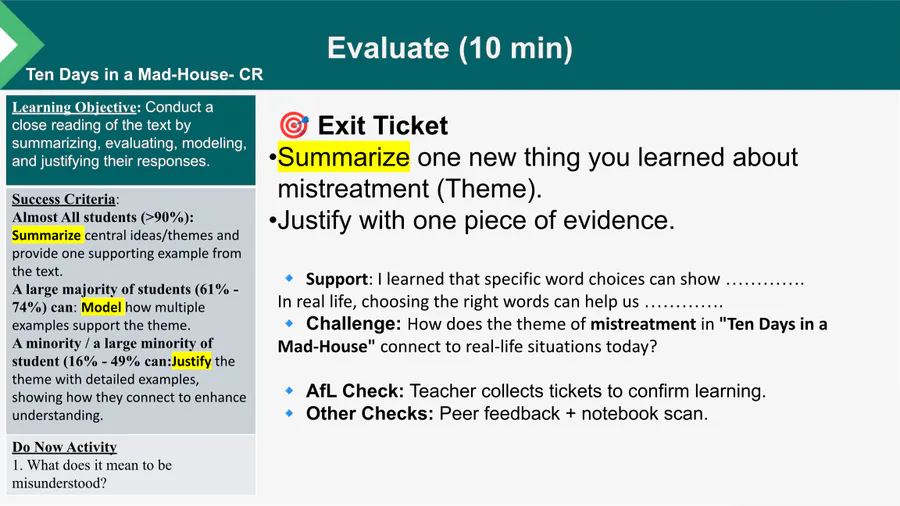
13
Multiple Choice
Evaluate
Why should you include exact quotations or details from a story when you explain your ideas?
A. They make your answer longer even if it is not clear.
B. They make the story easier to rewrite in your own words.
C. They help you remember every character’s name.
D. They show where your ideas come from and give proof for your explanation.
Show answer
Auto Play
Slide 1 / 13
SLIDE
Similar Resources on Wayground

10 questions
Narrative Nonfiction
Presentation
•
6th - 8th Grade
9 questions
Dependent clauses
Presentation
•
6th - 8th Grade
10 questions
Revision for Vocab/Spelling Assessment 1 Term 2
Presentation
•
7th Grade
10 questions
Verbs
Presentation
•
7th Grade
9 questions
Research & Citing Sources
Presentation
•
6th - 8th Grade
11 questions
Foreshadow and Suspense
Presentation
•
6th - 8th Grade
12 questions
The Dreaded Comma Splice
Presentation
•
6th - 8th Grade
12 questions
Subject and Object Pronouns
Presentation
•
6th - 8th Grade
Popular Resources on Wayground
6 questions
PRIDE Always and Everywhere
Presentation
•
12th Grade
20 questions
Lab Safety Quiz

Quiz
•
6th Grade
26 questions
KOR Review Kahoot Questions
Quiz
•
8th Grade
21 questions
Continents and Oceans
Quiz
•
6th Grade
12 questions
Unit Zero lesson 2 cafeteria
Presentation
•
9th - 12th Grade
20 questions
Parts of Speech
Quiz
•
5th Grade
10 questions
Riddles Riddles fun Riddles
Quiz
•
6th - 12th Grade
16 questions
Subject & Predicate
Quiz
•
5th Grade
Discover more resources for English
20 questions
Context Clues
Quiz
•
6th Grade
20 questions
Types of sentences
Quiz
•
6th Grade
8 questions
Main Idea & Key Details
Quiz
•
3rd - 6th Grade
20 questions
Figurative Language Review
Quiz
•
6th Grade
20 questions
Figurative Language Review
Quiz
•
8th Grade
12 questions
Plot Elements
Quiz
•
6th Grade
20 questions
Homophones and Homonyms
Quiz
•
6th Grade
25 questions
Making Inferences
Quiz
•
6th - 8th Grade