
Q1W8D1 Lesson

Presentation
•
World Languages
•
7th Grade
•
Practice Problem
•
Hard

ROBERTO CUELLO
FREE Resource
9 Slides • 11 Questions
1

2
Multiple Choice
Why is it important to learn how to use -er and -ir verbs in Spanish when talking about school and afternoon activities?
Because it helps describe daily routines accurately
Because it is required for all Spanish exams
Because -er and -ir verbs are easier than -ar verbs
Because it is only used in written Spanish
3

4
Open Ended
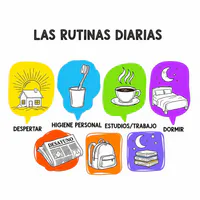
How does your morning routine compare to the typical student's routine described in the image?
5

6
Multiple Choice
Which of the following activities is NOT mentioned as part of the student's morning routine before leaving the house?
Brushing teeth
Packing backpack
Eating breakfast
Playing video games
7

8
Open Ended
List two activities the student does after school according to the routine described.
9

10
Fill in the Blanks
Fill in the blank: The student eats lunch in the cafeteria at
Type answer...
11
Multiple Choice
Which of the following actions does the student do during school hours?
Takes notes in the notebook
Plays video games
Watches television
Goes to bed
12

13
Multiple Choice
What is the infinitive form of the verb 'camino' as used in the student's daily routine?
caminar
camino
camina
camine
14

15
Open Ended
Explain the difference in conjugation between -ar, -er, and -ir verbs for the pronouns 'yo' and 'tú' in Spanish, using examples from the student's daily routine.
16

17

18
Open Ended
Reflect on your daily routine: Which new Spanish vocabulary words from today's lesson will help you describe your school or afternoon activities?
19
Multiple Choice
What are some activities you do at school or in the afternoon that use -er or -ir verbs in Spanish?
leer (to read), comer (to eat), escribir (to write)
cantar (to sing), bailar (to dance), saltar (to jump)
jugar (to play), escuchar (to listen), mirar (to watch)
hablar (to talk), caminar (to walk), estudiar (to study)
20
Multiple Choice
What is the main purpose of the 'Interview a Peer' activity described in the lesson?
To practice writing essays in Spanish
To practice interpersonal communication and listening skills using 'yo' and 'tú' forms
To memorize Spanish vocabulary lists
To learn about Spanish-speaking countries' geography
Show answer
Auto Play
Slide 1 / 20
SLIDE
Similar Resources on Wayground

15 questions
Making Inferences on Random Samples
Presentation
•
7th Grade
15 questions
There is, There are
Presentation
•
7th Grade
15 questions
War of 1812
Presentation
•
7th Grade
15 questions
Tener lesson
Presentation
•
8th Grade
15 questions
Japan Geography
Presentation
•
7th Grade
15 questions
Theme Review
Presentation
•
7th Grade
15 questions
Bacteria
Presentation
•
7th Grade
15 questions
Biased VS Unbiased and Sampling Methods
Presentation
•
7th Grade
Popular Resources on Wayground
10 questions
How much do you know about our Portrait of an Eagle?

Quiz
•
10th Grade
10 questions
Fast Food Slogans
Quiz
•
6th - 8th Grade
21 questions
Continents and Oceans
Quiz
•
6th Grade
20 questions
Parts of Speech
Quiz
•
5th Grade
16 questions
Subject & Predicate
Quiz
•
5th Grade
25 questions
Multiplication Facts
Quiz
•
5th Grade
12 questions
Map Skills
Quiz
•
3rd Grade
22 questions
Continents and Oceans
Quiz
•
5th Grade
Discover more resources for World Languages
21 questions
Definite and Indefinite Articles in Spanish
Quiz
•
7th - 8th Grade
25 questions
Spanish Cognates
Quiz
•
7th - 12th Grade
14 questions
Los Dias de la Semana
Quiz
•
6th - 8th Grade
10 questions
Exploring Hispanic Heritage Month

Interactive video
•
6th - 10th Grade
20 questions
Ser vs Estar (DOCTOR/PLACE)
Quiz
•
6th - 8th Grade
20 questions
Spanish Speaking Countries Trivia
Quiz
•
7th Grade
11 questions
Telling time in Spanish
Quiz
•
7th - 12th Grade
18 questions
French Greetings
Quiz
•
7th Grade