

The Skeletal System

Presentation
•
Biology
•
11th Grade
•
Practice Problem
•
Hard

Amy Kirincich
FREE Resource
28 Slides • 16 Questions
1

2
Multiple Choice
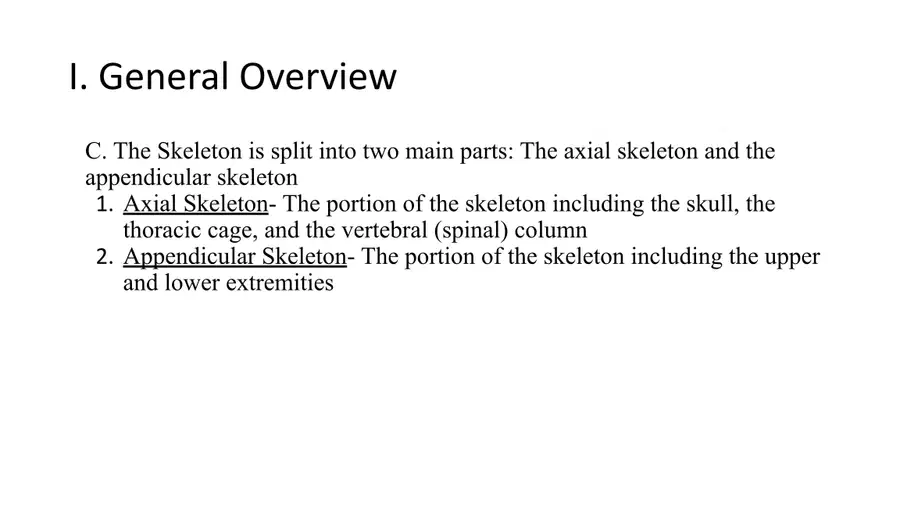
Why is the skeletal system important for the human body?
It helps in digestion
It supports and protects the body, enables movement, stores minerals, and makes blood
It controls the nervous system
It produces hormones
3
4

5
Multiple Choice
Which type of bone cell is responsible for building new bone tissue?
Osteoblasts
Osteoclasts
Osteocytes
Chondrocytes
6

7

8
Multiple Select
Which of the following are correct descriptions of bone shapes and their typical locations?
Long bones are found in the leg, arm, and fingers.
Short bones are found in the wrist, ankle, and knee cap.
Flat bones are found in the head, ribs, and hip.
Irregular bones are found in the spine and face.
9

10
Multiple Choice
What is the function of articular cartilage in a long bone?
Protects the bone from wearing down as it hits other bones
Stores fat
Produces blood cells
Provides structural support
11

12

13
Multiple Choice
Which bone marking is described as a large rounded projection that provides structural support to form joints with other bones?
Condyle
Foramen
Fossa
Sinus
14

15
Multiple Choice
Which bone marking is described as a large prominence on a bone for the attachment of muscles?
Trochanter
Tubercles
Process
Condyle
16

17
Multiple Select
Which of the following bones are part of the cranium?
Occipital
Parietal
Mandible
Temporal
18

19

20
Multiple Choice
Which facial bone forms the upper jaw?
Maxilla
Mandible
Zygomatic
Lacrimal
21

22
23

24
Multiple Choice
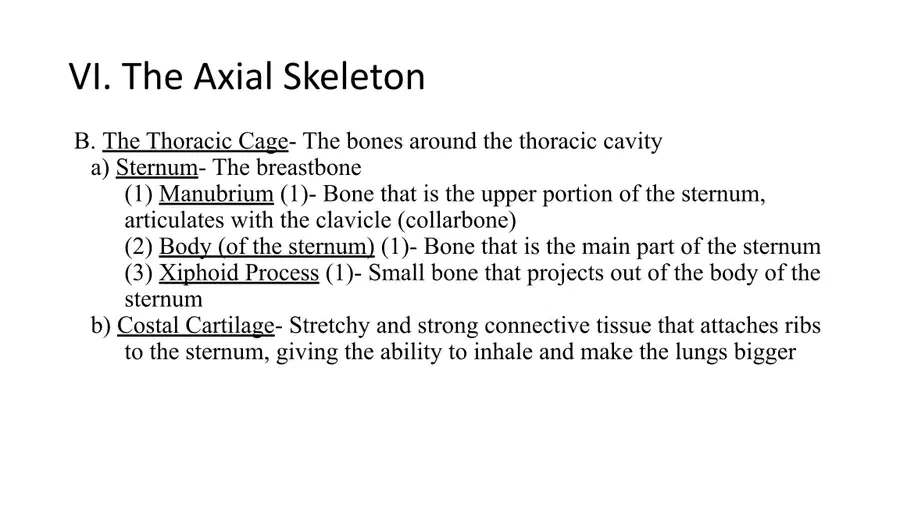
Which type of ribs are not attached to the sternum at all?
True ribs
False ribs
Floating ribs
Costal ribs
25

26

27

28
Multiple Choice
Which bone is known as the collarbone?
Scapula
Clavicle
Humerus
Radius
29

30

31

32
Multiple Choice
Which bone forms the front part of your pelvic girdle?
Ilium
Ischium
Pubis
Femur
33

34
Multiple Choice
Which bones make up the ankle region of the foot?
Tarsals
Metatarsals
Phalanges
Carpals
35
36
Multiple Select
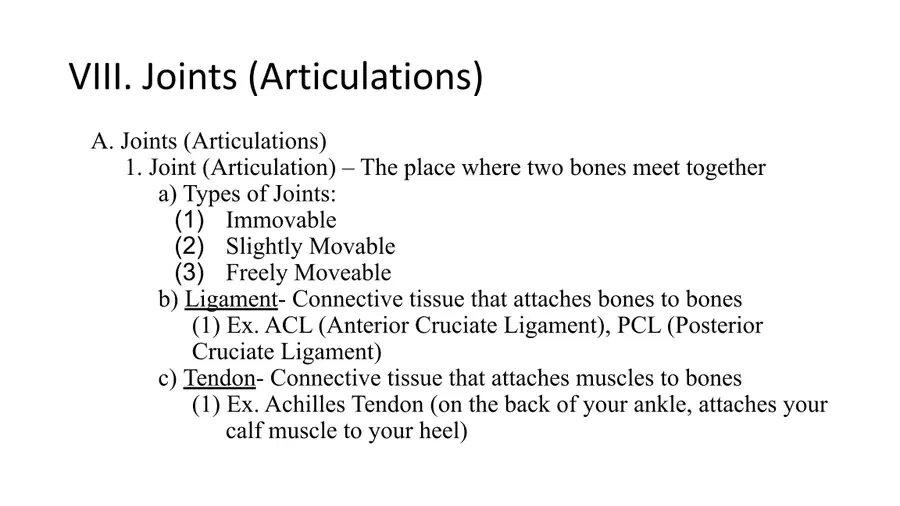
Which of the following are types of joints?
Immovable
Slightly Movable
Freely Moveable
Elastic
37

38

39

40
Multiple Select
Which of the following are examples of freely movable joints?
Gliding
Pivot
Sutures
Synchondroses
41

42
Multiple Choice
Which type of freely movable joint allows bones to move in a one directional open and closed motion, and what is an example of this joint?
Saddle joint; Metacarpals and carpals
Hinge joint; Elbow/ulna and humerus
Condylar joint; Metacarpals and phalanges
Ball and Socket joint; Shoulders and hips
43

44
Multiple Choice
What are the two main parts of the human skeleton, and what does each part include?
Axial skeleton (skull, thoracic cage, vertebral column) and appendicular skeleton (upper and lower extremities)
Cranial skeleton (skull, jaw) and postcranial skeleton (spine, limbs)
Central skeleton (spine, ribs) and peripheral skeleton (arms, legs)
Superior skeleton (head, arms) and inferior skeleton (legs, feet)
Show answer
Auto Play
Slide 1 / 44
SLIDE
Similar Resources on Wayground

38 questions
DNA and Genetics
Presentation
•
11th Grade
37 questions
Introduction to Earth Science
Presentation
•
11th Grade
41 questions
Energy flow in food chains
Presentation
•
11th Grade
38 questions
Exponential Functions
Presentation
•
11th Grade
43 questions
Viruses
Presentation
•
11th Grade
38 questions
Rhetorical Appeals and Strategies
Presentation
•
9th Grade
37 questions
Sistem Reproduksi
Presentation
•
11th Grade
40 questions
Mechanism of Opening and Closing of Stomata
Presentation
•
11th Grade
Popular Resources on Wayground
10 questions
Safety Day 2026 – Student Review

Quiz
•
9th Grade
21 questions
Continents and Oceans
Quiz
•
6th Grade
20 questions
Parts of Speech
Quiz
•
5th Grade
16 questions
Subject & Predicate
Quiz
•
5th Grade
25 questions
Multiplication Facts
Quiz
•
5th Grade
12 questions
Map Skills
Quiz
•
3rd Grade
22 questions
Continents and Oceans
Quiz
•
5th Grade
15 questions
Rounding Decimals
Quiz
•
5th Grade
Discover more resources for Biology
20 questions
Cell Transport
Quiz
•
9th - 12th Grade
8 questions
DNA vs. RNA
Presentation
•
9th - 12th Grade
16 questions
Epithelial tissues
Quiz
•
11th - 12th Grade
15 questions
DNA Structure and Replication
Quiz
•
9th - 12th Grade
20 questions
Ecological Succession Review
Quiz
•
9th - 12th Grade
22 questions
Photosynthesis and Cellular Respiration Review
Quiz
•
9th - 11th Grade
3 questions
Enzymes & Energy
Quiz
•
9th - 12th Grade
38 questions
Mitosis & Meiosis
Quiz
•
9th - 12th Grade