Search Header Logo
49a  and 49c - Partitioning leads to Conflict Remediation

49a and 49c - Partitioning leads to Conflict Remediation

Assessment

Presentation

Geography

7th Grade

Practice Problem

Easy

DOK Level 1: Recall

Standards-aligned

Created by

Hope Culpepper

Used 9+ times

FREE Resource

9 Slides • 38 Questions

1
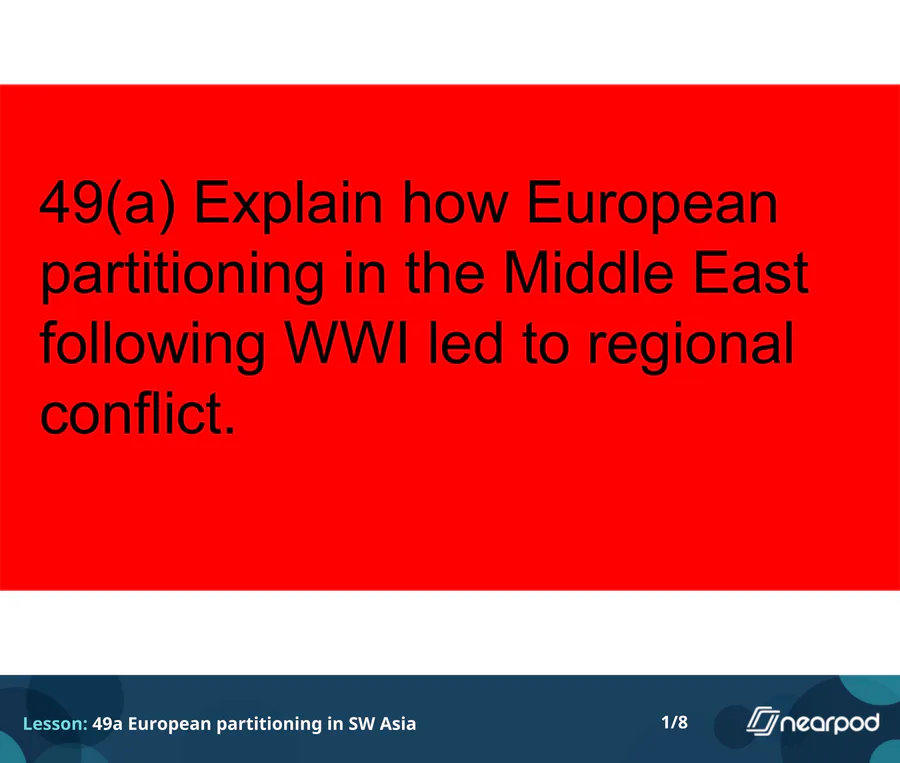
media

2

media

3

media

4

media

5

media

6

Multiple Choice

Question image

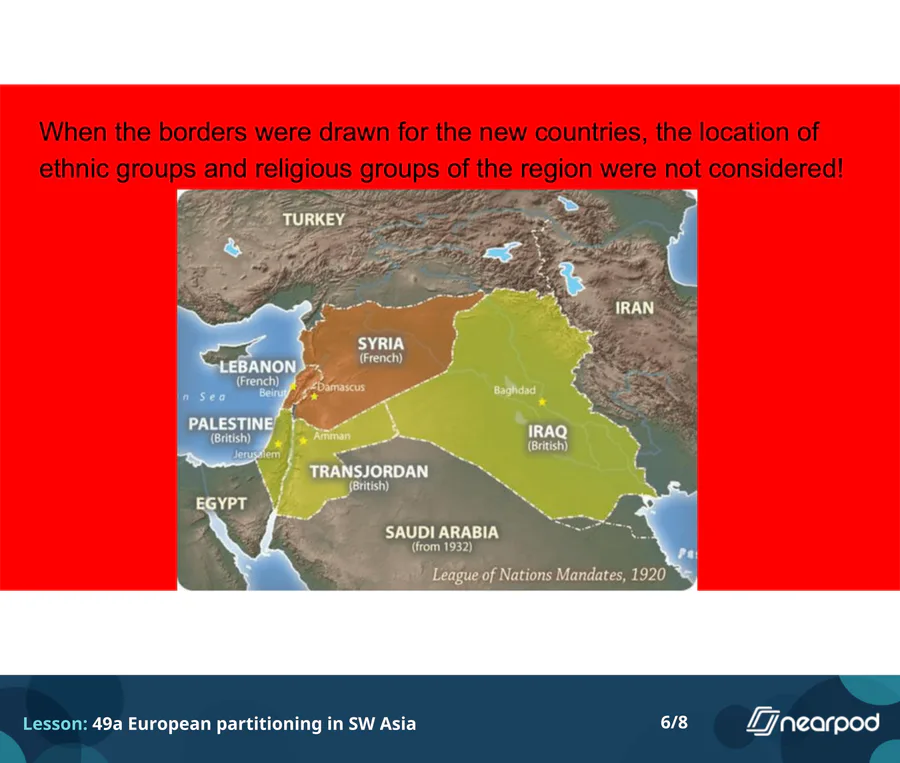
Europeans created artificial borders in the Middle East causing conflict between ethnic and religious groups. How were Europeans able to partition the land?

1

Europeans persecuted Jews through the Holocaust

2

Europeans won land from the Ottoman Empire after WWI

3

Jews were forced to leave by the Romans in the Diaspora

4

Immigrants moved to Palestine after WWII

7

Multiple Choice

Question image

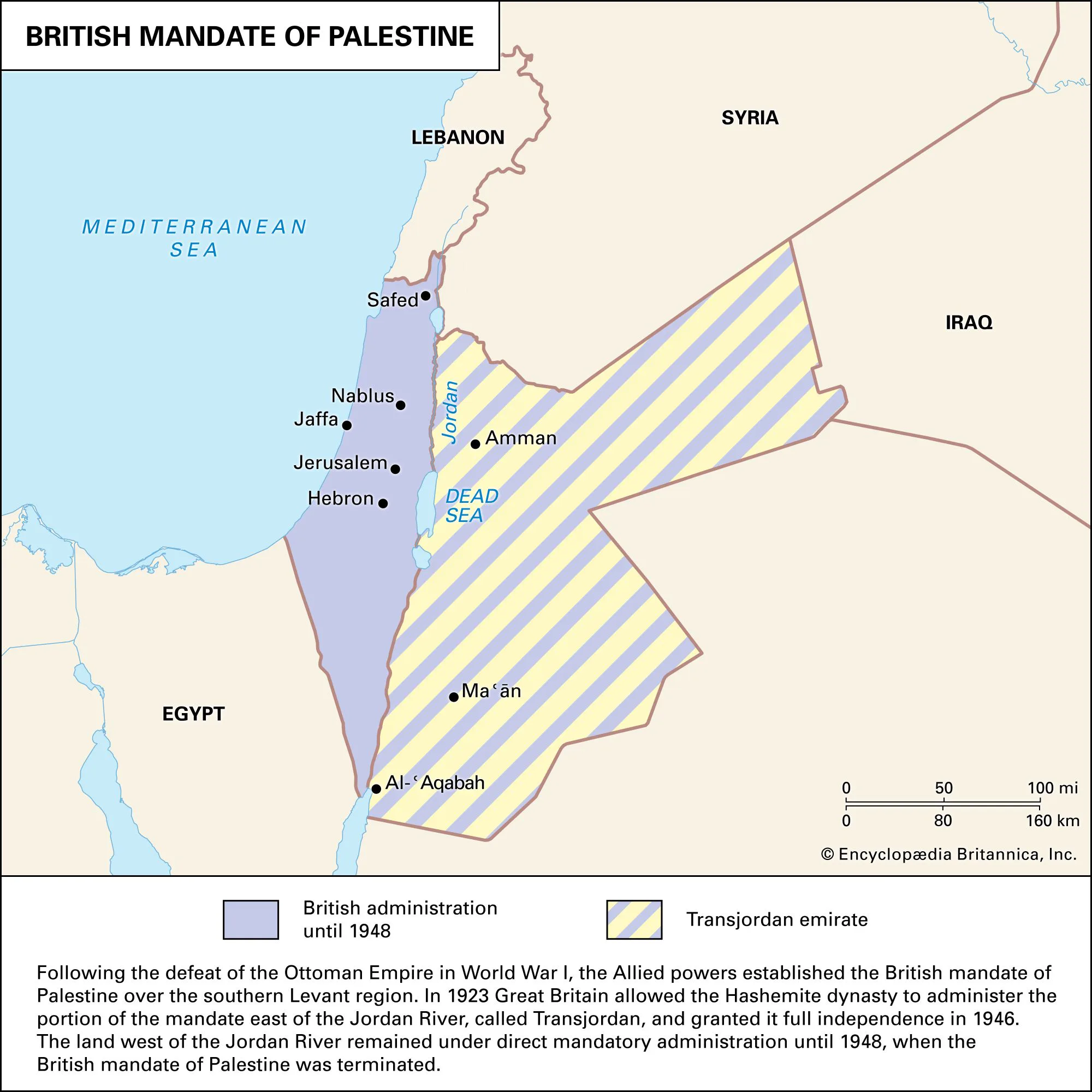
Who controlled the mandate of Palestine following the Ottoman Empire's collapse after World War I?

1

France

2

United States

3

Germany

4

Great Britain

8

Multiple Choice

Question image

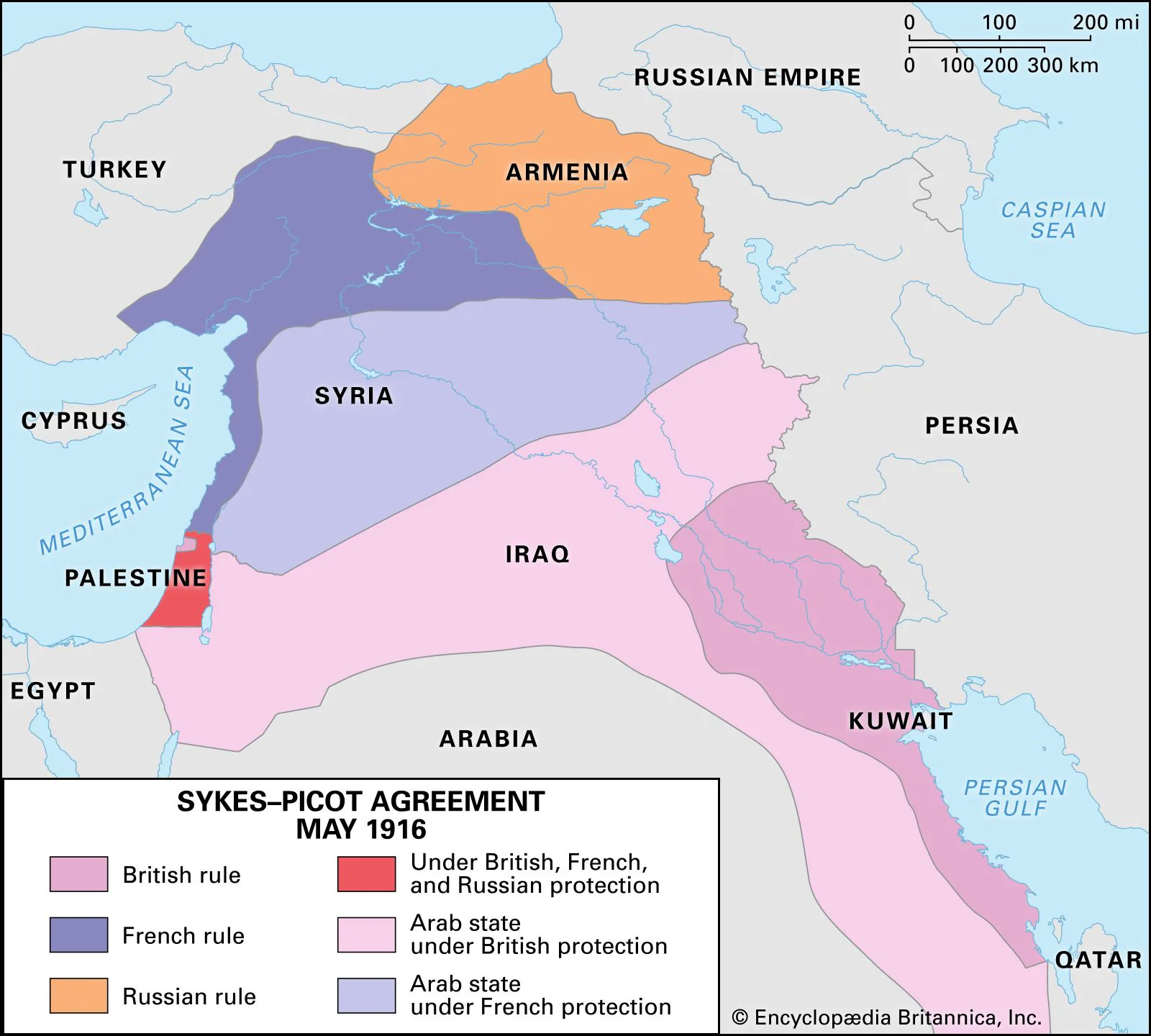
Why did the European Partitioning under the Sykes-Picot agreement cause conflict?

1

Other European nations were upset they did not acquire more territory.

2

The French disagreed with the British on which land to mandate.

3

Countries were allowed to maintain wealth of natural resources.

4

Europeans ignored historical and religious/ethnic borders.

9

Multiple Choice

Question image

Why were Arab leaders upset by the Skyes-Picot agreement?

1

They were denied true independence as promised.

2

They desired stronger mandates tying them to European rule.

3

They worried about their safety from terrorist militia.

4

They were granted self-rule and autonomous governing.

10

Multiple Choice

Question image

Which answer most accurately completes the following sentence: “In Southwest Asia (Middle East), land and religion are major sources of ________.”

1

aid

2

water

3

conflict

4

agreement

11

Multiple Choice

Question image

How did European involvement in Southwest Asia impact the region after the collapse of the Ottoman Empire?

1

Many Europeans immigrated to Southwest Asia.

2

Countries in Southwest Asia modeled their governments on European governments.

3

Political borders were decided by European powers without consideration of the political and historic connections in the region.

4

European powers presence in Southwest Asia established a long period of peace and improved relations with non-Muslim western nations.

12

Multiple Choice

Question image

After the breakup of the Ottoman Empire, European powers partitioned Southwest Asia (Middle East). What has been a result of the artificial boundaries they created?

1

regional peace

2

regional wealth

3

regional conflict

4

regional pollution

13

Multiple Choice

Question image

What led to the end of the Ottoman Empire at the close of World War I?

1

The Ottomans fought on the losing side of the war.

2

The Empire spent too much money on buildings and new roads and went bankrupt.

3

The people in the Empire were starving because a long drought had ruined agriculture.

4

The Ottoman government was overthrown by a revolt of factory workers who went unemployed when the war ended.

14

Multiple Select

Question image

Which of these describe the legacy of European control of the Middle East? (Choose all that are correct.)

1

Multiple ethnic and religious groups within in country boundaries

2

Political instability in countries where ethnic and religious groups compete for power

3

Trade agreements resulting in Middle Eastern nations supplying raw materials and European powers exporting final products

4

Peace and cooperation between members of religious and ethnic groups with in national borders

15

media

16

media

17

media

18

media

19

Multiple Choice

Question image

Sykes-Picot Agreement

1

A treaty that ended World War I

2

An agreement that divided the Ottoman Empire's territories in the Middle East between Britain and France

3

A peace agreement between Israel and Palestine

4

A coalition formed to fight terrorism

20

Multiple Choice

Question image

ethnic conflict

1

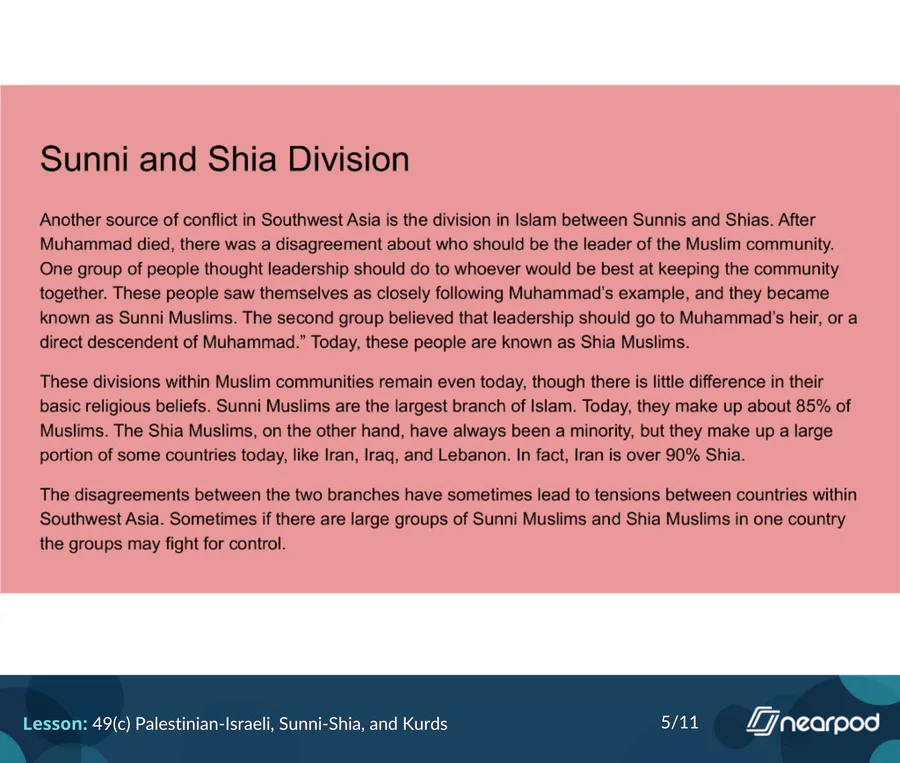
disagreement over the rightful successor to the Prophet Muhammad

2

loyalty and devotion to a country (nation)

3

an alliance of groups or countries that work together to achieve a common goal

4

when different ethnic groups compete for the same goal—notably power, access to resources, or land

21

Multiple Choice

Question image

sectarian conflict

1

conflict based on perceived differences between divisions or sects within a religion

2

loyalty and devotion to a country (nation)

3

an alliance of groups or countries that work together to achieve a common goal

4

when different ethnic groups compete for the same goal—notably power, access to resources, or land

22

Multiple Choice

Question image

Palestine

1

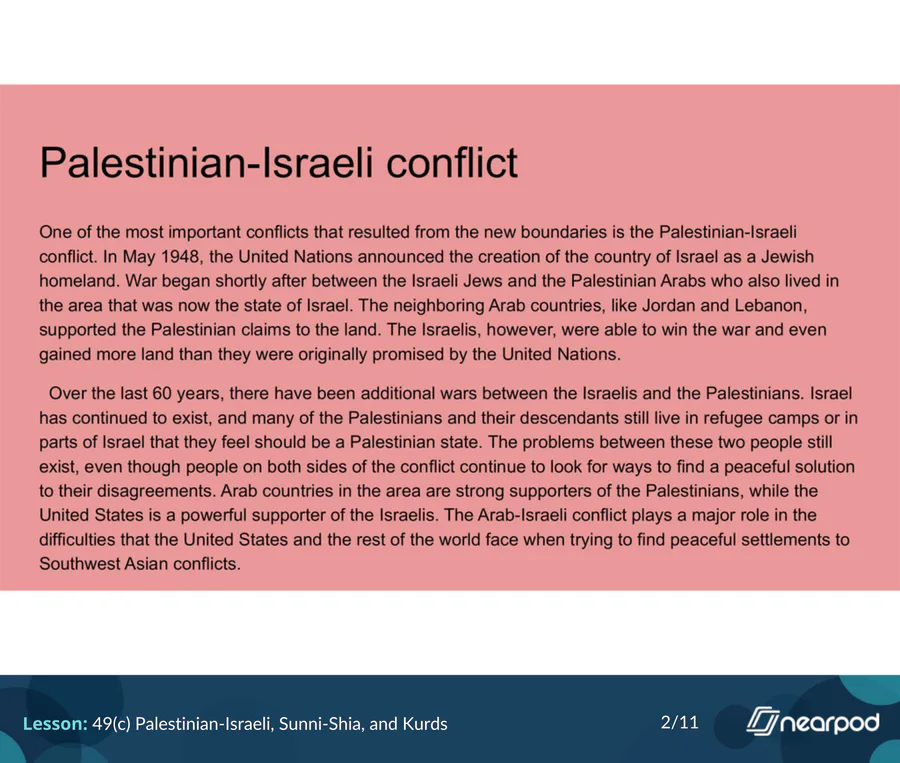
Islamic-run superpower ruled large areas of the Middle East, Eastern Europe and North Africa for more than 600 years until World War I

2

loyalty and devotion to a country (nation)

3

an alliance of groups or countries that work together to achieve a common goal

4

area of the eastern Mediterranean region, comprising parts of modern Israel along with the West Bank and the Gaza Strip.

23

Multiple Choice

Question image

artificial political boundaries

1

political borders that are drawn by people that live in the areas they partition

2

political borders that are drawn by people who do not live in the areas they divide, often by former colonizers

3

to divide

4

ending of colonial rule in the Middle East

24

Multiple Choice

Question image

partition

1

political borders that are drawn by people that live in the areas they partition

2

political borders that are drawn by people who do not live in the areas they divide, often by former colonizers

3

to divide land

4

ending of colonial rule in the Middle East

25

Multiple Choice

secular

1

not influenced by religious beliefs

2

when two or more people or groups temporarily work together to achieve a common goal

3

controlled by religion and religious laws

4

the use of violence and intimidation in the pursuit of political aims

26

Multiple Choice

extremism

1

believing in and supporting ideas that are very far from what most people consider correct or reasonable

2

support for the establishment of a Jewish homeland in Palestine

3

temporary control of a territory by a foreign power

4

not influenced by religious beliefs

27

Multiple Choice

Question image

majority

1

a group that is the biggest in a country, usually over 50%

2

a group that is equal in number when compared to the majority population

3

a group that is smaller in number compared to the majority population

4

a group that is larger in number compared to the majority population

28

Multiple Choice

Question image

minority

1

a group that is the biggest in a country

2

a group that is equal in number when compared to the majority population

3

a group that is smaller in number compared to the majority population

4

a group that is larger in number compared to the majority population

29

Multiple Select

Question image

Which of these describe the legacy of European control of the Middle East? (Choose all that are correct.)

1

Multiple ethnic and religious groups within in country boundaries

2

Political instability in countries where ethnic and religious groups compete for power

3

Trade agreements resulting in Middle Eastern nations supplying raw materials and European powers exporting final products

4

Peace and cooperation between members of religious and ethnic groups with in national borders

30

Multiple Choice

Question image

What is the difference between the Sunni and the Shia that caused them to split?

1

The Shia thought that only Muhammad's descendants could become caliphs, but the Sunni were open to anyone as caliphs.

2

The Sunni like fighting, but the Shia do not.

3

The Shia came from Spain, and the Sunni came from Australia.

4

There are no differences between the Sunni and Shia.

31

Multiple Choice

Question image

What would be the BEST title for the image?

1

Kurdish Dream for Homeland

2

Country of the Kurds

3

Partial Control of Kurdish territories

4

Mesopotamia

32

Multiple Choice

Question image

Why did the European Partitioning under the Sykes-Picot agreement cause conflict?

1

Other European nations were upset they did not acquire more territory.

2

The French disagreed with the British on which land to mandate.

3

Countries were allowed to maintain wealth of natural resources.

4

The Europeans made promises to different groups that they didn't keep because they kept the land.

33

Multiple Choice

Question image

Why are Sunnis and Shias in conflict today?

1

They are fighting over Muhammad.

2

They fight for power in nations where there are both groups.

3

Both want to create a new Islamic nation.

4

The only fighting is between Iran and Saudi Arabia.

34

Multiple Choice

Question image

Why did the Sunni-Shia split happen?

1

The Sunni did not want a new leader, but the Shia did.

2

They could not agree on who would lead Islam after the death of Mohammad.

3

The Sunnis are Jewish and Shia are Muslims.

4

After Mohammad died they split because they could not agree on a holy city.

35

Multiple Choice

Question image

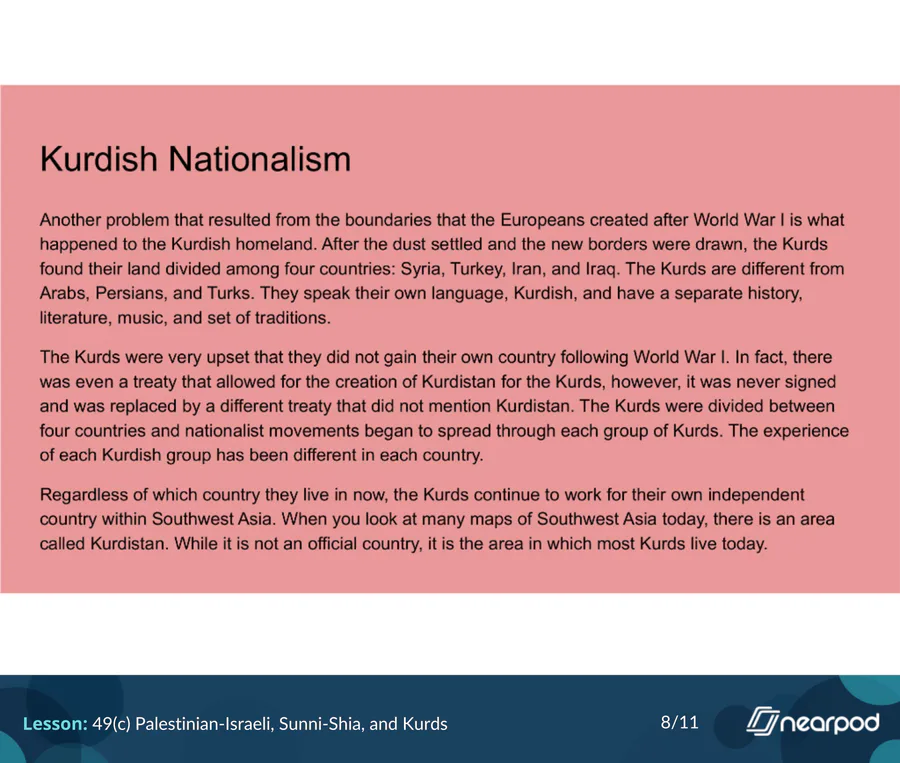
What is the goal of Kurdish nationalism?

1

a Kurdish language

2

to take over the country of Iraq

3

a country for the Kurds

4

to take over the land of Palestine

36

Multiple Choice

Question image

Who are the Kurds?

1

People from the largest nation in the Middle East.

2

A minority group that has been removed from the Middle East due to continued conflict with Islamic Sects.

3

The 4th largest ethnic group in SW Asia and he largest ethic group in the world that does not have their own country.

4

A distinct Arab subgroup that can be found in Saudi Arabia who came to power with the help of Saddam Hussein.

37

Multiple Choice

Question image

Which answer most accurately completes the following sentence: “In Southwest Asia (Middle East), land and religion are major sources of ________.”

1

aid

2

water

3

conflict

4

agreement

38

Multiple Choice

Question image

Who controlled the mandate of Palestine following the Ottoman Empire's collapse after World War I?

1

France

2

United States

3

Germany

4

Great Britain

39

Multiple Choice

Question image

The Balfour Declaration demonstrated whose support for the Jews?

1

France

2

United States

3

Germany

4

Great Britain

40

Multiple Choice

Question image

How did the Arab Palestinians react to the UN Partition Plan of 1947?

1

Rejected it and declared war

2

Accepted it and declared war

3

Rejected it but remained peaceful

4

Accepted it and remained peaceful

41

Multiple Choice

Question image

What are the 4 primary reasons for the establishment of the modern State of Israel in 1948?

1

Holocaust, anti-Semitism, Zionism, and birthplace of Jesus

2

Jewish promised land, the Holocaust, anti-Semitism, and Zionism

3

partitioning, Judaism, anti-Semitism, and Zionism

4

Jewish holy land, the Holocaust, Islam, and Israel

42

Multiple Choice

Question image

Where do most Palestinian Arabs live today?

1

Israel and Egypt

2

Gaza Strip and West Bank

3

Suez Canal and Jordan River

4

Israel and Syria

43

Multiple Choice

Question image

Jerusalem is a holy city for which group of people?

1

Christians

2

Jews

3

Muslims

4

all of these people

44

Multiple Choice

Question image

How was Israel created?

1

Great Britain partitioned Syria

2

Israel invaded Palestine

3

The United Nations partitioned Palestine

4

The Ottoman Empire was partitioned by Great Britain

45

Multiple Choice

Question image

What has been a common goal of the Jews and Muslims in this area?

1

To unite all Middle eastern nations as one

2

To become leaders in the world economy

3

To have their own independent countries

4

To impose their religion on others

46

Multiple Choice

Question image

Through multiple wars, who gained control over the majority of Israel-Palestine?

1

Israeli Jews

2

Palestinian Arabs

47

Multiple Choice

Question image

A major argument between the Israelis and the Palestinians is that each side

1

wants to control oil resources in the area

2

has close military alliances with neighboring countries

3

believes in different interpretations of the same religion

4

claims Palestine as their homeland

media

Show answer

Auto Play

Slide 1 / 47

SLIDE