
Lesson 13: Myths of the Aztec and Inca Reading Portion

Presentation
•
English
•
5th Grade
•
Easy
+19
Standards-aligned

Giron Giron
Used 3+ times
FREE Resource
10 Slides • 15 Questions
1

2
3
4
5
Multiple Choice
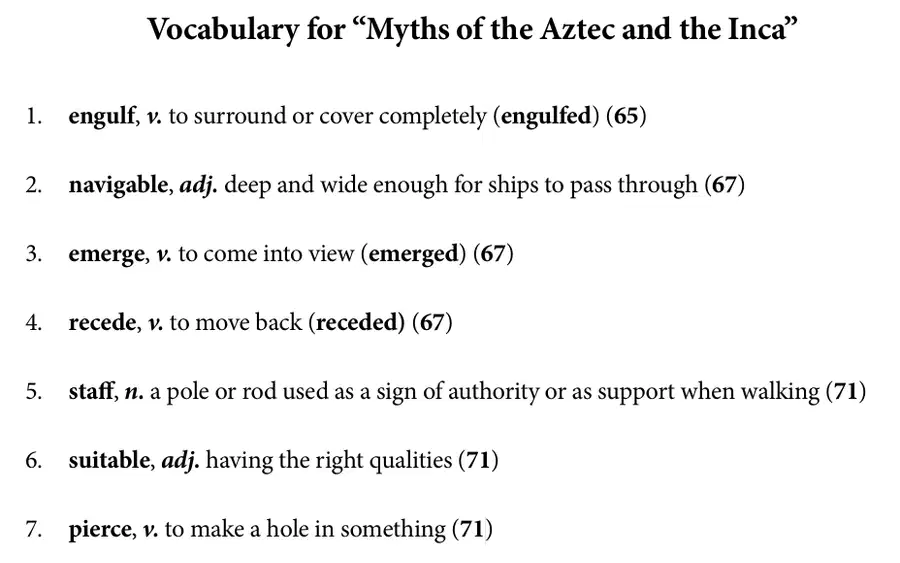
Which of the following words from the vocabulary list is an adjective?
engulf
navigable
emerge
staff
6
Multiple Choice
Which vocabulary word means 'to come into view'?
engulf
navigate
emerge
recede
7
8
9
Multiple Choice
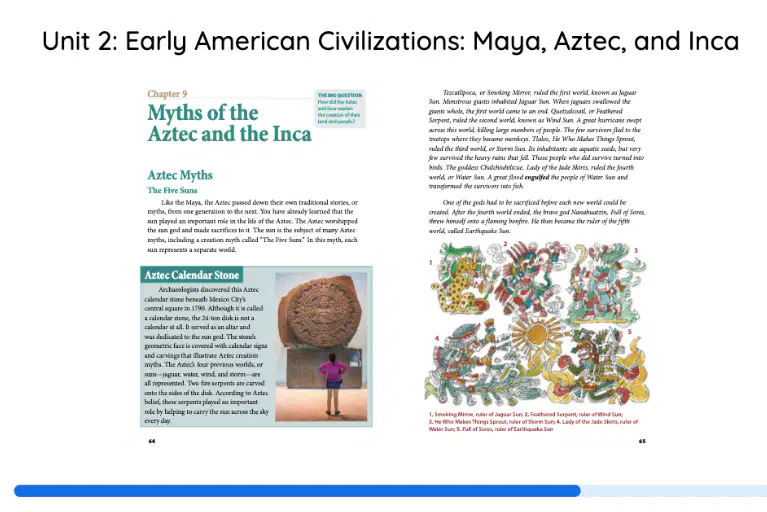
What word could replace suns in the title of the myth “The Five Suns”?
¿Qué palabra podría sustituir a soles en el título del mito “Los cinco soles”?
Moons
Lunas
Worlds
Mundos
Years
Años
Gods
Dioses
10
Multiple Choice
How does the description of each sun, or world, and its ruler align with its image?
¿Cómo se alinea la descripción de cada sol, o mundo, y su regente con su imagen?
Each ruler is shown holding tools they used to build the world./
Se muestra a cada gobernante sosteniendo las herramientas que utilizó para construir el mundo.
Each ruler’s image matches the natural disaster that ended their world./ La imagen de cada gobernante coincide con el desastre natural que acabó con su mundo.
The rulers look exactly like humans from Earthquake Sun./Los gobernantes se parecen exactamente a los humanos de Earthquake Sun.
11
12
Multiple Choice
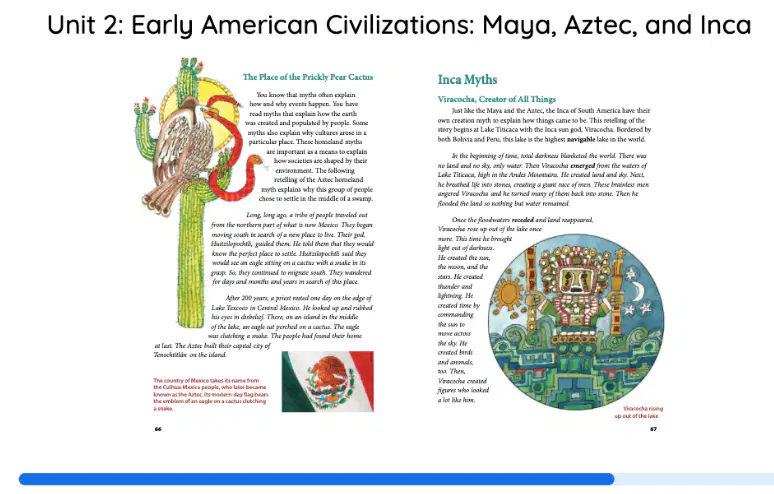
Why is the image of an eagle sitting on a cactus and clutching a snake significant?
¿Por qué es significativa la imagen de un águila sentada sobre un cactus y agarrando una serpiente?
It represents the first ruler of the Aztec people./ Representa al primer gobernante del pueblo azteca.
It was a warning that danger was near and a symbol of war./ Era una advertencia de que el peligro estaba cerca y un símbolo de guerra.
It showed the Aztec people where to build their city./ Mostró al pueblo azteca dónde construir su ciudad.
13
Open Ended
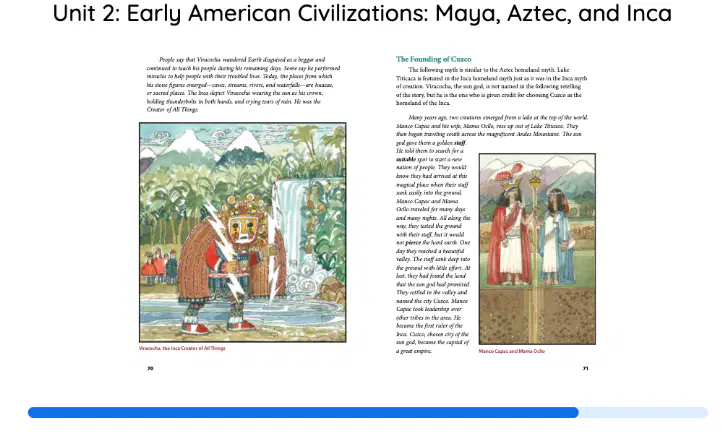
Contrast what Viracocha did the first and second times he emerged from Lake Titicaca.
Contraste lo que hizo Viracocha la primera y la segunda vez que emergió del lago Titicaca.
14
Multiple Choice
How did the Aztec people know when they had found the right place to settle down to live?
¿Cómo sabían los aztecas cuando habían encontrado el lugar adecuado para establecerse a vivir?
They saw an eagle sitting on a cactus holding a snake/ Vieron un águila sentada sobre un cactus sosteniendo una serpiente.
They found a place full of food and water./ Ellos encontraron un lugar lleno de comida y agua.
Their god told them in a dream and that's how they found the right place./ Su dios se lo dijo en un sueño y así encontraron el lugar correcto.
15
16
Multiple Choice
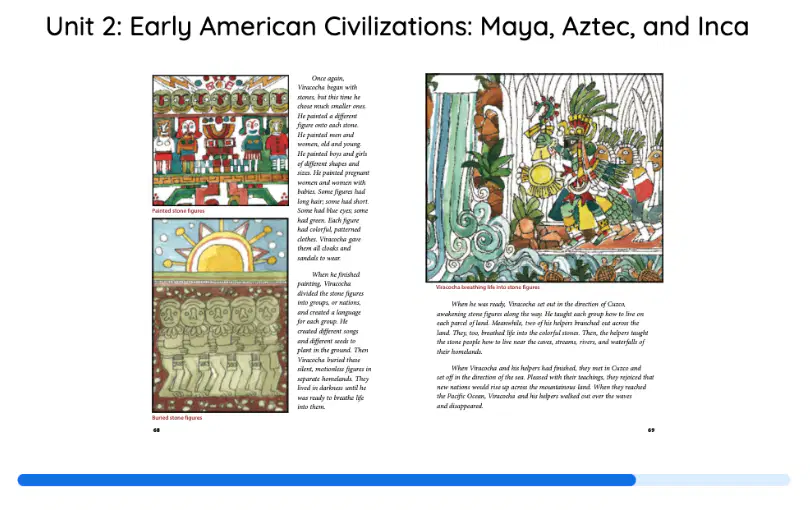
What does the narrator say that suggests the figures Viracocha buried were not yet alive?
¿Qué dice el narrador que sugiere que las figuras que enterró Viracocha aún no estaban vivas?
They spoke different languages before being buried./ Hablaban diferentes idiomas antes de ser enterrados.
They were silent and motionless until he breathed life into them./ Permanecieron en silencio e inmóviles hasta que él les insufló vida.
They were waiting to be painted to sing and dance underground./ Estaban esperando ser pintados para cantar y bailar bajo tierra.
17
Multiple Choice
Why do you think Viracocha and his helpers disappeared?
¿Por qué crees que desaparecieron Viracocha y sus ayudantes?
Their work was finished, and they returned to the sea./ Su trabajo terminó y regresaron al mar.
They wanted to hide from the people they made./ Querían esconderse de la gente que ellos mismos crearon.
They were captured by enemies in the stars./ Ellos fueron capturados por enemigos en las estrellas.
18
Multiple Choice
What kinds of characteristics did Viracocha give the small stone figures?
¿Qué tipos de características le dio Viracocha a las pequeñas figuras de piedra?
They were shaped like animals and all looked the same./ Tenían forma de animales y todos parecían iguales.
They were only painted in black and white./ Ellos solo estaban pintados en blanco y negro.
Each had different ages, clothes, and colors/ Cada uno tenía diferentes edades, ropa y colores.
19
20
Multiple Choice
Based on the text, how do we know that Viracocha cared about the well-being of the people he had created?
Basándonos en el texto, ¿cómo sabemos que Viracocha se preocupaba por el bienestar de las personas que había creado?
He taught them how to live and take care of their land./
Les enseñó cómo vivir y cuidar su tierra.
He left them food before disappearing./ Los dejó comida antes de desaparecer.
He built a palace for them to live in and gave them gold crowns/ Él les construyó un palacio para vivir y les dio coronas de oro.
21
Multiple Choice
Why is the golden staff important to this myth?
¿Por qué es importante el bastón dorado para este mito?
It was used to find the land chosen by the sun god./ Se utilizó para encontrar la tierra elegida por el dios del sol.
It protected them from evil spirits./ Los protegía de los espíritus malignos.
It turned rocks into gold and showed who was king./ Convirtió las rocas en oro y demostró quién era el rey.
22
Multiple Choice
How did Manco Capac and Mama Ocllo know when they had found the right place to start the city of Cuzco?
¿Cómo supieron Manco Capac y Mama Ocllo que habían encontrado el lugar adecuado para fundar la ciudad de Cuzco?
They saw a rainbow appear in the sky and heard a voice./ Vieron un arco iris aparecer en el cielo y oyeron una voz.
Their golden staff sank easily into the ground./ Su bastón dorado se hundió fácilmente en el suelo.
The land was full of gold and silver./ La tierra estaba llena de oro y plata.
23
Open Ended
“The Five Suns” is an Aztec creation myth. What does the story tell us about how the Aztec world was made?
«Los Cinco Soles» es un mito azteca de la creación. ¿Qué nos dice la historia sobre cómo se creó el mundo azteca?
24
Open Ended
“Viracocha, Creator of All Things” is an Inca creation myth. What does the story tell us about how the Inca world was made?
«Viracocha, Creador de Todas las Cosas» es un mito inca de la creación. ¿Qué nos dice la historia sobre cómo se creó el mundo inca?
25
Show answer
Auto Play
Slide 1 / 25
SLIDE
Similar Resources on Wayground

17 questions
Root Word: TRACT
Presentation
•
5th Grade
20 questions
Active and Passive Voice
Presentation
•
5th - 6th Grade
20 questions
Run-on Sentence
Presentation
•
5th - 6th Grade
19 questions
Reading comprehension
Presentation
•
4th - 5th Grade
20 questions
fast food
Presentation
•
KG
18 questions
TEXT TYPES
Presentation
•
5th Grade
18 questions
Lesson 10: Cougars
Presentation
•
5th Grade
18 questions
Direct and Indirect Speech
Presentation
•
5th Grade
Popular Resources on Wayground
24 questions
PBIS-HGMS Day 10

Quiz
•
6th - 8th Grade
10 questions
HCS SCI 03 Summer School Review 3
Quiz
•
3rd Grade
11 questions
Home Scope
Quiz
•
7th - 8th Grade
15 questions
HCS SCI 05 Summer School Assessment 3 Review
Quiz
•
5th Grade
35 questions
Lufkin Road Middle School Student Handbook & Policies Assessment
Quiz
•
7th Grade
18 questions
Geo 11.3 Area of Circles and Sectors
Quiz
•
9th - 11th Grade