Bio: Lesson Three (Chp.8.3)
Presentation
•
Science
•
10th Grade
•
Practice Problem
•
Easy
Standards-aligned
Maria Gomez
Used 8+ times
FREE Resource
10 Slides • 14 Questions
1
2
3
Multiple Choice
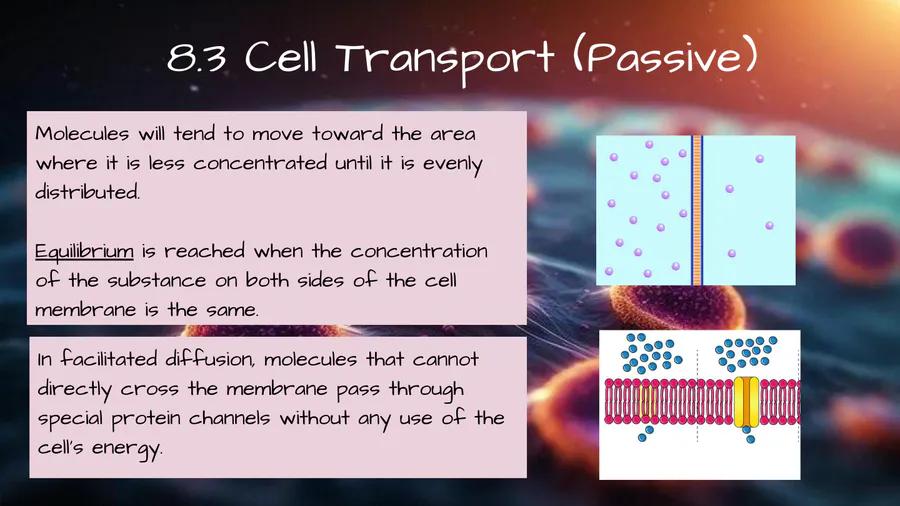
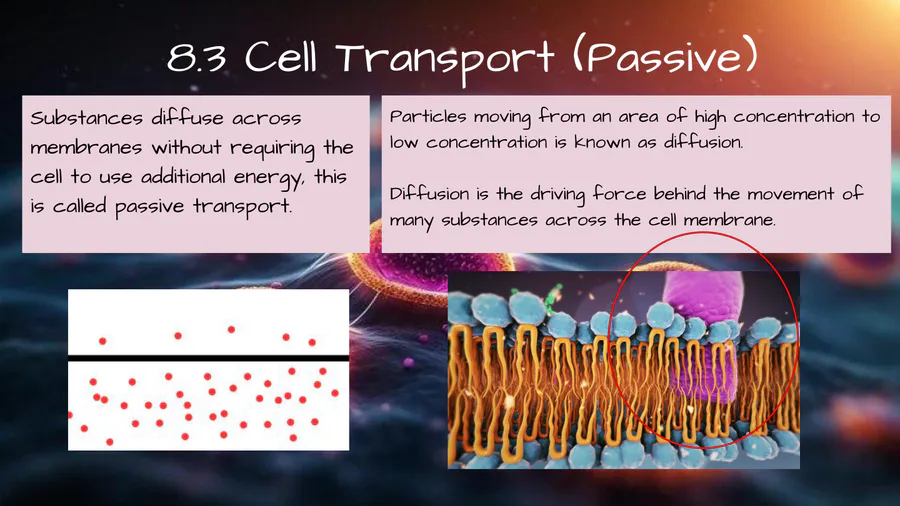
Which of the following best describes passive transport across a cell membrane?
Movement of substances using energy from the cell
Movement of substances from low to high concentration
Movement of substances without using additional energy
Movement of substances only through protein channels
4
5
Multiple Choice
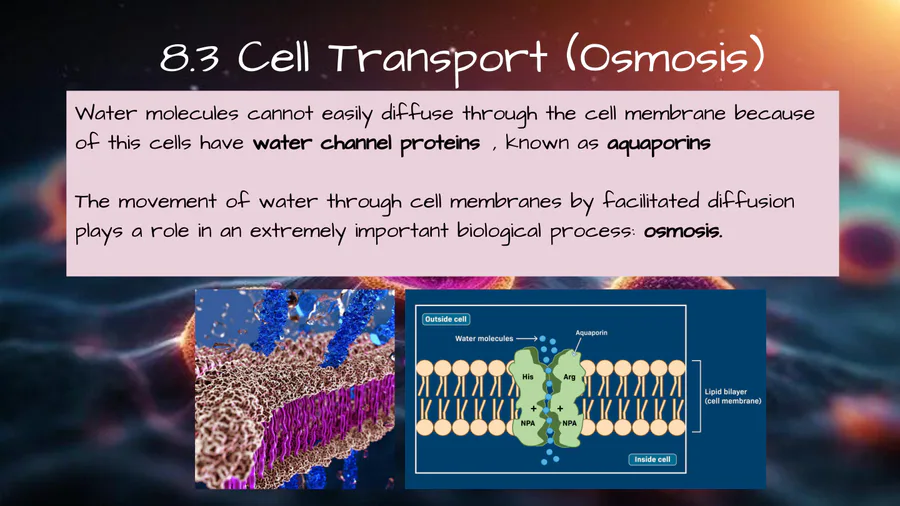
Which of the following statements best describes facilitated diffusion?
It requires energy from the cell to move molecules across the membrane.
Molecules move directly through the lipid bilayer without any assistance.
Molecules pass through special protein channels without using the cell's energy.
It only occurs with water molecules.
6
7
Fill in the Blanks
8
9
10
Multiple Choice
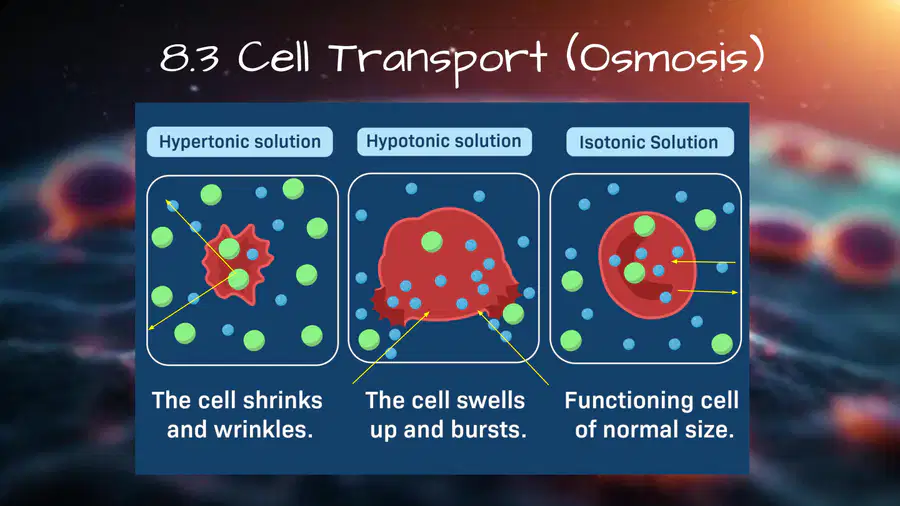
What happens to a cell placed in a hypertonic solution?
The cell swells up and bursts.
The cell shrinks and wrinkles.
The cell remains the same size.
The cell divides.
11
12
Multiple Select
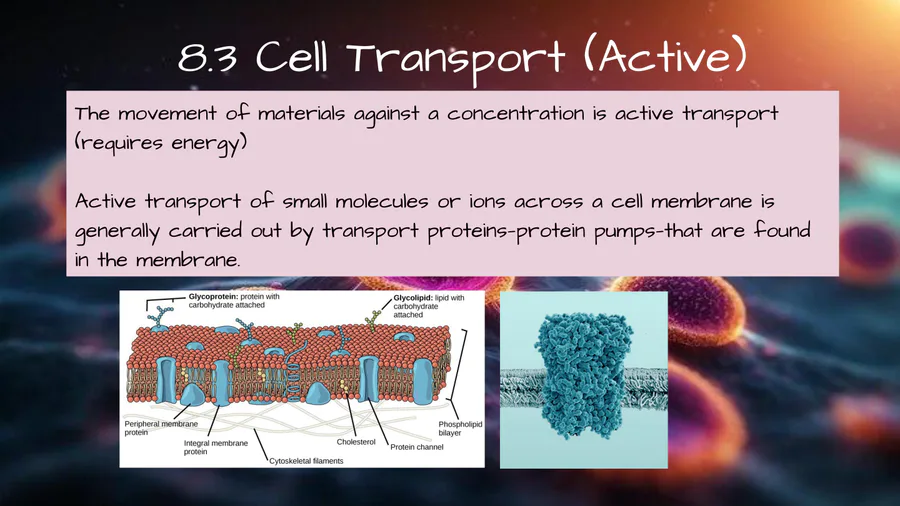
Which of the following are true about active transport?
It requires energy from the cell.
It moves materials against a concentration gradient.
It only occurs with water molecules.
It uses transport proteins in the membrane.
13
14
15
Multiple Choice
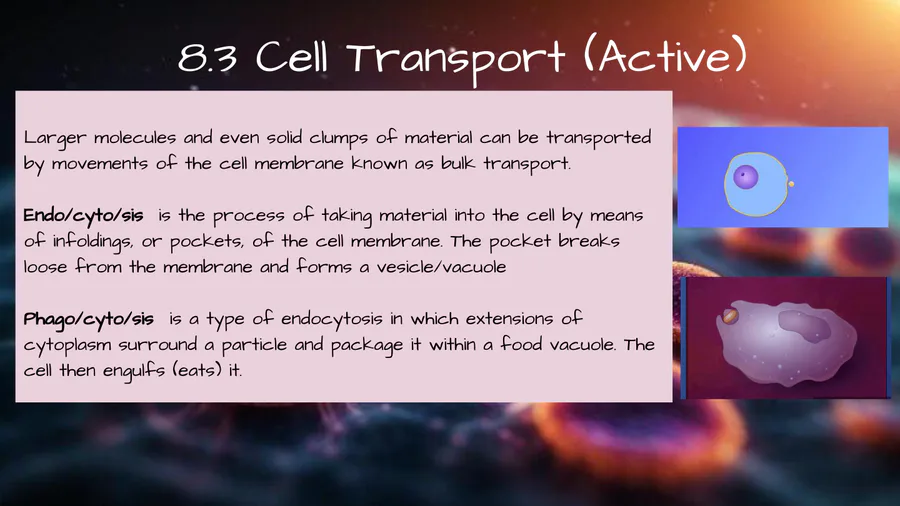
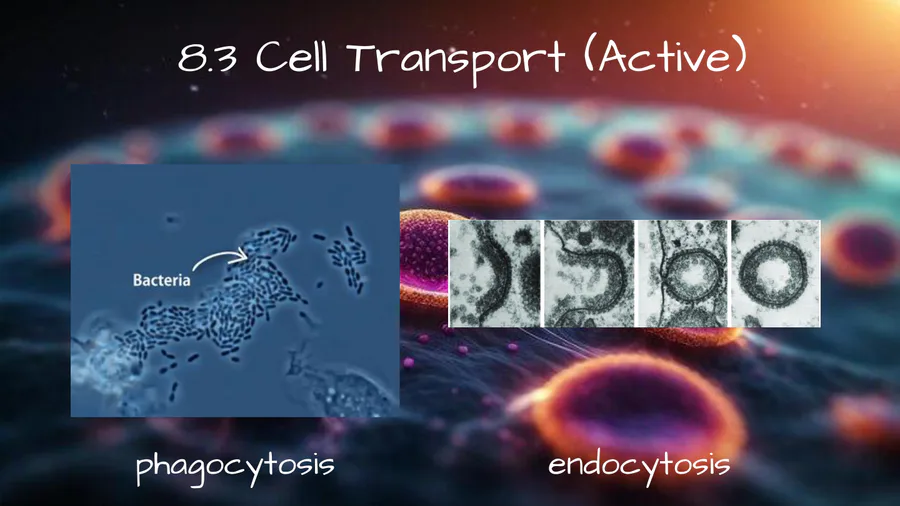
Which process involves a cell engulfing large particles such as bacteria?
Phagocytosis
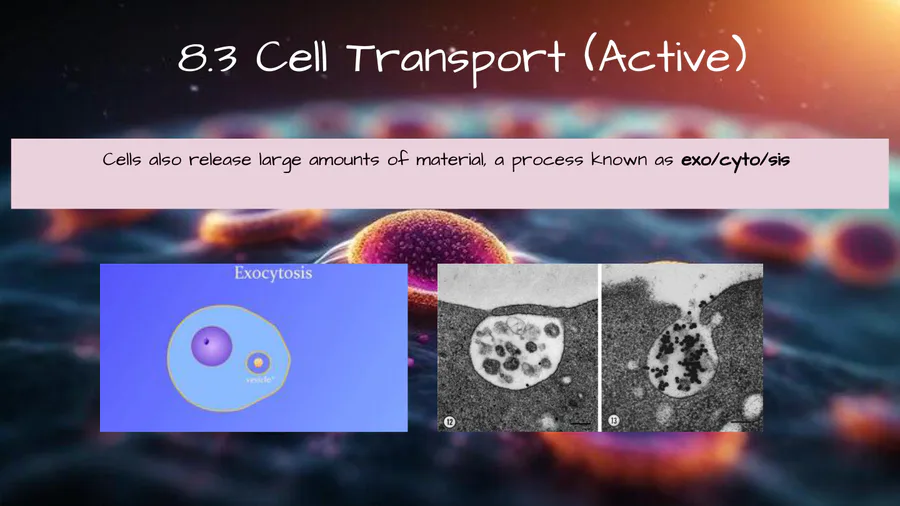
Exocytosis
Osmosis
Diffusion
16
17
Multiple Choice
What is the main function of the cell membrane in maintaining homeostasis?
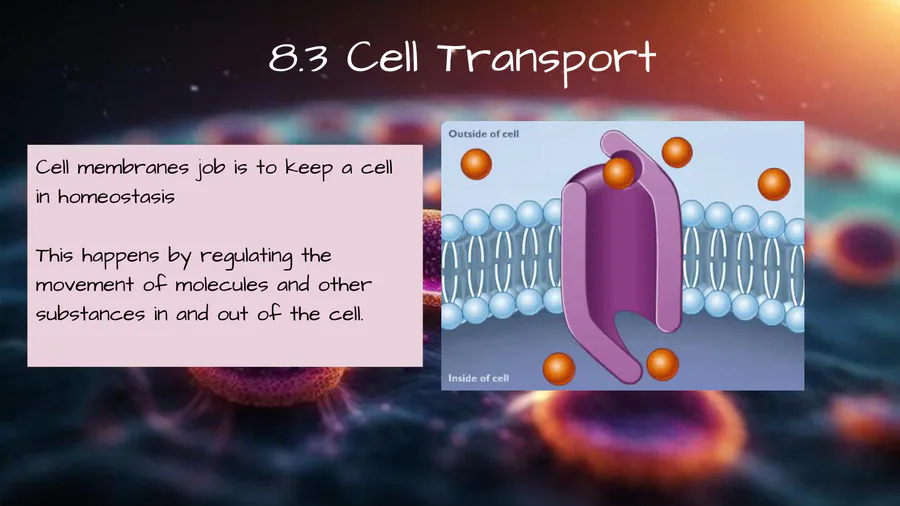
To regulate the movement of molecules and substances in and out of the cell
To produce energy for the cell
To store genetic information
To break down waste products
18
Multiple Choice
___ is particle movement from an area of lower concentration to an area of higher concentration.
Active transport
Passive transport
19
Multiple Choice
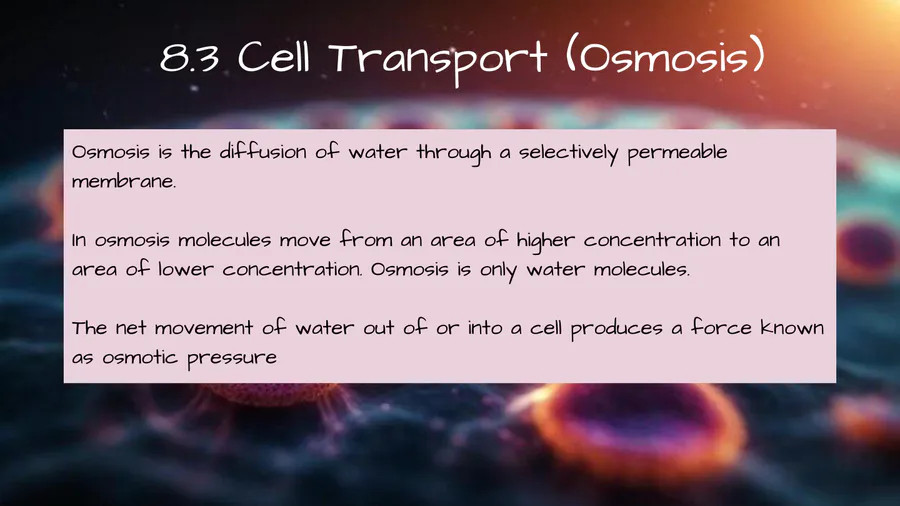
Which type of passive transport focuses on the movement of water through the membrane?
Facilitated diffusion
Osmosis
Diffusion
20
Multiple Choice
What term describes a solution that has the same solute concentration inside of and outside of the cell?
Hypertonic
Hypotonic
Isotonic
21
Multiple Choice
The cell shrunk in size, which means it was placed in a ____ solution.
Isotonic
Hypertonic
Hypotonic
22
Multiple Choice
23
Multiple Choice
What part of the cell regulates what can enter and leave the cell?
24
Multiple Choice
Show answer
Auto Play
Slide 1 / 24
SLIDE

Similar Resources on Wayground
21 questions
Cell Transport - Diffusion
Presentation
•
9th - 10th Grade
19 questions
Enzymes Notes
Presentation
•
9th - 11th Grade
19 questions
Scientific Notations
Presentation
•
9th Grade
20 questions
Basic Chemistry
Presentation
•
9th Grade
20 questions
Plant Nutrition
Presentation
•
10th Grade
18 questions
Plants
Presentation
•
6th - 8th Grade
18 questions
Active River
Presentation
•
10th Grade
15 questions
Dehydration Synthesis and Hydrolysis
Presentation
•
10th Grade
Popular Resources on Wayground
15 questions
Grade 3 Simulation Assessment 1
Quiz
•
3rd Grade
22 questions
HCS Grade 4 Simulation Assessment_1 2526sy
Quiz
•
4th Grade
16 questions
Grade 3 Simulation Assessment 2
Quiz
•
3rd Grade
19 questions
HCS Grade 5 Simulation Assessment_1 2526sy
Quiz
•
5th Grade
17 questions
HCS Grade 4 Simulation Assessment_2 2526sy
Quiz
•
4th Grade
20 questions
Equivalent Fractions
Quiz
•
3rd Grade
24 questions
HCS Grade 5 Simulation Assessment_2 2526sy
Quiz
•
5th Grade
20 questions
Math Review
Quiz
•
3rd Grade
Discover more resources for Science
20 questions
Earth Day Trivia
Quiz
•
9th - 12th Grade
100 questions
Biology EOC Review
Quiz
•
9th - 12th Grade
20 questions
Earth Day
Quiz
•
3rd - 12th Grade
38 questions
Biology EOC Review Game
Quiz
•
10th Grade
10 questions
Exploring Natural Selection Concepts
Interactive video
•
6th - 10th Grade
10 questions
Exploring Air Masses and Weather Fronts
Interactive video
•
6th - 10th Grade
20 questions
Cladograms and Phylogenetic Trees
Quiz
•
9th - 12th Grade
31 questions
STAAR Strand 1 TEKS(11,12)
Quiz
•
9th - 12th Grade