Search Header Logo
ESS2.1 Day 3 and 4

ESS2.1 Day 3 and 4

Assessment

Presentation

Science

6th Grade

Easy

NGSS
MS-ESS2-6, MS-PS1-4, MS-PS3-4

+1

Standards-aligned

Created by

Brittany Williams

Used 15+ times

FREE Resource

14 Slides • 10 Questions

1

​ESS2.1
EQ: How does the uneven heating of earth create convection patterns in the ocean and atmosphere?

By Brittany Williams

2

Open Ended

Question image

Engage: We are going to watch a video showing an empty balloon over the top of a bottle. 

Predict: 1. What will happen when the bottle goes into the hot water?

2. What will happen when the bottle goes into the cold water?

3

4

media

1's tell 2's: What is happening to the air at the equator?

2's tell 1's: What is happening to the air at the poles?

Can you connect it to the video you just watched?

Explore:

5

Explain: Let's learn about land and sea breezes. Note time!

6

What causes local winds?

  • Unequal heating: The sun heats the land and water differently. Land heats up faster than water. 

  • Air pressure differences: As air over a heated area gets warmer, it rises, creating an area of low pressure. Cooler air then moves in to fill the space, creating wind. 

  • Local geography: Things like coastlines, mountains, and valleys cause these temperature and pressure differences to happen on a small, local scale. 

7

media

8

media

9

Multiple Choice

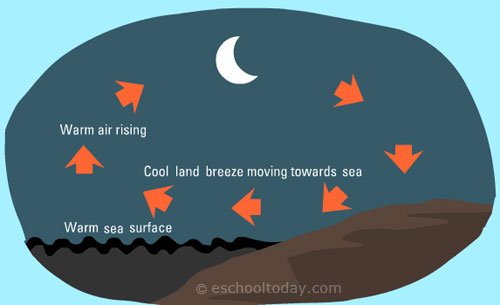
Why do land breezes occur at night?
1
Land cools off slower than water, so the air above water is cooler.
2
Water cools off slower than land, so the air above water is warmer.

10

Multiple Choice

Question image

Air moves from _______ pressure to ________ pressure.

1

high to low

2

low to high

11

Multiple Choice

Question image
Is this a land or a sea breeze?
1
land breeze
2
sea breeze

12

Multiple Choice

Question image

Sea and land breezes happen because

1

the land heats and cools more quickly than the water

2

the land heats and cools more slowly than the water

13

Global Winds: Be ready to discuss

14

media

​Let's add our new information and discuss what we saw in the video!

15

Multiple Choice

What causes wind?
1
differences in pressure
2
density

16

Multiple Choice

convection cells

1

warm, less dense air rises

2

large, circular patterns of moving air

17

What are jet streams?

18

media

​Let's add our new information and discuss what we saw in the video!

19

Multiple Choice

What are jet streams?

1

The trail left from an airplane.

2

Bands of strong wind.

20

Multiple Choice

Which direction do jet streams generally blow?

1

East to West

2

West to East

21

Multiple Choice

If you were in a plane traveling from west to east, you would get there ________ than if you travel from east to west.

1

faster

2

slower

22

Summarizing Task Options:

  1. Describe where you start (land, sea, or high in the atmosphere).

  2. Explain why you move (hint: think about temperature and air pressure).

  3. Tell what kind of breeze or current you are (sea breeze, land breeze, jet stream, etc.).

  4. End with how you help move air and weather around Earth.

Option 1: Write a “Wind Story”

Write a short paragraph (6–8 sentences) from the point of view of the wind.

23

Summarizing Task Options:

Option 2: Make a chart or concept map that summarizes how all the ideas are connected. Include:


Then write a 3–4 sentence summary below your chart explaining how all these winds are connected by uneven heating of Earth.

media

24

Summarizing Task Options:

Option 3: Visual Summary Poster

Draw and label a poster that includes:

  • Arrows showing wind movement (land breeze, sea breeze, jet stream)

  • A few short labels or sentences explaining why air moves the way it does

  • A one-sentence summary at the bottom.

​ESS2.1
EQ: How does the uneven heating of earth create convection patterns in the ocean and atmosphere?

By Brittany Williams

Show answer

Auto Play

Slide 1 / 24

SLIDE