
Respiratory System: Part 1 - Interactive Lecture

Presentation
•
Science
•
University
•
Practice Problem
•
Easy
Standards-aligned

Christine Boudreau
Used 1+ times
FREE Resource
23 Slides • 15 Questions
1
Part 1
Interactive Lecture
2
3
Multiple Choice

During an asthma attack, a 21-year-old woman experiences chest tightness and difficulty getting air into her lungs. Which structural feature of the respiratory system is most directly affected, making it harder for her to breathe?
The alveoli collapse, preventing gas exchange.
The bronchioles narrow due to smooth muscle constriction.
The diaphragm becomes paralyzed.
The nasal cavity dries out and blocks airflow.
4
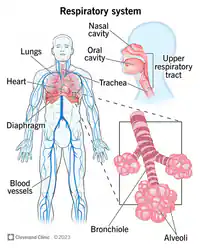
Bronchioles are the small, cartilage-free airways whose walls contain circumferential smooth muscle and a mucosal lining. Because they lack rigid cartilage, even small changes in smooth muscle tone or mucosal thickness can markedly change their radius.
In asthma, airway hyperresponsiveness and inflammation trigger smooth muscle bronchoconstriction, plus mucosal edema and mucus plugging. By Poiseuille’s law, airflow ∝ r⁴, so a modest decrease in radius causes a huge drop in airflow. That’s why she feels “chest tightness” and struggles to move air.

5
6
Multiple Choice
Which of the following correctly lists the main structures of the upper respiratory tract and their basic functions?
Trachea, bronchi, alveoli — transport air and exchange gases
Nose, nasal cavity, pharynx, sinuses — filter, warm, moisten air and serve as a passageway
Larynx, trachea, bronchi — move air to the alveoli
Alveoli, diaphragm, intercostal muscles — regulate ventilation
7
The upper respiratory tract includes the nose, nasal cavity, pharynx, and sinuses. These structures condition incoming air before it reaches the lower tract.
Nose and nasal cavity filter out particulates, warm the air, and add moisture.
Pharynx serves as a shared passageway for air and food.
Sinuses help humidify and warm air and reduce skull weight.
This preparation protects delicate lower airway structures and helps maintain efficient gas exchange deeper in the lungs.

8
Multiple Choice
A patient has laryngeal nerve damage that prevents the vocal cords from closing fully. Which of the following is the greatest risk?
Inability to warm and humidify air
Aspiration of food or liquid into the airway
Complete loss of lung capacity
Increased mucociliary clearance
9
The larynx protects the airway during swallowing by closing the vocal folds (true cords) and the glottis, while the epiglottis folds over the laryngeal inlet.
Closure of the vocal cords is driven by laryngeal motor innervation (primarily via the recurrent laryngeal nerve). If this nerve is damaged and the cords cannot adduct (close), the glottic seal fails.
Without that seal, chewed material or liquids can pass from the pharynx into the laryngeal inlet and trachea—i.e., aspiration.
Loss of vocal fold closure also weakens the cough (glottic closure is needed to build intrathoracic pressure), so material that enters the airway is harder to expel, further heightening aspiration risk and predisposing to aspiration pneumonitis/pneumonia.
If sensory input from the internal branch of the superior laryngeal nerve is also impaired, patients may have “silent aspiration” (reduced cough reflex).

10
11
Multiple Choice
A patient presents with lung crackles caused by fluid in the lungs. Which structural feature of the respiratory system best explains why this sound occurs?
Fluid accumulates in the nasal cavity, blocking airflow.
Fluid collects in the alveoli, interfering with normal air movement.
Mucus builds up in the larynx, causing vibrations.
Bronchioles collapse completely during inspiration.
12
The alveoli are small, thin-walled air sacs at the ends of the bronchioles where gas exchange occurs. Their structure allows air to fill them easily with minimal resistance when they’re dry and compliant.
When fluid accumulates in or around the alveoli (as in pneumonia or pulmonary edema), air must bubble through this fluid, producing crackling or “rales” sounds on inhalation. This disrupts the normal smooth passage of air and impairs oxygen diffusion.
Clinical relevance: These crackles are a sign of impaired gas exchange and may indicate conditions such as pneumonia, heart failure, or fluid overload.

13
14
Multiple Choice
A patient with pneumonia is experiencing shortness of breath and low oxygen levels. Which function of the respiratory system is most directly impaired in this condition?
Regulation of body temperature and humidity
Gas exchange between alveoli and capillaries
Vocalization through the larynx
Filtration of air in the nasal cavity
15
Gas exchange is the primary function of the respiratory system. Oxygen must move from alveoli into pulmonary capillaries, and carbon dioxide must move out.
Pneumonia causes alveolar inflammation and fluid accumulation, reducing the surface area for diffusion and impairing oxygenation.
This results clinically in dyspnea, hypoxemia, and possibly respiratory failure.
The other options are secondary functions and are not the main cause of the symptoms described.
16
Multiple Choice
A patient experiencing hyperventilation is likely to have which of the following changes in their acid–base balance?
Increased CO₂ and decreased pH
Decreased CO₂ and increased pH
Decreased CO₂ and decreased pH
Increased CO₂ and increased pH
17
The respiratory system regulates pH by controlling CO₂ levels through changes in breathing rate and depth.
Hyperventilation increases the amount of CO₂ exhaled → lowers CO₂ in the blood → shifts the blood toward alkalosis (higher pH).
This is clinically relevant in panic attacks, sepsis, or compensation for metabolic acidosis.
18
Multiple Choice
Why are patients with chronic smoking more susceptible to respiratory infections?
Smoking decreases the surface area for gas exchange.
Smoking damages mucociliary defenses, allowing pathogens to remain in the airways.
Smoking causes the vocal cords to vibrate less efficiently.
Smoking lowers body temperature and humidity in the lungs.
19
The mucociliary escalator uses mucus and cilia to trap and remove inhaled particles and pathogens.
Smoking damages cilia and thickens mucus, impairing this clearance mechanism.
As a result, bacteria and other contaminants remain in the airways, increasing the risk of bronchitis, pneumonia, and other infections.
Gas exchange, vocalization, and temperature regulation are less directly affected in the early stages of smoking-related disease.
20
21
Multiple Choice
A patient presents with sudden shortness of breath and chest pain due to a pneumothorax. Which structural change best explains why breathing becomes difficult?
Collapse of the alveoli decreases mucociliary clearance.
Loss of negative intrapleural pressure causes the lung to collapse, impairing ventilation.
Narrowing of the bronchioles increases airway resistance.
Thickening of the respiratory membrane reduces oxygen diffusion.
22
Under normal conditions, the negative pressure in the pleural cavity keeps the lungs expanded against the chest wall.
In a pneumothorax, air enters the pleural space and eliminates that negative pressure, allowing the lung to recoil and collapse.
This structural change prevents effective lung expansion during inspiration, reducing tidal volume and causing shortness of breath.
Bronchioles and alveolar membranes may be structurally intact, but the loss of the pressure gradient disrupts lung function.
23
24
Multiple Choice
Which of the following best explains how air enters the lungs during normal inhalation?
The diaphragm relaxes, increasing pressure inside the lungs and drawing air in.
The diaphragm and external intercostals contract, expanding thoracic volume and lowering intrapulmonary pressure.
Air enters the lungs because alveolar surface tension increases.
Negative intrapleural pressure pushes air into the lungs.
25
During inhalation, the diaphragm contracts and flattens, and the external intercostal muscles lift the rib cage.
This increases thoracic cavity volume, which lowers intrapulmonary pressure below atmospheric pressure, causing air to flow in.
Air moves down a pressure gradient, not because of active “pushing” forces.

26
Multiple Choice
Why does air flow out of the lungs during quiet exhalation?
The diaphragm contracts, increasing lung pressure.
Elastic recoil of the lungs decreases thoracic volume, increasing intrapulmonary pressure.
The intercostal muscles force air out actively.
Intrapleural pressure becomes more negative to expel air.
27
Quiet exhalation is passive.
When the diaphragm and intercostal muscles relax, the thoracic cavity volume decreases.
Elastic recoil and alveolar surface tension increase intrapulmonary pressure above atmospheric, causing air to flow out.
This is the opposite of the inhalation pressure gradient.

28
Multiple Choice
A patient develops a pneumothorax. Which of the following best explains why ventilation becomes impaired?
The diaphragm no longer contracts.
Airway resistance increases in the bronchioles.
Loss of negative intrapleural pressure prevents lung expansion during inhalation.
Elastic recoil is permanently lost.
29
Normally, negative intrapleural pressure keeps the lungs expanded against the chest wall.
In pneumothorax, air enters the pleural space, eliminating this negative pressure.
Without that structural force, the lung collapses, and the pressure gradient for airflow is disrupted, severely impairing ventilation.
30
31
Multiple Choice
A healthy adult has a tidal volume of approximately 500 mL and a respiratory rate of 12 breaths per minute.
What best explains why tidal volume is clinically important?
It determines the total oxygen content of hemoglobin.
It represents the air moving in and out of the lungs with each breath, which directly impacts minute ventilation.
It reflects the amount of air remaining in the lungs after maximal exhalation.
It measures how much air bypasses the alveoli.
32
Tidal volume (TV) is the amount of air inhaled or exhaled during normal breathing.
It is a key determinant of minute ventilation (TV × respiratory rate), which affects oxygen delivery and CO₂ removal.
Low tidal volumes can lead to hypoventilation and hypercapnia, while abnormally high tidal volumes may indicate respiratory distress.
33

34
Multiple Choice
A patient is asked to take the deepest breath possible and then exhale fully. This maneuver is measuring which respiratory capacity,
and why is it clinically relevant?
Residual volume — to assess airway resistance.
Inspiratory capacity — to detect pleural pressure changes.
Vital capacity — to evaluate maximum air exchange during breathing.
Total lung capacity — to measure alveolar surface area.
35
Vital capacity (VC) = IRV + TV + ERV.
It represents the maximum amount of air a person can exhale after a maximal inhalation, reflecting lung compliance, muscle strength, and airway patency.
VC is often reduced in restrictive diseases (e.g., pulmonary fibrosis) or muscle weakness.

36
Multiple Choice
Why is residual volume important in maintaining normal lung function?
It ensures a fresh supply of oxygen with each breath.
It prevents lung collapse by maintaining alveolar inflation after exhalation.
It increases during forced exhalation to improve airflow.
It represents the total lung capacity during exercise.
37
Residual volume (RV) is the air remaining in the lungs after maximal exhalation.
This volume keeps alveoli partially inflated, preventing collapse (atelectasis) and maintaining continuous gas exchange between breaths.
Changes in RV can indicate obstructive lung disease (e.g., emphysema).
38
Labeling
Label this graph with the following labels.
TLC
VC
RV
FRC
TV
IRV
Part 1
Interactive Lecture
Show answer
Auto Play
Slide 1 / 38
SLIDE
Similar Resources on Wayground

36 questions
Y4 Retrieval - Spring
Presentation
•
KG - University
35 questions
I am a university student.
Presentation
•
University
32 questions
Volcanic Eruption
Presentation
•
12th Grade
32 questions
SI Units and measurement
Presentation
•
KG
33 questions
Polar Seas
Presentation
•
KG - University
34 questions
Fuzzy logic control
Presentation
•
University
32 questions
First and Second Laws of Thermodynamics
Presentation
•
University
35 questions
What If The Sun Disappeared?
Presentation
•
KG
Popular Resources on Wayground
10 questions
Safety Day 2026 – Student Review

Quiz
•
9th Grade
21 questions
Continents and Oceans
Quiz
•
6th Grade
20 questions
Parts of Speech
Quiz
•
5th Grade
16 questions
Subject & Predicate
Quiz
•
5th Grade
25 questions
Multiplication Facts
Quiz
•
5th Grade
12 questions
Map Skills
Quiz
•
3rd Grade
22 questions
Continents and Oceans
Quiz
•
5th Grade
15 questions
Rounding Decimals
Quiz
•
5th Grade
Discover more resources for Science
20 questions
Disney Trivia
Quiz
•
University
10 questions
Spanish Greetings and Goodbyes!
Presentation
•
6th Grade - University
20 questions
Physical or Chemical Change/Phases
Quiz
•
8th Grade - University
39 questions
Unit 7 Key Terms
Quiz
•
11th Grade - University
25 questions
SER and Subject Pronouns
Quiz
•
8th Grade - University
38 questions
Unit 6 Key Terms
Quiz
•
11th Grade - University
19 questions
Key Concepts in Buddhism
Quiz
•
University
0 questions
Cell Domain Basic Review (Biology)
Quiz
•
University