
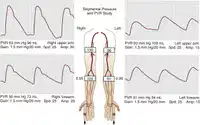
Upper Extremity Testing

Presentation
•
Health Sciences
•
University
•
Practice Problem
•
Easy

Megan Mullins
Used 1+ times
FREE Resource
34 Slides • 12 Questions
1

2

3
Multiple Choice
Which of the following is a common symptom of arterial disease in the upper extremities?
Arm/hand weakness with exercise
Swelling of the ankles
Frequent headaches
Blurred vision
4

5
Multiple Choice
Which of the following is NOT a component of the baseline physiologic exam to rule out arterial occlusive disease in upper extremity testing?
Segmental arm pressures
Pulse volume recording
Doppler waveform analysis
Electrocardiogram
6

7

8
Open Ended
Describe how the baseline upper extremity segmental study (pulse volume recording) helps in diagnosing vascular diseases of the arm.
9

10
Multiple Choice
What does a pressure gradient of ≥ 20 mmHg between brachial pressures indicate?
Subclavian artery disease
Brachial artery disease
Raynaud's phenomenon
Normal vascular function
11

12

13
Multiple Select
Which of the following methods can be used to monitor limb function during a Thoracic Outlet Syndrome test?
CW-Doppler on radial artery
Pulse volume recording (PVR) of arms
PPG on index finger
Electroencephalogram
14

15
Multiple Choice
Which arm position is referred to as the 'stick-up' or costo-clavicular position in traditional TOS test positions?
Abducted 90 degrees to torso
Elevated 180 degrees above head
Adson’s test (30° abduction)
Elbows at side and to the back, hands up, shoulders pressed downward and back
16

17
Multiple Choice
What is the definitive positive finding in a TOS study that suggests vascular compression?
Increase in amplitude of waveform tracings
Loss of pulsatility or flatline waveform in symptomatic position
Decrease in amplitude during resting position
Waveform tracings remain similar to baseline in all positions
18

19

20

21

22

23

24

25
Multiple Choice
Which findings would indicate a positive cold immersion study?
Waveforms return to baseline amplitude within 5 minutes
Waveforms do not return to baseline amplitude for more than 10 minutes
Temperature increases rapidly after immersion
No change in waveform amplitude
26
Multiple Choice
What does a persistent decrease in digital waveform amplitude for 10 minutes or longer after cold immersion indicate?
Normal vascular response
Vasospastic disorder or Raynaud’s syndrome
Peripheral neuropathy
Infection
27

28

29

30

31
Multiple Choice
Based on the case study and waveform results, what is the most likely cause of reduced perfusion in the left 3rd, 4th, and 5th digits?
Raynaud’s syndrome
Fixed occlusive disease
Peripheral neuropathy
Normal physiologic variation
32

33

34

35

36
Multiple Choice
Which of the following tests can be used to assess palmar arch patency before radial artery harvest?
Allen Test
Doppler Ultrasound
Electrocardiogram
Chest X-ray
37

38

39

40

41

42

43

44

45

46
Multiple Choice
Which of the following is NOT a symptom of arterial disease in the upper extremities?
Arm/hand weakness with exercise
Reduced or absent pulses
Hand numbness/weakness/pain, position related
Increased sweating
Show answer
Auto Play
Slide 1 / 46
SLIDE
Similar Resources on Wayground

43 questions
GS START - Medicines commonly Prescribed in General Surgery
Presentation
•
KG - University
38 questions
Respiratory System: Part 1 - Interactive Lecture
Presentation
•
University
38 questions
Chapter 12 Sensory Mechanisms
Presentation
•
University
37 questions
Haemochromatosis
Presentation
•
University
38 questions
tiña
Presentation
•
Professional Development
41 questions
10_MusicOnStrings
Presentation
•
11th Grade - University
36 questions
Transfusion Reactions
Presentation
•
Professional Development
Popular Resources on Wayground
10 questions
Safety Day 2026 – Student Review

Quiz
•
9th Grade
21 questions
Continents and Oceans
Quiz
•
6th Grade
20 questions
Parts of Speech
Quiz
•
5th Grade
16 questions
Subject & Predicate
Quiz
•
5th Grade
25 questions
Multiplication Facts
Quiz
•
5th Grade
12 questions
Map Skills
Quiz
•
3rd Grade
22 questions
Continents and Oceans
Quiz
•
5th Grade
15 questions
Rounding Decimals
Quiz
•
5th Grade
Discover more resources for Health Sciences
20 questions
Disney Trivia
Quiz
•
University
10 questions
Spanish Greetings and Goodbyes!
Presentation
•
6th Grade - University
20 questions
Physical or Chemical Change/Phases
Quiz
•
8th Grade - University
39 questions
Unit 7 Key Terms
Quiz
•
11th Grade - University
25 questions
SER and Subject Pronouns
Quiz
•
8th Grade - University
38 questions
Unit 6 Key Terms
Quiz
•
11th Grade - University
19 questions
Key Concepts in Buddhism
Quiz
•
University
0 questions
Cell Domain Basic Review (Biology)
Quiz
•
University