

Adrenal incidentalomas

Presentation
•
Science
•
Professional Development
•
Practice Problem
•
Medium

Emily Manlove
Used 1+ times
FREE Resource
23 Slides • 27 Questions
1

2

3
Multiple Select
What two questions do you need to answer regarding the mass on the L adrenal gland?
Is it benign or malignant?
Is it producing hormones?
What is the size of the mass?
What are the symptoms of the patient?
4

5
Multiple Choice
What are the characteristics of Adrenocortical adenomas, Myelolipomas, and Adrenocortical carcinoma (ACC) based on their location, benignity, hormones produced, and percentage?
Adrenocortical adenomas: Cortex, Benign, 15% functional: Cortisol or aldosterone, Non 89.7% Cortisol 6.4% Aldo 0.6%
Myelolipomas: Cortex, Benign, No hormones, No percentage
Adrenocortical carcinoma (ACC): Cortex, Malignant, 60% functional: Cortisol or androgens, 1.9%
Pheochromocytoma: Medulla, 10% malignant, Catecholamines, 3.1%
6
Multiple Choice
Mark, a 45-year-old man, sought medical attention due to recurrent episodes of severe headaches, sweating, and palpitations that occurred unpredictably over the past six months. During one of these episodes, his blood pressure was found to be significantly elevated. Mark's primary care physician referred him to the endocrinology clinic suspecting a possible adrenal disorder. What lab values and tests would help to confirm a diagnosis of pheochromocytoma?
Plasma cortisol, plasma aldosterone, and plasma renin activity
Serum metanephrines & Vanillylmandelic acid (VMA), Urine VMA, and abdominal CT scan
7

8

9
Multiple Choice
What are the characteristics of "lipid rich" and "lipid poor" lesions in terms of Hounsfield units?
Lipid rich lesions have > 10 HU
Lipid poor lesions have < 10 HU
Lipid rich lesions are darker on CT
Lipid poor lesions are lighter on CT
10

11
Open Ended
What do you do next?
12

13
Multiple Choice
What are the primary secretory products of the adrenal cortex and medulla?
Aldosterone
Cortisol
Catecholamines
All of the above
14

15
Multiple Choice
What testing do you order for Ms. J who is taking levothyroxine for hypothyroidism?
Cortisol
DHEAS
(+/- ACTH)
+/- dex suppression test
16
Multiple Choice
Emma, a 30-year-old woman, was admitted to the internal medicine ward with a two-month history of progressive weakness, fatigue, and unintentional weight loss. She reported episodes of dizziness upon standing. On examination, her blood pressure was significantly lower than expected. Laboratory tests revealed hyponatremia, hyperkalemia. Further testing confirmed low levels of serum cortisol. What is this likely medical diagnosis?
17
Multiple Choice
James, a 45-year-old man, presented to the endocrinology clinic with a three-month history of persistent headaches, muscle weakness, and intermittent episodes of palpitations. Clinical examination revealed hypertension, and further investigation demonstrated hypokalemia and metabolic alkalosis. Laboratory tests revealed elevated levels of plasma aldosterone, suppressed plasma renin activity, and an increased aldosterone-to-renin ratio. A contrast-enhanced abdominal CT scan showed an adenoma in the left adrenal gland. What is James' diagnosis?
18
Multiple Choice
Emma, a 30-year-old woman, was admitted to the internal medicine ward with a two-month history of progressive weakness, fatigue, and unintentional weight loss. She reported hyperpigmentation of her skin and episodes of dizziness upon standing. On examination, her blood pressure was significantly lower than expected, and she exhibited generalized hyperpigmentation. Laboratory tests revealed hyponatremia, hyperkalemia, and a markedly elevated plasma adrenocorticotropic hormone (ACTH) level. Further testing confirmed low levels of serum cortisol. An adrenocortical antibody test was positive. What is this patient's diagnosis?
19

20

21

22
Multiple Choice
What is the suggested testing scheme for subclinical Cushing's according to Dr. Young?
Morning ACTH, cortisol, DHEAS
DHEAS > 100: not subclinical Cushing's
DHEAS < 100: get a 1 mg overnight dex suppression test
AM cortisol < 1.8: confirm diagnosis
23
Multiple Choice
Which of the following is a common cause of Cushing Syndrome?
Underactive thyroid
Long-term use of corticosteroid medication
Low blood sugar levels
Vitamin D deficiency
24

25
Multiple Choice
What is the purpose of the low-dose dexamethasone suppression test (DST)?
To measure blood sugar levels
To diagnose endogenous hypercortisolism
To assess kidney function
To evaluate liver enzymes
26

27
Multiple Choice
What does Ms. J's DHEAS level of 75 indicate in terms of her health condition?
Normal adrenal function
Possible adrenal insufficiency
Possible adrenal hyperplasia
Normal cortisol levels
28

29
Multiple Choice
What are the potential consequences of subclinical Cushing's syndrome?
Metabolic syndrome
Osteoporosis
Atrial fibrillation
All of the above
30

31
Open Ended
What is your assessment of Mr. M's condition based on the information provided?
32

33
Multiple Choice
What is the role of aldosterone in the regulation of blood pressure?
Increases blood volume
Decreases blood volume
Inhibits renin production
Promotes vasodilation
34

35
Multiple Choice
What testing do you order for the patient?
Cortisol
Aldosterone
Renin
All of the above
36

37
Open Ended
Does the patient have spontaneous hypokalemia and PAC ≥20 ng/dL (555 pmol/L)?
38
Multiple Choice
What is the significance of PAC and PRA levels in the diagnosis of primary aldosteronism?
PAC levels indicate aldosterone production
PRA levels indicate renin production
Both PAC and PRA levels are used for diagnosis
PAC levels are irrelevant
39
Multiple Choice
What conditions should prompt testing for primary aldosteronism?
HTN and hypokalemia
Adrenal incidentaloma and HTN
Onset of HTN at a young age
Severe HTN
40

41
Multiple Choice
What does Ms. M's results show?
PAC 10
PAC 15
PAC 20
PAC 25
42
43
Multiple Choice
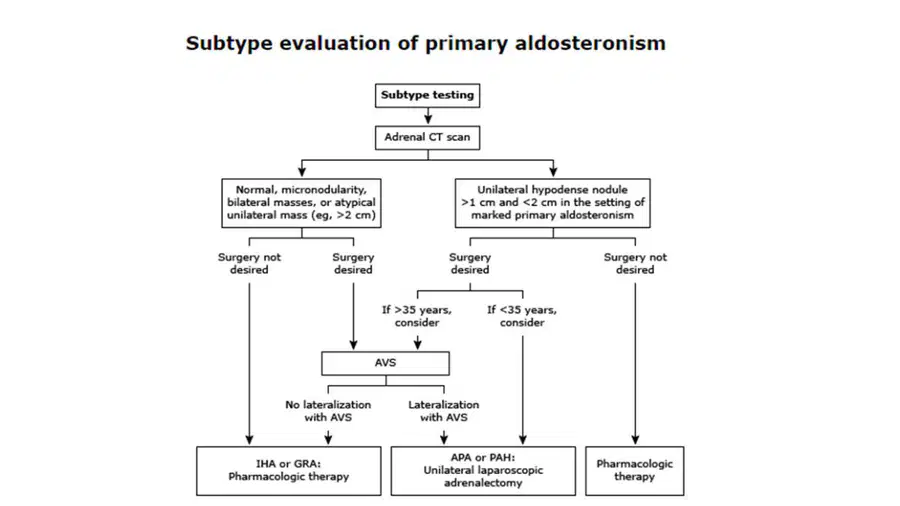
What are the treatment options for a patient with a unilateral hypodense nodule greater than 1 cm and less than 2 cm in the setting of marked primary aldosteronism?
IHA or GRA: Pharmacologic therapy
APA or PAH: Unilateral laparoscopic adrenalectomy
Pharmacologic therapy
Surgery not desired
44
45
Multiple Choice
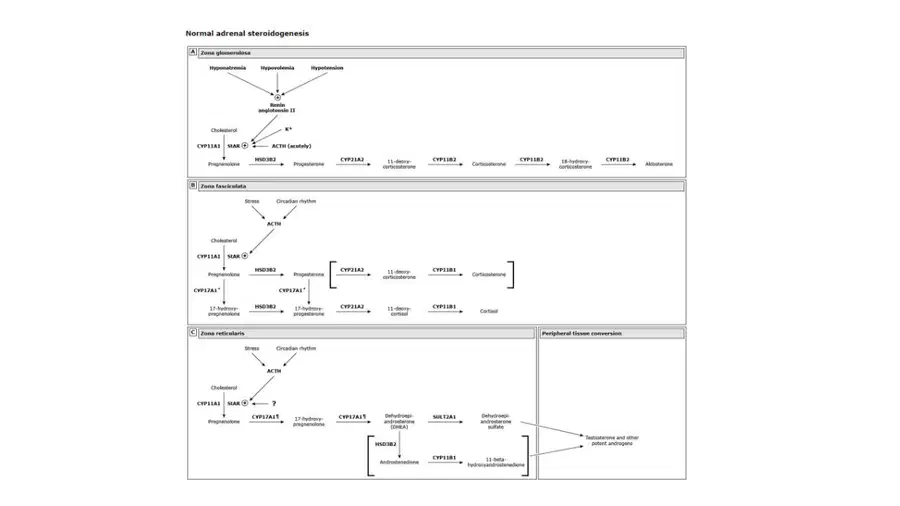
What is the role of Dehydroepiandrosterone sulfate (DHEAS) in the adrenal steroidogenesis pathway?
It is a mineralocorticoid
It is a glucocorticoid
It is a sex hormone
It is a precursor for cortisol
46
47
Multiple Choice
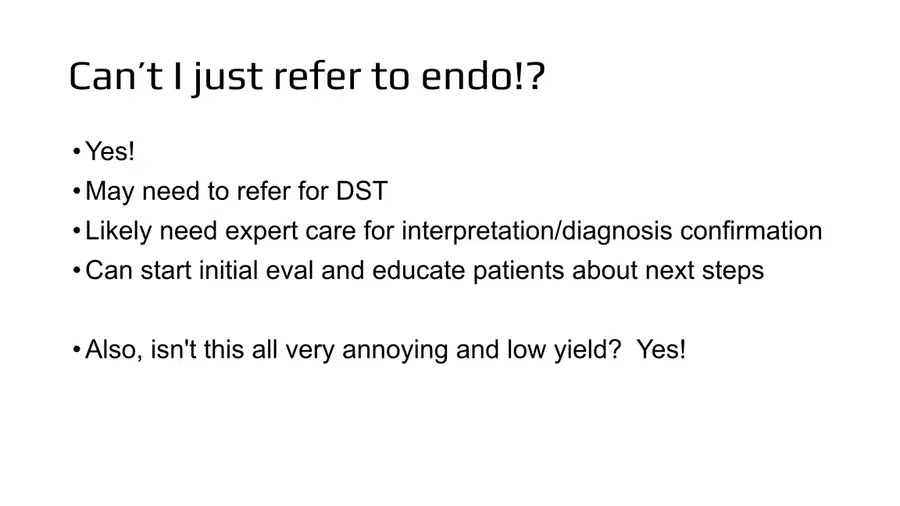
Can’t I just refer to endo!?
Yes!
May need to refer for DST
Likely need expert care for interpretation/diagnosis confirmation
Can start initial eval and educate patients about next steps
48
49
Multiple Choice
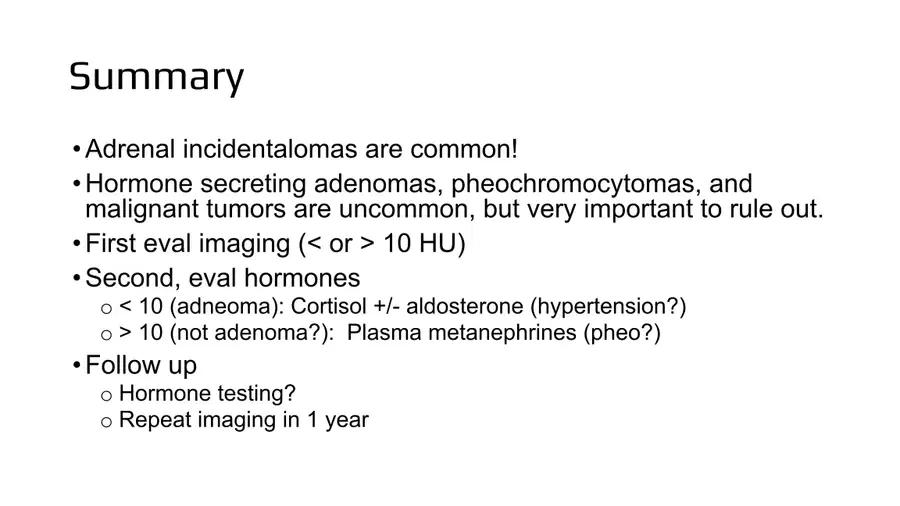
What are the first steps in evaluating adrenal incidentalomas according to the summary?
Imaging and hormone evaluation
Surgery and imaging
Hormone testing and follow-up
Immediate treatment
50
Poll
How confident do you feel about this topic now?
Show answer
Auto Play
Slide 1 / 50
SLIDE
Similar Resources on Wayground

50 questions
Презентация без названия
Presentation
•
KG - University
45 questions
Reproductive System Functions
Presentation
•
University
47 questions
CCU4 Advanced Econfig Isoelectric
Presentation
•
University
48 questions
DLE1224(5) PSYCHOLOGICAL CRIMINOLOGY
Presentation
•
University
41 questions
CHAP ONE INTRO TO BUSS COMM
Presentation
•
University
40 questions
KULIAH BIOKIMIA HORMON GENAP 24/25
Presentation
•
University
44 questions
Supply Chain Management
Presentation
•
Professional Development
Popular Resources on Wayground
10 questions
GPA Lesson
Presentation
•
9th - 12th Grade
7 questions
Albert Einstein

Quiz
•
3rd Grade
31 questions
Bridge A Review
Quiz
•
3rd Grade
6 questions
Blue Sue and Red Ruth
Quiz
•
3rd Grade
8 questions
(Day12 HW) Inverse Trig Ratios
Quiz
•
9th Grade
20 questions
Summer Geometry QUIZ (Week3)
Quiz
•
9th Grade
16 questions
Theme Practice
Quiz
•
7th Grade
20 questions
Taxes
Quiz
•
9th - 12th Grade