

AKS 10a/10b CIA Review

Presentation
•
Science
•
9th - 12th Grade
•
Hard
+13
Standards-aligned

Marissa Brown
FREE Resource
18 Slides • 34 Questions
1
By Marissa Brown
2


3
Battery
Bulb
Switch
Resistor
Circuit Symbols

4
Match
Battery
Bulb
Switch
Resistor
Battery
Bulb
Switch
Resistor
5

Comes from the battery or another voltage source
The "push" that moves electrons around the circuit
Think of it like a water pump - without the pump, the water would just sit in the pipe and not move anywhere
Voltage (v)

6
Electrons in the circuit flowing or moving around the circuit
Measured in amps
When electrons move faster, the current is greater
Like the water flowing through a pipe
Current (I)

7
Makes it harder for electrons to flow through the circuit
Measured in Ohms
Kind of like friction or sand that slows the water in the pipe down
Resistance (R)

8
Shows the relationship between current, voltage, and resistance
V is for VOLTAGE (volts)
I is for CURRENT (amps)
R is for RESISTANCE (ohms)

9
Multiple Choice
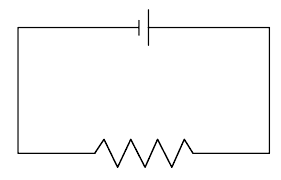
3 Amps
192 Amps
2 Amps
4 Amps
10
Multiple Choice
A light circuit is operating at 75 Volts. What is the circuit's current if the resistance is 5 Ohms?
375 Amps
50 Amps
15 Amps
0.07 Amps
11
There are 4 amps of current flowing through a circuit with a 12 volt battery. How much resistance is in the circuit?

12
Multiple Choice
How many Volts would we need to produce a current of 8 Amps through a 6 Ohm resistor?
1.33 volts
24 volts
0.75
48 volts
13
Multiple Choice
What is the voltage if a resistance of 25 Ω produces a current of 250 amperes
6250V
10V
0.1 V
625 V
14
Multiple Choice
What is the current produced by a voltage of 240 V through a resistance of 0.2 Ω
1200 Amps
48 amps
0.0008 Amps
480 Amps
15
Multiple Choice
16
Multiple Choice
17
Multiple Choice
18
Multiple Choice
19
Multiple Choice
Increase
Decrease
Stay the same
X
20
Multiple Choice
Increase
Decrease
Stay the same
X
21
Multiple Choice

What is the total amount of voltage?
9 v
18 ohms
10 ohms
3 ohms
5 ohms
22
Multiple Choice
What is the total amount of resistance?
9 v
18 ohms
18 volts
3 ohms
5 ohms
23
Multiple Choice
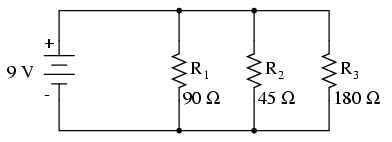
24
Multiple Choice
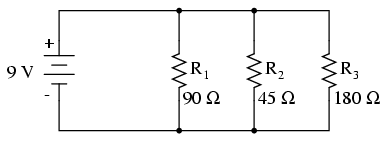
25
Multiple Choice

What is the Total Resistance in this circuit?
3 ohms
30 ohms
30 amps
90 volts
26
Multiple Choice
27

Most real circuits happen to be more complex than just open and closed circuits (simple circuits)
the complex cicuits contain multiple power sources and multiple wire pathways.
Circuits
28

29

circuits with only 1 path for electrons to travel (just like the simple circuits)
these are used in devices such as:
flashlights
lamps
refrigerators
Series Circuits
30

Pros
each part of the circuit is wired one after the other (so it is very easy to set up) and this allows a constant current to be produced
the devices don't overheat easily
Series Circuit Pros/Cons
31

Voltage, Current, and Resistance
The current is the same through every load because there is only a single path for the electricity to flow.
The total resistance is the sum of all the individual resistances.
The total voltage is shared among the components, and the sum of the voltage drops across each component equals the source voltage.
Series Circuit
32

Cons
when any part of a series circuit is disconnected, the current is not able to flow (it is an open circuit)
Series Circuit Pros/Cons
electricity is cut off from ALL parts of the circuit
dimming lights (resistance is increasing)
you need more batteries to keep the lights in series bright
33
Open Ended
What would happen in your home if it used a series circuit and you turned off one light?
34

These circuits have multiple paths for electrons to travel (unlike the simple circuits)
these are used in:
our homes
businesses
voltmeters
Parallel Circuits
35

Pros
the parts of the circuit are on separate branches
Parallel Circuit Pros/Cons
breaks in the circuit (such as an unscrewed lightbulb or burned out light) will not stop the flow of electricity to the rest of the circuit
the lightbulbs will have the same brightness with less batteries (because resistance is not decreasing)
more paths = less resistance
36

Cons
the current is not consistent
energy is used up quicker
the devices can overheat faster (causing fires because of hot wires)
Parallel Circuit Pros/Cons
37
Voltage, Current, and Resistance
voltage is the same across all components,
the total current is the sum of the individual currents through each branch
The total resistance of a parallel circuit is always less than the resistance of the smallest individual resistor.
The total current leaving the power source is the sum of the currents flowing through each individual branch.
Parallel Circuit
38
Multiple Choice

What is a Series Circuit?
A circuit with more than one path way for current to flow
A circuit with one path way with one switch.
An electric circuit with a single path for current to flow.
Two circuits with one path way for current to flow
39
Multiple Choice
What is a closed circuit?
A pathway that allows one circuit to flow
A pathway that does not allow an electric current to flow.
A Parallel circuit.
A pathway that allows an electric current to flow freely - light is on!
40
Multiple Choice
What is an open circuit?
A parallel circuit
A pathway that prevents electric current from flowing freely or stops the flow - light is off!
A series circuit
A pathway that allows electric current from flowing freely or stops the flow - light is off!
41
Multiple Choice
What is an Electric Current
The pathway through which electric current (electron) flows.
A Parallel Current
A series current
The pathway through which electric current (electron) flows.
42
Multiple Choice
What is a Conductor?
A Parallel circuit
A material that allows heat and electricity to flow through it
The pathway through which electric current (electron) flows.
A series current
43
Multiple Choice
What is an Insulator?
A material that allows heat and electricity to flow through it
The pathway through which electric current (electron) flows.
A pathway that prevents electric current from flowing freely or stops the flow - light is off!
A material that stops heat and electric current from flowing
44
Multiple Choice
What is an example of an Insulator?
Copper wire
Glass
Rubber, styrofoam, cotton
Water
45
Multiple Choice
What is an example of a Conductor?
Rubber, styrofoam, cotton
Wood
Plastic
Paperclip, penny, pencil lead
46
Multiple Choice
What is Voltage?
The energy available to move charges through a circuit
A material that allows heat and electricity to flow through it
A material that stops heat and electric current from flowing
Rubber, styrofoam, cotton
47
Multiple Choice
What is Current?
Rubber, styrofoam, cotton
The flow of electrons in a circuit
A material that stops heat and electric current from flowing
Paperclip, penny, pencil lead
48
Multiple Choice
What is a Battery?
Rubber, styrofoam, cotton
The energy available to move charges through a circuit
The flow of electrons in a circuit
The device that provides electrical energy
49
Multiple Choice
What is a Light Bulb in a circuit?
The energy available to move charges through a circuit
The device that provides electrical energy
Rubber, styrofoam, cotton
One of the parts of a circuit, when it is in a closed circuit it is lit
50
Multiple Choice
What is a wire in a circuit?
One of the parts of a circuit that carries electrons from place to place
The device that provides electrical energy
The energy available to move charges through a circuit
One of the parts of a circuit, when it is in a closed circuit it is lit
51
Multiple Choice
What is a Switch in a circuit?
One of the parts of a circuit that carries electrons from place to place
One of the parts of a circuit that carries electrons from place to place
The device that provides electrical energy
The device that opens and closes a circuit
52
Multiple Choice

What is Parallel Circuit?
A wire that has a battery and a switch.
A circuit that contains more than one path for current flow.
A circuit that contians one path for current flow
A circuit with a switch
By Marissa Brown
Show answer
Auto Play
Slide 1 / 52
SLIDE
Similar Resources on Wayground

48 questions
Bonding Theories
Presentation
•
9th - 12th Grade
51 questions
Human Impact on Earth
Presentation
•
9th - 12th Grade
46 questions
AR Verb Conjugations
Presentation
•
9th - 12th Grade
48 questions
POPULAR MEMBER SERVICES DIAGNOSTICS, HOSPITILIZATION AND SURGERY
Presentation
•
KG
46 questions
Properties of Waves
Presentation
•
9th - 12th Grade
46 questions
Intro to Muscular System and Organization
Presentation
•
9th - 12th Grade
46 questions
Sun and Electromagnetic Spectrum Lesson
Presentation
•
9th - 12th Grade
Popular Resources on Wayground
10 questions
Safety Day 2026 – Student Review

Quiz
•
9th Grade
21 questions
Continents and Oceans
Quiz
•
6th Grade
20 questions
Parts of Speech
Quiz
•
5th Grade
16 questions
Subject & Predicate
Quiz
•
5th Grade
25 questions
Multiplication Facts
Quiz
•
5th Grade
12 questions
Map Skills
Quiz
•
3rd Grade
22 questions
Continents and Oceans
Quiz
•
5th Grade
15 questions
Rounding Decimals
Quiz
•
5th Grade
Discover more resources for Science
10 questions
Exploring Chemical and Physical Changes

Interactive video
•
6th - 10th Grade
20 questions
Atomic Structure
Quiz
•
9th Grade
10 questions
Exploring the Electromagnetic Spectrum for Middle School Science
Interactive video
•
6th - 10th Grade
10 questions
Exploring Force and Motion Concepts
Interactive video
•
6th - 10th Grade
10 questions
Exploring Air Masses and Weather Fronts
Interactive video
•
6th - 10th Grade
14 questions
Periodic Trends
Interactive video
•
11th Grade
10 questions
Exploring the States of Matter
Interactive video
•
6th - 10th Grade
10 questions
Exploring Forces: Net Force, Normal Force, Gravity, and Friction
Interactive video
•
6th - 10th Grade