

Newton's First Law - Conceptual Physics Part 2

Presentation
•
Physics
•
9th - 12th Grade
•
Practice Problem
•
Easy
+4
Standards-aligned

LYDIA FILLHART
Used 2+ times
FREE Resource
27 Slides • 26 Questions
1
2
Open Ended
Why is Newton's first law also called the law of inertia, and what is its significance in understanding motion?
3
4
Multiple Choice
According to Newton's law of inertia, what will happen to an object at rest if no force acts upon it?
It will start moving on its own
It will remain at rest
It will accelerate
It will change direction
5
6
Multiple Choice
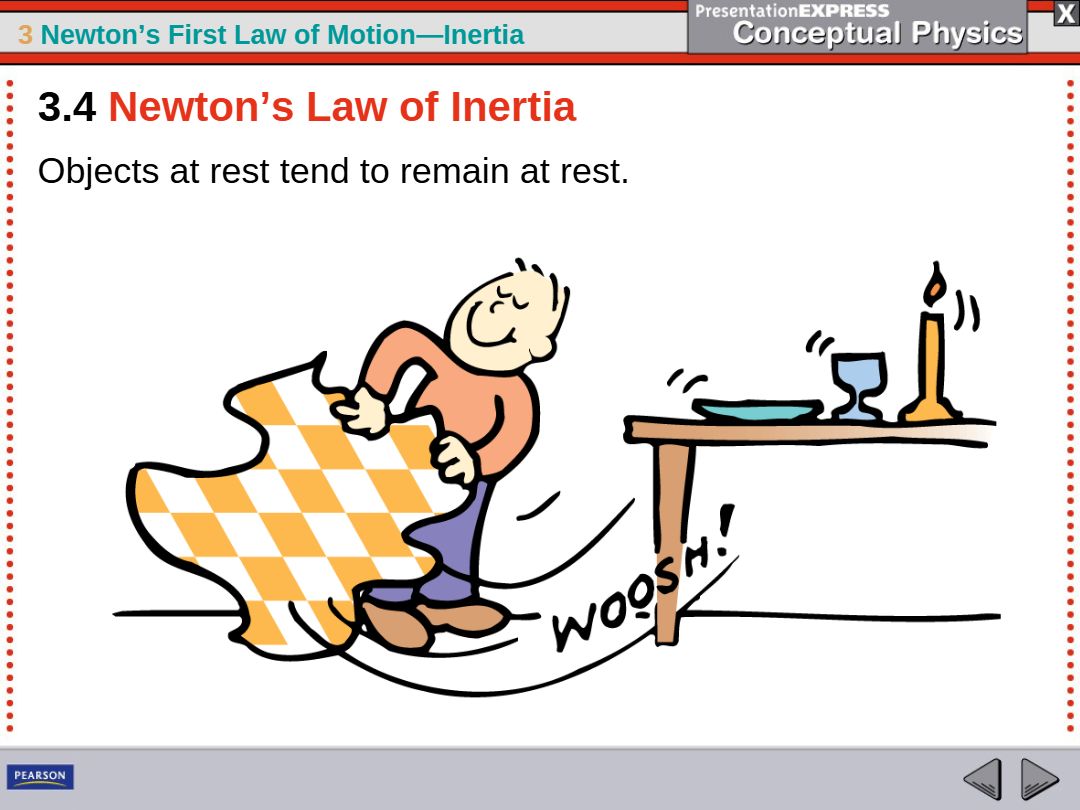
Which of the following best describes Newton's Law of Inertia as illustrated by the tablecloth trick?
Objects at rest tend to remain at rest unless acted upon by an external force.
Objects in motion tend to stop immediately when a force is applied.
Objects at rest will always start moving on their own.
Objects in motion will always change direction without a force.
7
8
9
Open Ended
Explain how Newton's Law of Inertia applies to both objects at rest and objects in motion, using examples from the slides.
10
Multiple Select
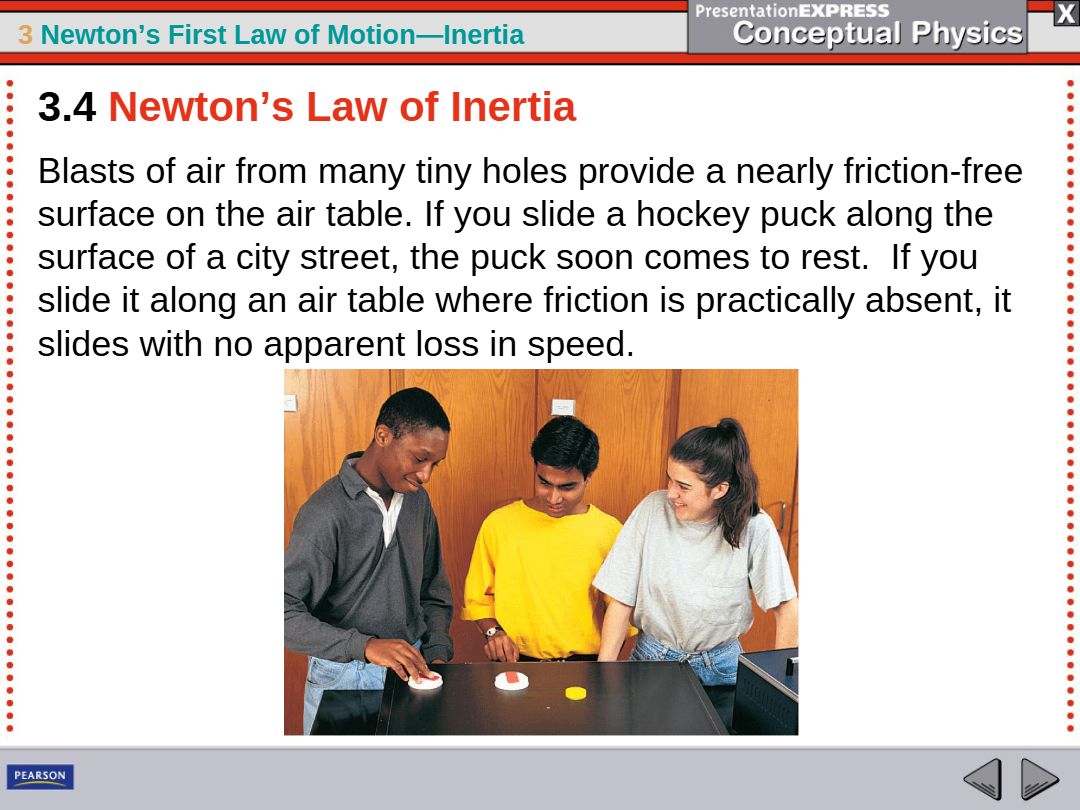
Which of the following scenarios demonstrates the effect of friction on inertia?
A hockey puck sliding on a city street comes to rest.
A puck sliding on an air table moves with no apparent loss in speed.
A ball dropped from a height falls straight down.
A car parked on a hill remains stationary.
11
12
Fill in the Blanks
The law of inertia provides a completely different way of viewing motion from the
13
14
Open Ended
A force of gravity between the sun and its planets holds the planets in orbit around the sun. If that force of gravity suddenly disappeared, in what kind of path would the planets move?
15
16
Fill in the Blanks
According to Newton's Law of Inertia, if the force of gravity disappeared, each planet would move in a
17
18
19
20
Open Ended
What is Newton’s first law of motion?
21
22

23
Multiple Select
Select all statements that are true about inertia and mass.
Mass is a measure of inertia.
Objects with more mass require more force to change their motion.
Inertia is unrelated to the amount of material in an object.
An object with less mass has less inertia.
24
Fill in the Blanks
The amount of inertia an object has depends on its
25
Multiple Choice
Which of the following statements best describes the relationship between mass and inertia?
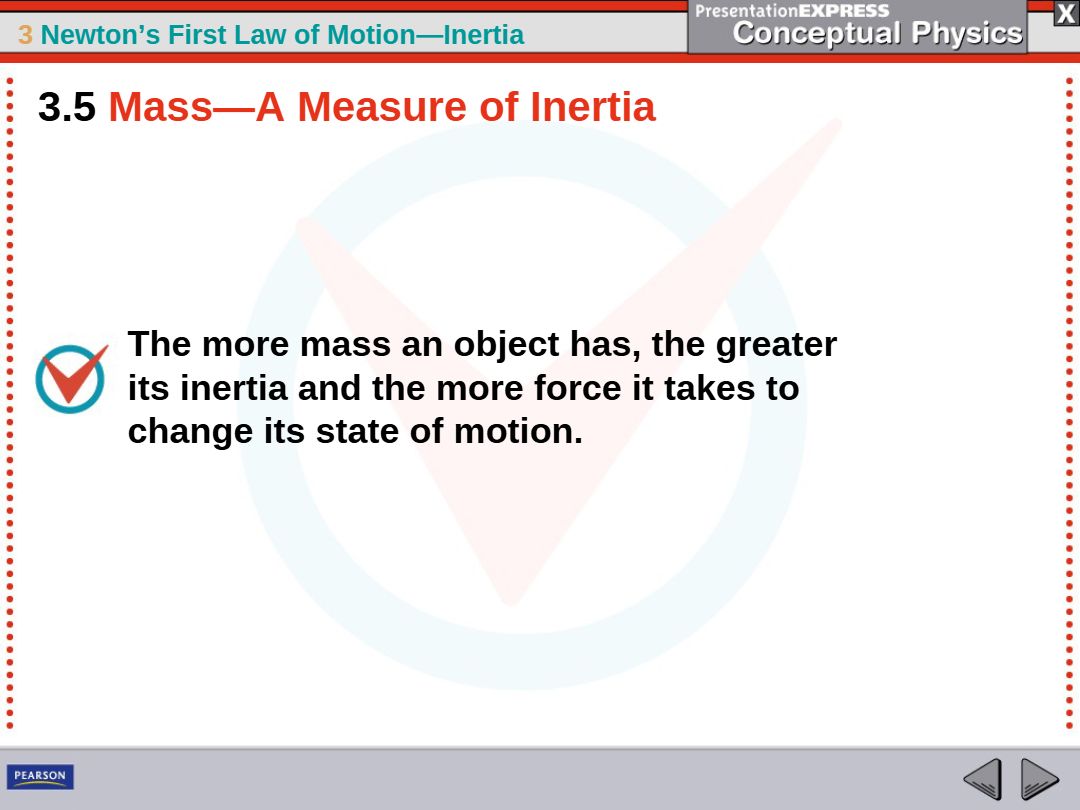
The more mass an object has, the greater its inertia.
The less mass an object has, the greater its inertia.
Mass and inertia are not related.
Inertia only depends on the shape of the object.
26

27
Open Ended
Why does a can filled with sand move less than an empty can when kicked with the same amount of force?
28
29
Multiple Choice
Which of the following statements correctly distinguishes between mass and volume?
Mass is measured in kilograms, while volume is measured in cubic units such as centimeters or liters.
Mass is measured in liters, while volume is measured in kilograms.
Both mass and volume are measured in kilograms.
Mass and volume are both measured in liters.
30

31
Multiple Choice
Which has more mass, a feather pillow or a common automobile battery?
A feather pillow
A common automobile battery
Both have the same mass
It depends on their size
32
33
Open Ended
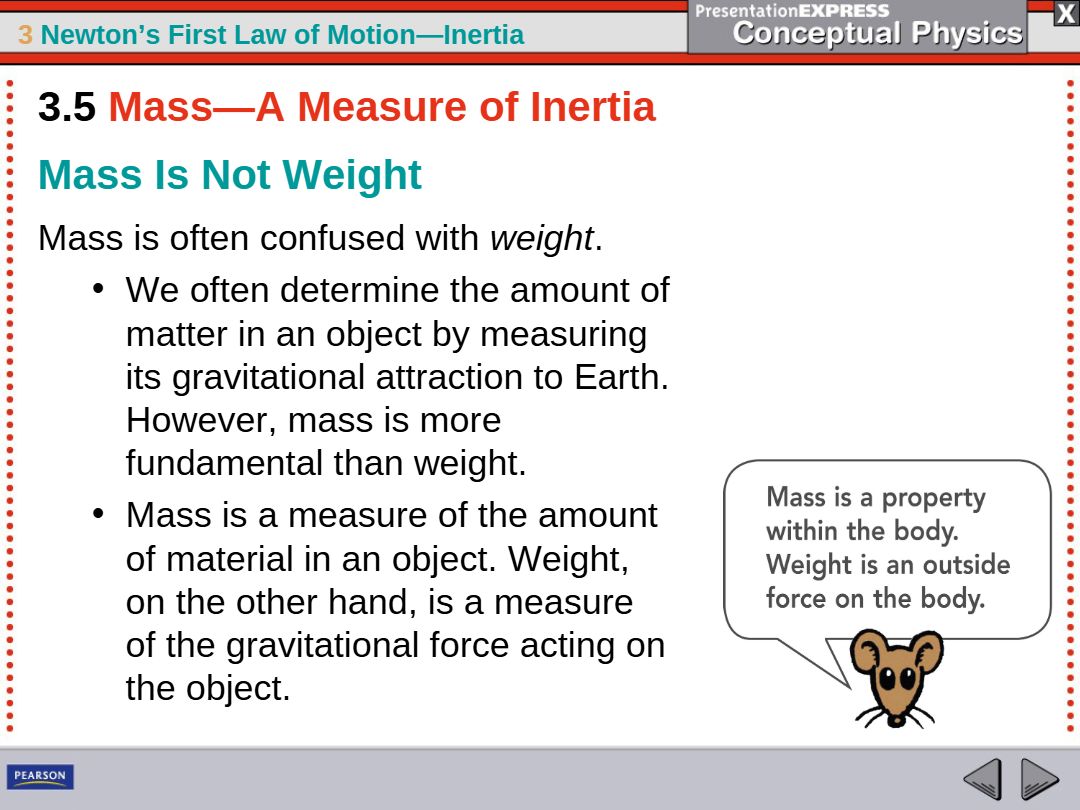
Explain the difference between mass and weight, and why mass is considered more fundamental than weight.
34
35
Fill in the Blanks
The mass of a stone remains the same whether it is on Earth, the moon, or in outer space. However, its
36

37
38
Open Ended
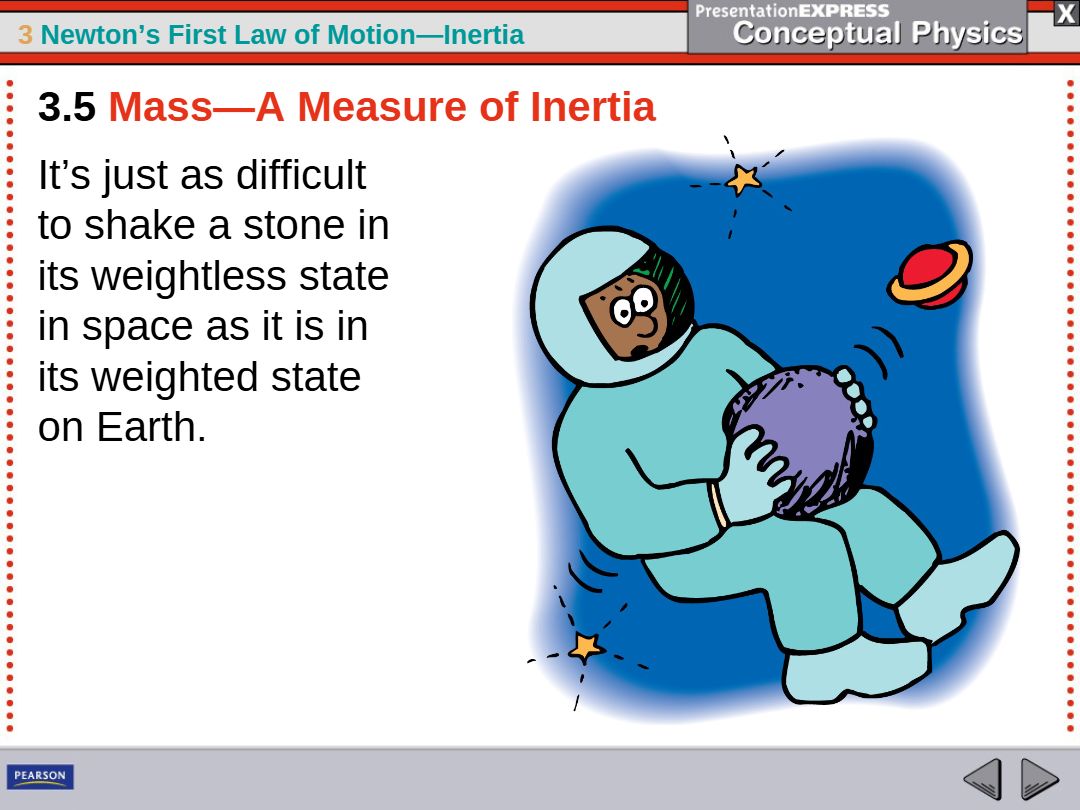
Why is it just as difficult to shake a stone in its weightless state in space as it is in its weighted state on Earth?
39
Multiple Select
Select all the correct statements about mass and inertia.
Mass is a property of an object that does not depend on its location.
The inertia of an object is directly related to its mass.
The force required to shake an object changes depending on its location.
Mass and inertia are independent of each other.
40
41
Multiple Choice
Which of the following best describes the relationship between mass and inertia?
Mass is a measure of inertia, or the resistance of an object to changes in its state of motion.
Mass is the force of gravity on an object.
Mass and inertia are unrelated properties.
Inertia is the force that acts on mass.
42
43
Open Ended
Explain how mass and weight are related, and why they are not considered equal to each other.
44
45
46
Fill in the Blanks
The SI unit of force is the
47
48
Multiple Select
Select all statements that are true about the relationship between mass, weight, and location.
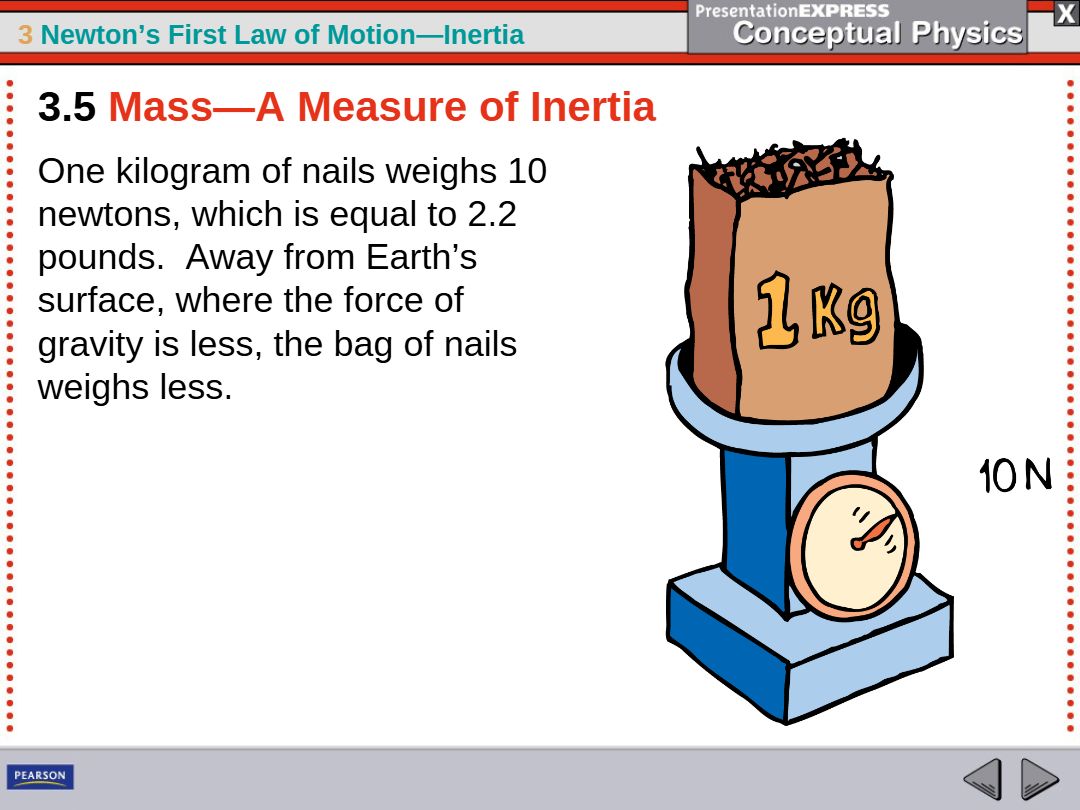
At Earth's surface, 1 kilogram weighs 10 newtons.
Away from Earth's surface, the same mass weighs less due to lower gravity.
Mass and weight are always equal.
Weight depends on the gravitational pull at a location.
49
50
Open Ended
Does a 2-kilogram bunch of bananas have twice as much inertia, mass, volume, and weight as a 1-kilogram loaf of bread when weighed in the same location? Explain your reasoning.
51
52
Open Ended
Reflecting on Newton's law of inertia, how do you think this principle applies to everyday situations you have observed or experienced?
53
Multiple Choice
How does Newton's first law, also known as the law of inertia, relate to Galileo's idea about forces and motion?
It states that a force is always needed to keep an object moving.
It is a restatement that a force is not needed to keep an object moving.
It says objects at rest will always start moving on their own.
It claims that motion is impossible without gravity.
Show answer
Auto Play
Slide 1 / 53
SLIDE
Similar Resources on Wayground

45 questions
Trigonometric Ratios
Presentation
•
9th - 12th Grade
47 questions
Scalars and Vectors
Presentation
•
9th - 12th Grade
50 questions
Study Guide: Newton's Laws and Forces
Presentation
•
9th - 12th Grade
47 questions
Scalars and Vectors
Presentation
•
9th - 12th Grade
49 questions
Multistep equations Mastery review
Presentation
•
9th - 12th Grade
46 questions
Song: La invitación (Pre-song story, 2021)
Presentation
•
9th - 11th Grade
50 questions
Adaptive Value of Behavior
Presentation
•
9th - 12th Grade
Popular Resources on Wayground
10 questions
Safety Day 2026 – Student Review

Quiz
•
9th Grade
21 questions
Continents and Oceans
Quiz
•
6th Grade
20 questions
Parts of Speech
Quiz
•
5th Grade
16 questions
Subject & Predicate
Quiz
•
5th Grade
25 questions
Multiplication Facts
Quiz
•
5th Grade
12 questions
Map Skills
Quiz
•
3rd Grade
22 questions
Continents and Oceans
Quiz
•
5th Grade
15 questions
Rounding Decimals
Quiz
•
5th Grade
Discover more resources for Physics
20 questions
Position vs. Time Graphs
Quiz
•
9th Grade
10 questions
Exit Check 5.1 - Forms of Energy
Quiz
•
9th Grade
11 questions
Electricity Explained

Interactive video
•
9th - 12th Grade
87 questions
25-26 Unit 1.2 Review - Radioactivity & Earth's Age
Quiz
•
8th - 10th Grade
15 questions
Position vs. Time and Velocity vs. Time Graphs
Quiz
•
10th - 12th Grade
18 questions
Quiz #8 Practice: Forces on an Incline
Quiz
•
9th Grade
25 questions
Newton's Laws of Motion
Quiz
•
9th Grade