

Electric and magnetic force on a charged particle

Presentation
•
Physics
•
9th - 12th Grade
•
Practice Problem
•
Medium

Nauman Ali
Used 1+ times
FREE Resource
15 Slides • 16 Questions
1
Multiple Choice
Which of the following best describes the significance of studying electric and magnetic forces on particles?
It helps us understand how charged particles behave in different environments, which is crucial for technology and scientific research.
It is only important for understanding magnets.
It has no real-world applications.
It is mainly about electricity in homes.
2
3

4
5
6
Multiple Choice
Which law states that the acceleration of an object is proportional to the net force and inversely proportional to the mass of the object being accelerated?
Newton's first law
Newton's second law
Newton's third law
Law of conservation of mass
7
8
Open Ended
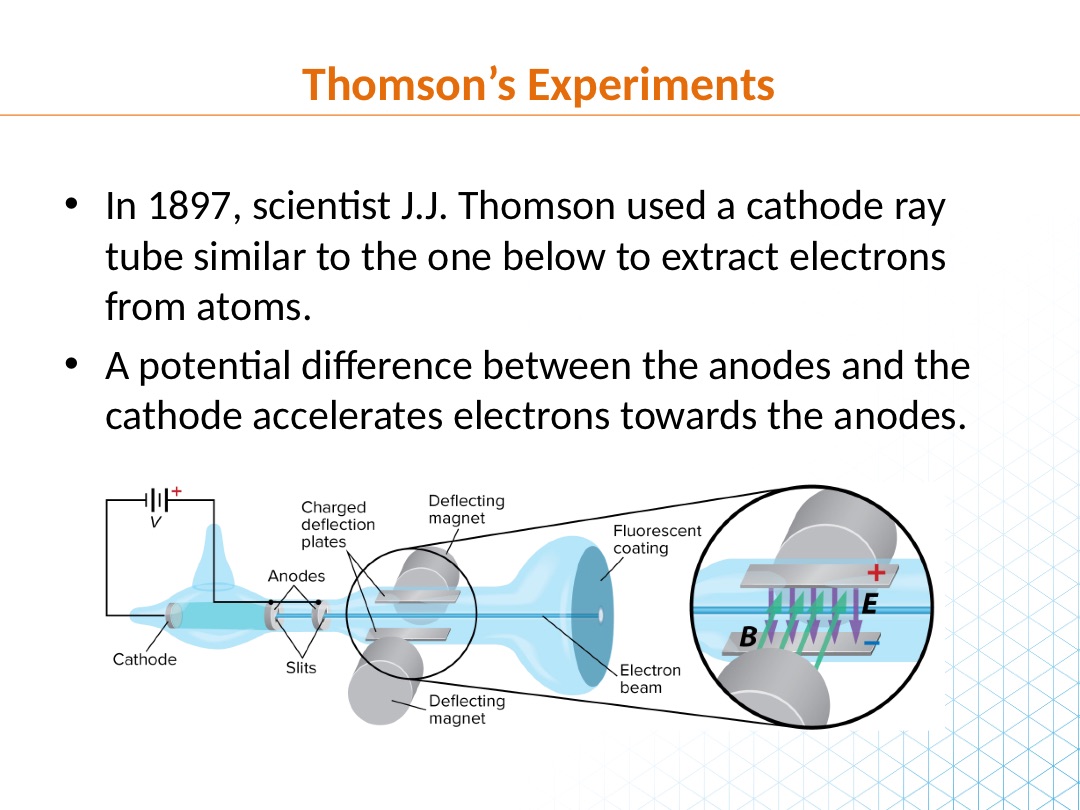
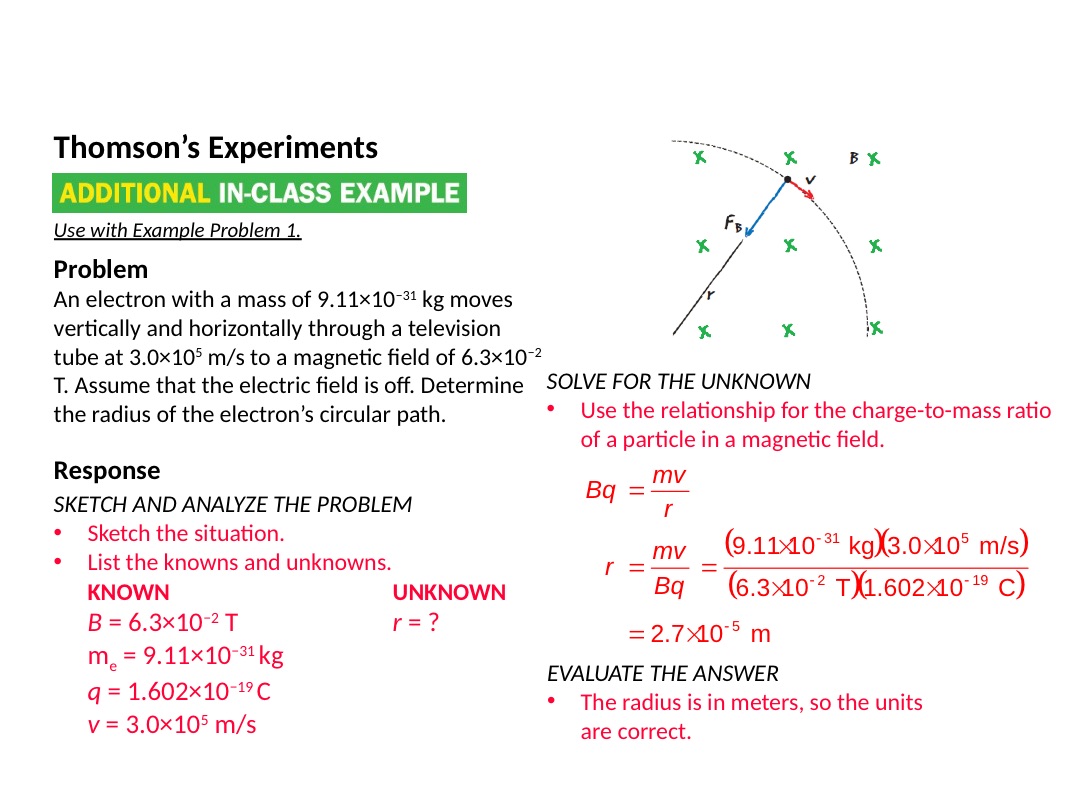
Describe the main steps and purpose of J.J. Thomson's cathode ray tube experiment.
9

10
Multiple Choice
What equation did Thomson use to determine the charge-to-mass ratio of an electron, and what value did he obtain for q/m?
q/m = v/Br; -1.759 × 10^11 C/kg
q/m = F/m; -1.602 × 10^-19 C/kg
q/m = E/B; 9.11 × 10^-31 C/kg
q/m = v/r; 1.759 × 10^11 C/kg
11
12
Fill in the Blanks
Type answer...
13
14
Open Ended
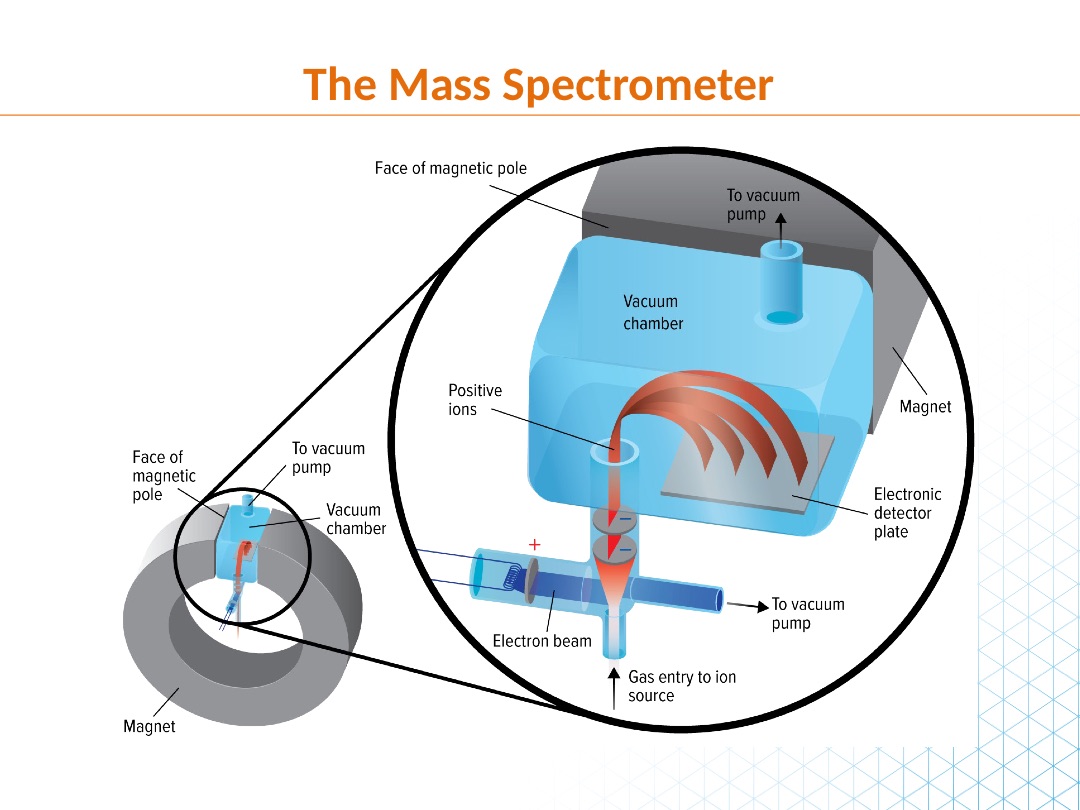
Explain how a mass spectrometer can be used to determine the relative abundance of isotopes in a sample.
15
Multiple Select
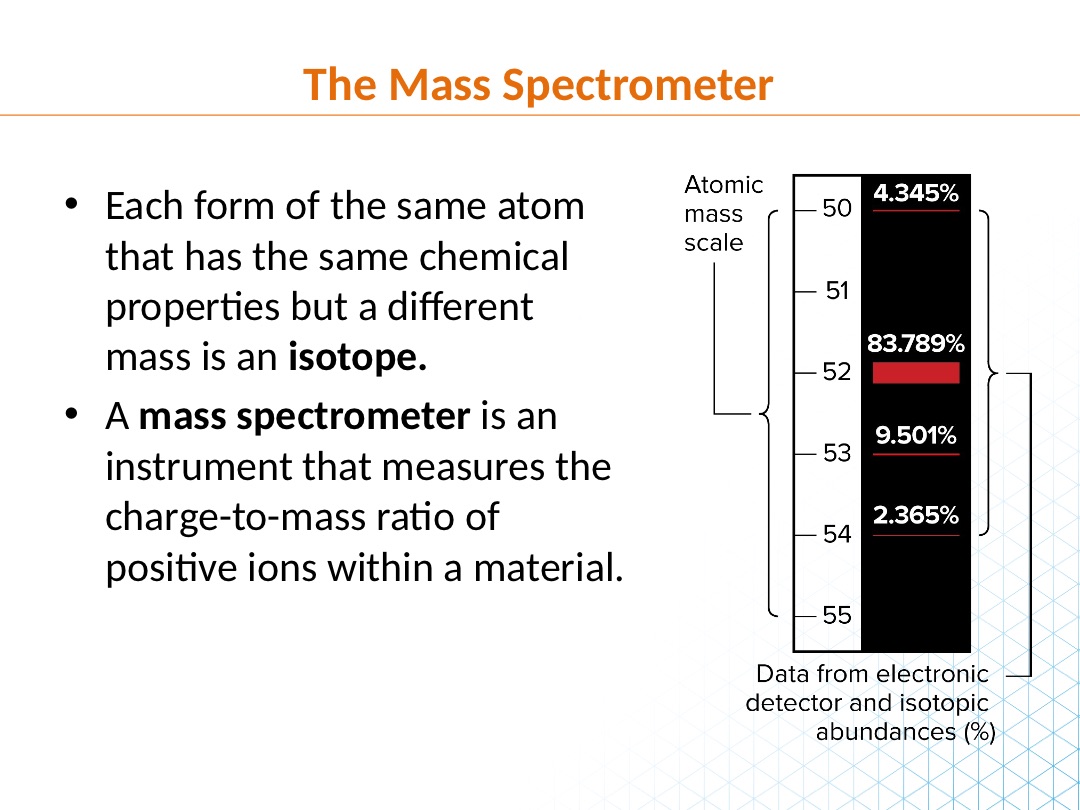
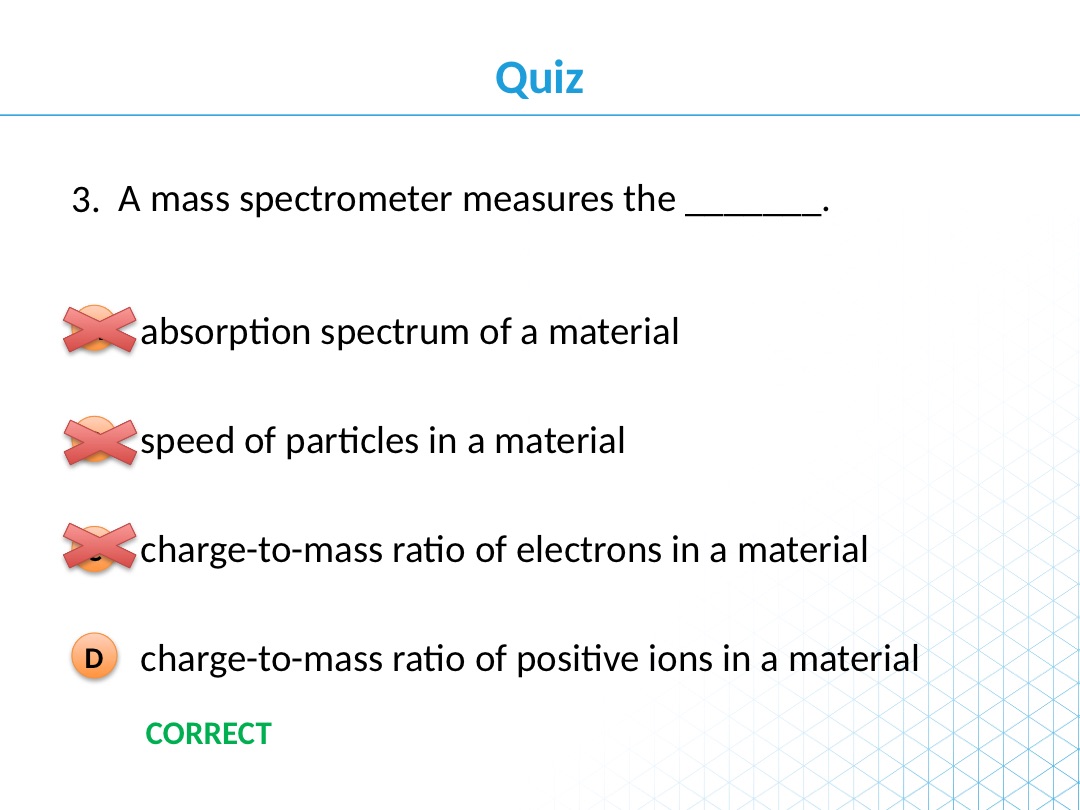
Which of the following statements about isotopes and mass spectrometers are correct?
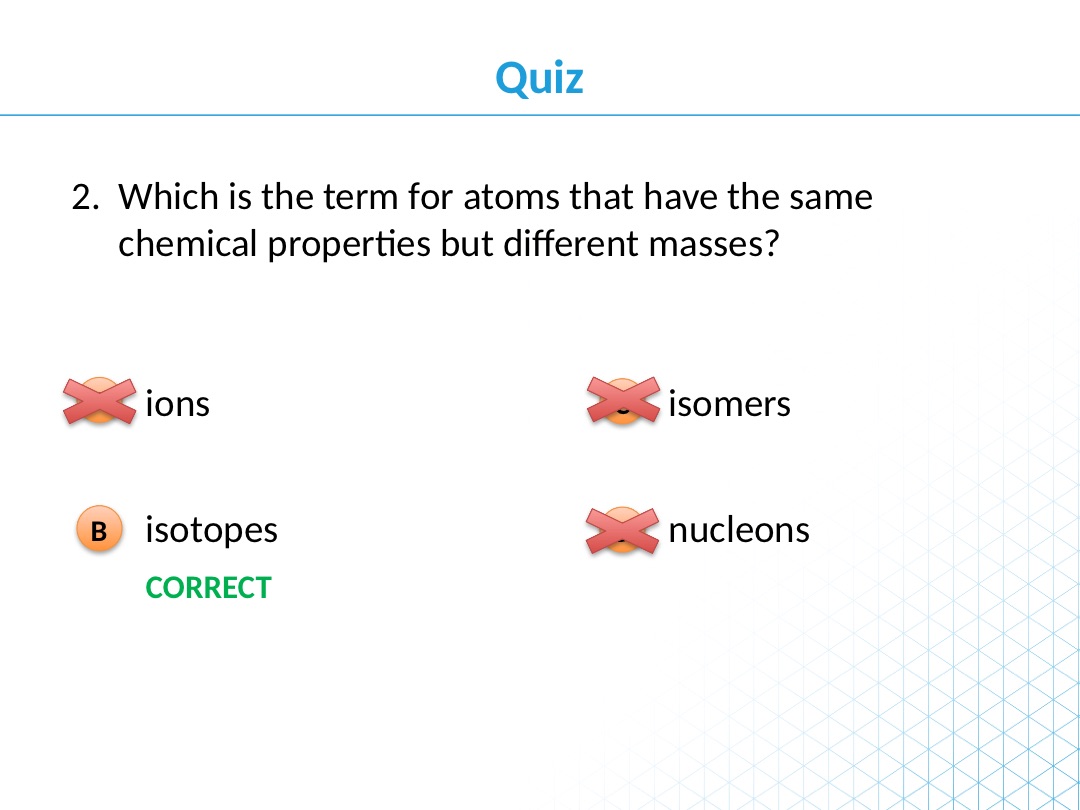
Isotopes have the same chemical properties but different masses.
A mass spectrometer measures the charge-to-mass ratio of positive ions.
Isotopes have different chemical properties but the same mass.
A mass spectrometer measures the mass of electrons.
16
17
Multiple Choice
Which component in a mass spectrometer is responsible for separating ions based on their mass-to-charge ratio?
Vacuum chamber
Magnet
Gas entry to ion source
Electronic detector plate
18
19
Multiple Select
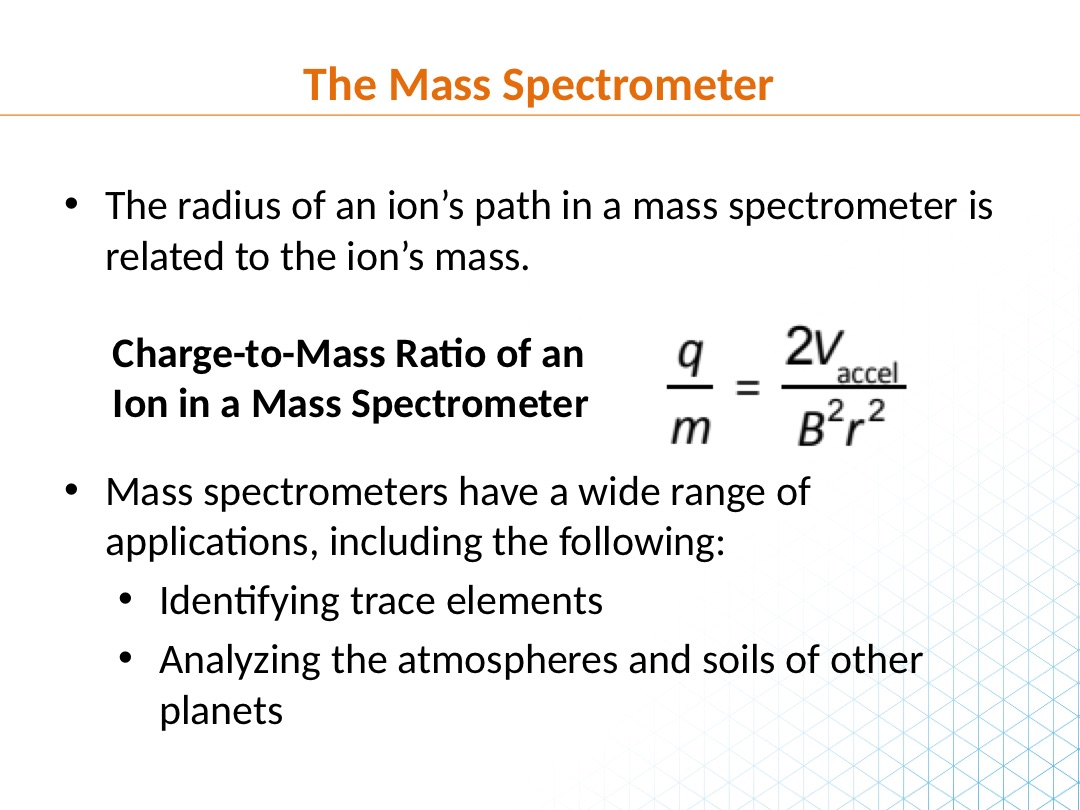
Which of the following are applications of mass spectrometers?
Identifying trace elements
Analyzing the atmospheres and soils of other planets
Measuring the speed of light
Determining the boiling point of substances
20
Fill in the Blanks
Type answer...
21
Open Ended
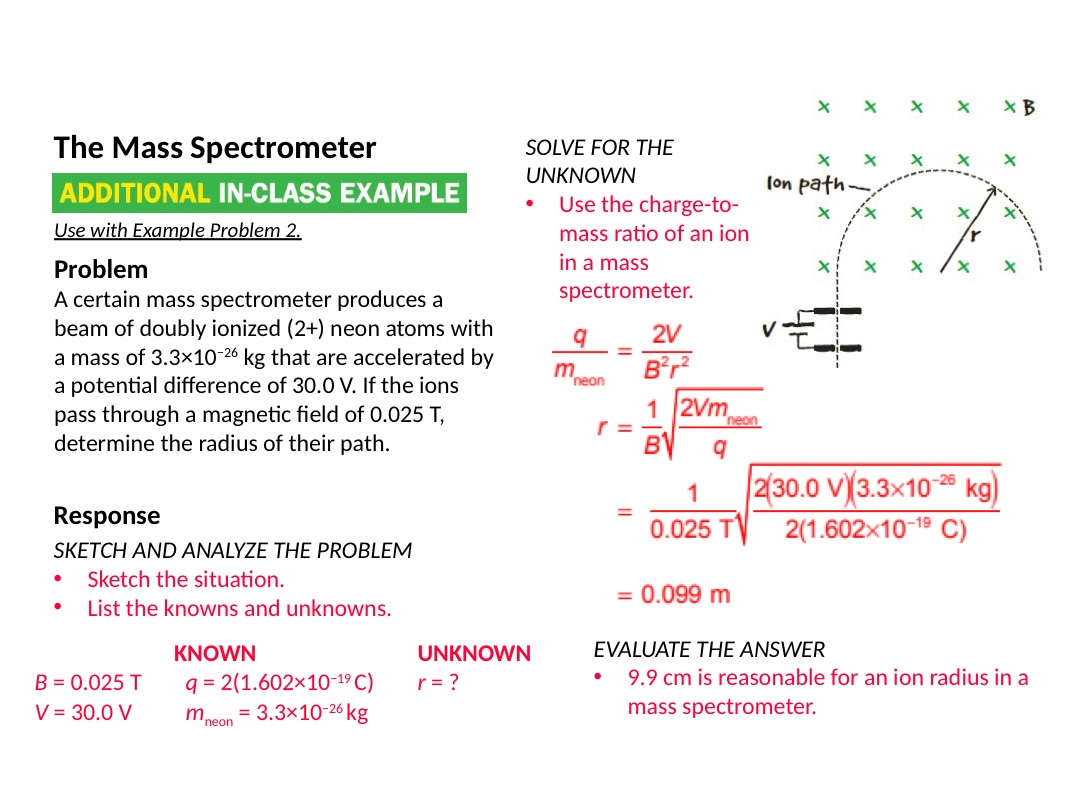
Explain how the radius of an ion's path in a mass spectrometer is related to its mass and what information this provides about the ion.
22
23
Open Ended
Describe the steps involved in determining the radius of an ion's path in a mass spectrometer, using the provided example of doubly ionized neon atoms.
24
Multiple Choice
In the example problem, what is the value of the magnetic field (B) used to determine the radius of the ion path?
0.025 T
30.0 V
3.3×10^-26 kg
1.602×10^-19 C
25

26
27
28
29
Open Ended
What is one concept about electric and magnetic forces on particles that you would like to learn more about or found most interesting in this lesson?
30
Open Ended
How does a mass spectrometer work?
31
Multiple Choice
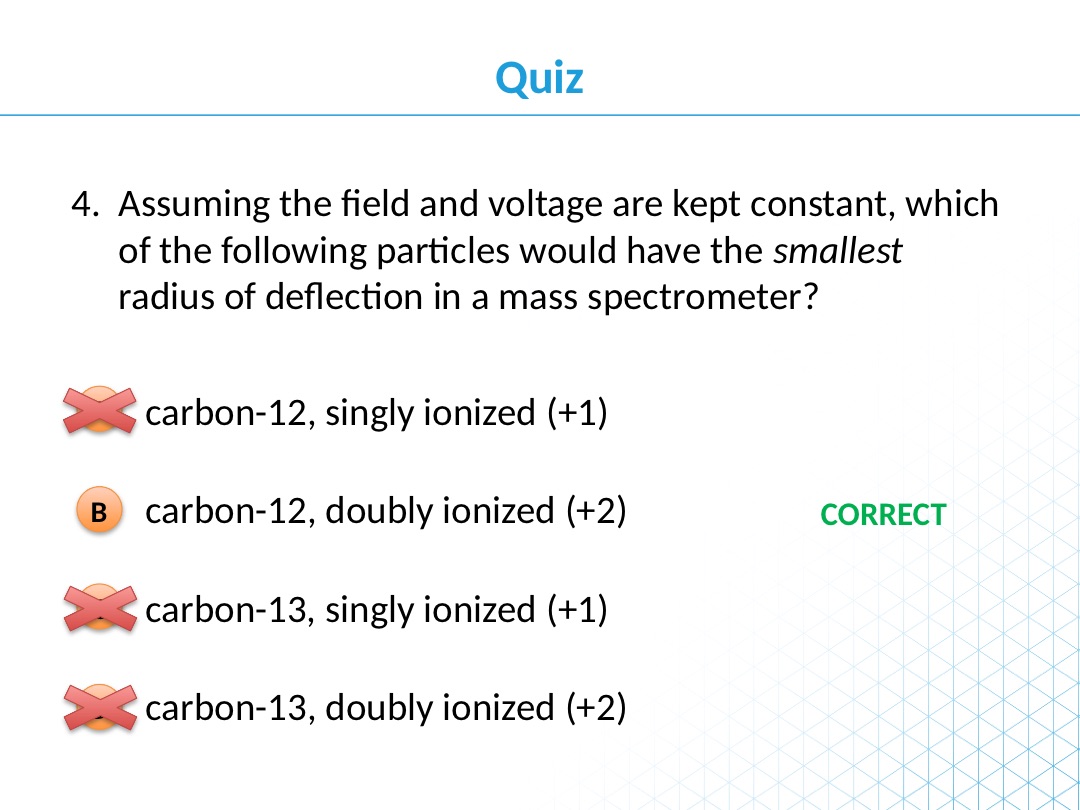
Assuming the field and voltage are kept constant, which of the following particles would have the smallest radius of deflection in a mass spectrometer?
carbon-12, singly ionized (+1)
carbon-12, doubly ionized (+2)
carbon-13, singly ionized (+1)
carbon-13, doubly ionized (+2)
Which of the following best describes the significance of studying electric and magnetic forces on particles?
It helps us understand how charged particles behave in different environments, which is crucial for technology and scientific research.
It is only important for understanding magnets.
It has no real-world applications.
It is mainly about electricity in homes.
Show answer
Auto Play
Slide 1 / 31
MULTIPLE CHOICE
Similar Resources on Wayground

23 questions
unit 7 -- intro to work
Presentation
•
9th - 12th Grade
20 questions
Energy review
Presentation
•
9th - 12th Grade
25 questions
Crime Scene Investigation and Evidence Collection Part 2
Presentation
•
9th - 12th Grade
25 questions
Mandatos informales (+)(-)
Presentation
•
9th - 12th Grade
25 questions
newton's laws
Presentation
•
9th - 12th Grade
23 questions
5.3: Ser vs Estar
Presentation
•
9th - 12th Grade
20 questions
HP 7-2: Transverse Waves
Presentation
•
9th - 12th Grade
Popular Resources on Wayground
24 questions
PBIS-HGMS Day 10

Quiz
•
6th - 8th Grade
10 questions
HCS SCI 03 Summer School Review 3
Quiz
•
3rd Grade
11 questions
Home Scope
Quiz
•
7th - 8th Grade
15 questions
HCS SCI 05 Summer School Assessment 3 Review
Quiz
•
5th Grade
35 questions
Lufkin Road Middle School Student Handbook & Policies Assessment
Quiz
•
7th Grade
18 questions
Geo 11.3 Area of Circles and Sectors
Quiz
•
9th - 11th Grade