CO Category 2 Astronomy
Presentation
•
Physics
•
9th Grade
•
Medium
IRENE C. SANCHEZ
Used 1+ times
FREE Resource
17 Slides • 44 Questions
1
CO : Category 2 (Astronomy)
By IRENE C. SANCHEZ
2
Astronomy
3
Multiple Choice
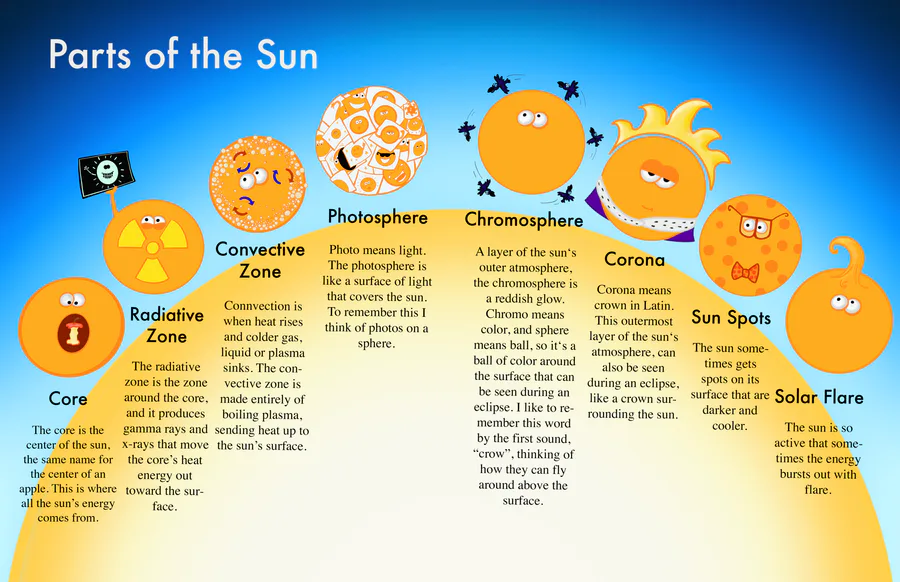
This layer is the visible "surface" of the sun that we see.
The convection zone
The corona
The chromopshere
The photosphere
4
Multiple Select
Which of these are considered the three interior layers of the sun?
The core
The radiation zone
The convection zone
The corona
5
6
7
Multiple Choice
A star is formed when:
nuclear fusion begins
a nebula becomes a protostar
a supernova occurs
All hydrogen is changed to helium
8
Multiple Choice
Protostar
Nebula
Main Sequence
Red Giant
9
Multiple Choice
Old stars can form new stars because
A supernove explosion creates nebula
A big star explodes into smaller stars
A black hole takes light from old stars and gives it to new stars
10
Multiple Choice
11
Multiple Choice
12
13
Multiple Choice
Which of the following shows the correct order of spectral types from coolest to hottest?
O - B - A - F - G - K - M
M - K - G - F - A - B - O
A - B - F - G -K - M - O
14
Multiple Choice
Which of the following properties depends on the distance from Earth?
Absolute magnitude
Apparent magnitude
Surface temperature
Spectral type
15
Multiple Choice
Stars are classified by their brightness and temperature on the H-R diagram. How would you describe a white dwarf star, compared to most other stars?
A white dwarf has a lower temperature and is brighter than most stars.
A white dwarf has a higher temperature and is brighter than most stars.
A white dwarf has a lower temperature and is not as bright as most stars.
A white dwarf has a higher temperature and is not as bright as most stars.
16
Multiple Choice
Which star is brighter in terms of absolute magnitude: a star with an absolute magnitude of -1 or a star with an absolute magnitude of 3?
The star with an absolute magnitude of -1
The star with an absolute magnitude of 3
Both stars have the same brightness
Cannot be determined from the given information
17
18
19
Multiple Choice
What type of galaxy is this?
Spiral
Elliptical
Irregular
20
Multiple Choice
This type of galaxy is active, young galaxy with a black hole at their center
elliptical
quasar
spiral
irregular
21
Multiple Choice
Stars are still forming in these types of galaxies, with a clearly defined structure.
One of the most common types of galaxies
What am I?
Spiral
Elliptical
Irregular
22
23
Multiple Choice
a type of matter that fills space and is undetectable at the moment
Dark Matter
Invisiible Matter
Dark Filler
Empty Space
24
Multiple Choice
a change in wavelength of a wave due to the source and observer moving closer or farther apart
Doppler Effect
Siren Shift
Duck Wake
Distance Effect
25
Multiple Choice
leftover thermal energy from the big bang
solar nebula
cosmic background radiation
planetesimal
dark matter
26
Multiple Choice
27
28
Multiple Choice
What type of radiation in the universe is believed to the residue of the early universe?
cosmic background microwave
infrared rays
radio waves
ultraviolet waves
29
Multiple Choice
What is the central idea of the big bang theory?
All matter in the universe started
at a single point of origin.
As the universe continues to
expand, it will eventually
collapse.
When two or more galaxies
collide, a big bang occurs.
The current universe is at its
original location of the cosmic
explosion.
30
Multiple Choice
Most of the universe is made of
visible matter
dark matter
dark energy
dark energy and dark matter
31
Multiple Choice
A force that speeds up the expansion of the universe is called
supernova
gravity
dark energy
dark matter
32
Multiple Choice
What does dark matter not interact with?
Time
Black holes
Light or normal matter
Gravity
33
Multiple Choice
How does dark energy differ from dark matter?
Dark energy is visible, dark matter is not
Dark energy causes expansion, dark matter causes attraction
Dark energy is a form of matter, dark matter is energy
Dark energy interacts with light, dark matter does not
34
35
36
Multiple Choice
series of missions designed to send people to the moon and back
Apollo
Mercury
Gemini
Artemis
37
Multiple Choice
Cosmic Microwave Background Radiation is a form of _________.
Matter
Energy
Visible Light
Water
38
Multiple Choice
How does Cosmic Microwave Background Radiation support the Big Bang Theory?
Microwaves are found everywhere in the universe.
Microwaves occurred at the time of the Big Bang
Microwaves are useful in our everyday lives
39
Multiple Choice
Hubble's Law describes that the galaxies that are the farthest away from us are...
moving away the fastest.
moving toward us the fastest.
not moving at all.
disappearing.
40
41
Multiple Choice
What year did humans broadcast a radio message containing information about the human race?
1980
1974
1999
1960
42
Multiple Choice
What is the habitable zone?
the area in the universe where life could exist
the area on a planet where life could exist
the area in a galaxy where life could exist
the area around a star where life on a planet could exist
43
Multiple Choice
What is the Fermi Paradox?
Even with the huge number of planets in the Milky Way, we haven't seen any signs of aliens
It would take a couple of million years to colonize the whole galaxy.
There are three different possible levels for a civilization.
There are no aliens in the universe.
44
Multiple Choice
Drake's equation predicts the possibility of _____ life or civilizations in our galaxy.
microbial
basic
intelligent
multi-cellular
45
Multiple Choice
This type of Supernova has very little remnants.
Type I
Type II
Type A
Type B
46
Multiple Choice
Which of the following is a distinguishing property of a neutron star?
Spinning Rapidly
Strong Magnetic Field
Density beyond belief
All of the above
47
Multiple Choice
What conditions must exist for a black hole to form?
When the core remnants of a Supernova I are greater than 3 solar masses.
When core remnants of a Supernova II are less than 3 solar masses.
When core remnants of a Supernova II are greater than 3 solar masses.
When the core remnants of any type of Supernova are greater than 1 solar mass.
48
49
Multiple Choice
There are two types of GRBs. The shorter ones that last only milliseconds come from ___
galactic collisions
supergiants
hypernovae
neutron star collisions
50
Multiple Choice
Every time we see a gamma ray burst, we’re witnessing ___
a neutron star dying
a galaxy dying
a black hole being born
a galaxy being born
51
Multiple Choice
Due to the USA’s distrust of the Soviets, we launch a series of satellites called Vela to detect…
UV light
X-rays
Infrared
Gamma-Rays
52
Multiple Select
What makes Quasars the most awesome astrophysical phenomena? (Check all that apply)
The spear through black holes
They have super massive black hole
They are surrounded by a solar system sized whirl-pool of plasma that shines brighter than an entire galaxy.
Quasars help shape our universe
53
Multiple Choice
What is a quasar?
A type of star
A small planet
The extremely luminous nucleus of a galaxy
A type of black hole
54
55
56
57
Multiple Choice
series of missions designed to send people to the moon and back
Apollo
Mercury
Gemini
Artemis
58
Multiple Choice
What is the main purpose of the New Horizons mission?
To land on Pluto
To explore the outer planets
To return samples to Earth
To orbit the Sun
59
Multiple Choice
What is the main purpose of the Curiosity rover's mast?
To store samples
To carry stereo cameras and a laser
To provide power
To communicate with Earth
60
61
Multiple Choice
What fundamental question does the Fermi Paradox address regarding extraterrestrial life?
Why are there so few planets in the universe?
Why haven't we found evidence of intelligent alien civilizations despite the vastness and age of the universe?
How do black holes form in distant galaxies?
What is the origin of the Milky Way galaxy?
CO : Category 2 (Astronomy)
By IRENE C. SANCHEZ
Show answer
Auto Play
Slide 1 / 61
SLIDE

Similar Resources on Wayground
55 questions
Earth Science Review Lesson
Presentation
•
8th Grade
55 questions
Science TCAP Practice
Presentation
•
8th Grade
58 questions
Africa Map 1
Presentation
•
9th Grade
53 questions
SSA Earth Review All Topics
Presentation
•
9th Grade
58 questions
Petroski - Physical Science LEAP Review
Presentation
•
8th Grade
53 questions
Forces in Motion
Presentation
•
8th Grade
57 questions
Waves
Presentation
•
10th Grade
58 questions
Executive Branch part 1
Presentation
•
9th Grade
Popular Resources on Wayground
20 questions
STAAR Review Quiz #3
Quiz
•
8th Grade
20 questions
Equivalent Fractions
Quiz
•
3rd Grade
6 questions
Marshmallow Farm Quiz
Quiz
•
2nd - 5th Grade
20 questions
Main Idea and Details
Quiz
•
5th Grade
20 questions
Context Clues
Quiz
•
6th Grade
20 questions
Inferences
Quiz
•
4th Grade
19 questions
Classifying Quadrilaterals
Quiz
•
3rd Grade
12 questions
What makes Nebraska's government unique?
Quiz
•
4th - 5th Grade