

Intro to Crime Scene

Presentation
•
Specialty
•
9th - 12th Grade
•
Practice Problem
•
Medium

Jennifer Sneed
Used 1+ times
FREE Resource
37 Slides • 18 Questions
1

2

3

4

5

6

7

8
Multiple Choice
Which of the following best describes an affidavit?
A written statement made under oath declaring information is true to the best of one's knowledge.
A verbal agreement between two parties.
A document used to transfer property ownership.
A type of legal punishment.
9
Multiple Select
Which of the following statements about 'curtilage' are correct?
It includes the yard, driveway, or fenced-in space around a home.
It is part of the property and receives the same legal protection as the house.
It refers to public parks near a home.
It is considered the 'home's personal space.'
10
Multiple Choice
Which of the following best describes a dwelling?
A place where people live, such as a house or apartment
A location where a crime has occurred
A place where evidence is stored
A location where police officers work
11

12

13

14
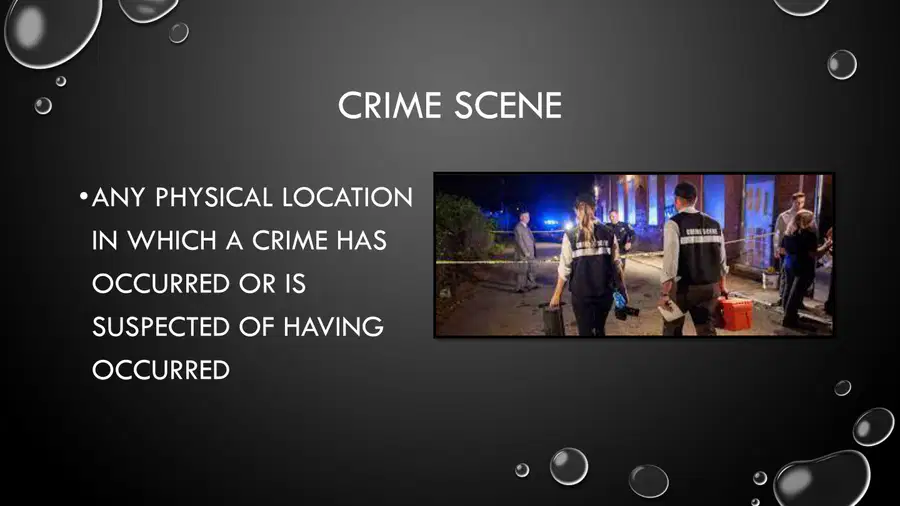
15
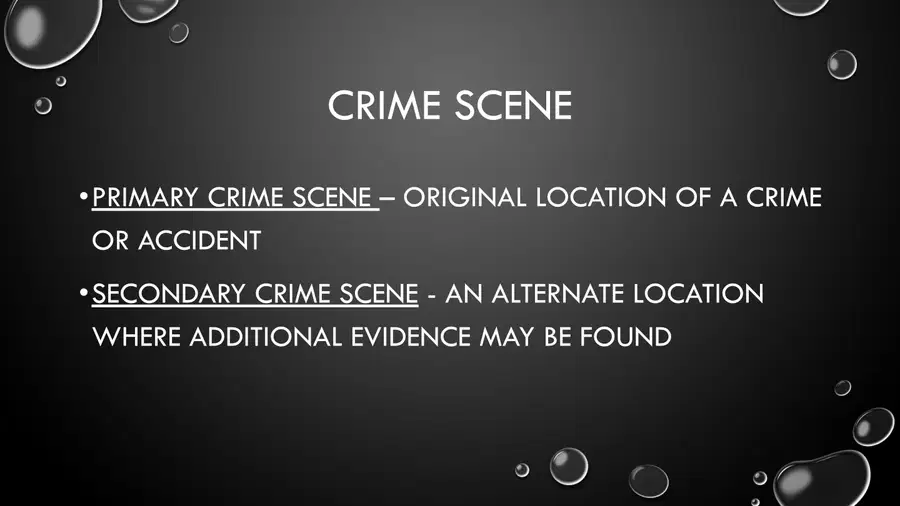
16
Open Ended
Explain the difference between a primary crime scene and a secondary crime scene.
17
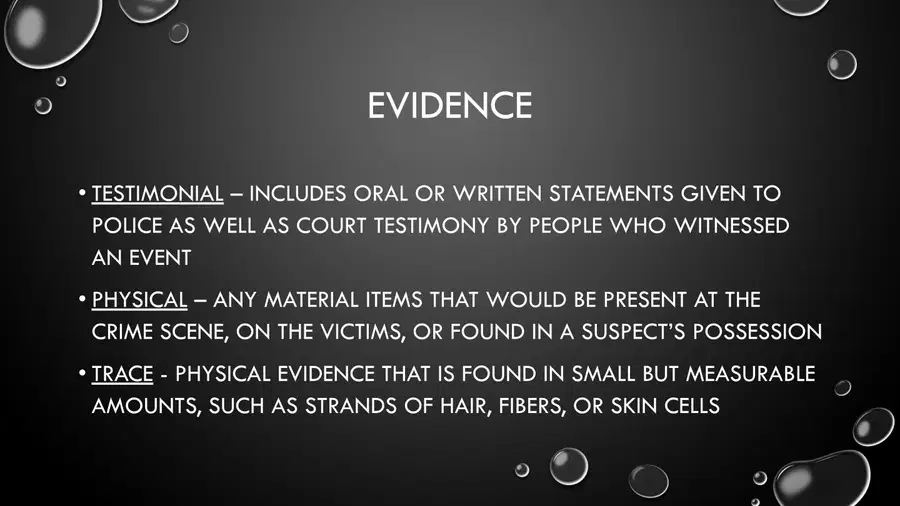
18
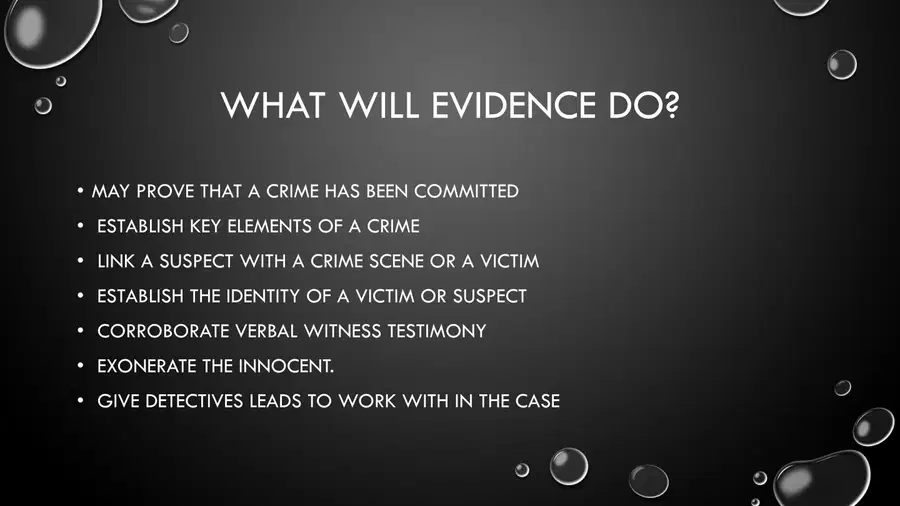
19
Multiple Select
Which of the following are purposes of evidence in a crime scene investigation?
Establish key elements of a crime
Link a suspect with a crime scene or a victim
Prove the guilt of every suspect
Give detectives leads to work with in the case
20
Open Ended
How can evidence help in exonerating the innocent during a crime scene investigation?
21
22
Multiple Choice
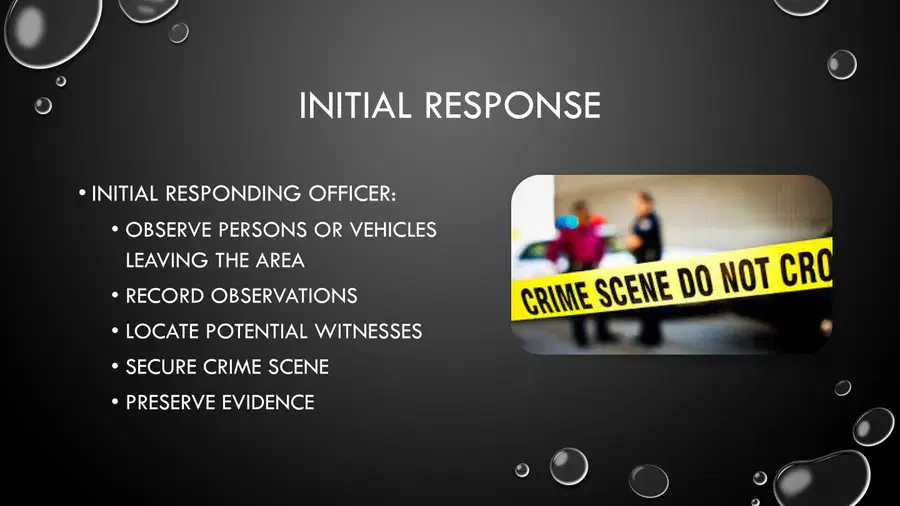
Which of the following is NOT a responsibility of the initial responding officer at a crime scene?
Observe persons or vehicles leaving the area
Record observations
Collect and analyze evidence in the lab
Locate potential witnesses
23
24
25
26
27
28
Open Ended
Why is it important to control the movement of persons at a crime scene and limit the number of people who enter?
29
Multiple Choice
What actions should the initial responding officer take to prevent individuals from altering or destroying physical evidence at the scene?
Allow free movement of all individuals
Restrict movement, location, and activity while ensuring safety
Remove all individuals immediately without assessment
Focus only on suspects and ignore others
30
Multiple Select
Which of the following individuals should be secured and separated at a crime scene?
Suspects
Witnesses
Bystanders
All of the above
31
32
Multiple Choice
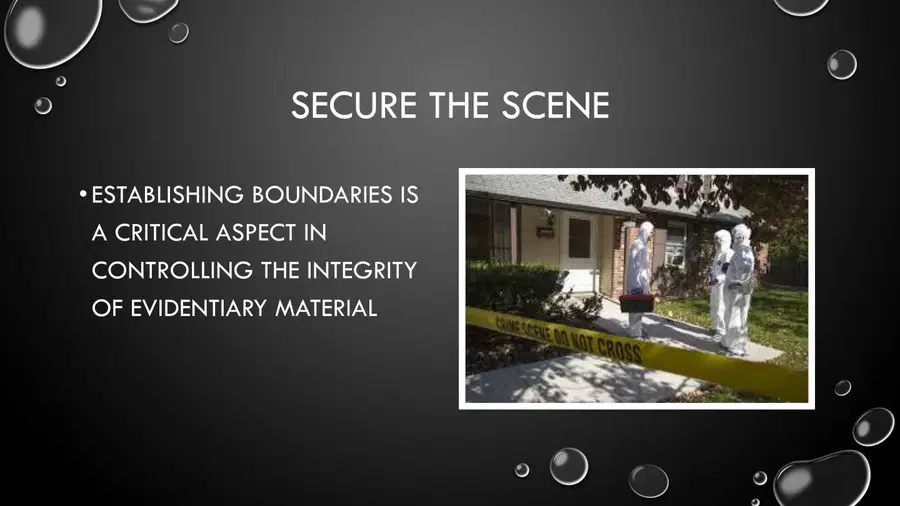
Why is establishing boundaries important when securing a crime scene?
To control the integrity of evidentiary material
To keep the public away from the scene
To make the scene look official
To allow media access
33

34
35
36
37
Multiple Choice
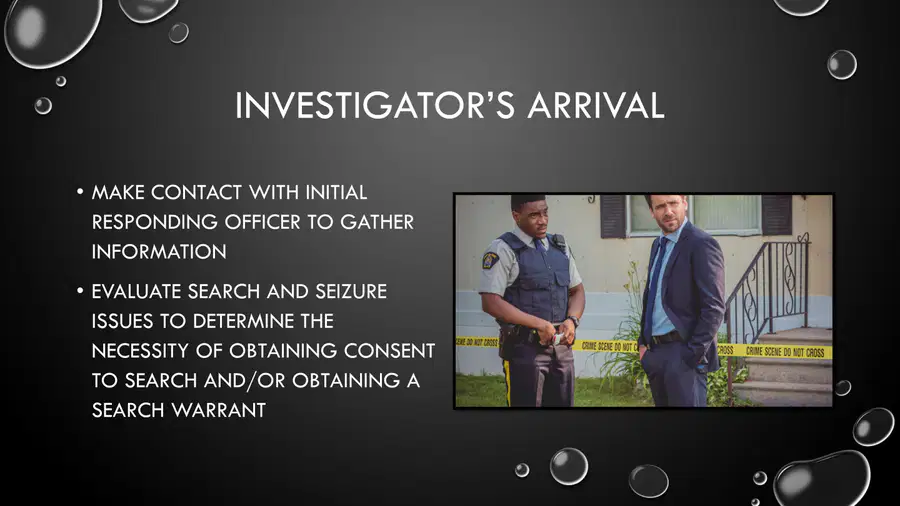
What are the key steps an investigator should take upon arrival at a crime scene?
Make contact with the initial responding officer and evaluate search and seizure issues
Immediately start collecting evidence
Interview all witnesses before securing the scene
Release information to the media
38
Open Ended
Explain how scene assessment contributes to the development of investigative strategies.
39
Multiple Select
Which of the following are important actions during scene assessment?
Evaluate initial scene boundaries
Ensure continued scene integrity
Canvass and document the surrounding area
Release evidence to the public
40
41
42
Open Ended
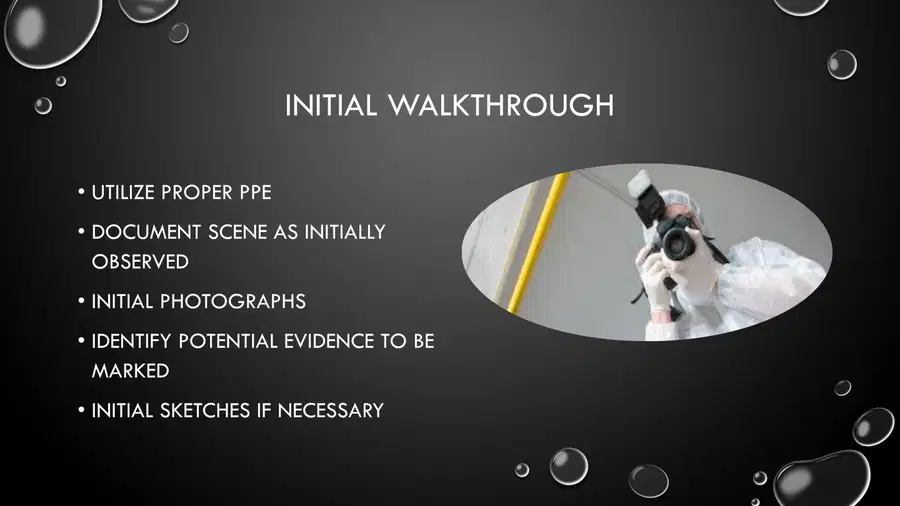
Describe the purpose and process of an initial walkthrough at a crime scene.
43

44
45
46
47
Multiple Choice
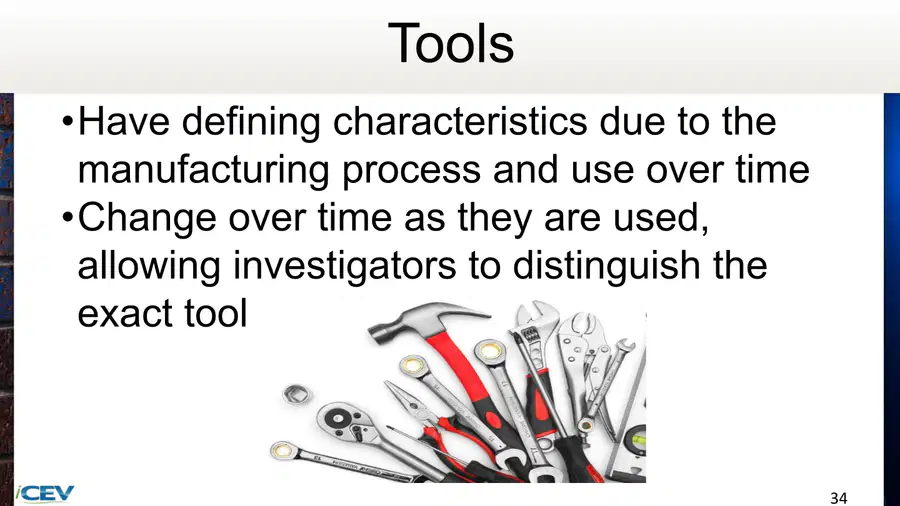
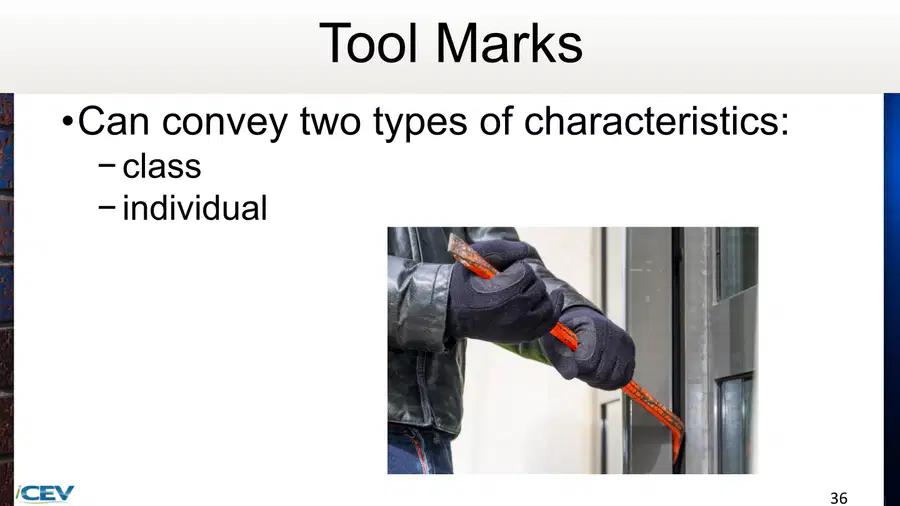
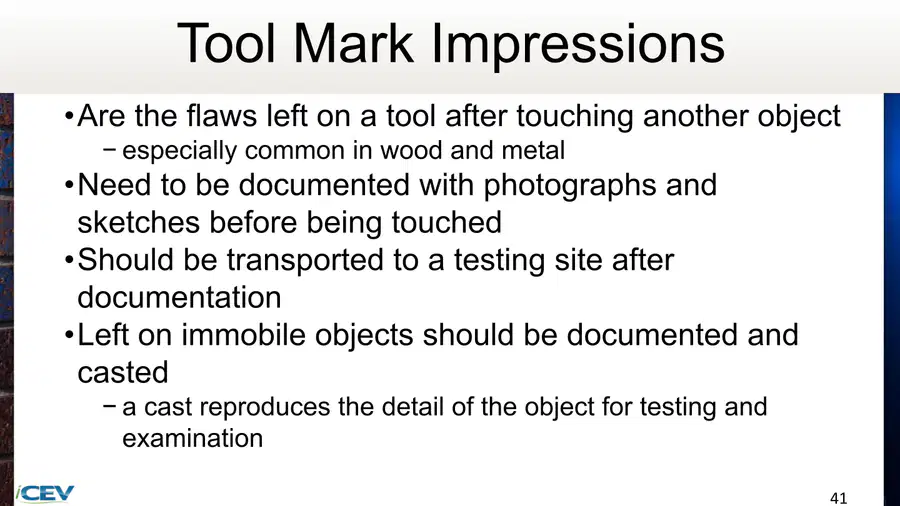
Which statement best describes tool mark evidence in forensic investigations?
Tool marks always look the same, no matter how long the tool has been used.
Tool marks are useful only for identifying the brand of a tool, not the exact one.
Tool marks have defining characteristics that change over time and can show both class and individual traits.
Tool marks are unrelated to how a crime was performed or how entry was made.
48
49
50
Multiple Choice
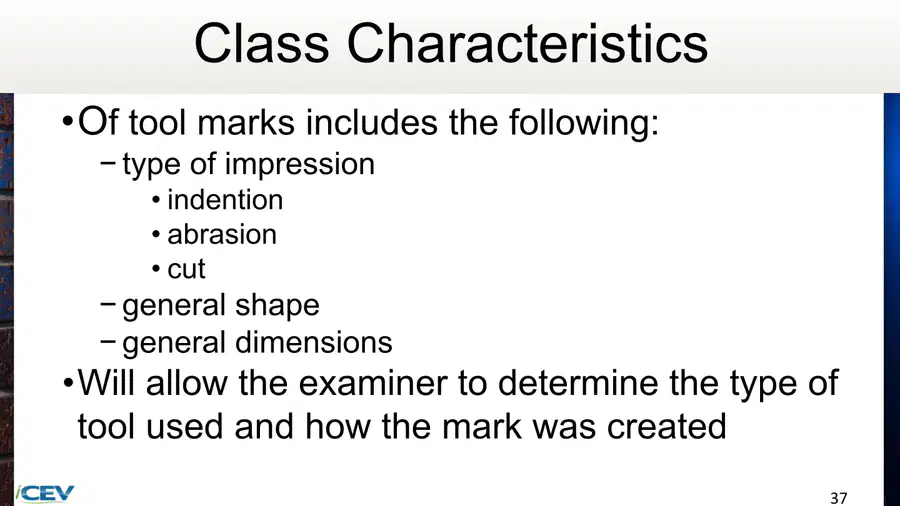
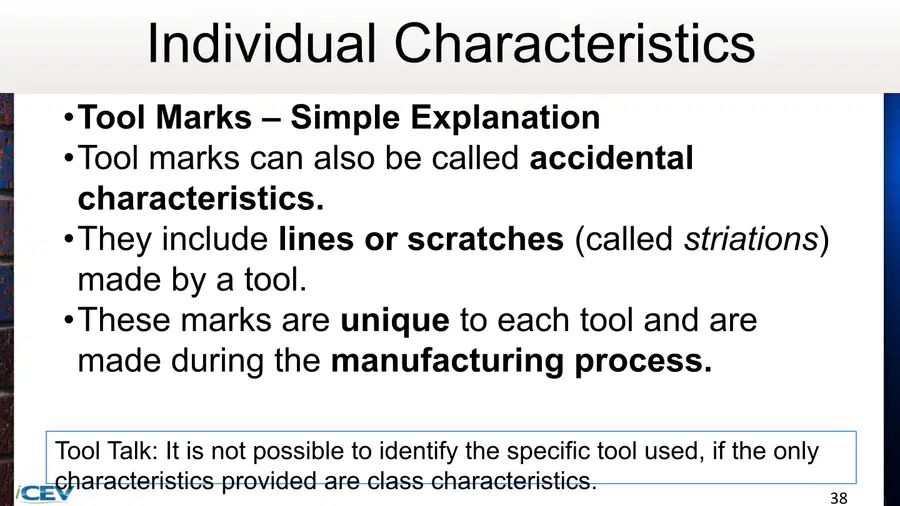
What makes tool marks unique and valuable for forensic investigations?
They are made from common factory designs that all tools share.
They contain accidental lines or scratches (called striations) formed during manufacturing and use, making each tool mark one of a kind.
They can only show the general category of tool, such as “hammer” or “screwdriver.”
They disappear quickly and cannot be used for comparison.
51
52
53
54

55
Multiple Choice
Which statement best describes how forensic examiners analyze and classify tool marks?
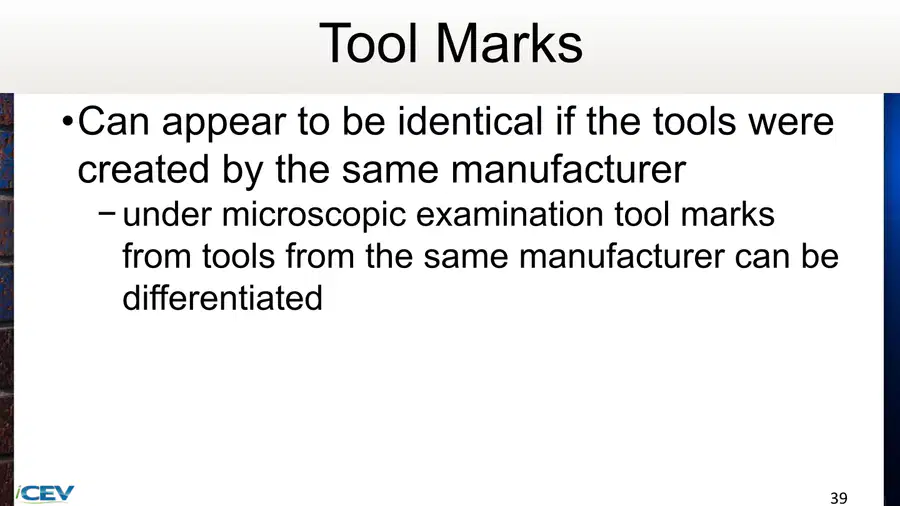
Tool marks from the same manufacturer always appear identical and cannot be distinguished.
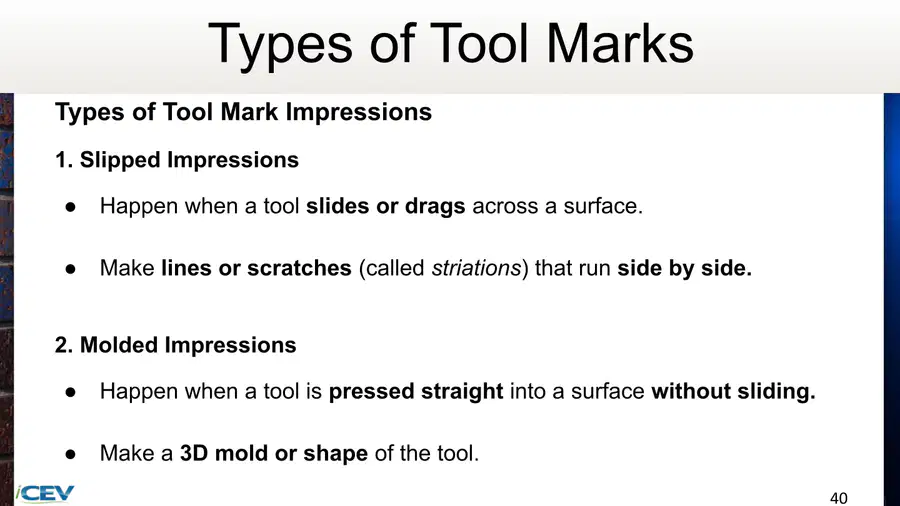
Molded impressions are created when a tool slides across a surface, leaving scratch marks called striations.
Slipped impressions happen when a tool is pressed directly into a surface, creating a 3D mold.
Tool marks are analyzed for their type of impression (such as slipped or molded), and under a microscope, even tools from the same manufacturer can show unique differences.
Show answer
Auto Play
Slide 1 / 55
SLIDE
Similar Resources on Wayground

53 questions
iPad Basecamp 2025-2026
Presentation
•
9th - 12th Grade
50 questions
Web Development Review
Presentation
•
9th - 12th Grade
50 questions
Transformations in the Coordinate Plane: Parent Functions
Presentation
•
9th - 12th Grade
52 questions
Plumbing Basics
Presentation
•
9th - 12th Grade
46 questions
Matrices; 11.2
Presentation
•
9th - 12th Grade
51 questions
MLA Format 1,3
Presentation
•
9th - 12th Grade
47 questions
The Periodic Table
Presentation
•
10th - 12th Grade
51 questions
-RE Verbs and Inversion
Presentation
•
9th - 12th Grade
Popular Resources on Wayground
24 questions
PBIS-HGMS Day 10

Quiz
•
6th - 8th Grade
10 questions
HCS SCI 03 Summer School Review 3
Quiz
•
3rd Grade
11 questions
Home Scope
Quiz
•
7th - 8th Grade
15 questions
HCS SCI 05 Summer School Assessment 3 Review
Quiz
•
5th Grade
35 questions
Lufkin Road Middle School Student Handbook & Policies Assessment
Quiz
•
7th Grade
18 questions
Geo 11.3 Area of Circles and Sectors
Quiz
•
9th - 11th Grade