

Timbuktu

Presentation
•
Other
•
7th Grade
•
Practice Problem
•
Medium

Shelby Morrow
Used 4+ times
FREE Resource
7 Slides • 4 Questions
1
Timbuktu, a city in Mali, West Africa, wasn't always the remote place that comes to mind when you hear its name. Once upon a time, it was a bustling center of trade, learning, and culture, attracting people from all over Africa and beyond. Let's take a look at how this city rose to prominence and what factors led to its eventual decline.
2
Timbuktu started as a seasonal settlement around the 5th century BCE. Nomadic people would come to the area to store salt and other goods. Around the 12th century, it became a permanent settlement. Its location was perfect: on the edge of the Sahara Desert and near the Niger River. This made it a key stop for caravans crossing the desert, carrying goods like gold, salt, ivory, and even slaves.
As trade increased, Timbuktu grew richer and more important. In the early 1300s, it became part of the Mali Empire. The city truly prospered under the rule of the Mali Empire. People came from across the continent to trade and live there.
3
Open Ended
Describe how Timbuktu's location contributed to its rise as a prominent trade center. What specific geographical features made it ideal for trade?
4
But Timbuktu's real "Golden Age" wasn't just about gold. It was about knowledge. The city became a major center of Islamic learning, with numerous scholars and a large book trade. The Sankoré Madrasa, a famous university, attracted students from far and wide. People came to Timbuktu to study science, mathematics, medicine, and religion.
The first University in history
In the 15th and 16th centuries, Timbuktu was at its peak. However, this period of prosperity didn't last forever. In 1591, the Moroccan army invaded and took control of the city. Although Timbuktu became their capital, the city's golden age was over.
5
Fill in the Blanks
6
After the Moroccan invasion, Timbuktu went into a long period of decline. Different groups fought for control, and the city's importance as a trade and learning center diminished. Eventually, the French took over in 1893. Today, Timbuktu is part of the Republic of Mali. While it's still a UNESCO World Heritage Site, it faces challenges like poverty and desertification. Despite these challenges, Timbuktu remains a symbol of Africa's rich history and its contributions to trade, learning, and
culture.
7
Multiple Choice
Why was Timbuktu considered a significant center for trade, learning, and culture in West Africa?
Because of its location near the Sahara Desert and the Niger River, attracting traders and scholars from all over Africa and beyond.
Because it was the capital of the Moroccan Empire.
Because it was known for its advanced irrigation systems.
Because it was a major center for gold mining.
8
Multiple Choice
Which factor contributed to Timbuktu's decline after its golden age?
The establishment of a democratic government.
The discovery of vast gold reserves within the city itself.
The construction of advanced irrigation systems.
The opening of new trade routes that bypassed the city.
9
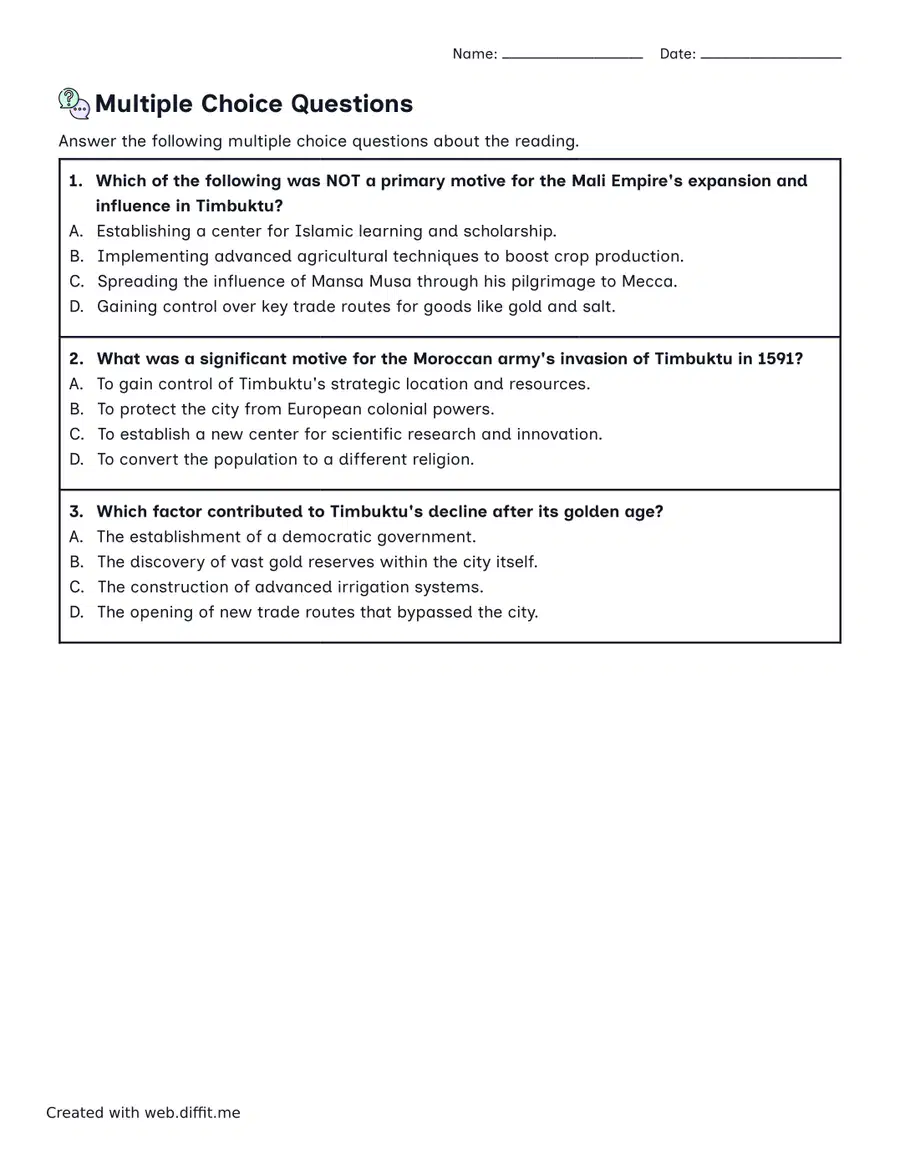
Answer the following Questions- 2 minutes.
10
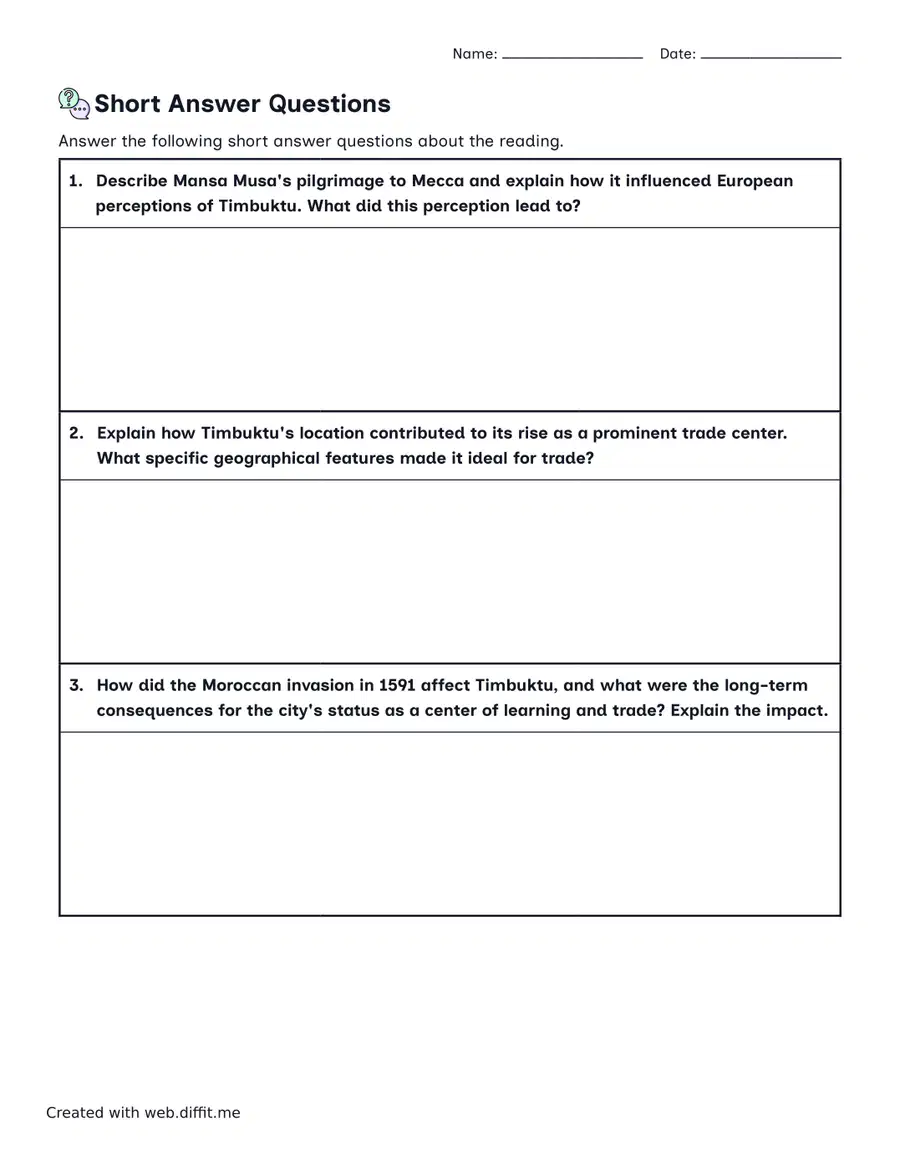
11
Google Classroom
Click on this link to chat with a scholar from Timbuktu. As you are chating:
write down some facts about the scholars
Ex. what ideas are they coming up with? Their culture, their schools, etc
* 3 minutes https://app.briskteaching.com/ws/p56y9j
Timbuktu, a city in Mali, West Africa, wasn't always the remote place that comes to mind when you hear its name. Once upon a time, it was a bustling center of trade, learning, and culture, attracting people from all over Africa and beyond. Let's take a look at how this city rose to prominence and what factors led to its eventual decline.
Show answer
Auto Play
Slide 1 / 11
SLIDE
Similar Resources on Wayground

8 questions
Text Structure Practice
Presentation
•
7th Grade
10 questions
Dangling Modifiers
Presentation
•
7th Grade
10 questions
Text Structure
Presentation
•
7th Grade
10 questions
Unit 2 lesson 4: order of operations integers
Presentation
•
7th Grade
8 questions
Using Samples to Make Predictions
Presentation
•
7th Grade
9 questions
Revising and Editing Practice
Presentation
•
7th Grade
9 questions
Gmas
Presentation
•
7th Grade
9 questions
Feudalism in Europe
Presentation
•
7th Grade
Popular Resources on Wayground
6 questions
Secondary Safety Quiz
Presentation
•
9th - 12th Grade
10 questions
MyPath Diagnostic Overview
Presentation
•
6th - 8th Grade
20 questions
Lab Safety Quiz

Quiz
•
6th Grade
21 questions
Continents and Oceans
Quiz
•
6th Grade
20 questions
Adding and Subtracting Decimals
Quiz
•
5th Grade
20 questions
Parts of Speech
Quiz
•
5th Grade
16 questions
Subject & Predicate
Quiz
•
5th Grade
21 questions
Lab Safety
Quiz
•
10th Grade
Discover more resources for Other
10 questions
MyPath Diagnostic Overview
Presentation
•
6th - 8th Grade
10 questions
Fact Check Ice Breaker: Two truths and a lie
Quiz
•
5th - 12th Grade
20 questions
💯4. Quiz: Safety in the Science Lab
Quiz
•
7th Grade
20 questions
Lab Safety
Quiz
•
5th - 8th Grade
15 questions
Subtracting Integers
Quiz
•
7th Grade
10 questions
Lab Safety Essentials

Interactive video
•
6th - 10th Grade
20 questions
Add and Subtract Integers
Quiz
•
6th - 8th Grade
10 questions
Understanding Scientific Investigations
Interactive video
•
4th - 8th Grade