

side lý

Presentation
•
Science
•
6th Grade
•
Practice Problem
•
Hard

Nhật Phạm
FREE Resource
13 Slides • 16 Questions
1

2
Multiple Choice
What are the tools used for measuring in science?
Thermometer
Ruler
Microscope
Calculator
3

4
Multiple Choice
Who are the members of the group shown in the images?
Lê Khánh Hoàng
Lê Thị Lan Hương
Võ Thị Hà Linh
Phạm Nhật Thanh
5

6
Multiple Choice
What are the main components of the experiment as listed in the content?
Mục tiêu, yêu cầu thí nghiệm
Cơ sở lý thuyết
Dụng cụ thí nghiệm
Các bước tiến hành
7

8
Multiple Choice
What are the requirements for using and reading data from calipers and Panme?
Knowledge of basic math
Ability to read measurements accurately
Understanding of the tools' functions
Experience in scientific experiments
9
Fill in the Blanks
What are the objectives of measuring the size of solid objects with high accuracy using a caliper and a Panme?
10
11
Multiple Choice
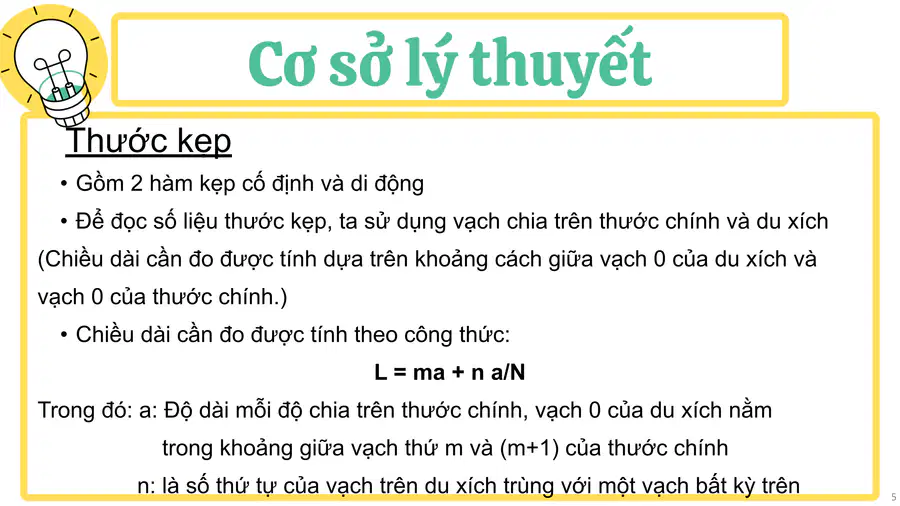
What is the formula for calculating the length of a double lever?
L = ma + n a/N
L = m + n
L = a + n
L = m a + n
12

13
Multiple Choice
What is the main component of a Panme measuring instrument?
A cylindrical rod
A flat surface
A digital display
A rotating dial
14
15
Multiple Choice
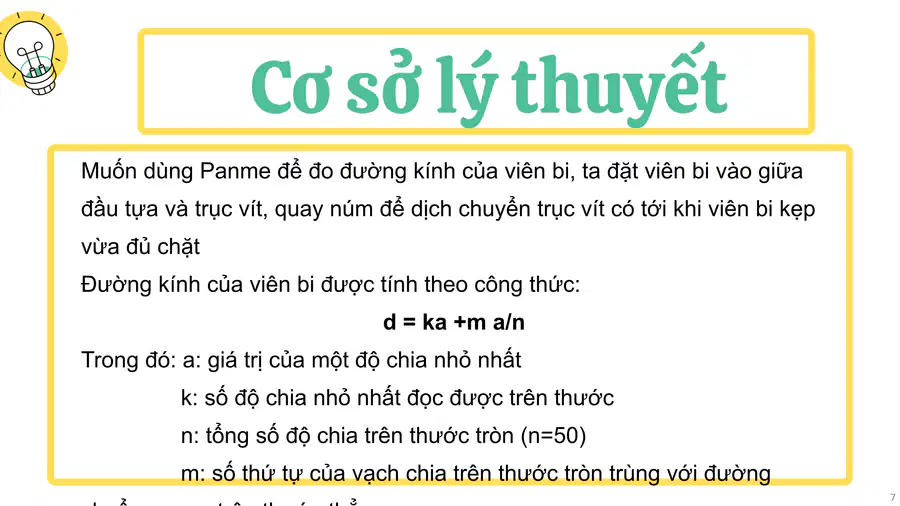
What is the formula to calculate the diameter of a ball using the Panme?
d = ka + m a/n
d = m a + k/n
d = k + m a/n
d = a + m k/n
16

17
Multiple Choice
What are the names of the measuring tools listed in the table?
Thước kẹp
Thước Panme
Tấm thủy tinh
Thước dây
18

19
Multiple Choice
What are the steps to measure the diameter and height of a cylinder using the Panme tool?
Step 1: Use the Panme tool to measure the diameter and height of the cylinder.
Step 2: Record the results in a table.
Step 3: Repeat steps 1 and 2 four times at different positions to obtain average values.
Step 4: Calculate the volume of the cylinder.
20

21
Multiple Choice
What is the average value of D (mm) from the data provided?
40.9
41.0
41.1
41.2
22

23
Multiple Choice
What is the external diameter of the metal cylinder represented by the equation D = D̄ ± ΔD?
40.98 ± 0.064
35.16 ± 0.088
85.74 ± 0.112
1.076 ± 0.0048
24

25
Open Ended
What is the significance of recording measurement results along with errors in scientific experiments?
26
Multiple Choice
What are the factors that can lead to measurement errors when reading results?
Incorrect reading angle
Inconsistent measurement tools
Environmental conditions
Lack of calibration
27

28
Multiple Choice
What are some key concepts related to energy and technology that you learned in this lesson?
Energy sources
Space exploration
Scientific methods
Environmental impact
29
Poll
Bây giờ bạn cảm thấy tự tin thế nào về chủ đề này?
Show answer
Auto Play
Slide 1 / 29
SLIDE
Similar Resources on Wayground

21 questions
Human Activities & Climate Change
Presentation
•
6th Grade
21 questions
Non Contact Forces
Presentation
•
6th Grade
21 questions
Gravity
Presentation
•
6th Grade
21 questions
Properties of Matter
Presentation
•
6th Grade
24 questions
1.8 Space Exploration
Presentation
•
6th Grade
23 questions
Circulation of Earth's Air and Water Unit 1 Lesson 1
Presentation
•
6th Grade
23 questions
Competitive Relationships and Predator and Prey
Presentation
•
6th Grade
21 questions
Matter - 6th Grade
Presentation
•
6th Grade
Popular Resources on Wayground
21 questions
Continents and Oceans

Quiz
•
6th Grade
20 questions
Parts of Speech
Quiz
•
5th Grade
16 questions
Subject & Predicate
Quiz
•
5th Grade
25 questions
Multiplication Facts
Quiz
•
5th Grade
12 questions
Map Skills
Quiz
•
3rd Grade
22 questions
Continents and Oceans
Quiz
•
5th Grade
15 questions
Rounding Decimals
Quiz
•
5th Grade
20 questions
Brand Labels
Quiz
•
5th - 12th Grade
Discover more resources for Science
20 questions
Elements, compounds, and mixtures
Quiz
•
6th Grade
10 questions
6.6D - Relative Density Review
Quiz
•
6th Grade
20 questions
Claim, Evidence and Reasoning (CER)
Quiz
•
6th - 8th Grade
10 questions
Exploring Chemical and Physical Changes

Interactive video
•
6th - 10th Grade
20 questions
Rocks and The Rock Cycle
Quiz
•
6th Grade
20 questions
6th Grade Force & Motion
Quiz
•
6th Grade
18 questions
Interpreting Distance/Time Graphs
Quiz
•
6th Grade
16 questions
Kinetic Energy and Potential Energy
Presentation
•
6th Grade