

Lesson 2.2.2 Suffrage Struggles and Powerful Protests

Presentation
•
English
•
9th - 12th Grade
•
Practice Problem
•
Hard

Jessica Gouse
Used 1+ times
FREE Resource
27 Slides • 7 Questions
1
Suffrage Struggles and Powerful Protests: "Is it a Crime to Vote?"
November 19th

2
Learners can:
evaluate an argument's logical structure and use of persuasive appeals
identify the use of parallel structure in arguments
Vocabulary: suffrage, logical argument, premise, parallel structure
Curriculum Kit Materials: English Notebook
Additional Household Materials Needed: none

3
Life was very different for women in the past than it is for women today.
Many rights that people in the United States and other democracies now take for granted had not yet been extended to women.
Women fought long and hard for these rights, including the right to vote, the opportunity to work in all professions, the privileges of equal education, and the chance to run for public office.
Consider the many legal rights you enjoy today and how you would feel if they were denied to you.

4
While watching this video...
THINK-What are the women wanting a say?

5
Lesson 2.2.2
6
What choices did women want a say in, as stated in the video? Do you think women have the right to make those decisions about their own lives?
The Women's Suffrage Movement—the collective efforts of women to gain the right to vote—is an important part of U.S. history. The literature of the Women's Suffrage Movement provides insight into the motivations and challenges that women faced in this struggle to vote.
7
Suffrage and the Women's Suffrage Movement
The word suffrage refers to the right to vote in political elections. Prior to 1870, only White men were allowed to vote in government elections in the U.S.
In the decade following the Civil War, in 1870, the right to vote was extended to Black men.

8
Women, on the other hand, did not secure the right to vote until 1920 with the passage of the 19th Amendment to the U.S. Constitution.
The Women's Suffrage Movement in the United States was a long and hard-fought struggle that sought to secure the right to vote for women.
The movement began in 1848 and was part of the broader fight for gender equality and women’s rights.

9
Susan B. Anthony
Susan B. Anthony was a prominent leader of the Women’s Suffrage Movement.
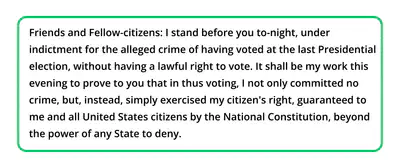
In 1872, she famously voted in the presidential election in Rochester, New York, despite the fact that it was illegal for women to vote at that time.
As a result, she was arrested and fined for voting illegally. Her bold action drew national attention to the suffrage cause.

10
In “Take a Stand” you learned:
about the women's rights events that took place in the 1800s;
who Lucretia Mott and Elizabeth Cady Stanton were;
about the significance of the Seneca Falls Convention; and
how Susan B. Anthony contributed to the women's suffrage movement.
Understanding the major events and key characters in the Women's Suffrage Movement provides context for Anthony's text, which you will read today. That text relies on reasoned arguments to support her ideas.

11
Logical Arguments
A logical argument is an appeal to the audience's sense of reason. It is an attempt to persuade someone to accept a particular point of view, belief, or conclusion by supporting it with reasons and evidence to make it convincing.
Logical arguments consist of three parts:
point of view: the idea that the author presents;
premise: support for the point of view; and
conclusion: the main point of the argument that aligns with the premise.

12
13

Arguments start with a stated point of view or opinion about a topic
A just and democratic society grants voting rights to all its citizens who are affected by its laws and policies.
A premise provides information that supports the conclusion.
Example: Women are citizens who contribute to society in various ways, including economically, socially, and politically.
A conclusion is the main point of the argument that can be drawn from the premise.
Example: Therefore, denying women the right to vote is unjust and contradicts democratic principles.
14
Match
Match each example to the part of the argument it represents.
Women deserve the right to vote because political representation is a fundamental democratic principle that should apply to all citizens, regardless of gender.
Women actively contribute to society through work, education, and family responsibilities. Since they are affected by laws and policies, they should have a say in electing leaders who represent their interests.
Denying women the right to vote undermines the very foundations of democracy, fairness, and justice. Therefore, women’s suffrage is not just a political necessity but a moral imperative.
Point of View
Premise
Conclusion
Point of View
Premise
Conclusion
15

16
Parallel Structure
Parallel structure or parallelism refers to the repetition of a grammatical pattern within a sentence or among sets of sentences. Repeating a pattern ensures that the information is presented in a consistent and balanced manner: the listed elements receive similar emphasis.
17
Parallel Structure in Arguments
It is especially important that the ideas of an argument are presented clearly.
The use of parallel structure helps a writer or speaker present a stronger argument because the information is easy to follow, and the emphasis is clear.
18
19
how parallel structures are created;
how parallelism is used;
how parallelism can make an idea memorable or highlight a point; and
how to avoid faulty parallelism.

20

21
Multiple Choice
Which TWO of these are examples of parallel structure?
We ask the juries to fail to return a verdict of "guilty'" against honest, law–abiding, tax paying United States citizens for offering their votes, at our elections.
Surely, the right of the whole people to vote is here clearly implied.
It was we, the people, not we, the white male citizens, nor yet we, the male citizens; but we, the whole people, who formed this Union.
22
Persuasive Techniques and Rhetorical Appeals
Arguments, along with their use of logical structures, rely on a certain persuasive techniques to convince their readers and listeners. Each has its own appeal, or use of rhetoric.
23
https://ccaeducate.zoom.us/rec/play/9WpPS6kW3By3TlMOMYDHOkk7ZRq34cwv8JakMk3YhGBVSEw6FU2iDAv7gM_4JuE1nBQgdgtMCidlkwUj.s8vR2FXoNvnj_ORQ?autoplay=true&startTime=1762354733000

24

25

26
27

28


29
Multiple Choice
Which of the following choices best describes Susan B. Anthony's main point?
Women participate in American society more than men and should, therefore, never be denied the right to vote.
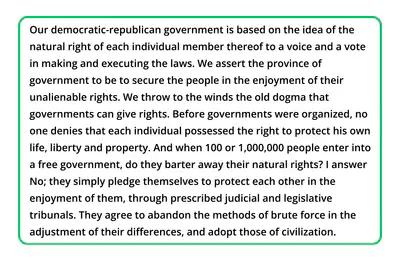
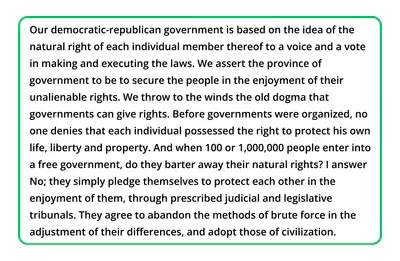
All U.S. citizens have unalienable rights according to the Constitution; voting is an unalienable right, so all U.S. citizens, including women, have a right to vote.
Women participated in the American Revolution and fought for freedom and therefore, woman should also be allowed to vote.
30
Multiple Choice
Which of the following choices use parallel structure?
Women fought for their right to vote, to be recognized as equals, and to have their voices heard.
Women were denied the right to vote, treated as inferior, and forced to obey laws they had no say in creating.
Women were taxed without representation and property was not under their control.
31
Multiple Choice
What is the effect of the words grand and pretends in the excerpt from Anthony's argument below?
Nor can you find a word in any of the grand documents left us by the fathers that assumes for government the power to create or to confer rights. The Declaration of Independence, the United States Constitution, the constitutions of the several states and the organic laws of the territories, all alike propose to protect the people in the exercise of their God–given rights. Not one of them pretends to bestow rights.
These words add emphasis because flowery language makes the argument more appealing.
These words evoke emotions because grand has strong positive connotations, while pretends has strong negative connotations.
These words help the audience understand Anthony's point because they are strong and valuable.
32
Open Ended
How does Susan B. Anthony use both logical arguments and emotional appeals to make her case for women's suffrage?
Provide examples from the text to support your answer.
You can start your response with:
Susan B. Anthony appeals to logic by . . .
Susan B. Anthony appeals to emotion by . . .
Respond in 2 complete sentences

34
Poll
On a scale of 1-5, how well do you understand the concept of
rhetoric strategies; logos, ethos, and pathos?
1-being not so well and 5-very well
1
2
3
4
5
Suffrage Struggles and Powerful Protests: "Is it a Crime to Vote?"
November 19th
Show answer
Auto Play
Slide 1 / 34
SLIDE
Similar Resources on Wayground

26 questions
Preterite Tense AR Verbs
Presentation
•
9th - 12th Grade
27 questions
Annotating Texts
Presentation
•
9th - 12th Grade
25 questions
Semicolons
Presentation
•
9th - 12th Grade
27 questions
Understanding Shakespearean Language
Presentation
•
9th - 12th Grade
25 questions
Antithesis
Presentation
•
9th Grade - University
27 questions
Medical Terminology Lesson 1
Presentation
•
9th - 12th Grade
28 questions
Demonstrative Adjectives
Presentation
•
9th - 12th Grade
Popular Resources on Wayground
10 questions
Safety Day 2026 – Student Review

Quiz
•
9th Grade
21 questions
Continents and Oceans
Quiz
•
6th Grade
20 questions
Parts of Speech
Quiz
•
5th Grade
16 questions
Subject & Predicate
Quiz
•
5th Grade
25 questions
Multiplication Facts
Quiz
•
5th Grade
12 questions
Map Skills
Quiz
•
3rd Grade
22 questions
Continents and Oceans
Quiz
•
5th Grade
15 questions
Rounding Decimals
Quiz
•
5th Grade
Discover more resources for English
10 questions
Test Your Knowledge on Bullying
Quiz
•
9th Grade
16 questions
Ethos, Pathos, Logos Practice
Quiz
•
9th Grade
20 questions
Context clues
Quiz
•
10th Grade
10 questions
Exploring the Role of Setting in Storytelling

Interactive video
•
6th - 10th Grade
10 questions
Differentiating the 3 Types of Irony
Interactive video
•
6th - 10th Grade
15 questions
Poetry Terms
Quiz
•
6th - 9th Grade
10 questions
Unlocking English Vocabulary through Latin and Greek Roots
Interactive video
•
6th - 10th Grade
16 questions
Complete Sentences vs Fragments and Run-Ons
Presentation
•
5th - 12th Grade