Search Header Logo
Lesson 1.4

Lesson 1.4

Assessment

Presentation

Science

7th Grade

Practice Problem

Medium

NGSS
MS-ESS2-1, MS-ESS1-4, 4-ESS1-1

+7

Standards-aligned

Created by

Brandon Moore

Used 1+ times

FREE Resource

44 Slides • 30 Questions

1

media

2

Multiple Choice

Question image
This rock was another type of rock that was heated and compressed over time. What type of rock is this?
1
Sedimentary
2
Igneous
3
Metamorphic

3

Multiple Choice

Question image
This rock formed when bits of other rocks became pressed into a solid. What type of rock is it?
1
Sedimentary Rock
2
Metamorphic Rock
3
Igneous Rock

4

Open Ended

Describe a situation where knowing about rock transformations could be useful in everyday life.

5

Multiple Choice

Why is it important to understand how rocks are formed and transformed in nature?

1

It helps us predict natural disasters like earthquakes and volcanoes.

2

It allows us to identify valuable minerals and resources.

3

It helps us understand Earth's history and changes over time.

4

All of the above

6

media

7

media

8

Open Ended

How long do you think it took for each layer of rock in the Quebrada de Humahuaca formation to form?

9

media

10

Open Ended

Why do you think it is difficult to observe rocks forming in nature?

11

media

12

Multiple Select

Which of the following are reasons why it is difficult to observe rock formation in nature?

1

Rock formation takes a very long time

2

Rock layers are often underground

3

Weathering can change rock appearance

4

Rocks form only at night

13

Multiple Choice

Why do scientists use models to study rock formation?

1

Because rocks form too quickly to observe directly

2

Because rocks form too slowly to observe directly

3

Because models are more fun than real rocks

4

Because models are the only way to study rocks

14

media

15

media

16

Fill in the Blanks

Type answer...

17

media

18

Open Ended

How does using hard candy as a model help us understand how sediment forms rock?

19

media

20

Open Ended

What do you think the crushed candy represents in the model?

21

Open Ended

How does the crushed candy compare to the sediment?

22

media

23

Multiple Choice

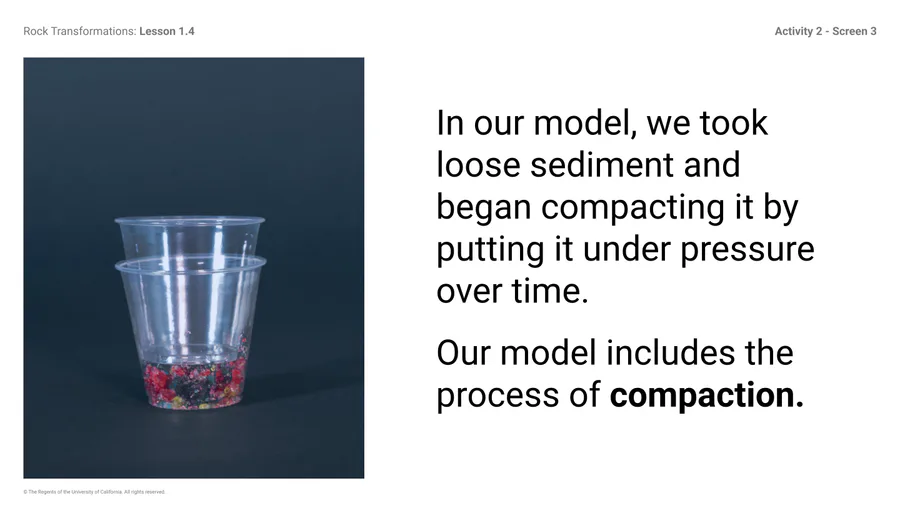
Which materials are used to model how sediment is compacted to form sedimentary rock?

1

Crushed candy, plastic cups, pen

2

Sand, water, spoon

3

Clay, glass, ruler

4

Salt, paper, pencil

24

media

25

media

26

Open Ended

How are the pieces of hard candy like pieces of rock (sediment)? How are they different?

27

Multiple Choice

What is the purpose of pressing down on the stacked cups in the candy rock formation model?

1

To mix the candy pieces

2

To compact the candy and model sedimentary rock formation

3

To break the cups

4

To separate the candy by color

28

media

29

Multiple Choice

After lifting the inner cup, what changes do you observe in the candy pieces?

1

They are more compacted

2

They have melted

3

They have changed color

4

They have disappeared

30

media

31

media

32

Open Ended

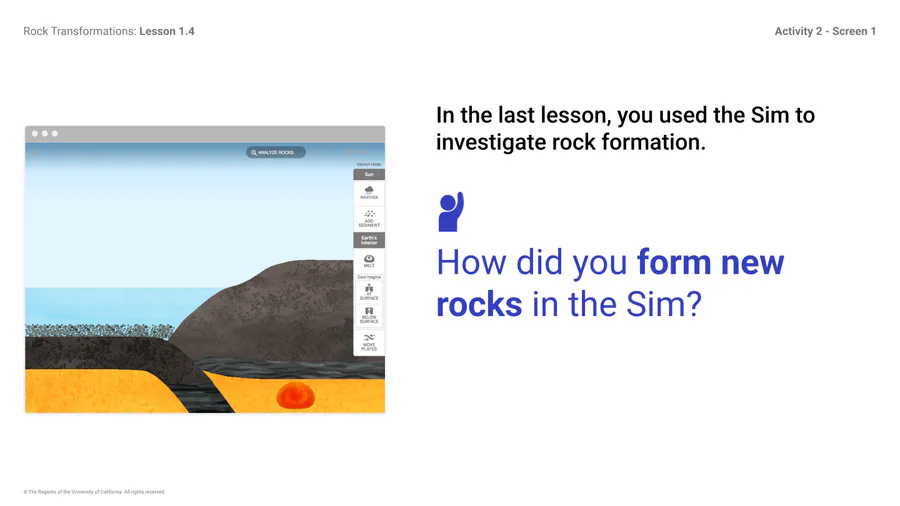
How are we modeling the formation of new rock from sediment?

33

media

34

media

35

Fill in the Blanks

Type answer...

36

Multiple Choice

Which rock type is formed when sediment is pressed and glued together?

1

Igneous rock

2

Metamorphic rock

3

Sedimentary rock

4

Volcanic rock

37

media

38

Open Ended

What do you expect to observe when we return to your model in Chapter 2?

39

media

40

media

41

Open Ended

Describe the changes that occur to sediment grains as they transform from loose sediment to cemented sediment over thousands of years.

42

Multiple Choice

Which of the following processes are involved in transforming loose sediment into sedimentary rock?

1

Melting and cooling

2

Compaction and cementation

3

Evaporation and condensation

4

Erosion and weathering

43

media

44

Multiple Choice

Which process involves sediment being buried and pressed together?

1

Compaction

2

Cementation

3

Erosion

4

Melting

45

media

46

Fill in the Blanks

Type answer...

47

Multiple Choice

Which process involves sediment being glued together?

1

Cementation

2

Compaction

3

Weathering

4

Cooling

48

media

49

Open Ended

Explain how the model shown demonstrates the process of compaction in rock formation.

50

media

51

Open Ended

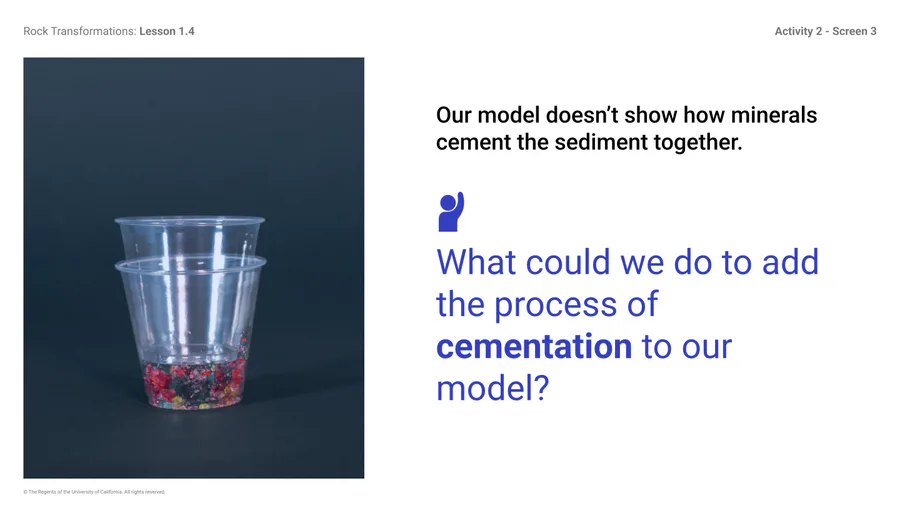
What could we do to add the process of cementation to our model?

52

media

53

Open Ended

How could we use hard candy to model magma forming rock?

54

media

55

media

56

media

57

media

58

media

59

media

60

media

61

Look at video

Video

https://learning.amplify.com/m/60f8420c266c57f/2500k-MSSCI_RT_NA_CS_20111.mp4?assetId=9C6C55AA-E193-4054-87A1B10FEA154016

62

media

63

media

64

media

65

media

66

media

67

media

68

media

69

media

70

media

71

media

72

media

73

Fill in the Blanks

Type answer...

74

Open Ended

What is one thing you learned today about how rocks are formed?

media

Show answer

Auto Play

Slide 1 / 74

SLIDE