Copy of G6ENG_SD_11.19_6.9A_6.8Diii_6.2C_6.10DViii_6.6F
Presentation
•
English
•
6th - 8th Grade
•
Practice Problem
•
Easy
+17
Standards-aligned
Jesus Garcia
Used 12+ times
FREE Resource
25 Slides • 11 Questions
1
Open Ended
What superpower would you give AI, and what real-world problem would it solve?
Sentence Stem: The superpower I would give AI is _. It would solve the problem of _, because _.
2
Fill in the Blanks
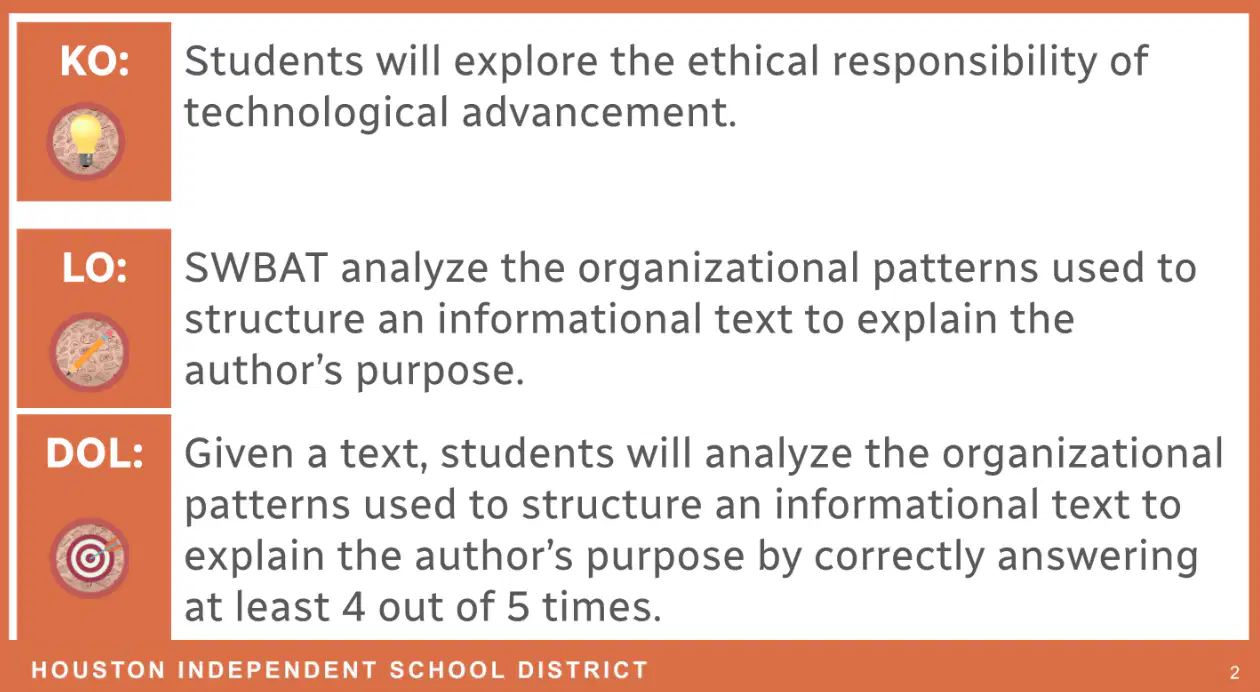
LO: SWBAT analyze the
3
4
First, let's annotate the text
5
6
7
8
9
10
11
Multiple Choice
Based on paragraph 1 of New Research Shows That A Robot Doctor Can Make Diagnosis Decisions, how does the author structure the information to reveal the main problem in the healthcare system?
By describing how emergency room doctors use advanced technology to diagnose patients quickly and accurately.
By comparing emergency rooms in different countries to show how the U.S. system is more efficient but still imperfect.
By explaining the crowded conditions, long wait times, and unnecessary treatments that show how overwhelmed emergency rooms are.
By listing several solutions that hospitals already use to reduce wait times and improve patient satisfaction.
12
13
14
Multiple Choice
Based on paragraph 2, how does the author structure the information to show the shift from the problem in paragraph 1 to a possible solution?
By introducing the idea of AI house-call technology as a potential solution and explaining how AI can already recognize medical patterns.
By listing several ways human doctors travel to patients' homes and comparing these methods to ER procedures.
By arguing that modern hospitals no longer need human doctors because AI can diagnose every illness on its own.
By describing how urgent care centers have already replaced emergency rooms with robots that diagnose children instantly.
15
16
Fill in the Blanks
Artificial intelligence, or AI, systems are already equipped to recognize patterns in medical images like X-rays to help with diagnosis.
In these sentences, the word
17
18
19
Multiple Choice
Based on paragraph 3, how does the author show the process the AI used to analyze patient records?
By describing how hospitals in China store medical files in alphabetical and digital folders for quick access.
By explaining that doctors manually checked each record again after the AI finished its work to make sure no mistakes were made.
By showing the step-by-step process: doctors created key words, trained the AI, and then the AI scanned over 567,000 medical records for important information.
By comparing the AI’s work to how emergency room doctors diagnose children in the United States.
20
21
22
Multiple Choice
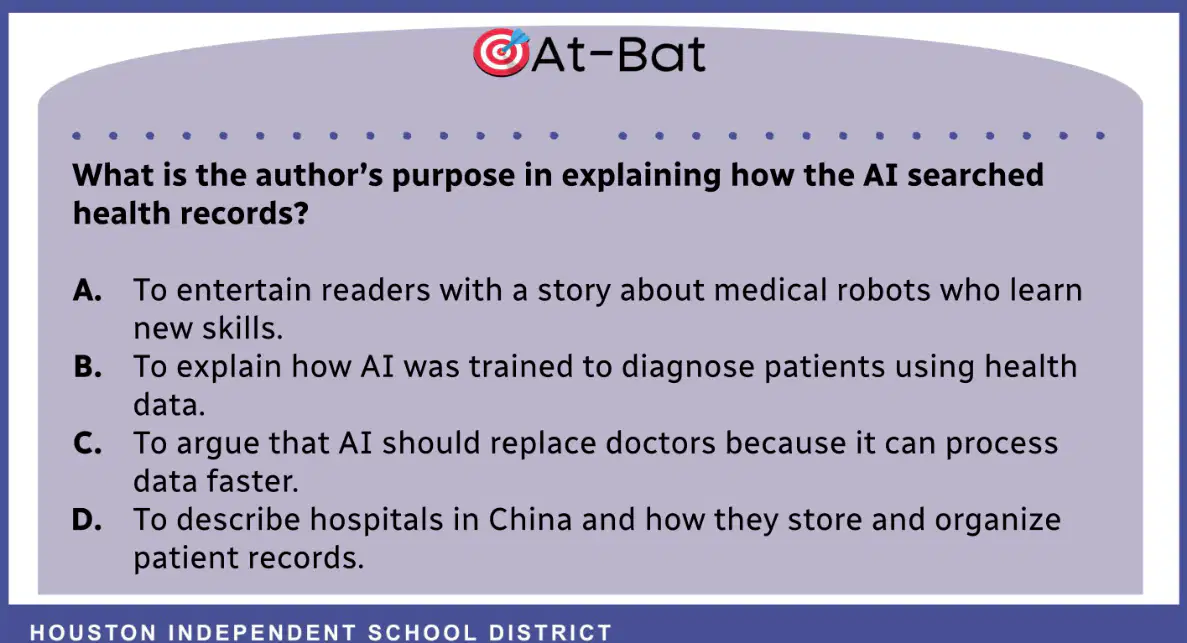
What is the author’s purpose in explaining how the AI searched health records?
To entertain readers with a story about medical robots who learn new skills.
To explain how AI was trained to diagnose patients using health data.
To argue that AI should replace doctors because it can process data faster.
To describe hospitals in China and how they store and organize patient records.
23
24
25
26
Multiple Choice
Based on paragraph 5, how does the author use organizational structure to explain concerns about AI in medicine?
By giving a list of reasons why doctors reject using robots and prefer traditional tools like stethoscopes and handwritten charts.
By comparing human doctors’ judgment to AI processing to explain why some people are unsure whether machines can make medical decisions.
By describing the step-by-step process of how AI replaces doctors during physical examinations.
By showing how emergency rooms train AI machines to understand patient emotions and communication styles.
27
28
29
Multiple Choice
How does the author use organizational structure in paragraph 6 to support their purpose for explaining how the AI system was trained?
By comparing several different hospitals to show how each one uses different types of diagnostic codes.
By describing the emotional reactions of physicians who worked on the AI project and how they felt about the results.
By presenting a clear sequence of steps—from reviewing charts to training the AI—to show that the system was built carefully using expert human knowledge.
By organizing the paragraph around a list of diseases the AI can diagnose to show how powerful the system already is.
30
31
32
Multiple Choice
Which statement best explains the organizational pattern used in paragraphs 5 through 7?
The author presents a concern about AI in medicine and then explains how humans help reduce that concern.
The author lists random facts about AI and doctors without showing any connection between them.
The author compares different types of AI systems to show which one is better for hospitals.
The author explains the history of medical technology in the order that it was invented.
33
34
Open Ended
How does the author use the sequence/process organizational pattern in the section “Human Doctors Checked The AI’s Work,” and how does this pattern help reveal the author’s purpose for including this part of the article?
35
36
What superpower would you give AI, and what real-world problem would it solve?
Sentence Stem: The superpower I would give AI is _. It would solve the problem of _, because _.
Show answer
Auto Play
Slide 1 / 36
OPEN ENDED

Similar Resources on Wayground
30 questions
Connotation and Denotation
Presentation
•
7th - 8th Grade
32 questions
Subject Verb Agreement Review
Presentation
•
7th Grade
30 questions
Inequalities
Presentation
•
5th - 8th Grade
25 questions
Types of Conflict
Presentation
•
6th - 8th Grade
32 questions
Context Clues Lesson
Presentation
•
6th - 8th Grade
33 questions
Persuasive Techniques
Presentation
•
6th - 8th Grade
29 questions
Personal and Possessive Pronouns
Presentation
•
6th - 8th Grade
32 questions
Past form of to be-Was were
Presentation
•
6th - 9th Grade
Popular Resources on Wayground
6 questions
PRIDE Always and Everywhere
Presentation
•
12th Grade
20 questions
Lab Safety Quiz
Quiz
•
6th Grade
26 questions
KOR Review Kahoot Questions
Quiz
•
8th Grade
21 questions
Continents and Oceans
Quiz
•
6th Grade
12 questions
Unit Zero lesson 2 cafeteria
Presentation
•
9th - 12th Grade
20 questions
Parts of Speech
Quiz
•
5th Grade
10 questions
Riddles Riddles fun Riddles
Quiz
•
6th - 12th Grade
16 questions
Subject & Predicate
Quiz
•
5th Grade
Discover more resources for English
20 questions
Context Clues
Quiz
•
6th Grade
20 questions
Types of sentences
Quiz
•
6th Grade
8 questions
Main Idea & Key Details
Quiz
•
3rd - 6th Grade
20 questions
Figurative Language Review
Quiz
•
6th Grade
20 questions
Figurative Language Review
Quiz
•
8th Grade
12 questions
Plot Elements
Quiz
•
6th Grade
20 questions
Homophones and Homonyms
Quiz
•
6th Grade
25 questions
Making Inferences
Quiz
•
6th - 8th Grade