

Typhoon

Presentation
•
Other
•
1st - 5th Grade
•
Practice Problem
•
Hard
Used 1+ times
FREE Resource
20 Slides • 16 Questions
1

2

3
Multiple Choice
Which of the following best describes a typhoon?
A powerful tropical cyclone that forms over warm ocean waters in the Western Pacific Ocean
A small storm system that forms over land
A snowstorm that occurs in polar regions
A tornado that forms in the Midwest United States
4
Multiple Choice
Why do you think typhoons are significant to study in regions near the Western Pacific Ocean?
Because the region experiences many typhoons.
Because typhoons rarely occur there.
Because typhoons have no impact on communities.
Because the region controls global weather.
5

6
Multiple Choice
Where do hurricanes, cyclones, and typhoons form?
Hurricanes form in the Atlantic or Northeast Pacific, cyclones in the Indian Ocean, and typhoons in the Northwest Pacific.
Hurricanes form in the Indian Ocean, cyclones in the Atlantic, and typhoons in the Arctic.
All three form only in the Atlantic Ocean.
Typhoons form in the Atlantic, hurricanes in the Northwest Pacific, and cyclones in the Indian Ocean.
7

8
Multiple Choice
Which sequence best describes the formation of a typhoon?
Cool air sinks over warm ocean water, creating calm winds → clouds disperse → a vortex forms from cold fronts.
Warm, moist air rises from the ocean surface → air begins to rotate due to wind shear and the Earth’s rotation → the rotation strengthens, forming a violent spiraling system.
Dry air from land moves over the ocean → condensation rapidly cools the sea surface → a spiral cloud tower forms instantly.
Ocean water cools to below 20°C → winds slow down → clouds compress into a rotating storm.
9

10
Multiple Select
Which of the following are characteristics of a typhoon?
Very strong winds
Heavy rainfall
Snowfall
Thunderstorms
11

12
Fill in the Blanks
13
Multiple Choice
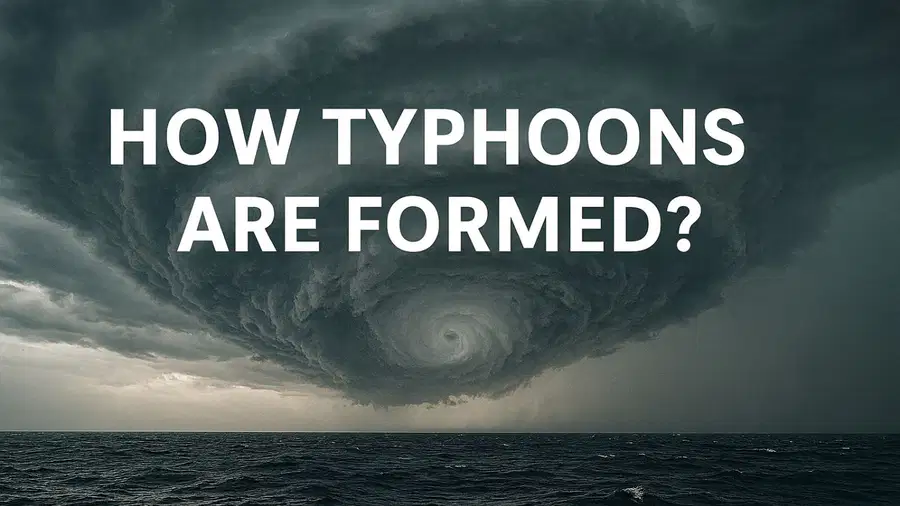
Which countries are commonly affected by typhoons?
Philippines, Japan, Taiwan, China, Vietnam
India, Australia, South Africa, Brazil
United States, Canada, Mexico, Argentina
Russia, Germany, France, Italy
14

15
16
Multiple Choice
Which of the following regions is most likely to experience a typhoon?
Atlantic Ocean
Indian Ocean
Eastern Pacific
Western Pacific
17

18
Multiple Choice
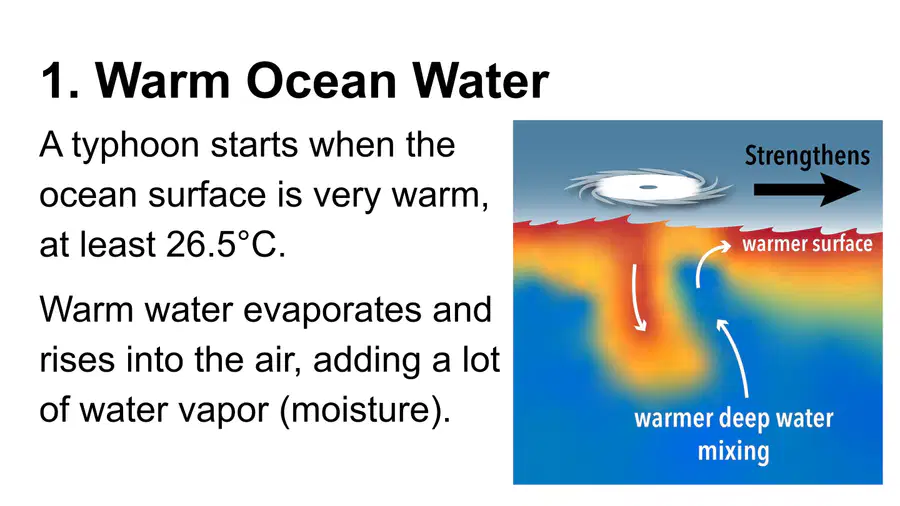
Based on the diagrams, what effect does warmer deep water mixing have on a hurricane's strength compared to cooler deep water mixing?
It weakens the hurricane
It has no effect on the hurricane
It strengthens the hurricane
It causes the hurricane to change direction
19
20
Multiple Choice
What is the minimum ocean surface temperature required for a typhoon to start forming?
18°C
21°C
26.5°C
30°C
21

22

23

24
Fill in the Blanks
25

26

27
Multiple Choice
Which part of a typhoon is characterized by descending air and calm conditions?
Eyewall
Eye
Warm, moist air region
Low pressure area
28

29
30
Multiple Select
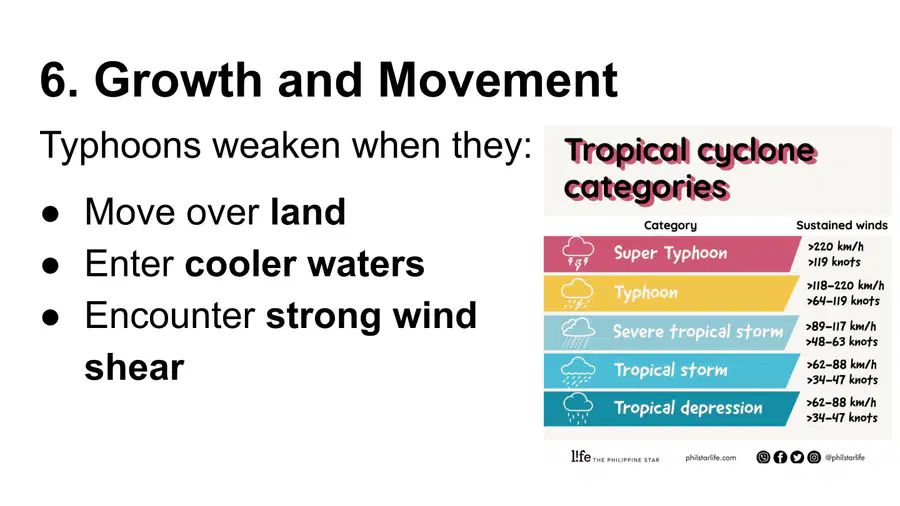
Which of the following conditions will cause a typhoon to weaken?
Moving over warm water
Encountering strong wind shear
Staying over low wind shear
Moving over land
31

32
33
Multiple Choice
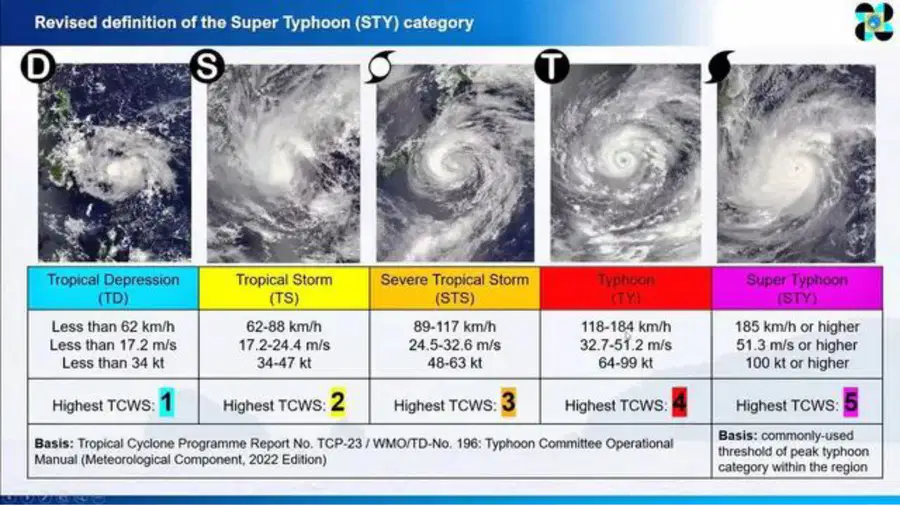
Arrange the following tropical cyclone categories in order of increasing wind speed: Tropical Depression, Severe Tropical Storm, Typhoon, Super Typhoon.
Tropical Depression, Severe Tropical Storm, Typhoon, Super Typhoon
Tropical Depression, Typhoon, Severe Tropical Storm, Super Typhoon
Severe Tropical Storm, Tropical Depression, Typhoon, Super Typhoon
Typhoon, Tropical Depression, Severe Tropical Storm, Super Typhoon
34
Fill in the Blanks
35
36
Fill in the Blanks
Show answer
Auto Play
Slide 1 / 36
SLIDE
Similar Resources on Wayground

30 questions
Quizizz Lesson
Presentation
•
KG
29 questions
Teaching using anchor charts
Presentation
•
1st - 5th Grade
28 questions
Sofa model in tinkercad
Presentation
•
1st - 5th Grade
28 questions
Topic and Main Idea
Presentation
•
2nd - 5th Grade
27 questions
Sonic Test 1991 - 1994
Presentation
•
1st - 5th Grade
32 questions
Hindi Shabdavali
Presentation
•
KG
31 questions
Common Research Designs
Presentation
•
KG
31 questions
U4 W1 L4 - Rural vs. Urban
Presentation
•
KG
Popular Resources on Wayground
10 questions
HCS SCI 03 Summer School Review 4

Quiz
•
3rd Grade
11 questions
HSMS - Standard Response Protocol
Quiz
•
6th - 8th Grade
16 questions
1.1-1.2 Quiz Review
Quiz
•
9th - 12th Grade
12 questions
Exponent Expressions
Quiz
•
6th Grade
20 questions
Adding and Subtracting Integers
Quiz
•
6th - 7th Grade
11 questions
Northeast States
Quiz
•
3rd - 4th Grade
10 questions
Characterization
Quiz
•
3rd - 7th Grade
10 questions
Common Denominators
Quiz
•
5th Grade