Search Header Logo
  1. Resource Library
  2. Science
  3. Chemistry
  4. Metals
  5. Metals And Their Extractions
Metals and their Extractions

Metals and their Extractions

Assessment

Presentation

Science

9th Grade

Medium

NGSS
MS-PS1-2, HS-PS2-5

Standards-aligned

Created by

Karen Cymru

Used 1+ times

FREE Resource

8 Slides • 17 Questions

1

Multiple Choice

Question image
In which region would the most reactive elements be found? 
1
1
2
4
3
5
4
3

2

media

3

Multiple Choice

Why is the reactivity series important in the extraction of metals from their ores?

1

It helps determine the method used for extraction

2

It shows the color of metals

3

It predicts the melting point of metals

4

It tells us the cost of extraction

4

Multiple Choice

Question image

Arrange the metals W, X, Y and Z in increasing order of reactivity.

1

X, W, Y, Z

2

X, Y, W, Z

3

Z, Y, W, X

4

W, Z, Y, X

5

media

6

Multiple Choice

Question image
A copper penny turning greenish after a few years is an example of ...
1
Chemical Change
2
Physical Change

7

Multiple Choice

Question image
Which best describes the reactivity of metals when moving from left to right on the periodic table? 
1
They become less reactive.
2
They become more reactive.

8

media

9

Multiple Choice

Question image
The most reactive metals are colored : 
1
Orange
2
Red
3
Blue
4
Green

10

Multiple Choice

Which of the following statements best explains why aluminium is extracted by electrolysis rather than by reduction with carbon?

1

Aluminium is less reactive than carbon

2

Aluminium is more reactive than carbon

3

Aluminium forms alloys with carbon

4

Aluminium cannot conduct electricity

11

media

12

Multiple Choice

Question image
What particle carries the charge in the electrolyte?
1
electron
2
proton
3
ion
4
atom

13

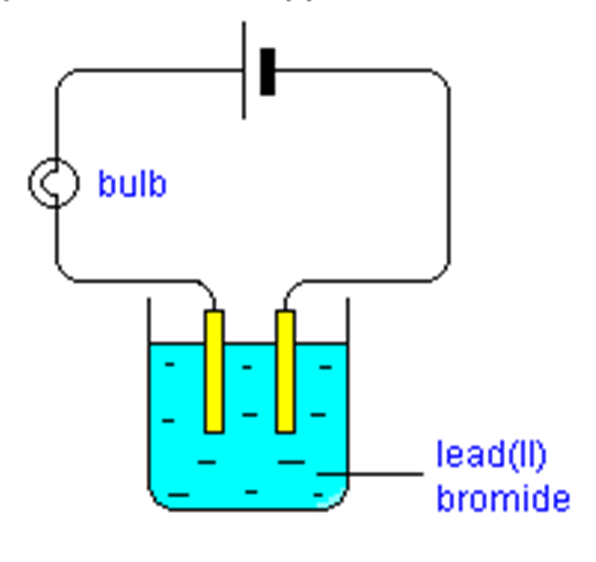
Multiple Choice

Question image
The diagram shows the electrolysis of lead(II) bromide using inert electrodes. Why does the bulb only light up  when the lead(II) bromide is melted?
1
Bromine atoms in lead(II) bromide are converted to ions when it is melted
2
Electrons flow through the lead(II) bromide when it is melted
3
The ions in lead(II) bromide are acting as the mobile charge carriers when it is melted
4
There are no ions in solid lead(II) bromide

14

media

15

Open Ended

Explain why the positive electrode in the industrial electrolysis of aluminium needs to be replaced often.

16

Multiple Select

Question image

Diagram shows the electrolysis of concentrated copper(II) chloride solution using carbon as electrodes.

Which of the followings is the correct half equations represents the reactions at the anode?

1

4OH- → 2H2O + O2 + 4e

2

2Cl- → Cl2 + 2e

3

Cu → Cu2+ + 2e

4

Cu2+ + 2e → Cu

17

Fill in the Blanks

18

Multiple Select

Which of the following are correct statements about the products formed at the electrodes during the electrolysis of molten lead bromide?

1

Lead forms at the cathode

2

Bromine forms at the anode

3

Lead forms at the anode

4

Bromine forms at the cathode

19

media

20

media

21

Multiple Choice

Which property is shared by most transition metals?

1

Low melting points

2

Form coloured compounds

3

Poor conductors of electricity

4

Very reactive

22

media

23

Multiple Choice

Question image

Pb + 2Ag+ → Pb+2 + 2Ag


The chemical species being reduced is

1

Ag

2

Pb

3

Pb+2

4

Ag+

24

Fill in the Blanks

25

Multiple Choice

Question image

In a redox reaction, the species that loses electrons

1

is called the cathode

2

is oxidized

3

gains mass at the electrode

4

decreases in oxidation number

Question image
In which region would the most reactive elements be found? 
1
1
2
4
3
5
4
3

Show answer

Auto Play

Slide 1 / 25

MULTIPLE CHOICE