Protein Synthesis Notes
Presentation
•
Biology
•
9th - 12th Grade
•
Easy
Standards-aligned
Teresa Schlueter
Used 8+ times
FREE Resource
23 Slides • 10 Questions
1
2
3
Multiple Select
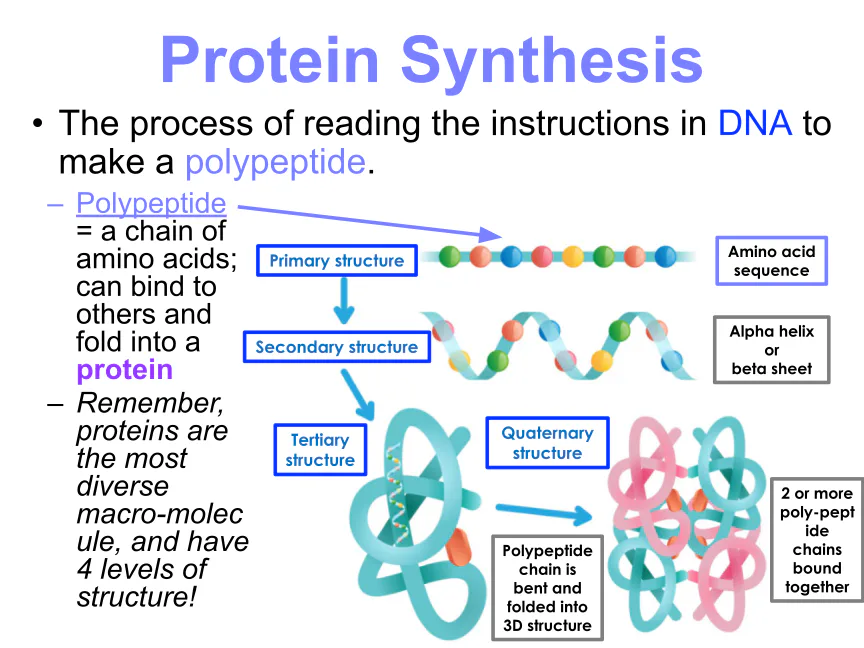
What are the four levels of protein structure as illustrated in the image?
Primary structure
Secondary structure
Tertiary structure
Quaternary structure
4th Level Structure
4
5
Multiple Select
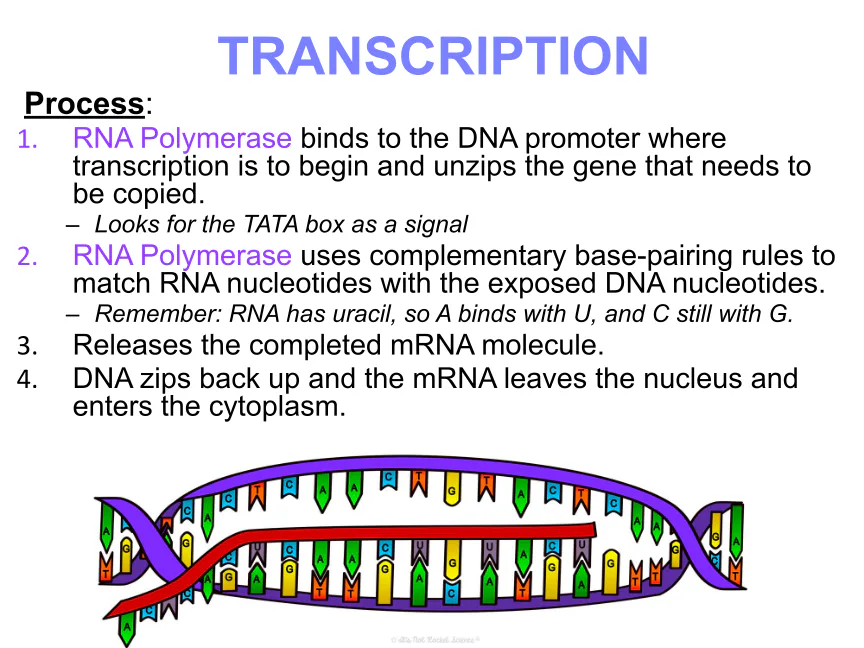
What are the two steps of protein synthesis as described in the Central Dogma of Genetics?
Replication
Transcription
Translation
Mutation
6
7
8
Match
RNA Transcription
RNA Translation
mRNA
tRNA
rRNA
DNA to mRNA
mRNA code builds protein
carries code from DNA in nucleus to ribosome
brings amino acid to mRNA
part of ribosomal structure
DNA to mRNA
mRNA code builds protein
carries code from DNA in nucleus to ribosome
brings amino acid to mRNA
part of ribosomal structure
9
10
11
12
13
Multiple Choice
What is the mRNA sequence transcribed from the given DNA template?
3' TACGCTAGTACGATT 5'
5' AUGCGUAUCAGUAA 3'
3' AUGCGUAUCAGUAA 5'
5' ATGCGTATCAGTAA 3'
3' ATGCGTATCAGTAA 5'
14
Multiple Choice
What is RNA editing?
The process of copying DNA into RNA
The modification of RNA nucleotides after transcription
The removal of exons from RNA
The synthesis of proteins from RNA
15
16
17
18
Multiple Choice
19
20
21
22
23
24
25
26
27
Fill in the Blanks
28
Match
Match the codon with its amino acid
ACC
CCA
UAG
AUG
GAC
THR
PRO
stop
MET
ASP
THR
PRO
stop
MET
ASP
29
30
31
32
Multiple Choice
The study of changes in organisms caused by modification of gene expression rather than alteration of the genetic code itself
hypogenomics
epigenetics
microgenomics
none of these
33
Multiple Choice
These diagrams show a variety of cells from the same organism.
How can cells from the same organism have such different shapes and functions?As each cell differentiates, the DNA changes so that each type of cell has different DNA once it reaches maturity.
As each cell differentiates, the DNA changes so that each type of cell has different
During differentiation, different parts of the DNA in each type of cell are activated, resulting in the different structure and function of the cells.
During differentiation, different types of cells produce proteins which destroy the nonactive DNA, leading to cell specialization.
Show answer
Auto Play
Slide 1 / 33
SLIDE

Similar Resources on Wayground
23 questions
The Cell Theory
Presentation
•
9th - 12th Grade
30 questions
Evidence of Evolution
Presentation
•
9th - 12th Grade
26 questions
Biomagnification/ Bioaccumulation
Presentation
•
8th - 12th Grade
27 questions
MUTASI
Presentation
•
9th - 12th Grade
30 questions
AP Biology - graphing review
Presentation
•
9th - 12th Grade
27 questions
Cold War (Intro)
Presentation
•
9th - 12th Grade
27 questions
Discrete and Continuous Data
Presentation
•
9th - 12th Grade
26 questions
Enzymes
Presentation
•
9th - 12th Grade
Popular Resources on Wayground
20 questions
STAAR Review Quiz #3
Quiz
•
8th Grade
20 questions
Equivalent Fractions
Quiz
•
3rd Grade
6 questions
Marshmallow Farm Quiz
Quiz
•
2nd - 5th Grade
20 questions
Main Idea and Details
Quiz
•
5th Grade
20 questions
Context Clues
Quiz
•
6th Grade
20 questions
Inferences
Quiz
•
4th Grade
19 questions
Classifying Quadrilaterals
Quiz
•
3rd Grade
12 questions
What makes Nebraska's government unique?
Quiz
•
4th - 5th Grade
Discover more resources for Biology
14 questions
Ecological Succession: Primary and Secondary
Quiz
•
9th Grade
20 questions
Structure & DNA Replication Quiz
Quiz
•
9th Grade
50 questions
Biology EOC Review
Quiz
•
9th Grade
33 questions
Module C - Virus vs Cells, Biomolecules & Enzymes
Quiz
•
9th Grade
25 questions
photosynthesis and cellular respiration
Quiz
•
9th Grade
25 questions
STAAR Evolution Vocabulary
Quiz
•
9th Grade
20 questions
Food Chains and Food Webs
Quiz
•
7th - 12th Grade
20 questions
Genetics 2026
Quiz
•
10th Grade