

Bio Organisms and Evolution Review (Bio 4.2-4.6, 5.1, 5.3, 5.5-5

Presentation
•
Biology
•
9th - 12th Grade
•
Easy
+21
Standards-aligned

James Franks
Used 1+ times
FREE Resource
53 Slides • 106 Questions
1
Essential Questions:
What evidence supports the theory of evolution and common ancestry among organisms?
How does natural selection lead to adaptation and speciation?
How do environmental changes affect population growth and ecosystem stability?
In what ways do organisms depend on and influence one another within ecosystems?
How do ecological succession and human activity shape biodiversity over time?
2
Standard 4.1-4.3 Basic Review:
Common Ancestry
Chemical and Organic Evolution
Chemical Evolution, Prokaryote Metabolism, Endosymbiotic Theory
Convergent and Divergent Evolution
Evidence of Evolution
Homologous structures, vestigial structures, embryology, fossils, biogeography
Cladograms
Common ancestor, derived traits
3
BIO.4.1 Use models to differentiate between organic and chemical evolution, illustrating the steps leading to aerobic heterotrophs and photosynthetic autotrophs.
BIO.4.2 Evaluate empirical evidence of common ancestry and biological evolution, including comparative anatomy (e.g., homologous structures and embryological similarities), fossil record, molecular/biochemical similarities (e.g., gene and protein homology), and biogeographic distribution.
BIO.4.3 Construct cladograms/phylogenetic trees to illustrate relatedness between species.
4
Divergent Evolution explains how new species form from a recent common ancestor.
Evidence: Homologous structures are body parts that are similar in structure but different in function indicates the species share a common ancestor.
Convergent Evolution explains how similar traits evolve in unrelated species due to similar environmental pressure and do not share a recent common ancestor
Evidence: Analogous structures are body parts that are different in structure but similar in function and indicate the species do not share a common ancestor.
5
Drag and Drop
indicates the species
6
Dropdown
The beaks are the result of a.
Birds and giant squid c.
7
Drag and Drop
indicates the species
8
Drag and Drop
These are called a.
and indicate that whales, birds, and monkeys c.
9
Homologous structures are similar in structure but different in function indicates the species share a common ancestor

Vestigial Structures have no use in the current species but did have use in ancestral species

Fossils provide evidence of evolutionary changes by showing how the structures of species have transformed over time.


10
Drag and Drop
11
Drag and Drop
are known as b.
12
Drag and Drop
showing how the structures of species have
13
Drag and Drop
showing how the structures of species have
14
Multiple Choice
A scientist compares the bone structure of a human arm, a bat wing, and a whale flipper. Although they have different functions, they share the same basic bone arrangement. What does this suggest about these organisms?
They evolved in the same environment.
They share a common ancestor.
They are members of the same species.
They evolved from different ancestors to look similar (convergent evolution).
15
Multiple Choice

The diagram shows the front limb bones of a frog, whale, human, and bat. These structures have different functions but similar bone patterns.
What do these similarities provide evidence for?
The animals all use their limbs in the same way
The animals live in the same environment
The animals inherited the structure from a common ancestor
The animals are the same species with slight differences
16
Multiple Choice

Which of these structures are the best evidence of evolutionary relationships?
bat wing and bee wing
bat lower jaw and whale lower jaw
whale flipper and bee wing
bat wing and whale flipper
17
Dropdown

Compared to early whale ancestors,
the body structure of modern whales has
and the number of visible limbs has
18
Multiple Choice

Scientists compared several whale species using genetic and anatomical evidence. The cladogram shows the evolutionary relationships among these whales. Rice’s whale is shown as a distinct branch.
Which type of evidence BEST supports the conclusion that Rice’s whale is a unique species?
Similar migration behavior between Rice’s and Bryde’s whales
The blowhole shapes of Rice’s whale and Eden’s whale
Genetic differences shown in mitochondrial DNA
Similar skull measurements between Rice’s whale and blue whale
19
Multiple Select
Scientists discovered a desert lizard population once thought to be the same species as the common spotted lizard. New evidence suggests it may be a separate species:
Different scale patterns and colors
No response to each other’s mating call
Mitochondrial DNA differences
Different activity times
Fossils show both groups are over 2 million years old
Populations live 200 miles apart
Which THREE types of data BEST support that the desert lizards are a new species?
Scale pattern and coloration
Mating behavior differences
Genetic differences in mitochondrial DNA
Fossil record age
Geographic distance between the populations
20
Embryology shows similarities in developmental patterns across species indicates they share common ancestor
Biogeography shows species on different continents that share similar structures and behaviors but have different adaptations share a common ancestor
Supercontinents - Pangea / Gondwanaland


21
Sequence Homology
Compare similarities and differences in DNA (best), RNA, or amino acids sequences.
More similarities in sequences indicate the closer the species are related and that they share common ancestry.
Check to see if chart is comparing similarities or differences.


Similarities Highlighted
Differences Highlighted

22
Multiple Choice
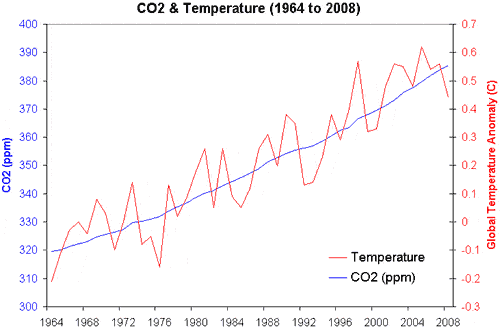
Several species of extinct giant tortoises once lived on different islands in the Indian Ocean. One species still lives today on Aldabra Island. Scientists want to find out how closely the living tortoise is related to the extinct ones.
What is the MOST accurate way to determine how closely they are related?
Look at old journal entries and drawings of the extinct tortoises
Compare the size and shape of their shells and bones
Measure the distance between Aldabra and the other islands
Compare the DNA sequences of the living and extinct tortoises
23
Multiple Choice
Scientists compared the DNA sequences of four different species.
Which statement best explains how DNA sequence homology supports the idea that the species share a common ancestor?
Species with more similar DNA sequences likely evolved in the same environment.
Species with more similar DNA sequences likely inherited them from a common ancestor.
Species with different DNA sequences cannot be related.
Species that have similar physical features always have identical DNA.
24
Multiple Choice

The table shows a portion of a gene sequence from four organisms.
Based on the data, which two organisms are MOST closely related?
[count the number of similar nucleotides]
Human and Lemur
Human and Gorilla
Chimpanzee and Human
Gorilla and Lemur
25
Multiple Choice

Which organism listed below is MOST closely related to the raccoon?
[count the number of similar nucleotides]
Black Bear
Giant Panda
Red Panda
26
Multiple Choice

Which organism listed below is most closely related to humans?
[the number of different amino acids shown]
Yeast
Chicken
Dog
Rattlesnakes
27
Multiple Choice

The illustration below shows the results of gel electrophoresis of 4 different deer species.
Which two species of deer are more closely related?
1 and 3
1 and 4
2 and 3
2 and 4
28
Common Ancestry
Shared node indicates most recent common ancestor
Shared Characteristics
Traits present in all species being analyzed.
Derived Characteristics
Traits that evolved in some species but not others.

29
Multiple Choice

Which trait to spiders share with carpenter ants?
legs
antenna
wings
2 sets of wings
30
Labeling
Label the cladogram.
legs
opposable thumbs
development of lungs
presence of fur
31
Multiple Select

The diagram below shows an incomplete cladogram for four organisms. Use the traits to determine the correct order of branching.
Which TWO statements BEST describe the relationships shown in the cladogram?
The trait that separates amphibians from reptiles is the presence of feathers
The trait that separates birds from mammals is the presence of fur and milk production
The trait that separates amphibians from reptiles is the ability to lay eggs on land
The trait that separates mammals from reptiles is the ability to lay eggs
The trait that separates reptiles from birds is the development of lungs
32
Standard 4 Basic Review Part 2:
Natural Selection and Gene Pools
Darwin's Theory of Natural Selection
Stabilizing, Directional, Disruptive Selection
Speciation, Reproductive Isolation
33
BIO.4.4 Design models and use simulations to investigate the interaction between changing environments and genetic variation in natural selection leading to adaptations in populations and differential success of populations.
BIO.4.5 Use Darwin's Theory to explain how genetic variation, competition, overproduction, and unequal reproductive success acts as driving forces of natural selection and evolution.
BIO.4.6 Construct explanations for the mechanisms of speciation (e.g., geographic and reproductive isolation).
34
Natural selection: organisms with favored traits survive and reproduce
Variation is the variety of traits
Mutations are the main source of variation
Genetic recombination (meiosis / crossing over in sex cells and fertilization) reshuffle existing genes and increase variation
Overproduction is producing more offspring than can survive
Competition is the struggle over resources
Adaptations are traits that help an organism survive
Unequal reproductive success is when individuals with favored traits survive and reproduce
35
Match
Match the driving forces of natural selection.
Some beetles in a population are green, and others are brown.
A frog lays hundreds of eggs, but only a few survive to adulthood.
Two plants grow close together and compete for sunlight and water.
Lizards with longer legs run faster and escape predators, so they survive and have more offspring.
variation
overproduction
competition
unequal reproductive success
variation
overproduction
competition
unequal reproductive success
36
Match
Match the driving forces of natural selection.
In a population of rabbits, some have white fur and some have brown fur.
Each rabbit produces many baby rabbits, but not all survive.
The rabbits compete for food and must avoid predators in their environment.
Brown rabbits are better camouflaged and survive more often, so they have more babies and pass on the brown fur trait.
variation
overproduction
competition
unequal reproductive success
variation
overproduction
competition
unequal reproductive success
37
Multiple Choice

The skeletal structures of the flipper and the arm are similar, but seals use their flippers for swimming, while monkeys use their arms primarily for grasping and lifting.
This difference is the result of
migration
genetic engineering
succession
natural selection
38
Multiple Choice
Cactus plants in desert regions often grow far apart and have thick, waxy skin. Their roots spread wide near the surface to absorb rainwater quickly. Some cacti also release chemicals into the soil that slow the growth of nearby plants.
Which statement BEST explains how these traits help the cactus survive in its environment?
The wide roots increase sunlight absorption, helping the cactus grow faster.
The waxy skin reduces the need for nutrients from the soil.
The chemical release decreases competition for water from nearby plants.
The chemicals help attract insects to pollinate the cactus flowers.
39
Multiple Select
Which TWO examples best show how natural selection helps some organisms survive and pass on their traits?
A rabbit that runs faster than others escapes predators and has more babies.
A bird learns a new song by copying other birds in the same area.
A plant with deep roots survives a drought and makes more seeds.
A fish hides under rocks but rarely comes out to eat.
An animal grows bigger because it eats more than others after birth.
40
Multiple Choice
Which scenario best shows how natural selection can cause a trait to become more common in a population over time?
All members of a species decide to change color to match their environment.
A group of animals with different fur colors are all equally likely to survive and reproduce.
Some insects are born with thicker shells. Birds eat the soft-shelled ones, so more thick-shelled insects survive and pass on that trait.
A plant grows faster after being moved to a greenhouse with more sunlight.
41
Multiple Choice
Before a volcanic eruption, light-colored lizards were more common because they blended in with sandy soil. After the eruption, the ground became dark with ash and rock. Over several generations, dark-colored lizards became more common.
What most likely caused this change in the population?
Lizards changed color to match the new environment during their lifetime
Light-colored lizards were better at finding food in dark environments
Dark-colored lizards were more likely to survive and reproduce in the new environment
All lizards moved away from the dark area after the eruption
42
Multiple Choice

In northern Canada, a population of rabbits was predominantly white in color.
The allele for white color is recessive (g), while the allele for gray color is dominant (G).
Over the last several decades, the average annual temperature of this area has increased, and the long-term deposits of ice and snow have become scarce. We see the result of this change in the graph above.
How can we explain this change in terms of allelic frequency?
Gray alleles are dominant over white.
Changes in the environment caused harmful mutations that were passed to offspring.
In order to survive, rabbits changed from white to gray and they passed the gray allele to offspring.
Gray rabbits were more likely to survive in the changed habitat. The gray alleles were passed to offspring.
43
Multiple Choice

The dots represent a bacterial infection. Sal was very sick with this bacterial infection. The infection was treated with antibiotics. Sal seemed to get well, but in a few weeks, she was sick again. How can this be explained using natural selection?
The antibiotics were ineffective to this strain of bacteria.
The stronger, more resistant bacteria survived the antibiotics and reproduced.
The antibiotics did not kill the bacteria; it only forced them to be dormant.
Antibiotics will only kill a portion of the bacteria, no matter how much medicine Sal takes.
44
Frequency Graphs

No Change
Increase then Decrease
Increase
Decrease
Frequency Graphs show how often a particular form of a trait occurs in a population.
As natural selection acts, the frequency of a favored trait increases
45
Multiple Choice
If BROWN fur is favored in mice,
which graph represents what could happen over time to the number of mice with BLACK fur or WHITE fur?
46
Multiple Choice
Moths in Pontotoc can be white or green. Pontotoc had a green leafy environment so most moths had green leafy colored wings.
50 years ago Pontotoc experienced an extreme snow storm which covered the land in snow that has not melted since.
Which graph best represents the change in the number of green leafy moths?
47
Multiple Choice
A population of mice includes individuals with white fur and individuals with dark fur. The environment changes from a light sandy beach to dark volcanic rock. Which graph best represents the expected change in the mouse population over time?
A graph showing the white mice increasing and dark mice decreasing.
A graph showing the dark mice increasing and white mice decreasing.
A graph showing both white and dark mice decreasing equally.
A graph showing no change in the frequency of fur color.
48
Stabilizing Selection
Favors the average or medium trait
Directional Selection
Favors one extreme trait over the other
Disruptive Selection
Favors both extreme traits


Natural selection favors traits that increase survival and reproduction
49
Multiple Choice
Moths in Houlka-land can be white or green. Houlka-land had a green leafy environment so most moths had green leafy colored wings.
50 years ago Houlka-land experienced an extreme snow storm which covered the land in snow that has not melted since.
Which graph best represents this change?
50
Multiple Choice
When a group of deer migrated to a cold mountain, the thin-furred deer and average-furred deer died.
The thick-furred deer survived and eventually the population became thicker-furred.
Which graph represents this change?
51
Multiple Choice
Robins typically lay four eggs.
If more than four eggs are produced then the baby chicks are malnourished.
Fewer than four eggs usually result in no viable (able to live) baby chicks.
Which graph represents this?
52
Multiple Choice

The graph shows the fitness of different rabbit ear lengths in a forest environment.
Which statement BEST explains this outcome?
Rabbits with short and long ears (points 1 and 3) are more likely to survive and reproduce, so they pass on their traits more often than rabbits with medium ears (point 2).
Rabbits with medium ear length (point 2) are more likely to survive and reproduce, while rabbits with very short or very long ears (points 1 and 3) are less fit and less likely to pass on their traits.
Medium ear length (point 2) is caused by environmental factors and does not affect survival.
Rabbits with short ears (point 1) and medium ears (point 2) survive equally, while long-eared rabbits (point 3) are most likely to pass on their traits.
53
Divergent evolution occurs when a population of a certain species accumulates differences over time.
Species is a group of organisms that can successfully interbreed and produce viable, fertile offsprings
Population is a group of of the same species living in the same place at the same time
Speciation is the formation of a new species
Speciation occurs when members of populations no longer interbreed (stop)

54
Multiple Choice
Anoles are a type of lizard that exist as almost 400 different species. An estimated 50 million years ago, populations of Anoles lizards spread to the Caribbean Islands.
Many different species of Anoles evolved over time as they adapted to different niches on the islands.
The emergence of different species of anoles is an example of which of the following?
selective breeding
bottleneck effect due to near extinction
divergent evolution
hybridization
55
Multiple Choice
Scientists observed two populations of songbirds on nearby islands. At first, they were considered the same species, but researchers gathered the following data:
The birds sing distinct mating calls that are not recognized by the other group
DNA analysis shows consistent genetic differences between the populations
One group builds nests in trees, the other nests only on the ground
Offspring from cross-breeding attempts between the groups do not survive
Which piece of evidence BEST supports the conclusion that these are two different species?
The type of nesting location
The difference in mating calls
The inability to produce viable offspring
The fact that they live on different islands
56
Reproductive Isolation the inability of a population to interbreed due to a barrier
Geographic Isolation
a physical barrier forms that divides a population into two or more separate groups
Mountain range or Canyon forms; River forms
Temporal Isolation
a species develops different reproductive cycles
Bloom at different times; Day or night spawning; A spring cycle or a fall cycle
Behavioral Isolation
two populations do not interbreed because of differences in courtship behaviors
Different courtship dance, song
Mechanical Isolation
physical differences prevent successful mating
Members of a species develop incompatible sex organs
Physically cannot reproduce together.
Sex organs will not physically fit together
Pollination only occurs with certain pollinators
57
Multiple Choice
A single population of lizards lived across a wide desert. Over time, a large river formed and split the population into two separate groups that could no longer cross and mate. After thousands of years, the two groups developed different scale patterns, colors, and mating calls.
Which process MOST likely caused the formation of two different lizard species?
Natural disasters caused both groups to migrate to new areas
Genetic drift removed all variation from both populations
The river caused geographic isolation, and over time the groups evolved separately
Both groups chose to evolve differently in response to human activity
58
Multiple Choice
In North America, the eastern spotted skunk mates in late winter, and the western spotted skunk mates in late summer.
Even though their geographic ranges overlap, the species do not mate with each other.
What most likely prevents these two species from interbreeding?
They have different physical features
They compete for the same food sources
They live in completely different environments
They reproduce at different times of the year
59
Multiple Choice
Which statement best describes how geographic isolation can contribute to land animal speciation?
Geographic isolation physically separates populations but allows them to interact.
Geographic isolation physically separates populations and prevents them from interacting.
Geographic isolation causes genetic changes in individual organisms but allows them to interact.
Geographic isolation causes genetic changes in individual organisms and prevents them from interacting.
60
Multiple Choice
A population of fish once lived in a single large lake. Over thousands of years, climate changes caused the lake to split into two smaller lakes that no longer connected. Scientists later discovered that the fish in each lake had developed different colors, mating behaviors, and feeding habits.
Which explanation BEST describes how two new fish species formed?
The lakes had different water temperatures, so the fish needed to change their behaviors to survive
The fish were physically separated, and over time their traits changed through mutation and adaptation, leading to speciation
The fish migrated between the lakes and adapted to both habitats equally
The fish randomly changed traits and became different species without environmental pressure
61
Multiple Choice
A population of snakes originally lived in southern Mississippi’s wetland areas. Over time, some snakes migrated north into hill regions and others moved west into dry pine forests. The two new populations developed differences in color and behavior. After many years, the populations came into contact again but could no longer successfully mate.
Which statement BEST explains what happened to these snake populations?
The snakes adapted to different environments and eventually became separate species due to reproductive isolation
Both populations changed in the same ways, so they merged back into one population
Climate changes caused the snakes to lose their genetic variation and become less successful
One population outcompeted the other for food and forced it to go extinct
62
Multiple Choice
A population of bacteria is treated with an antibiotic. Most of the bacteria are killed, but a few survive and reproduce. Over time, the entire population becomes resistant to the antibiotic. Which principle of natural selection best explains this?
Geographic isolation caused the bacteria to become a new species.
The bacteria mutated because they needed to survive.
The antibiotic caused the bacteria to become stronger.
The resistant bacteria survived and passed their resistant genes to their offspring ("survival of the fittest")
63
Gene Pools represent all of the different genes (alleles) available in a population
Small Gene Pools have very little genetic variation and are more likely to undergo rapid evolution, especially through random events.
Large Gene Pools have a lot of genetic variation, increasing a population’s ability to adapt and survive environmental changes.
Genetic Drift is a random change (by chance) in allele frequencies, especially impactful in small populations.
Bottleneck Effect occurs when a population’s size is drastically reduced due to a sudden event (e.g., natural disaster), leaving a smaller gene pool with less variation.
Founder Effect happens when a small group separates from a larger population and starts a new colony, carrying only a limited sample of the original gene pool.
64
Multiple Choice
Which of the following best describes gene pool?
The alleles only in the immediate family members
A total set of different alleles in a population
A frequency of given alleles in a population
Half the number of the alleles within the population
65
Multiple Choice
Genetic drift is change in the allele frequency of a population due to...
random chance
natural selection
non-random mating (sexual selection)
artificial selection
66
Multiple Choice
A few deer wander out of their native woods into a completely new park where no deer had ever been before.
They go on to create an entirely new population.
What has occurred?
Genetic Drift (bottleneck )
Natural Selection
Genetic Drift (founder effect)
Mutation
67
Multiple Choice

Which of the following is an example of the bottleneck effect?
Cheetah populations reach their lowest levels with reduced diversity and as they rebound are so genetically similar they appear to be inbred.
Affected individuals with blue skin can trace their ancestry back to one of the first settlers in the region.
The environment of a fox population changes and over time foxes who are white survive and pass on their genes to their offspring.
Humans choose two dogs they like the characteristics of and breed them together.
68
Standard 5.1, 5.4, 5.5, 5.6 - Basic Review 1
Organisms and their Environment
Ecological organization
organism, population, community, ecosystem, biome, biosphere
Coevolution and ecological relationships
herbivory, predation, competition, cooperation, mutualism, commensalism, parasitism, mimicry
Energy flow and matter
Food chains, webs, pyramids
Population Growth Patterns
Exponential and logistic growth, carrying capacity, density dependent and independent limiting factors
Interdependence
69
BIO.5.1 Illustrate levels of ecological hierarchy, including organism, population, community, ecosystem, biome, and biosphere.
BIO.5.4 Develop and use models to describe the flow of energy and amount of biomass through food chains, food webs, and food pyramids.
BIO.5.5 Evaluate symbiotic relationships (e.g., mutualism, parasitism, and commensalism) and other coevolutionary (e.g., predator-prey, cooperation, competition, and mimicry) relationships within specific environments.
BIO.5.6 Analyze and interpret population data, both density-dependent and density-independent, to define limiting factors. Use graphical representations (growth curves) to illustrate the carrying capacity within ecosystems.
70
Biotic Factors
living parts of an ecosystem
plants, animals, bacteria, mushrooms, mosquitos…
Abiotic Factors
nonliving parts of an ecosystem
rock, temperature, water, soil, energy, pH

71
INCLUDE ONLY BIOTIC FACTORS
ORGANISM
an individual living thing
Ex. one goldfish
POPULATION
a group of the same species at the same place and time
Ex. all of the goldfish in a lake
COMMUNITY
all of the different populations living in the same place at the same time
Ex. All of the goldfish, starfish, aquatic plants...in a lake


72
Drag and Drop
Frogs, fish, insects, and plants all living together in the same pond -
One frog sitting on a lily pad -
A group of frogs living in the same pond -
73
INCLUDE BOTH BIOTIC & ABIOTIC FACTORS
ECOSYSTEM
All of the living things and their nonliving environment at the same place and time
Ex. all of goldfish, starfish, aquatic plants...and their nonliving environment in a lake
BIOME
All ecosystems with similar climates
BIOSPHERE
All places on earth where life exists
Ex. all of Earth’s ecosystems


74
Drag and Drop
A group of deer living in the same forest. -
Deer, trees, birds, foxes, sunlight, soil, water, and temperature in the same forest. -
One deer walking through the forest. -
75
Drag and Drop
A group of organisms of the same species living in the same area is a
All the different populations (biotic factors) living in an area make up a
All the biotic factors interacting with the abiotic factors (non-living) make up an
76
Herbivory +/-
animals eating plants
Autotrophs
use light energy to make their own food
Heterotrophs
must consume other organisms for food
Predation +/-
animals consuming animals
Predator
organism hunts for food
Prey
organism killed and consumed for food


77
Carnivores
animals that only eat animals
ex. lions only eat other animals
Herbivores
animals that only eat plants
ex. deer only eat plants
Omnivores
animals that only both plants and animals
ex. bears eat berries and fish

78
Drag and Drop
79
Drag and Drop
Elephants eat bark, leaves, small branches, roots, grasses, and fruit -
Lions eat zebras and wildebeests -
80
Camouflage
resembling something that blends in with your surroundings
ex. leaf bug; stick bug
Mimicry
one organism (the mimic) evolves traits to resemble another organism to gain a survival advantage
ex. harmless snake looks like venomous snake
Self-mimicry
one part of an animal resembles another part of its body
ex. eye spots on fish; head and tail on snake look alike


81
Dropdown

A squirrel's fur resembles the tree it lives in -
82
Drag and Drop

A hoverfly has the same coloration as a bee -
83
Competition +/-
one competitor must develop a competitive advantage over the other for resources
many male animals fight each other for food and/or mating opportunities
Cooperation +/+
organisms learn to help and depend on each other
e.x dolphins herd fish together so they can easily trap and eat them
ex. animals feeding their young


84
Dropdown
A lion kills an antelope for food -
85
Dropdown
Ants work together to take care of the colony -
86
MUTUALISM +/+
Both organisms benefit
Ex. Flower gets pollinated, humming bird gets food
Ex. Alligator and bird - bird gets meal, alligator gets teeth cleaned
COMMENSALISM +/0
One organism benefits, other is not affected
Ex. Sucker fish and shark - sucker fish attaches to shark and gets leftovers
Shark is not affected
Ex. Barnacles on whale
PARASITISM +/-
One organism benefits, other is harmed
Parasite lives in or on host
Ex. Fleas get a meal, the dog loses blood and is harmed


87
Multiple Choice
What term refers to a close relationship between different species where one benefits and the other is harmed?
88
Drag and Drop

Hummingbirds feed on nectar from flowers and pollinate them in the process. This relationship is called
89
Drag and Drop
False widow spiders look like deadly black widow spiders -
Chameleon coloration blends in to hide from the flies it catches to eat -
Predation
90

Nutrients (matter) are cycled in an ecosystem - used over and over
carbon, nitrogen, phosphorus, oxygen..,
Energy flows in one direction, and is not cycled
Most energy is used or lost as heat
10%
91
Multiple Choice
Nutrients
92
PRODUCERS (autotrophs)
organisms that use energy from the sun to make food (plants)
convert light energy (Sun) into chemical energy (sugar)
has the most energy available and greatest biomass
plants, cyanobacteria, algae
CONSUMERS (heterotrophs)
organisms that get energy by eating other organisms
animals; most bacteria, fungi

93
PRIMARY
CONSUMERS
Herbivores - only eat producers (plants)
cows, rabbits, and deer
TERTIARY
CONSUMERS
eat secondary consumers
Carnivores
Top Predator
Top Consumer
Has least available energy
SECONDARY CONSUMERS
eat primary consumers
Omnivores - eat plants and animals
Carnivores - only eat animals

94
Dropdown
Producer =
Primary Consumer =
Secondary Consumer =
95
Decomposers
Bacteria and Fungi that chemically break down dead and decaying matter and put nutrients back into the soil
Plants must have these nutrients to grow

96
Multiple Choice
How do decomposers help other organisms in an ecosystem?
They break down dead organisms and add nutrients back to the soil that plants use.
They use the sunlight to make their own food that other organisms eat for energy.
They help disperse seeds for plant growth.
Decomposers do not help other organisms in an ecosystem.
97
Food Chain
simple linear diagram showing the flow of energy in an ecosystem
Arrow points in the direction energy is moving
Food Web
complex diagram that shows many interweaving food chains


Sun
Producer
Primary
Consumer
Secondary
Consumer
Tertiary
Consumer
Quaternary
Consumer

98
Hotspot
Click the food chain that has the correct arrows.
99

100

Producer
Sun
Primary
Consumer
Quaternary
Consumer
Tertiary
Consumer
Secondary
Consumer
101


A Trophic Level is each step in a food chain or food web
Indicates how many times energy is transferred or how much biomass is available


Level 0
Sun
Main energy source for life
Light Energy
Level 1
Producers
Most available energy and biomass
Level 2
Primary Consumers
Level 3
Secondary Consumers
Level 4
Tertiary Consumers
Least available energy and biomass
102
Labeling
Label the trophic levels.
2
3
0
4
1
5
103

Trophic Level 1 - Bottom
Always producers
Most available energy and biomass
Trophic Level 4/5 - Top
Always predator
Least available energy and biomass
Energy and Biomass
decrease as you move to next level
only 10% is transferred to next level
the rest is used or lost
104
Dropdown
The Apex Predator always found at the
105
Dropdown
The apex predator has the
106
Dropdown

107

108

Producers - 50,000J
Primary Consumers - 5,000 J
Secondary Consumers - 500 J
Tertiary Consumers - 50 J
109
Labeling
Label the transfer of energy correctly on the energy pyramid.
5 J
500 J
50 J
5,000 J
50,000 J
110
Increasing Population Size
Birth Rate (natality)
organisms being born
Immigration
organisms moving into a population
Decreasing Population Size
Death Rate (mortality)
organisms dying
Emigration
organisms moving out of a population
LIMITING FACTORS
Any resource or environmental condition that slows the growth of a population
2 Types:
Density Dependent
Density Independent
111
Multiple Choice
Which statement best describes the relationship between birth rate and death rate in a growing population?
The birth rate is equal to the death rate, so the population stays the same.
The birth rate is less than the death rate, so the population decreases.
The birth rate is greater than the death rate, so the population increases.
The birth rate and death rate have no effect on population size.
112
Multiple Choice
How do immigration and emigration affect the size of a population?
Immigration increases population size, while emigration decreases it.
Immigration decreases population size, while emigration increases it.
Immigration and emigration both decrease population size.
Immigration and emigration have no effect on population size.
113
Exponential Growth
grows without limit
new population that initially has
unlimited resources
few or no predators
very little competition for resources
J-shaped curve
Logistic Growth
natural growth
grows quickly at first then levels off
slowed by limiting factors
S-shaped curve
Has a Carrying capacity
number of organisms an ecosystem can support


114
Labeling
Label the growth curve.
fast growth
carrying capacity
slow growth
115
Labeling
Label the growth curve.
slow growth
fast growth
carrying capacity
116
DENSITY INDEPENDENT
ABIOITIC Limiting factors that affect a population regardless of its size or density. All species equally affected
temperature - abiotic
unusual weather - abiotic
flood, hurricane, tornado, drought
oxygen levels - abiotic
sunlight - abiotic
natural disasters - abiotic
human activities - anthropogenic
habitat destruction; pollution
deforestation
DENSITY DEPENDENT
BIOTIC Limiting factors that increase in effect as a population grows larger or denser.
competition - biotic
overcrowding - biotic
predation - biotic
parasitism - biotic
disease - biotic
bacteria/viral infection
food supply - biotic
117
Multiple Choice
Which of the following is an example of a density-independent limiting factor?
Competition for food
A contagious disease
A wildfire
Predation by wolves
118
Multiple Choice
Which graph represent the change in black bear population if a drought reduces the number of blueberry bushes in Pickens county?
119
Multiple Choice
A population of fish in a pond dies suddenly after a chemical spill contaminates the water. This is an example of which type of limiting factor?
Density-dependent, because it affected a large population.
Density-dependent, because the fish were competing for clean water.
Density-independent, because the spill affected the fish regardless of population size.
Density-independent, because the fish population increased after the spill.
120
The number of organisms an ecosystem can support
Population growth is limited by limiting factors
resources, predation, weather, disease...

Slow Growth
Slow Growth
Fast Growth
121
Multiple Choice
What happens to a population when it reaches the carrying capacity of its environment?
The population continues to grow without limits.
The population crashes and becomes extinct.
The birth rate becomes higher than the death rate.
The population levels off as resources become limited.
122
Multiple Choice

Based on the graph, what does the leveling off of the deer population around 500 most likely represent?
The number of predators in the area
A decrease in the birth rate only
The forest’s carrying capacity for deer
The start of an extinction event
123
Multiple Choice

A population of raccoons in a Mississippi wetland is growing rapidly.
At first, the population increases exponentially, but over time the growth slows and levels off.
What most likely caused the change from exponential to logistic growth?
A sudden increase in birth rate
A decrease in predator populations
The presence of limiting factors like food and space
The migration of raccoons from other areas
124
Multiple Choice

A lake in Mississippi is stocked with a new species of fish.
Over the first few years, the fish population grows rapidly.
After a while, the growth slows and the population levels off.
What most likely explains this shift from exponential to logistic growth?
The fish ran out of genetic variation.
Predators stopped hunting the fish.
Resources like oxygen and food became limited as the population grew.
The fish evolved to stop growing after a certain number of years.
125
Producers have the most effect on all organisms in an ecosystem

A decrease producers will affect ALL organisms in a food web
A decrease in sunlight or rainfall will decrease the number of producers
126
If a primary consumer is removed from a food chain, the number of producers will increase.
Less Grasshoppers, Mice, or Rabbits > more Grass
If a secondary consumer is removed from a food chain, the number of producers will decrease.
Less Snakes and Lizards means more Grasshoppers, Mice, or Rabbits > less Grass
127
If a secondary consumer is removed from a food chain, the number of primary consumers will increase.
Less Snakes and Lizards > more Grasshoppers and Mice
If a secondary consumer is removed from a food chain, the number of tertiary consumers will decrease.
Less Snakes and Lizards > less Hawks
128
Multiple Choice

What is the most likely effect of removing a top predator, like a bobcat, from a Mississippi forest ecosystem?
Prey populations will decrease, and plant life will thrive.
Prey populations will increase, leading to overgrazing and less plant life.
Other predators will stop hunting to avoid competition.
The ecosystem will remain stable and unaffected.
129

As the prey population increases the predator population increases (but lags behind).
When the prey population exceeds carrying capacity, the prey population decreases.
Since the predators primarily depend on the prey as their main food source, their population decreases as well (but lags)
More prey survive due to more food and less predators
More predators are born and survive due to more prey available...

Predator-Prey Cycle (boom-bust cycle)
130
Multiple Choice
What usually happens to a predator population when the prey population decreases?
The predator population increases because there is more competition.
The predator population decreases due to a lack of food.
The predator population stays the same regardless of prey numbers.
The predator population becomes more genetically diverse.
131
Greenhouse gases are gases that trap heat in the Earth's atmosphere
Carbon dioxide (CO2 - main one), methane, water vapor
Greenhouse Effect is the warming of the Earth caused by greenhouse gases.
Necessary for life to exist on Earth!

132
Evidence - Carbon Dioxide measurements taken over time compared to the Earth's temperature
As carbon dioxide levels increase, the temperature of the Earth increases.

Excess greenhouse gases cause climate change
Increasing Carbon Dioxide in the Atmosphere Increases Global Temperatures
133
Multiple Choice
Which greenhouse gas is most commonly associated with climate change discussions due to its significant role in trapping heat in Earth’s atmosphere?
134
Multiple Choice
The graph below shows CO2 emissions and temperatures from 1909 to 1949. What conclusion is best supported by the graph?
135
Increasing the Greenhouse Effect
Increases Earth's temperature
Combustion - Burning Fossil Fuels - MAIN CAUSE
Deforestation - cutting down forests - less photosynthesis
Wildfires
Warmer Oceans
Decomposition
Decreasing the Greenhouse Effect
Decreases the Earth's temperature
Burn less fossil fuels
Use renewable energy sources like solar, wind, hydroelectric
Planting Trees - more photosynthesis
Cooler Oceans
136
Multiple Choice
The main human activity that releases greenhouse gases is...
137
Multiple Choice

138
Multiple Choice
Certain gases in the atmosphere – water vapor, carbon dioxide, methane, and nitrous oxide – help maintain the Earth’s temperatures and climate.
What are these gases called?
ozone gases
solar gases
greenhouse gases
stomach gases
139
Multiple Choice
Which of the following is contributing to an INCREASE in carbon dioxide in the atmosphere?
deforestation
photosynthesis
oceans
all of the above
the loss of animal species
140
Multiple Choice
Data collected over the last 100 years shows a strong correlation between the increase in atmospheric carbon dioxide (CO2) levels and the rise in global average temperatures. Which human activity is the primary cause of this increase in CO2?
Planting more trees and forests.
The use of nuclear power plants.
The burning of fossil fuels (coal, oil, gas).
The increase in recycling programs.
141
Pioneer Species first living thing in an ecosystem - small, fast growing, many seeds
lichens, mosses, grasses
Climax Community is the final mature community
hardwood forest of oaks, maple...

Ecological Succession is a series of predictable changes in an ecosystem
How life begins or returns to an area
142

Primary Succession
Begins after soil has been removed - on bare rock
Lava flow, glacier retreating, new land formed
Secondary Succession
Begins after life has been removed - soil is still there
Wildfire, flood, abandoned land


143

Primary Succession begins on bare rock
After lava flow, glacier retreating, new land formed
Pioneer species is mosses or lichen that break down rock creating layer of soil
Next = grasses, shrubs, fast-growing trees
Climax Community is hardwood trees
144
Multiple Select
After which events can primary succession occur? (2)
Volcanic eruption
Forest fire
Flood
A glacier retreating
A farmer clearing land
145
Reorder
Place primary succession in order
Bare rock
Lichens
Grasses
Shrubs
Trees
146
Secondary Succession begins after life has been removed but soil is still present
Wildfire, flood, abandoned land, cleared land
Pioneer species is grasses or mosses
Next = shrubs, fast-growing trees
Climax Community is hardwood forest

147
Multiple Select
After which events can secondary succession occur? (3)
Forest fire
Volcanic eruption
A glacier retreating
Flood
Clearing land to plant
148
Multiple Choice
149
Reorder
Place Secondary Succession in Order
Soil
Grasses
Shrubs
Fast-growing Trees
Hardwood Forest
150
Categorize
Barrier island formation in New Jersey
Landslide along a coast in California
Advancing of glaciers across Minnesota
Fire that released lodgepole pine seed in Colorado
Straight-line wind damage uprooting hardwood trees in Mississippi
Volcanic eruption and extensive lava flow in Hawaii
Match the events to the kind of succession that each could lead to.
151
Pond Succession
Begins with a depression in the earth
Pioneer species - Phytoplankton, blue-green algae bacteria are producers
Zooplankton feed on producers
Sediment gradually fills in the pond
Ponds are never climax communities
ORDER: Lake→Marsh→Grassland→Shrubs→Forest
Pond→Meadow→Shrubs→Forest

152
Multiple Choice
What is the climax community of a pond ecosystem?
the pond is the climax community
a meadow
a hardwood forest
153
Reorder
Pland pond succession in order - start with POND
Pond
Grasses
Shrubs
Small Trees
Forest
154
Multiple Choice
Which of the following is an example of secondary succession?
Regrowth of vegetation after a forest fire
Recovery of a coral reef after a bleaching event
Formation of a new island after a volcanic eruption
Replanting of crops after a harvest
155
Multiple Choice
Why do grasses appear before shrubs in ecological succession?
loosen the dirt for new trees to take roots?
provide food for animals returning to the area
require plenty of sunlight to make their own food
can grow even in areas with shallow soil
156
Multiple Choice
An example of typical pioneer species, that is one that appears in the earliest stages of ecological succession is:
Oak Trees
Spiders
Weeds
Small Conifer Trees
157
Multiple Choice
Which would result in primary succession?
volcano destroying habitat leaving only soil and ash
Tornado destroying a crop leaving very little soil
Glacier retreating exposing bare rock
limiting factors
158
Multiple Choice
Breaking News! A new island has formed off of Hawaii! What must occur for it to become an ecosystem?
Secondary Succession
Aquatic succession
Primary Succession
Ferns must grow
159
Drag and Drop
Scenario A: A volcano erupts and creates a new island of bare rock. Lichens slowly break down the rock into soil. This is
Scenario B: A farmer abandons a field that was once used for crops. Weeds and grasses quickly grow back in the existing soil. This is
Essential Questions:
What evidence supports the theory of evolution and common ancestry among organisms?
How does natural selection lead to adaptation and speciation?
How do environmental changes affect population growth and ecosystem stability?
In what ways do organisms depend on and influence one another within ecosystems?
How do ecological succession and human activity shape biodiversity over time?
Show answer
Auto Play
Slide 1 / 159
SLIDE
Similar Resources on Wayground

144 questions
BIOMOLECULES
Presentation
•
9th - 12th Grade
146 questions
Standard 5 Review ALL - Ecology
Presentation
•
9th - 12th Grade
152 questions
Unit 1 Lesson 2
Presentation
•
9th - 12th Grade
148 questions
Anatomy Female Reproductive System Lesson
Presentation
•
11th - 12th Grade
152 questions
Verbo subjuntivo 4.2
Presentation
•
KG
155 questions
Presentación sin título
Presentation
•
KG - University
146 questions
學輔國文
Presentation
•
9th Grade - University
149 questions
repaso lenguaje
Presentation
•
KG - University
Popular Resources on Wayground
10 questions
Safety Day 2026 – Student Review

Quiz
•
9th Grade
21 questions
Continents and Oceans
Quiz
•
6th Grade
20 questions
Parts of Speech
Quiz
•
5th Grade
16 questions
Subject & Predicate
Quiz
•
5th Grade
25 questions
Multiplication Facts
Quiz
•
5th Grade
12 questions
Map Skills
Quiz
•
3rd Grade
22 questions
Continents and Oceans
Quiz
•
5th Grade
15 questions
Rounding Decimals
Quiz
•
5th Grade
Discover more resources for Biology
20 questions
Cell organelles and functions
Quiz
•
10th Grade
20 questions
Cell Transport
Quiz
•
9th - 12th Grade
25 questions
photosynthesis and cellular respiration
Quiz
•
9th Grade
20 questions
Cell Cycle
Quiz
•
9th Grade
8 questions
DNA vs. RNA
Presentation
•
9th - 12th Grade
14 questions
Ecological Succession: Primary and Secondary
Quiz
•
9th Grade
20 questions
Macromolecules
Quiz
•
10th Grade
20 questions
Characteristics of Life
Quiz
•
9th - 10th Grade