

Shakespeare's Stage Overview

Presentation
•
English
•
9th Grade
•
Practice Problem
•
Medium
+22
Standards-aligned

Kevin Clement
Used 3+ times
FREE Resource
22 Slides • 22 Questions
1
2

3
Multiple Choice
Which of the following features best describes the Globe Theatre during Shakespeare's time?
It was open-air and circular, with no special effects or microphones.
It was a modern cinema with advanced sound systems.
It was a small, private indoor theatre.
It was primarily used for musical concerts.
4
Multiple Choice
Why do you think the Globe Theatre was significant for the original performances of Shakespeare's plays like Romeo & Juliet?
5

6
Multiple Choice
How did Shakespearean productions create a sense of setting without elaborate sets or painted backdrops?
By using detailed props and painted scenery
By relying on the power of words and language
By performing outdoors only
By using modern technology
7

8
Multiple Choice
How did the specific production nuances of Shakespeare's original Globe Theatre—namely, performing in natural daylight and having the "groundlings" stand directly near the stage—fundamentally affect the experience for both actors and viewers?
Actors relied on powerful, descriptive language to convey setting (since there was no artificial lighting), leading to a highly engaged and energetic audience experience due to the close proximity of the standing groundlings
It required plays to be much shorter to finish before the midday sun was too bright, and it ensured that every member of the large audience paid the same low price to guarantee full attendance.
The daylight allowed for intricate painted backdrops to be used in every scene, while the close audience proximity required actors to use only small gestures and whispers to maintain a sense of realism.
It forced all actors to wear masks so that their facial expressions were not visible in the bright light, and restricted the audience to only high-class nobles who were seated far away from the stage.
9

10
Multiple Choice
Which of the following statements about Elizabethan costumes is correct?
Actors wore historically accurate Italian clothes from the 1300s.
Costumes were inexpensive and simple.
Costumes indicated social status using expensive fabrics and colors.
Servants wore the same costumes as nobles.
11

12
Multiple Choice
The actual story of Romeo and Juliet is set in the ___ century.
14th
13

14
Multiple Choice
What features of noble men's clothing in 1300s Verona indicated their wealth and status?
Simple tunics and sandals
Houppelande with large sleeves, decorative dagging, and brightly colored hose
Uniforms provided by the city
Armor and helmets
15

16
Multiple Choice
In 14th-century Verona, noble women (like Juliet) wore tightly-laced gowns and elaborate veils, while noble men (like Romeo) wore flowing, wide-sleeved Houppelandes and highly visible, brightly colored hose. What do these distinct clothing styles reveal about the gender roles and social expectations for noble men and women?
Women's clothing prioritized modesty and contained the female body, reflecting an expectation of private, restrained behavior, while men's clothing emphasized extravagance, bold color, and freedom of movement to demonstrate their active political and social status.
Men's clothing was designed to be comfortable and easily changed for the physical activity of street fighting, whereas women's complex layering of velvet and silk gowns was meant only to show off the wealth they personallycontrolled.
Both men and women were expected to wear dull, monochromatic colors to show humility, but women's outfits were made of heavier wool to signal their role in managing the household, while men's clothes were only simple linen tunics.
The men's wide-sleeved Houppelandes were a practical requirement for riding horses on long trips outside the city, and the women's veils were simply a fashion trend imported from Eastern Europe that held no real social meaning.
17

18

19
Multiple Choice
Which materials were commonly used by nobles and commoners in medieval clothing?
Velvet and silk for nobles; rough wool and linen for commoners
Leather and hemp for nobles; silk damask for commoners
Gold threads and brocade for commoners; fur linings for nobles
Undyed linen and velvet for nobles; brocade for commoners
20

21
Multiple Select
Which of the following features are associated with noble clothing in medieval times?
Elaborate hoods
Bright red and gold colors
Silk and velvet fabrics
Simple caps
22
Multiple Choice
Compare the clothing features of nobles and servants in terms of silhouette, fabric, colors, and headwear.
23

24
Fill in the Blanks
Fashion in the 14th century was characterized by
25

26
Multiple Choice
How did men's fashion change from the 14th to the 17th century in terms of legwear and overall style?
27

28
Multiple Choice
Which features distinguished women's fashion in the 17th century compared to the 14th century?
High waistlines and wide lace collars
Vertical silhouettes and sideless surcotes
Tight hose and fitted tunics
Simple caps and hoods
29

30
Multiple Choice
How did the focus of men's footwear change from the 14th century to the 17th century?
From height to width
From pointed toes to square toes with heels
From soft leather to wooden soles
From boots to sandals
31

32
Multiple Choice
Explain how the treatment of the neckline evolved from the 14th to the 17th century and what this reveals about changing fashion priorities.
33
34
Multiple Choice
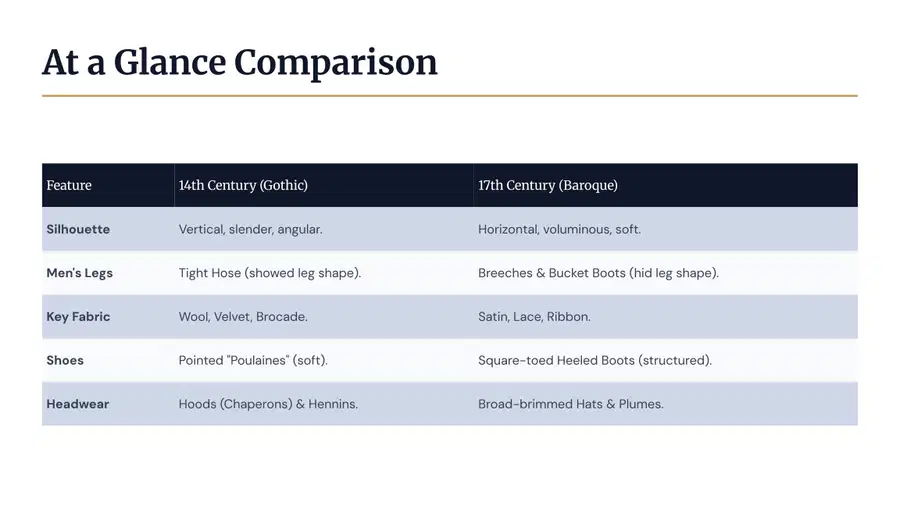
Which feature best distinguishes 14th-century Gothic fashion from 17th-century Baroque fashion according to the comparison table?
The use of lace collars
The presence of pointed shoes
The use of velvet fabric
The horizontal silhouette
35
36
Multiple Choice
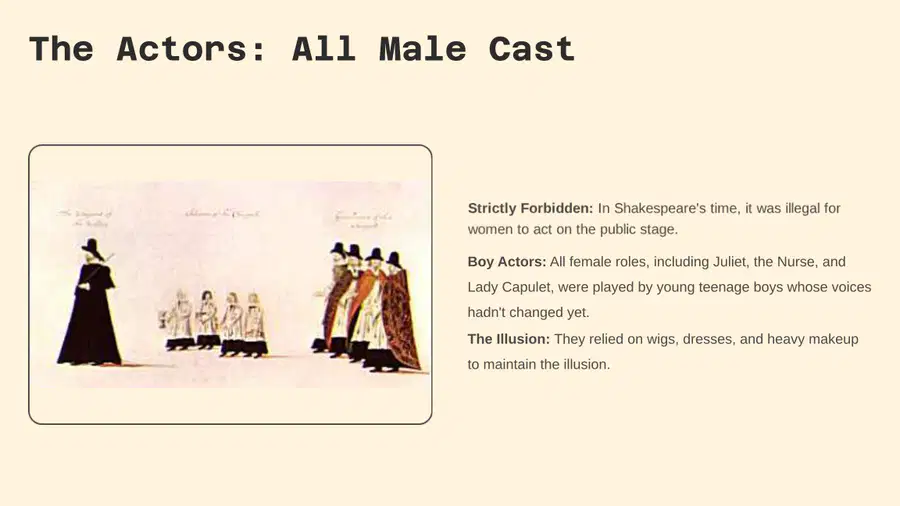
In Shakespeare's time, why were all female roles played by boys on stage?
Women were not interested in acting
It was illegal for women to act publicly
Women were considered less talented
There were not enough women
37

38
Fill in the Blanks
Blank verse in Shakespeare's plays is typically spoken by
39
40
Multiple Select
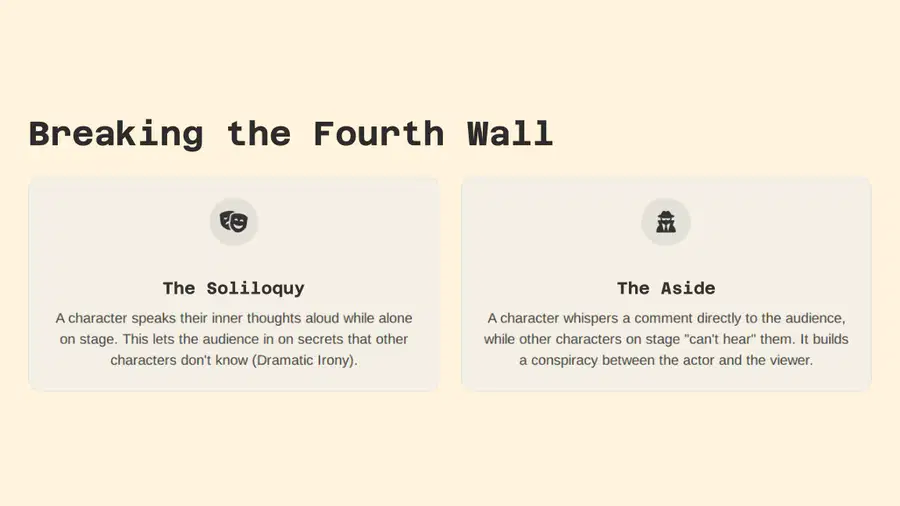
Which of the following are techniques used to 'break the fourth wall' in theatre?
Soliloquy
Aside
Monologue
Stage directions
41
42
Multiple Choice
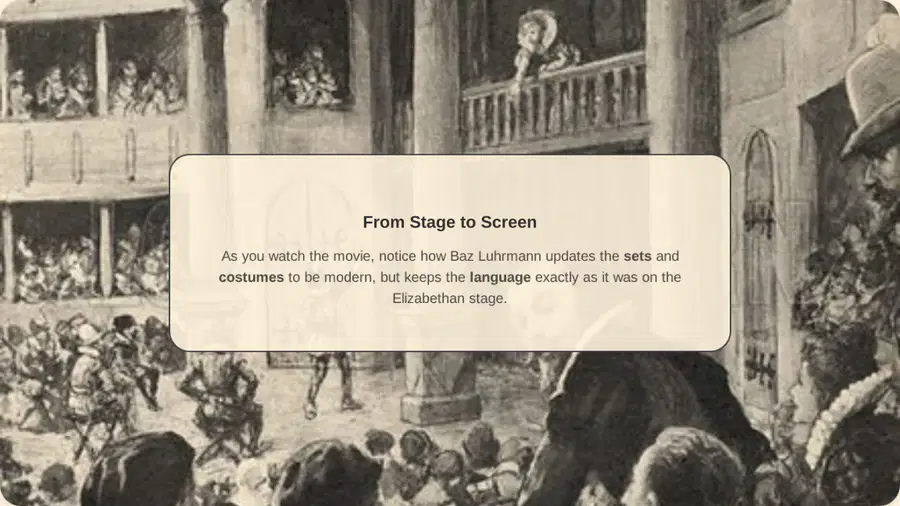
How does Baz Luhrmann's adaptation of Romeo and Juliet differ from the original Elizabethan stage version in terms of sets, costumes, and language?
He modernizes the sets and costumes but keeps the language the same.
He changes both the sets, costumes, and language to be modern.
He keeps everything exactly as it was in the Elizabethan stage.
He only updates the language to be modern.
43
Fill in the Blanks
The Globe Theatre was open-air, circular, and had no special effects or microphones. The entire world of Verona had to be built inside the circular wooden
44
Show answer
Auto Play
Slide 1 / 44
SLIDE
Similar Resources on Wayground

39 questions
S3 Conditional Sentences (Types 0, 1, 2, 3)
Presentation
•
9th Grade
41 questions
Literary Devices & Figurative Language
Presentation
•
9th Grade
39 questions
麥寮國中國三寒假作業英語-2-文法單選題
Presentation
•
9th Grade
40 questions
End Punctuation (Fragments & Run-Ons)
Presentation
•
9th Grade
39 questions
Poetry lesson 3 - Still I Rise
Presentation
•
9th Grade
39 questions
FORM 3 UNIT 1 (COUNTABLE & UNCOUNTABLE)
Presentation
•
8th - 9th Grade
37 questions
Transformations of Quadratic Functions
Presentation
•
9th Grade
37 questions
Neolithic Revolution
Presentation
•
9th Grade
Popular Resources on Wayground
10 questions
Safety Day 2026 – Student Review

Quiz
•
9th Grade
21 questions
Continents and Oceans
Quiz
•
6th Grade
20 questions
Parts of Speech
Quiz
•
5th Grade
16 questions
Subject & Predicate
Quiz
•
5th Grade
25 questions
Multiplication Facts
Quiz
•
5th Grade
12 questions
Map Skills
Quiz
•
3rd Grade
22 questions
Continents and Oceans
Quiz
•
5th Grade
15 questions
Rounding Decimals
Quiz
•
5th Grade
Discover more resources for English
10 questions
Test Your Knowledge on Bullying
Quiz
•
9th Grade
16 questions
Ethos, Pathos, Logos Practice
Quiz
•
9th Grade
10 questions
Exploring the Role of Setting in Storytelling

Interactive video
•
6th - 10th Grade
10 questions
Differentiating the 3 Types of Irony
Interactive video
•
6th - 10th Grade
15 questions
Poetry Terms
Quiz
•
6th - 9th Grade
10 questions
Unlocking English Vocabulary through Latin and Greek Roots
Interactive video
•
6th - 10th Grade
16 questions
Complete Sentences vs Fragments and Run-Ons
Presentation
•
5th - 12th Grade
18 questions
Interview with John Lewis
Quiz
•
9th Grade