Reading 小学校 Real
Presentation
•
English
•
Professional Development
•
Practice Problem
•
Hard
James Hall
Used 1+ times
FREE Resource
31 Slides • 27 Questions
1
2
3
4
Multiple Choice
Which of the following is NOT a type of intensive reading?
Skimming
Scanning
Reading for pleasure
Top-down processing
5
6
7
Multiple Select
Which of the following are examples of scanning in real life?
Finding the price of a meal on a restaurant menu
Reading for pleasure
Finding the time of an event
Reading a wikipedia entry about a famous person to find out which university they went to
8
Open Ended
Explain the difference between skimming and scanning in intensive reading, using real-life examples.
9
10
11
Fill in the Blanks
12
Fill in the Blanks
13
Fill in the Blanks
14
15
Fill in the Blanks
16
17
18
Multiple Choice
How does the brain adapt differently to reading and writing compared to speaking and listening?
The same brain regions are used for all language skills
Reading and writing use different brain regions than speaking and listening
Only the left hemisphere is involved in reading
Reading and writing do not require adaptation
19
20
Fill in the Blanks
21
22
Multiple Choice
How many sounds are there in "break"?
3
4
5
6
23
What are the sounds in break and how many are there?
/b/r/ei/k/ : four sounds
24
Multiple Choice
Which of the following are examples of phonemic awareness?
Identifying the sounds in the word 'cat'
Manipulating syllables in 'rainbow'
Deleting 'cil' from 'pencil'
Blending 'ch' and 'in' to make 'chin'
25
26
Phonological awareness
Examples
Segmenting syllables (音節の分割>
What parts do you hear in rainbow? >>
Deleting rimes (韻尾の削除)
Say pencil without cil. >>
Isolating phonemes ( 音素の分離)
What’s the first sound you hear in cup? >>
Blending onset and rime (開頭音と韻尾の結合)
What happens if we put ch and in together? >>
Matching phonemes (音素の一致)
What’s another word that starts like lap? >>
27
28
29
Multiple Choice
According to research at Cambridge University, why can people still read words even if the letters are jumbled, as long as the first and last letters are correct?
Because the brain reads every letter individually
Because the brain recognizes words as a whole
Because people memorize all possible letter combinations
Because the brain ignores spelling errors
30
31
32
Fill in the Blanks
33
Multiple Choice
Why is it important to understand about 90% of the words in a text when reading?
It allows you to guess the meaning of unknown words
It helps you read faster
It ensures you can understand the overall meaning, even when using a dictionary
It makes the text more interesting
34
35
36
Multiple Select
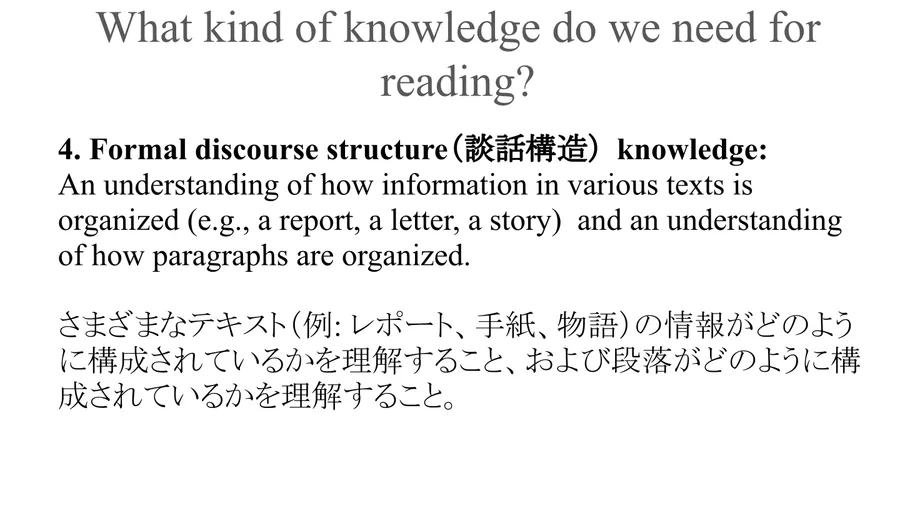
Which of the following are examples of formal discourse structure knowledge?
Knowing how to organize a story
Understanding how to begin an email in different languages
Memorizing vocabulary lists
Knowing the structure of an academic paper
37
38
Multiple Choice
Which of the following is necessary for content reading skills according to the slide?
Ability to memorize the text word for word
Knowledge of information related to the text and cultural context
Skill to translate the text into another language
Ability to write a summary in Japanese
39
40
Fill in the Blanks
41
Fill in the Blanks
Type answer...
42
Multiple Select
What are two key objectives of reading in the course of study as described in the slides?
To memorize all the letters and words
To identify letters and pronounce their sounds
To understand the meaning of simple words and phrases
To write essays in English
43
44
Fill in the Blanks
45
46
Multiple Choice
What is the reading skill here?
Phonological awareness
Scanning
Phonemic awareness
Skimming
47
48
Multiple Choice
What reading skill is being taught here?
Phonological awareness
Phomenic awareness
Scanning
Automatic recognition skills
49
50
Fill in the Blanks
Type answer...
51
52
Multiple Choice
skimming
scanning
content knowledge
reading for pleasure
53
54
Multiple Choice
What two reading skills does this task cover?
content knowledge
reading for pleasure
scanning
skimming
55
56
Open Ended
Type the skills that you thing are covered in the elementary school textbook.
Phonemic awareness
Phonological awareness
Automatic recognition skills
Formal discourse structure knowledge
Content knowledge
Skimming
Scanning
Reading for pleasure
57
58
Multiple Choice
Which of the following is NOT a recommendation for teaching reading and writing in elementary school according to the menu?
Immerse students in print and literature
Give explicit instruction in phonics
Build vocabulary and automaticity of high frequency words
Ignore students’ background knowledge
Show answer
Auto Play
Slide 1 / 58
SLIDE

Similar Resources on Wayground
54 questions
B1 Unit 1 Test Revision
Presentation
•
Professional Development
53 questions
12/01
Presentation
•
Professional Development
54 questions
English for Salesperson
Presentation
•
Professional Development
56 questions
Examen Parcial 2 - Semana 3
Presentation
•
Professional Development
55 questions
CEFR: Speaking Skill
Presentation
•
Professional Development
51 questions
EVERYDAY CONVERSATIONS 1: Informal Greetings
Presentation
•
Professional Development
52 questions
Knowledge Hub 1.5 hours
Presentation
•
Professional Development
51 questions
Pr1 2B VA
Presentation
•
University - Professi...
Popular Resources on Wayground
20 questions
STAAR Review Quiz #3
Quiz
•
8th Grade
20 questions
Equivalent Fractions
Quiz
•
3rd Grade
6 questions
Marshmallow Farm Quiz
Quiz
•
2nd - 5th Grade
20 questions
Main Idea and Details
Quiz
•
5th Grade
20 questions
Context Clues
Quiz
•
6th Grade
20 questions
Inferences
Quiz
•
4th Grade
19 questions
Classifying Quadrilaterals
Quiz
•
3rd Grade
12 questions
What makes Nebraska's government unique?
Quiz
•
4th - 5th Grade