
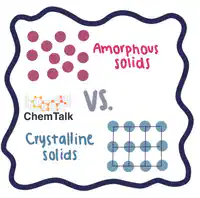
solids

Presentation
•
Physics
•
9th - 12th Grade
•
Practice Problem
•
Medium

eman zaki
Used 2+ times
FREE Resource
17 Slides • 8 Questions
1

2

3
Multiple Choice
Which of the following best describes a crystal lattice in solids?
A regular, repeating arrangement of particles
A random arrangement of particles
A loosely packed structure
A structure with no definite shape
4

5

6

7
Multiple Select
Which of the following are characteristics of amorphous solids?
They have a regular crystal structure.
They have a definite volume and shape.
They are classified as viscous or slowly flowing liquids.
Their particles do not form a fixed crystalline pattern.
8

9

10

11

12
Multiple Choice
What happens to the particles in a solid when it is heated?
They move closer together and the solid contracts.
Their kinetic energy increases and they move farther apart.
They lose energy and stop vibrating.
They change into a liquid immediately.
13

14

15
Multiple Choice
Which of the following statements about the coefficient of linear expansion is correct?
It is equal to the change in volume of a solid divided by its original volume and the change in temperature.
It is equal to the change in length of a solid divided by its original length and the change in temperature.
It is the same for all materials.
It is measured in meters.
16

17

18
Multiple Choice
A metal bar is 1.60 m long at room temperature (21°C). It is heated to 84°C and becomes 1.7 mm longer. What is the coefficient of linear expansion for this material?
1.7 × 10⁻⁵ m°C⁻¹
1.06 × 10⁻⁵ m°C⁻¹
2.5 × 10⁻⁵ m°C⁻¹
8.2 × 10⁻⁶ m°C⁻¹
19

20

21

22
Multiple Choice
What is a bimetallic strip typically made of?
Copper and aluminum
Brass and iron
Steel and copper
Iron and steel
23

24
Multiple Select
Which of the following statements about bimetallic strips in thermostats are correct?
They bend when heated due to different expansion rates of metals.
They are made of two strips of the same metal.
They help make or break an electric contact based on temperature changes.
They remain straight regardless of temperature.
25
Open Ended
Describe the difference between crystalline and amorphous solids, and give an example of each.
Show answer
Auto Play
Slide 1 / 25
SLIDE
Similar Resources on Wayground

20 questions
West African Kingdoms
Presentation
•
9th - 12th Grade
20 questions
Por y Para
Presentation
•
9th - 12th Grade
20 questions
Energy review
Presentation
•
9th - 12th Grade
20 questions
HP 7-2: Transverse Waves
Presentation
•
9th - 12th Grade
20 questions
El Pretérito
Presentation
•
9th - 12th Grade
20 questions
Properties of Water
Presentation
•
9th - 12th Grade
20 questions
Social Skills for Work
Presentation
•
9th - 12th Grade
20 questions
Motivation and Emotion
Presentation
•
9th - 12th Grade
Popular Resources on Wayground
10 questions
Safety Day 2026 – Student Review

Quiz
•
9th Grade
21 questions
Continents and Oceans
Quiz
•
6th Grade
20 questions
Parts of Speech
Quiz
•
5th Grade
16 questions
Subject & Predicate
Quiz
•
5th Grade
25 questions
Multiplication Facts
Quiz
•
5th Grade
12 questions
Map Skills
Quiz
•
3rd Grade
22 questions
Continents and Oceans
Quiz
•
5th Grade
15 questions
Rounding Decimals
Quiz
•
5th Grade
Discover more resources for Physics
20 questions
Position vs. Time Graphs
Quiz
•
9th Grade
10 questions
Exit Check 5.1 - Forms of Energy
Quiz
•
9th Grade
11 questions
Electricity Explained

Interactive video
•
9th - 12th Grade
87 questions
25-26 Unit 1.2 Review - Radioactivity & Earth's Age
Quiz
•
8th - 10th Grade
15 questions
Position vs. Time and Velocity vs. Time Graphs
Quiz
•
10th - 12th Grade
18 questions
Quiz #8 Practice: Forces on an Incline
Quiz
•
9th Grade
25 questions
Newton's Laws of Motion
Quiz
•
9th Grade