

Semester Exam Review: Unit 3 & 4

Presentation
•
Science
•
6th Grade
•
Medium
+20
Standards-aligned

Tanisha Ruff
Used 6+ times
FREE Resource
47 Slides • 74 Questions
1
UNIT 3
TEKS 6.7A: Types of Forces
TEKS 6.7B: Balanced and unbalanced forces (Calculating Net Force)
TEKS 6.7C: Newton’s Third Law of Motion
2


3
Key Vocabulary

Force
A push or a pull on an object, which is measured in a unit called Newtons.

Contact Force
A force that requires physical contact between objects to change an object's motion.

Non-contact Force
A force that acts on an object without any physical contact with it, like gravity.

Friction
A contact force that opposes motion between any two surfaces that are touching each other.

Gravity
A non-contact force that pulls objects with mass toward one another, such as toward Earth.

Normal Force
A support force from a stable surface on an object that is resting directly on it.
4
A force is a PUSH or a PULL
Forces are measured in a unit called NEWTONS
Forces are categorized into two groups: CONTACT or NON-CONTACT
5
Multiple Choice
What is force?
The rate of an object's motion with direction
The rate of an object's motion
any push or pull
6
Multiple Choice
What unit is used to measure force?
gram
magnitude
direction
Newton
7
Multiple Choice
What are the two main types of forces?
Frictional forces and gravitational forces.
Contact forces and non-contact forces.
Magnetic forces and electrical forces.
Tension forces and buoyant forces.
8
Contact Forces
These forces are applied only when objects are in direct physical contact.
Contact forces are also known as mechanical forces, requiring direct interaction.
An example is the muscular force you use to lift a book.


Non-Contact Forces


These forces can act on objects from a distance without any touching.
A common example is gravity, which pulls objects toward the Earth.
Magnetic force is another example, attracting items like paper clips from afar.
9
Multiple Choice
The forces that need two objects to be in contact with each other are called.......
contact forces
non-contact forces
electric forces
magnetic forces
10
Multiple Choice
What is the key difference between a contact force and a non-contact force?
Contact forces require objects to be physically touching, while non-contact forces do not.
Contact forces only push objects, while non-contact forces only pull.
Non-contact forces are always stronger than contact forces.
Only contact forces can change an object's motion.
11
A force that can cause or change motion of an object by touching it.
Examples of Contact Forces:
•Applied Force
•Normal Force
•Friction
•Air Resistance
12
Applied Force
An applied force happens when one object directly pushes or pulls on another.
It is a contact force that results from the interaction between two objects.
Kicking a soccer ball or pushing a door are examples of applied forces.

Normal Force
This is a support force a surface exerts on an object resting on it.
It supports the weight of the object and prevents it from falling through the surface.
For example, a table applies an upward normal force to support a book's weight.

13
Multiple Choice
What is applied force?
A force that is applied to an object by a person or another object.
A force that resists the motion of an object.
A force that acts at a distance without contact.
A force that is always directed upwards.
14
Multiple Choice
What is a normal force?
A force that acts parallel to a surface
A force that acts perpendicular to a surface
A force that acts in a circular motion
A force that acts in a random direction.
15
Multiple Choice
Which of the following is an example of an applied force?
The force of gravity acting on a falling apple.
The force exerted by a person pushing a shopping cart.
The force of friction between a car's tires and the road.
The tension in a rope holding a swing.
16
Multiple Choice
Which force is used when you push a door to open it?
Gravitational Force
Frictional Force
Magnetic Force
Applied Force
17
Multiple Choice
Which force is used when you lift a box from the floor?
Gravitational Force
Frictional Force
Magnetic Force
Applied Force
18
Multiple Choice
Normal force is any force that is applied ___ to a surface.
diagonal
slanted
flat
19
Friction

This contact force opposes motion between two surfaces that are touching each other.
It happens because even smooth surfaces have tiny bumps that resist movement.
Friction helps us walk, but in machines, it can cause heat and wear.
Air Resistance
This is a frictional force that acts on objects as they move through the air.
It is an upward force that opposes the downward pull of gravity, slowing an object down.
A parachute traps air to create resistance, which helps to slow down a person’s fall.

20
Multiple Choice

Bobby has created a track for his toy car that is made from different materials:
At which section will the most friction occur between the track and the car?
1
2
3
4
5
21
Multiple Choice

If you push a skateboard down a hill it will eventually roll to a stop. Why?
Because Friction between the ground and wheels will make it stop.
Because you were thinking about stopping it.
Because the hill eventually ends.
22
Multiple Choice

This photo represents...
Air resistance
water resistance
friction force between 2 solid bodies
23
Multiple Select

A small child is pulling a wagon to the left, at a constant speed. Check all the forces that are acting on the wagon.
Gravity
Normal Force
Applied Force
Friction
24


25

26
Multiple Choice
A non-contact force is between
two objects that aren't touching
two objects that are touching
the ground and wheels
you and me
27
Gravity

This is a non-contact force that pulls any two objects with mass toward one another.
On Earth, gravity is the force that pulls everything downward toward the planet’s surface.
The strength of gravity is greater for objects that have a much larger amount of mass.
28
Multiple Choice

Gravity is a
Contact Force
Myth
Non-contact Force
29
Multiple Choice
10. A ball rolls down from the top of a grassy hill, reaches the bottom of the hill, continues to roll, and then starts to slow down and comes to a stop. What forces caused this ball's motion?
Frictional force caused the ball to roll down the hill, but air resistance caused the ball to slow down and stop.
Magnetic force caused the ball to roll down the hill, but gravity caused the ball to slow down and stop.
The force of the hill caused the ball to roll down it, but gravity caused the ball to slow down and stop.
Gravity caused the ball to roll down the hill, but frictional force caused the ball to slow down and stop.
30
Multiple Choice
If the mass of one of two spheres increases, how does it affect the gravity between the two spheres?
the gravity increases
the gravity decreases
the gravity fluctuates
the gravity is not affected
31

32
Multiple Choice
Similar poles will ...
REPEL
ATTRACT
33
Multiple Choice
Opposite poles of a magnet will...
REPEL
ATTRACT
34

Is it Balanced or Unbalanced?

35
What is Net Force?
A force is a push or pull on an object, measured in Newtons (N).
The net force is the overall force found by combining all forces on an object.
When the net force is not zero, it causes the object to accelerate.
The object's acceleration is always in the same direction as the net force.


36
Multiple Choice
What is the term for the total amount of force acting on an object?
Gravity
Net Force
Friction
Acceleration
37
Balanced Forces
Forces are equal and in opposite directions, making the net force zero.
They do not cause a change in the object's state of motion.
A book resting on a table is an example, with its net force being 0 N.

Unbalanced Forces

Forces are unequal, making the net force greater than zero.
They cause a change in the object's motion, known as acceleration.
In tug-of-war, the rope moves in the direction of the larger force.
38
Multiple Choice
What is the result of balanced forces acting on an object?
The object accelerates.
The object's motion does not change.
The object changes direction.
The object stops moving immediately.
39
Multiple Choice
Which of the following best describes a balanced force?
Two teams pulling a rope with equal strength so the rope does not move
A car accelerating on a highway
A ball falling to the ground
A person jumping off a chair
40
Multiple Choice

41
Multiple Choice

42
Multiple Choice

43
Multiple Choice

44
Same Direction
When multiple forces act on an object in the same direction, you add the forces together.
The result of adding these forces together is a stronger overall force called the net force.
For example, 25 N + 20 N in the same direction gives a total net force of 45 N.

Opposite Directions

If forces are in opposite directions, you find the net force by subtracting the smaller force from the larger one.
If unbalanced, the object moves in the direction of the greater force; if balanced, the net force is 0 N.
For example, 12 N to the right and 10 N to the left results in a net force of 2 N right.
45
Multiple Choice
Two people push a box in the same direction. One pushes with a force of 10 N and the other with a force of 15 N. What is the net force on the box?
5 N
10 N
15 N
25 N
46
Multiple Choice
A box is being pushed to the right with 20 N of force and pulled to the left with 30 N of force. How will the box's motion be affected?
It will move right with a force of 10 N.
It will move left with a force of 10 N.
It will not move.
It will move left with a force of 50 N.
47
Multiple Choice
Two people are pushing a heavy crate to the right. The net force on the crate is 150 N to the right. If Person A is pushing with a force of 70 N, what force is Person B applying?
80 N to the right
80 N to the left
220 N to the right
70 N to the right
48
Multiple Choice
An object has a downward gravitational force of 15 N. A table pushes upward on it with a force of 15 N. If a person then pushes the object to the right with a force of 10 N, what is the net force and resulting motion?
The net force is 0 N, and the object does not move.
The net force is 40 N, and the object moves diagonally.
The net force is 10 N to the right, and the object accelerates to the right.
The net force is 15 N downward, and the object falls.
49

Middle School

50
Key Vocabulary

Newton's Third Law
This law of motion states that for every action, there is an equal and opposite reaction.

Action Force
The initial force one object exerts on another object during an interaction between the two objects.

Reaction Force
The force a second object exerts back on the first, equal in strength and opposite in direction.

Force Pair
The action and reaction forces that occur together in any interaction between two different objects.
51
What is Newton's Third Law?
For every action, there is an equal and opposite reaction force.
This means that forces always come in pairs called action-reaction forces.
When an object exerts a force, the second object pushes back equally.
A skateboarder pushes on the ground, so the ground pushes them forward.


52
Multiple Choice
According to Newton's Third Law, what is the relationship between an action force and a reaction force?
The reaction force is stronger than the action force.
The reaction force is equal in strength and opposite in direction to the action force.
The action and reaction forces act in the same direction.
The reaction force happens a few seconds after the action force.
53
Action-Reaction Forces
These are forces that two different objects apply to each other.
The forces are equal and opposite, but act on different objects.
They do not cancel out and can cause a change in motion.
Balanced Forces

These are equal and opposite forces that act on a single object.
Because they act on the same object, the forces cancel each other out.
This results in no change to the object's state of motion.

54
Multiple Choice
Why do action-reaction force pairs not cancel each other out?
Because one force is always stronger than the other.
Because they act on two different objects.
Because they act on the same object.
Because they are not always opposite in direction.
55
Examples of Force Pairs

Walking
Your foot pushes backward on the Earth (action).
The Earth pushes your foot forward (reaction).
This pair of forces is what allows you to walk.

Racket and Ball
A tennis racket applies a forward force to the ball (action).
The ball exerts an equal backward force on the racket (reaction).
You can feel this reaction force on your hand and arm.

Cannon and Bullet
The cannon pushes the bullet forward with great force (action).
The bullet pushes back on the canon with equal force (reaction).
This backward push on the cabob is known as recoil.
56
Multiple Choice
When a bowling ball hits a pin, the ball exerts a force on the pin. What is the reaction force in this scenario?
The force of gravity pulling the pin down.
The force the pin exerts back on the bowling ball.
The force of the floor on the pin.
The force of the air slowing the ball down.
57
Multiple Choice
How does a rocket engine generate the thrust needed for liftoff?
By using wings to push air downwards, creating lift.
By being lighter than the air around it.
By pushing hot gases downward, which creates an equal and opposite upward force on the rocket.
By pushing against the launchpad to spring upwards.
58
Multiple Choice
A student pushes against a wall with a force of 10 Newtons. What is the force exerted by the wall on the student?
0 Newtons, because the wall does not move.
10 Newtons, in the same direction as the student's push.
10 Newtons, in the opposite direction of the student's push.
Less than 10 Newtons, because the wall is stationary.
59
Multiple Choice
If a small car and a large truck collide, which statement is true about the forces they exert on each other during the collision?
The truck exerts a greater force on the car because it is larger.
The car exerts a greater force on the truck because it changes speed more rapidly.
The truck and the car exert equal and opposite forces on each other.
The forces are only equal if they were traveling at the same speed before the collision.
60
UNIT 4
TEKS 6.8A: Potential & Kinetic Energy
TEKS 6.8B: Energy Transformations
TEKS 6.8C: Transverse and longitudinal waves
61

Middle School

62
Potential Energy
Potential energy is the stored energy an object has due to its position or state.
This type of energy is ready to be used but is not currently in action.
A drawn bow or a book on a high shelf are examples of potential energy.


63

64
Multiple Choice
65
Multiple Choice

A rock falls over a waterfall as shown in the diagram. At which point does the rock have the most potential energy?
2
3
4
66
Multiple Choice
What type of energy is stored in food and is released when it is broken down in your digestive system?
Chemical
Mechanical
Thermal
Elastic
67
Multiple Choice
When you drop a basketball and it falls to the ground, it is an example of...
gravitational energy
chemical energy
radiant energy
elastic energy
68
Multiple Choice
Energy that is due to an object being compressed or stretched is called
elastic potential energy
kinetic energy
potential energy
gravitational potential energy
69
Multiple Choice
The potential energy that is stored in the nucleus of an atom is called
mechanical energy
nuclear energy
kinetic energy
electrical energy
70
Kinetic Energy

Kinetic energy is the energy that an object possesses because it is in motion.
Any object that is moving, from an arrow in flight to a rolling ball, has it.
The faster an object moves, the more kinetic energy it has.
71

72
Multiple Choice
Sliding down a slide is an example of....
Kinetic Energy
Potential energy
73
Multiple Choice
An apple on a tree waiting to fall is an example of....
Kinetic Energy
Potential energy
74
Multiple Choice
Running to second base is an example of....
Kinetic Energy
Potential energy
75
Multiple Choice
A sandwich that can give you energy is an example of....
Kinetic Energy
Potential energy
76

Middle School

77
Law of Conservation of Energy
Energy cannot be created or destroyed; it only changes from one form to another.
The total energy in a closed system always stays the same over time.
This process of changing energy forms is called energy transformation or energy conversion.
A battery’s chemical energy becomes light and sound in a toy.


78
Multiple Choice
According to the Law of Conservation of Energy, what happens to energy?
It can be destroyed but not created.
It can be created but not destroyed.
It cannot be created or destroyed, only transformed.
It is often lost and disappears completely.
79

80
is sometimes called energy conversion or energy transformation.
>>> Any form of energy can change into any other form of energy.

81

82

83

84

85
Multiple Choice
Which form of energy comes form eating a slice of pie?
Chemical
Mechanical
Radiant
Electrical
86
Multiple Choice

Which form of energy is not being shown in the image?
Electrical
Light
Mechanical
Sound
87
Multiple Choice

What is the energy transformation of a violin?
Mechanical to thermal
Mechanical to Sound
Sound to Mechanical
Thermal to Sound
88
Multiple Choice

What is the energy Transformation of a remote-controlled car?
Chemical to electrical to mechanical
electrical to chemical to mechanical
mechanical to electrical to chemical
Chemical to Mechanical to electrical
89
Multiple Select
What 3 forms of energy do we associate with the Sun?
Mechanical
Light
Thermal
Nuclear
Chemical
90
Multiple Select
What are 3 forms of energy that would occur when cooking a piece of bread in a toaster?
Thermal
Nuclear
Light
Chemical
Gravitational Potential
91
Multiple Select
What are 3 forms of energy that are employed using a ceiling fan?
Electrical
Chemical
Sound
Mechanical
Nuclear
92
Multiple Choice

List the energy transformations of this object.
Electrical → Mechanical/ Radiant Energy
Electrical → Mechanical / Sound / Thermal Energy
Mechanical → Chemical / Thermal energy
Mechanical→ Electrical energy
93
Multiple Select

When wood burn it changes from chemical energy to what 2 other forms of energy? Click the 2 other forms.
Radiant (Light)
Nuclear
Heat
Mechanical
94
Multiple Select

A gasoline-powered generator is used to provide lighting for a house.
Choose the best 3 energy forms found in this transformation example?
Chemical
Mechanical
Light
Nuclear
95
Multiple Choice
Electrical → Mechanical → Sound
Which device were the students most likely observing?
96
Multiple Choice
The picture showing the energy conversion
Chemical → heat
is:
97

Middle School

98
Key Vocabulary

Longitudinal Wave
A wave where particles vibrate parallel to the direction of the wave's energy transfer.

Transverse Wave
A wave where particles vibrate perpendicular to the direction that the wave's energy is traveling.

Compression
An area in a longitudinal wave where the particles of the medium are crowded together.

Rarefaction
An area in a longitudinal wave where particles of the medium are spread farther apart.

Crest
The highest point of a transverse wave, representing the maximum upward displacement from the rest position.

Trough
The lowest point of a transverse wave, representing the maximum downward displacement from the rest position.
99
What is a Wave?
A wave is a disturbance that moves energy from place to place.
Waves transfer energy over a distance, but not matter.
Mechanical waves need a medium like air or water to travel.
100
Multiple Choice
What is the definition of a wave?
A disturbance that moves energy from place to place.
A substance that moves matter through a medium.
A force that creates new matter and energy.
A particle that stays in one location.
101

102

103
Multiple Select
Which of the following are examples of mechanical waves?
Ocean Waves
Sound Waves
Radio Waves
Visible Light
104

105
Fill in the Blanks
Mechanical waves require a
106
Fill in the Blanks
Electromagnetic waves can transfer energy through a
107
Transverse Waves
Particles of the medium vibrate perpendicular to the direction of the wave.
This means the particles move in an up-and-down motion as the wave passes.
A classic example of this type of wave is a ripple on water.
Longitudinal Waves
Particles of the medium vibrate parallel to the direction of the wave.
This means the particles move in a back-and-forth motion as the wave passes.
Sound waves are a perfect example of a longitudinal wave traveling through air.


108
Multiple Choice
Which statement accurately compares the two types of mechanical waves described?
A transverse wave has examples like sound waves, while a longitudinal wave has examples like seismic S waves.
In a transverse wave, particles move perpendicular to the wave's energy, while in a longitudinal wave, they move parallel to it.
A transverse wave can be created with a Slinky, while a longitudinal wave can be created with a rope.
In a transverse wave, particles move back and forth, while in a longitudinal wave, they move up and down.
109
Multiple Choice
How do particles move in a transverse wave compared to the direction of energy transfer?
They move parallel to the direction of energy transfer.
They move perpendicular to the direction of energy transfer.
They do not move at all.
They move in a circular motion.
110
What Are Transverse Waves?
Particles in a transverse wave vibrate perpendicularly to the direction of the wave’s energy.
Imagine a rope wave: the rope moves up and down as the wave moves forward.
The highest points of a wave are called crests, and the lowest points are troughs.
Light, radio, and water waves are all examples of transverse waves.


111
Anatomy of a Transverse Wave
The rest position is the line halfway between the highest and lowest points.
A crest is the highest point of a wave; a trough is the lowest point.
Amplitude is the distance from the rest position to a crest or a trough.
Wavelength (λ) is the distance between two crests or two troughs.

112
Multiple Choice
In a transverse wave, how do the particles of the medium move relative to the direction of energy transfer?
Parallel to the direction of energy transfer.
Perpendicular to the direction of energy transfer.
In a circular motion.
They do not move at all.
113
Anatomy of a Longitudinal Wave
Compressions are areas where particles are crowded together.
Rarefactions are areas where particles are spread apart.
Wavelength is the distance between two compressions or rarefactions.
Compression: The region where particles of the medium are closest together.
Rarefaction: The region where particles of the medium are spread apart.

114
What are Longitudinal Waves?
Particles vibrate parallel to the direction of the wave's energy.
Think of a Slinky moving back and forth in the same direction.
This creates crowded compressions and spread-out areas called rarefactions.
Sound waves and earthquake P-waves are examples that need a medium to travel.

115
Multiple Choice
In a longitudinal wave, what is the area called where particles are spread far apart?
Compression
Rarefaction
Crest
Amplitude
116
Multiple Choice
What is the relationship between a wave and the matter it travels through?
The wave carries the matter with it as it travels.
The wave converts the matter into pure energy.
The wave transfers energy but does not move the matter over a long distance.
The matter is destroyed as the wave passes through it.
117
Multiple Choice
What are the areas called in a longitudinal wave where particles of the medium are crowded together?
Crests
Troughs
Compressions
Rarefactions
118
Wave Properties

Amplitude
Amplitude is the maximum distance a particle moves from its rest position.
This measurement from the rest position is also called the equilibrium.
Amplitude is a measure of the total energy of a wave.

Wavelength
Wavelength is the distance over which the shape of a wave repeats.
It is usually measured from one wave crest to the next one.
This can also be measured between any two corresponding points on the wave.

Frequency
Frequency is the number of waves that pass a point in time.
It is measured in a unit of Hertz (Hz), or waves per second.
Waves with higher frequencies are known to have a much shorter wavelength.


119
Multiple Choice
What is the correct way to measure the wavelength of a transverse wave?
From the crest to the trough.
From the rest position to the crest.
From one crest to the next crest.
The total length of the wave.
120
Multiple Choice
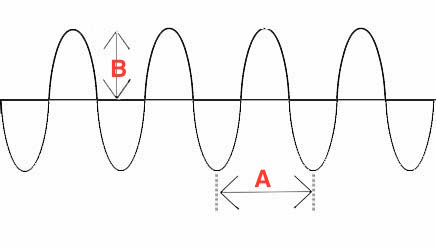
121
Multiple Choice
How is the wavelength of a longitudinal wave measured?
From the crest of one wave to the crest of the next.
From the highest point to the lowest point of the wave.
From the start of one compression to the start of the next compression.
From the midpoint of a rarefaction to the midpoint of the next crest.
UNIT 3
TEKS 6.7A: Types of Forces
TEKS 6.7B: Balanced and unbalanced forces (Calculating Net Force)
TEKS 6.7C: Newton’s Third Law of Motion
Show answer
Auto Play
Slide 1 / 121
SLIDE
Similar Resources on Wayground

107 questions
Magnetism, Electromagnets, and Generators
Presentation
•
6th Grade
112 questions
Statistics Review 1 2024
Presentation
•
6th - 8th Grade
118 questions
Untitled Presentation
Presentation
•
7th Grade
113 questions
recorder
Presentation
•
7th Grade
115 questions
Order of Operations and Evaluating Expressions
Presentation
•
6th - 8th Grade
113 questions
English SD & SMP
Presentation
•
6th - 8th Grade
116 questions
Grade_8_EoT_Review_2023-2024
Presentation
•
8th Grade
116 questions
Florida Civics
Presentation
•
7th - 8th Grade
Popular Resources on Wayground
10 questions
Safety Day 2026 – Student Review

Quiz
•
9th Grade
21 questions
Continents and Oceans
Quiz
•
6th Grade
20 questions
Parts of Speech
Quiz
•
5th Grade
16 questions
Subject & Predicate
Quiz
•
5th Grade
25 questions
Multiplication Facts
Quiz
•
5th Grade
12 questions
Map Skills
Quiz
•
3rd Grade
22 questions
Continents and Oceans
Quiz
•
5th Grade
15 questions
Rounding Decimals
Quiz
•
5th Grade
Discover more resources for Science
20 questions
Elements, compounds, and mixtures
Quiz
•
6th Grade
10 questions
6.6D - Relative Density Review
Quiz
•
6th Grade
10 questions
Exploring Chemical and Physical Changes

Interactive video
•
6th - 10th Grade
20 questions
CONDUCTION,CONVECTION AND RADIATION
Quiz
•
6th Grade
20 questions
Rocks and The Rock Cycle
Quiz
•
6th Grade
19 questions
Describing and Classifying Matter
Presentation
•
6th Grade
21 questions
Waves and Wave Properties
Quiz
•
6th - 8th Grade
20 questions
Phases of the Moon
Quiz
•
6th Grade