
Bundle 3 Midterm Study Guide & Reteach

Presentation
•
Social Studies
•
8th Grade
•
Practice Problem
•
Medium

Laura Strouth
Used 2+ times
FREE Resource
8 Slides • 24 Questions
1
2
3

But first...
Let's review Bundles 1 & 2
4
Multiple Choice
Which motive BEST explains Spain’s colonization of North America?
Spreading Christianity and gaining wealth.
5
Multiple Choice
Which activity was MOST associated with French colonization in North America?
Plantations and cotton farming
Establishment of fur trading posts
Gold and silver mining
6
Multiple Choice
Which factor MOST contributed to the growth of representative government in the colonies?
The distance and lack of communication from England.
7
Multiple Choice
Which action by Parliament BEST represents “taxation without representation”?
8
Multiple Choice
Which battle effectively ended major fighting in the American Revolution?
Declaration of Independence
Boston Tea Party
Battle of Yorktown
Battle of Saratoga
9
10
Multiple Choice
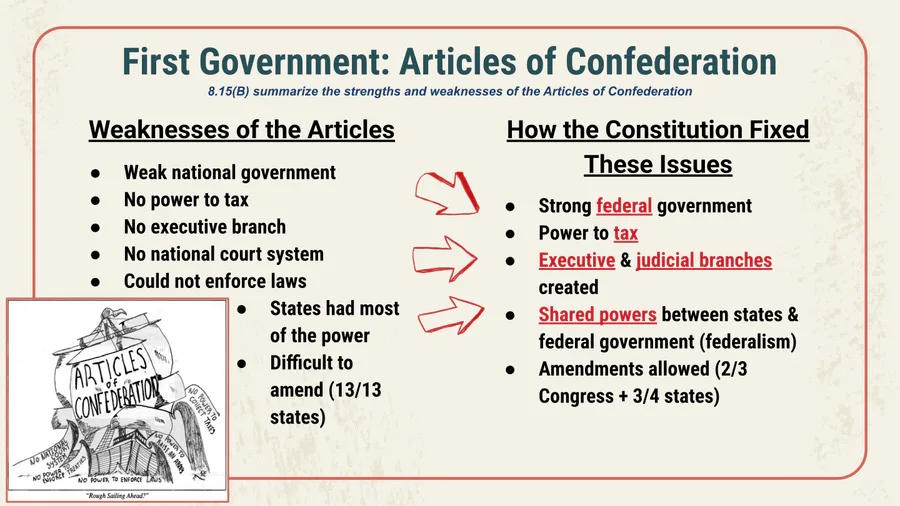
Which statement best describes a major weakness of the Articles of Confederation?
11
Multiple Choice
Which action shows how the Constitution fixed a weakness of the Articles of Confederation?
12
Multiple Choice
Why was it difficult for the government under the Articles of Confederation to make changes?
13
Multiple Choice
Which feature of the Constitution strengthened the national government compared to the Articles of Confederation?
14
15
Multiple Choice
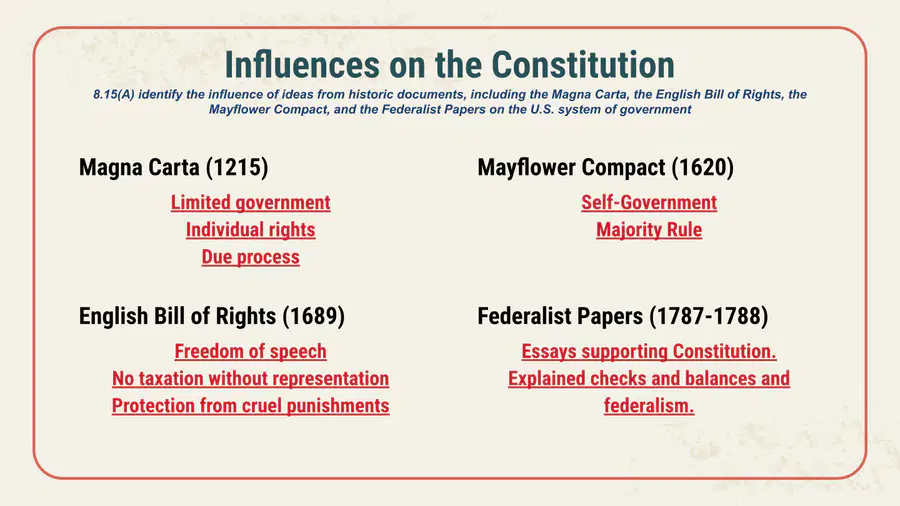
Which document introduced the idea that government leaders must obey the law?
16
Multiple Choice
Which historical document helped establish the principle of self-government in the colonies?
17
Multiple Select
Which document protected individual rights such as trial by jury?
English Bill of Rights
18
Multiple Choice
What was the main purpose of the Federalist Papers?
19
20
Multiple Choice
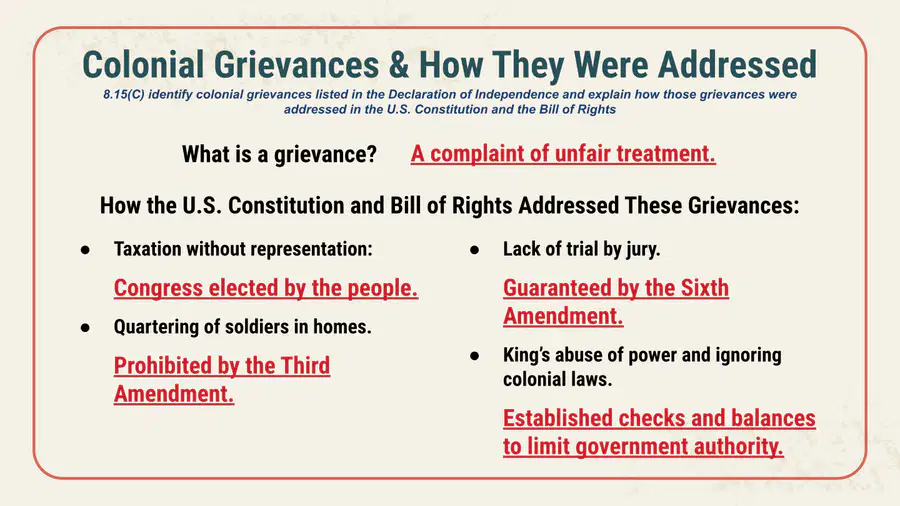
Which constitutional amendment addressed the colonial grievance of having soldiers housed in private homes?
21
Multiple Choice
Which grievance is addressed by the Sixth and Seventh Amendments?
22
Multiple Choice
How did the Constitution address the grievance of “taxation without representation”?
23
Multiple Choice
Which pair correctly matches a grievance from the Declaration with its solution in the Constitution?
No trial by jury → Sixth & Seventh Amendments
Quartering soldiers → First Amendment
Taxation disputes → Eighth Amendment
No representation → Tenth Amendment
24
25
Multiple Choice
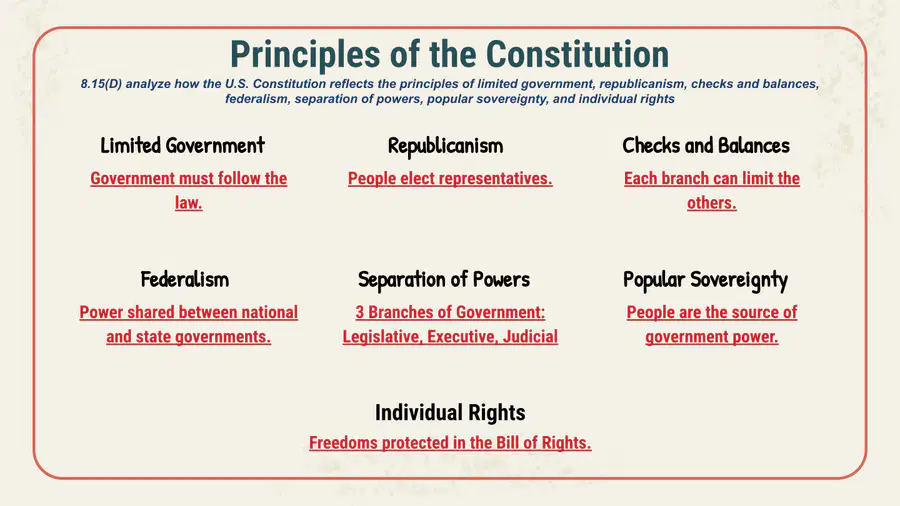
Which principle is shown when each branch of government can limit the power of the others?
26
Multiple Choice
Which principle is demonstrated when Congress makes laws, the President enforces laws, and the Supreme Court interprets laws?
27
Multiple Choice
Which principle divides power between the national government and the state governments?
28
Multiple Choice
Which principle protects freedoms such as speech, religion, and trial by jury?
Limited Government
Federalism
Individual Rights
Republicanism
29
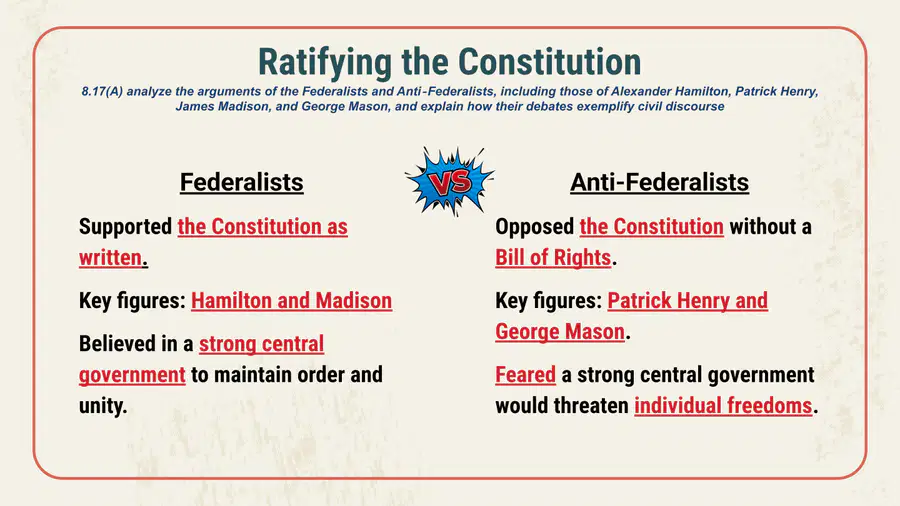
30
Multiple Choice
Why did Anti-Federalists oppose ratifying the Constitution?
31
Multiple Choice
Which belief did Federalists support during the ratification debate?
32
Multiple Choice
Which statement describes the compromise that allowed the Constitution to be ratified?
Show answer
Auto Play
Slide 1 / 32
SLIDE
Similar Resources on Wayground

26 questions
Elements of an Argumentative Essay
Presentation
•
8th Grade
24 questions
CSA Review Quarter 2 PT 1
Presentation
•
8th Grade
23 questions
AKS 43A Georgia's Constitution: (Davies Copy)
Presentation
•
8th Grade
22 questions
DAY 5 WW2-Post WW2
Presentation
•
8th Grade
25 questions
Washington’s Presidency
Presentation
•
8th Grade
26 questions
Maynard Jackson, Andrew Young, Jimmy Carter
Presentation
•
8th Grade
23 questions
WW2
Presentation
•
8th Grade
22 questions
Understanding Taxes
Presentation
•
8th Grade
Popular Resources on Wayground
10 questions
Safety Day 2026 – Student Review

Quiz
•
9th Grade
21 questions
Continents and Oceans
Quiz
•
6th Grade
20 questions
Parts of Speech
Quiz
•
5th Grade
16 questions
Subject & Predicate
Quiz
•
5th Grade
25 questions
Multiplication Facts
Quiz
•
5th Grade
12 questions
Map Skills
Quiz
•
3rd Grade
22 questions
Continents and Oceans
Quiz
•
5th Grade
15 questions
Rounding Decimals
Quiz
•
5th Grade
Discover more resources for Social Studies
19 questions
Foundations of America
Quiz
•
6th - 8th Grade
10 questions
Exploring the Age of Exploration: Key Events and Figures

Interactive video
•
6th - 10th Grade
20 questions
Articles of Confederation
Quiz
•
8th Grade
15 questions
Middle Ages of the Middle East Vocab List (CFA #2)
Quiz
•
6th - 8th Grade
13 questions
American Revolution Review
Quiz
•
8th Grade
18 questions
American Revolution Unit 3
Quiz
•
8th Grade
10 questions
Indigenous Peoples' Day Quiz
Quiz
•
8th Grade
5 questions
American Revolutionary War
Interactive video
•
8th Grade