

8 Life Cycle of a Star

Presentation
•
Science
•
8th Grade
•
Practice Problem
•
Medium
+1
Standards-aligned

Sonja Grubbs
Used 1+ times
FREE Resource
28 Slides • 26 Questions
1

2

3
Open Ended
How do you think the birth and death of stars might influence the structure and evolution of galaxies?
4
Multiple Choice
Why is it important to understand the life cycle of a star in the context of the universe?
It helps us predict the future of our solar system
It explains the origin of elements and planets
It allows us to classify galaxies
It reveals the mysteries of black holes
5

6

7

8
Multiple Select
Which of the following statements about nebulae is/are correct?
Nebulae are regions where stars are born.
Nebulae are made of gas and dust.
Nebulae are always visible without any instruments.
Nebulae can be triggered to collapse by supernovas or cloud collisions.
9

10
Fill in the Blanks
Type answer...
11
Multiple Choice
Which of the following best describes the role of gravity in the formation and life cycle of a star?
Gravity pulls gas together to form stars and keeps them stable during their life.
Gravity only affects stars after they have formed.
Gravity causes stars to explode at the end of their life.
Gravity makes stars cooler and smaller.
12

13
Open Ended
Explain how the color of a star relates to its temperature and lifespan.
14

15
Open Ended
Describe the main sequence stage in a star’s life and explain why it is considered the longest phase.
16
Multiple Choice
What does the Hertzsprung-Russell diagram classify stars by?
Brightness and temperature
Size and age
Distance from Earth and color
Shape and rotation speed
17

18
Open Ended
Explain how the H-R diagram helps astronomers classify stars and predict their life stages.
19
Multiple Choice
Which type of star is described as hot but dim, small, and fading in the H-R diagram?
Red Giant
Main Sequence
White Dwarf
Blue Giant
20

21

22

23
Multiple Choice
Which of the following are characteristics of red giants according to the H-R diagram and star life cycle?
Cool and huge
Hot and dim
Medium temperature and brightness
Small and fading
24

25

26
Multiple Choice
Which elements are fused in the onion-like layers of a massive star before it explodes as a supernova?
Hydrogen, helium, carbon, oxygen, magnesium, neon, silicon, sulfur, iron
Hydrogen, helium, lithium, beryllium, boron
Hydrogen, helium, nitrogen, phosphorus, potassium
Hydrogen, helium, sodium, calcium, zinc
27
Open Ended
Describe the process that leads to a supernova explosion in massive stars.
28

29
Multiple Choice
Which of the following determines whether a star becomes a neutron star or a black hole after a supernova?
The star's temperature
The star's core mass
The star's distance from Earth
The star's color
30

31
Multiple Select
Which of the following are stages in the life cycle of a star?
Nebula
Protostar
Red Giant
Black Hole
32
Open Ended
Explain how the life cycle of a star leads to the formation of different final stages such as white dwarf, neutron star, or black hole.
33

34
Multiple Select
Arrange the following stages of stellar evolution in chronological order from earliest to latest for a Sun-like star.
Main Sequence
Nebula
Red Giant
Protostar
35

36

37

38
39
Fill in the Blanks
Type answer...
40
Multiple Choice
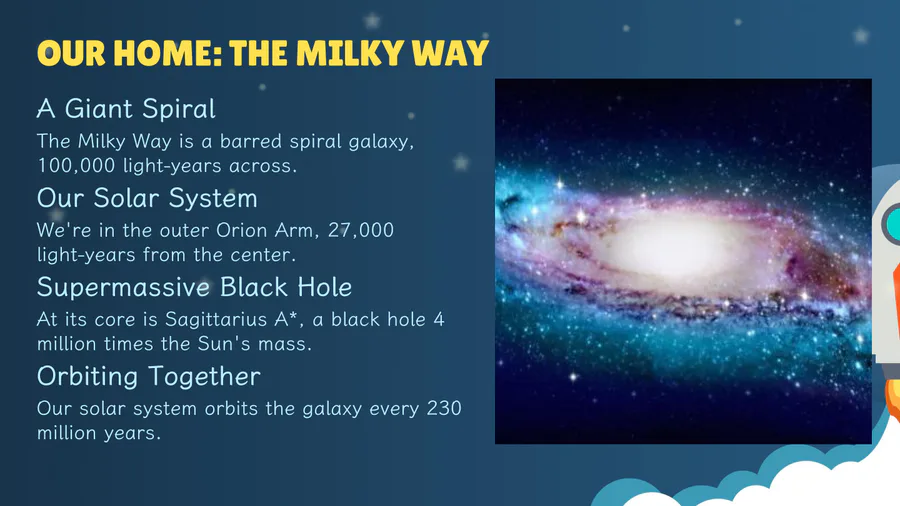
Which of the following statements about the Milky Way is correct?
The Milky Way is a spiral galaxy 10,000 light-years across.
Our solar system is located at the center of the Milky Way.
Sagittarius A* is a supermassive black hole at the core of the Milky Way.
Our solar system orbits the galaxy every 1 million years.
41

42

43
Multiple Select
Which characteristics are true for Star B?
Red color
Very hot temperature
Bright brightness
Located on H-R diagram top right
44
Open Ended
What stage of life might Star A be in, and how long will it likely live?
45

46

47

48
Multiple Select
Which of the following statements about red giants is correct?
Red giants are very hot stars.
Red giants are bright because they are very large.
Red giants have a high surface temperature.
Red giants are cooler than blue stars.
49

50
Multiple Choice
Which of the following is NOT a reason why stars matter, according to the lesson?
Stars provide light and energy vital for Earth's life.
Dying stars disperse elements, forming new stars, planets, and life.
Stars are responsible for the formation of all elements, including hydrogen and helium.
Studying stars reveals the universe and our unique role within it.
51

52
Open Ended
Explain how the life cycle of a star contributes to the formation of new elements and the evolution of galaxies.
53
Multiple Choice
Which of the following is NOT a type of galaxy you learned about in today's lesson?
Spiral
Elliptical
Irregular
Triangular
54
Open Ended
Reflecting on what you learned today, which stage of a star's life cycle do you find most fascinating and why?
Show answer
Auto Play
Slide 1 / 54
SLIDE
Similar Resources on Wayground

50 questions
American Revolution Part 1
Presentation
•
8th Grade
48 questions
Road to the Civil War
Presentation
•
8th Grade
44 questions
Newton's Laws of Motion
Presentation
•
8th Grade
51 questions
Physical and chemical properties
Presentation
•
8th Grade
50 questions
Reproduction & Heredity
Presentation
•
8th Grade
46 questions
Adaptations
Presentation
•
8th Grade
50 questions
Geocentric vs Heliocentric models
Presentation
•
8th Grade
51 questions
Catastrophic Events
Presentation
•
7th Grade
Popular Resources on Wayground
6 questions
Secondary Safety Quiz
Presentation
•
9th - 12th Grade
10 questions
Afterschool Activities & Sports

Quiz
•
6th - 8th Grade
19 questions
ROAR Week 2026
Quiz
•
9th - 12th Grade
20 questions
Lab Safety Quiz
Quiz
•
6th Grade
15 questions
Cool Tool:Chromebook
Quiz
•
6th - 8th Grade
22 questions
would you rather
Quiz
•
3rd - 11th Grade
21 questions
Continents and Oceans
Quiz
•
6th Grade
20 questions
Parts of Speech
Quiz
•
5th Grade
Discover more resources for Science
10 questions
Lab Safety
Quiz
•
8th Grade
20 questions
Lab Safety review
Quiz
•
8th Grade
20 questions
Lab Safety
Quiz
•
5th - 8th Grade
10 questions
Lab Safety Essentials

Interactive video
•
6th - 10th Grade
20 questions
Scientific Method and Variables
Quiz
•
8th Grade
20 questions
Scientific method and variables
Quiz
•
8th Grade
20 questions
Semester 1: Unit 1: Characteristics of Life
Quiz
•
6th - 8th Grade
22 questions
Scientific Method and Variables
Quiz
•
8th Grade