Search Header Logo
Lesson 1.3: Fossil Formation

Lesson 1.3: Fossil Formation

Assessment

Presentation

Science

4th Grade

Practice Problem

Hard

NGSS
MS-LS4-1, MS-ESS1-4, MS-ESS2-1

+9

Standards-aligned

Created by

Cecelia Cortes

Used 1+ times

FREE Resource

34 Slides • 20 Questions

1

media

2

media

3

media

4

Open Ended

How do fossils form?

5

media

6

Multiple Choice

Why might two fossils look different even if they are from the same type of animal?

1

One of the animals was nicer

2

They lived in different environments

3

One fossil is older

4

Both B and C are correct

7

media

8

media

9

Open Ended

What do you observe about the fossils?

10

media

11

media

12

media

13

Multiple Choice

What is a model?

1

When something affects one another

2

a scientist who studies ecosystems

3

A living thing, such as a plant or animal

4

Something scientists make to answer questions about the real world

14

media

15

Multiple Choice

Question image
In order for a fossil to form, which of the following events must happen FIRST?
1
Slowly, minerals in the water replace the bone.
2
Sediment covers the bone.
3
An animal dies.
4
The bone is no longer a bone, but a rock copy.

16

media

17

Multiple Choice

Question image

What was the environment for Layer W like?

1

A forest

2

Underwater

3

A desert

4

A jungle

18

media

19

Multiple Choice

How does the movement of time affect the fossil formation process in different environments?

1

It speeds up the process

2

It has no effect

3

It slows down the process

4

It can change the environment

20

media

21

Multiple Choice

Question image

A student planned an investigation to determine how likely different organisms were to form fossils. In her investigation she first weighed a dead frog and a dead fish. After weighing, she buried them in her yard. Then she waited for a period of six months. She then dug where she had buried the animals and recorded her findings. What was a major weakness of her investigation?

1

She did not wait long enough to determine decomposition

2

She did not have a dependent variable

3

She did not have an independent variable

4

She did not have a large enough sample size

22

media

23

Multiple Choice

What types of rock, sediment, organisms, and fossils can be revealed by selecting ANALYZE LAYERS?

1

Types of rocks

2

Types of fossils

3

Types of organisms

4

Types of sediments

24

media

25

Multiple Choice

What is the top layer with larger pieces called?

1

Sediment

2

Rock

3

Clay

4

Soil

26

media

27

Multiple Choice

What steps are needed to access the simulation for the Earth's Features unit?

1

Click on the Student Apps Page

2

Scroll down to the Earth's Features unit

3

Click on the orange box with a 1

4

All of the above

28

media

29

Multiple Choice

Question image

A student wants to create a model to represent how a turtle fossil formed once it dies. They designed the plan in the picture for the model.


Which of the following would be the BEST for the student to do to continue their model for step 3?

1

Fill in the gaps with glue to represent minerals filling in the space.

2

Reveal the fossil since it is time for scientists to discover the fossil.

3

Squish the clay to show that overtime fossils will disappear.

4

Smooth the imprint over with your fingers to show that sediment will fill in the spaces.

30

media

31

Open Ended

What did you observe in the Sim?

32

Multiple Choice

How do most fossils form?

1

An insect becomes trapped in amber.

2

An entire organism becomes frozen in ice.

3

A dead organism becomes buried in sediment.

4

A dead organism becomes buried in tar.

33

Multiple Choice

Juan is studying fossils. His teacher wrote the following statements on the board and asked the students to put them in the correct order to describe how fossils are formed.

1. Minerals seep into the organism's body and replace it with stone.

2. The organism completely decomposes, leaving behind an imprint.

3. An organism dies and its body is covered with a layer of sediment.

4. Time passes, and sediment layers continue to build up on the organism.

1

3, 2, 1, 4

2

3, 4, 1, 2

3

2, 3, 4, 1

4

1, 3, 2, 4

34

media

35

Multiple Choice

What are the different types of fossils and how do they form?

1

Body fossils

2

Trace fossils

3

Mold fossils

4

Cast fossils

36

media

37

Multiple Choice

Question image

Organisms D and C clearly lived in an aquatic (water) environment. Organism A does not look like it lived in the water. What is the most likely explanation for this?

1

The fossil in layer A died on land and was carried to the water

2

The fossils in layer C and D did not live in the same location as the fossil in layer A

3

The environment changed over a long period of time. It used to be under water, but is not anymore

38

media

39

media

40

media

41

Open Ended

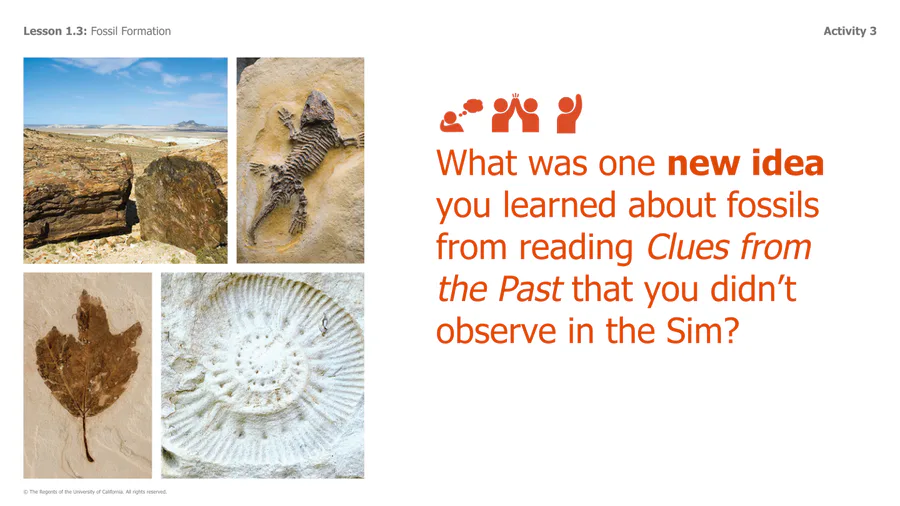
What was one new idea you learned about fossils from reading Clues from the Past that you didn’t observe in the Sim?

42

media

43

Open Ended

What always needs to happen for a fossil to form?

44

media

45

media

46

Open Ended

How is each type of sediment different?

47

media

48

media

49

media

50

media

51

media

52

media

53

media

54

media
media

Show answer

Auto Play

Slide 1 / 54

SLIDE