

CTBA 2 Reteach

Presentation
•
Science
•
7th Grade
•
Practice Problem
•
Medium
+12
Standards-aligned

Lacy Barnett
Used 13+ times
FREE Resource
15 Slides • 22 Questions
1

Reteach
2
Mass
The strength of gravity increases as the mass of the objects involved also increases.
An object with more mass has a stronger gravitational pull on other objects around it.
The Sun has a stronger gravitational field than Earth because it is far more massive.

Distance

The strength of gravity decreases as the distance between two objects becomes much greater.
When objects are located farther apart, the gravitational force between them becomes noticeably weaker.
This means that gravity gets weaker the farther away you get from an object.


3
Multiple Choice

4
Multiple Choice
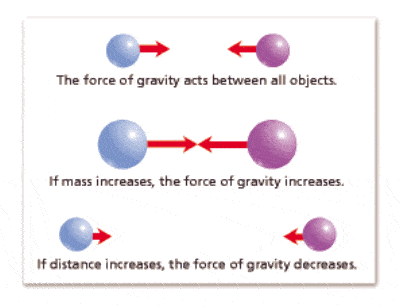
As mass increases, what happens to gravitational force?
increases
decreases
stays the same
5
Multiple Choice
6
Hotspot
Planets and their stars have a gravitational attraction to each other that depends on mass and distance. All 4 planets in the table orbit the same star. Based on the table, which planets have the most similar gravitational attraction with their star?
7

What does the "a" represent in this clip?
What does the "v" represent?
If either one increases or decreases, what could happen?
8
Multiple Choice
For an object, such as the Moon, to maintain a constant orbit around the Earth, which statement regarding the forces acting upon it is correct? The gravitational force from the Earth on the Moon must...
be greater than the Moon's forward motion.
be in balance with the Moon's tendency to move in a straight line (inertia).
constantly provide the necessary propulsive force.
be in balance with the Sun's gravitational pull.
9
Inner Planets
The four planets closest to the Sun are Mercury, Venus, Earth, and Mars.
These planets are small and are primarily composed of solid rock and metal.
They are located inside the asteroid belt that divides our solar system.

Outer Planets

The four planets farthest from the Sun are Jupiter, Saturn, Uranus, and Neptune.
These planets are much larger and are mostly composed of ice and gas.
They are located beyond the asteroid belt, a region with millions of asteroids.


10
Multiple Choice
How does the composition of the inner planets explain why they are also called 'rocky' planets?
They are primarily made of solid rock, unlike the outer planets.
They all have large rocks, like asteroids, orbiting them.
They have a rocky and uneven orbital path.
They are all a similar color to rocks found on Earth.
11
Asteroids and Comets: Rocky Bodies in Space
Asteroids
These are millions of small, rocky objects that orbit the Sun, mostly in the asteroid belt.
Their shape is often irregular, and their size can vary from very small to hundreds of kilometers wide.
Asteroids do not have atmospheres or tails, as they are primarily made of rock and metal.
If a small, round object orbits the Sun in the asteroid belt but is smaller than nearby asteroids, it may be classified as a dwarf planet because of its shape.

Comets

Comets are made of ice, dust, and gas, and are often called "dirty snowballs" by scientists.
They follow a long, oval-shaped orbit that takes them very close to and far from the Sun.
As a comet nears the Sun, it heats up and releases gas and dust, forming a glowing tail.
12
Multiple Choice
Which term describes the composition of the outer planets?
rocky
solid
water
gaseous
13
Multiple Select
During a trip to a planetarium, Greg learned that the outer planets are Jupiter, Saturn, Uranus, and Neptune.
Which statements describe the four outer planets? Select THREE answers.
They all have rings
They have a large number of moons
They are made mostly of gas.
They have rocky surfaces and volcanoes
They are the smallest in the solar system.
14
Multiple Choice
The outer planets are the largest in our solar system.
True
False
15
What are Temperature and Kinetic Energy?
Kinetic energy is the energy of moving molecules.
Temperature measures the average kinetic energy of these molecules.
Faster molecules mean higher kinetic energy and a higher temperature.
16
Multiple Choice
What happens to the kinetic energy of particles when the temperature of an object increases?
The kinetic energy of the particles increases.
The particles lose all their kinetic energy.
The kinetic energy of the particles stays the same.
The kinetic energy of the particles decreases.
17
Key Vocabulary

Thermal Energy
The total energy of all the moving particles that make up an object or a substance.

Heat
The transfer of thermal energy from a warmer object to a cooler one due to temperature differences.

Temperature
A measure of the average kinetic energy of the moving particles that make up a substance.

Conduction
The transfer of thermal energy between substances of different temperatures that are in direct physical contact.

Convection
Heat transfer through the movement of fluids, where hotter, less dense material rises and cooler material sinks.

Radiation
The heat transfer that can happen through empty space, like the Sun warming the Earth.
18
Thermal Energy, Heat, and Temperature
Thermal energy is the total energy of all moving particles in an object.
More particles mean more thermal energy, even at the same temperature.
Heat is the transfer of thermal energy from a warmer to a cooler object.
Temperature measures the average energy of the particles in a substance.


19
Multiple Choice
What causes the movement of fluid in a convection current?
Particles vibrating faster in a fixed position.
Differences in density, where warmer, less dense fluid rises and cooler, denser fluid sinks.
The transfer of energy through direct particle-to-particle contact.
The entire fluid becoming the same density all at once.
20
Balanced vs. Unbalanced Forces
Balanced forces are equal and opposite, so the net force is zero.
Unbalanced forces are unequal, resulting in a net force greater than zero.
A change in motion is always caused by an unbalanced force.
21
Multiple Choice
What is the primary difference between balanced and unbalanced forces?
Balanced forces cause a change in motion; unbalanced forces do not.
Only balanced forces are measured in Newtons.
Unbalanced forces only apply to objects at rest.
Unbalanced forces cause a change in motion; balanced forces do not.
22
Key Vocabulary

Distance-Time Graph
A graph showing how far an object has moved over a specific period of time.

Constant Speed
This is when an object covers the same distance in each equal time period.

Stationary
An object that is not moving or is at rest, shown as a horizontal line.

Gradient
The steepness of a line on a graph, which indicates the object's speed.

Acceleration
The rate at which an object's speed increases, shown by an upward-curving line.
23
Multiple Choice
On a distance-time graph, what does a horizontal line signify about an object's motion?
The object is moving at a constant speed.
The object is accelerating.
The object is stationary or not moving.
The object is moving backwards.
24
Multiple Choice
A bus travels a total distance of 300 km over 5 hours on its route. Which statement correctly describes its average speed?
The average speed is 60 km/h.
The average velocity is 60 km/h.
The average speed is 60 km/h east.
The displacement is 300 km.
25
The Speed Formulas


26
Multiple Choice

Find the speed of the following objects.
Which object is the fastest?
A
B
C
27
Multiple Choice

What is the speed of the object for the trip?
20 mps
80 mps
24 mps
5 mps
28
Concentration and Dilution
Concentration is how much solute is dissolved in a solvent.
A solution with a lot of solute is called concentrated.
A solution with very little solute is called dilute.
Adding more solvent makes a solution less concentrated, or diluted.


29
Multiple Choice
How can a solution be made less concentrated?
By stirring the solution
By adding more solute
By removing some solvent
By adding more solvent
30
Multiple Choice
If you have a very concentrated solution of salt water, what is the most effective way to dilute it?
Add more salt.
Add more water.
Stir the solution faster.
Heat the water.
31

32
Multiple Choice

Select the answer that is NOT a physical change.
baking bread
ripping paper
painting a picture
mixing coffee
33
Counting with Parentheses
A subscript outside parentheses affects all elements inside the group.
Multiply each element's subscript inside by the subscript outside the parentheses.
For example, in Al2(SO4)3, there are 2 Al atoms.
There are 3 S atoms (1 × 3) and 12 O atoms (4 × 3).


34
Multiple Choice
Based on the rules for parentheses, how many Oxygen atoms are in the formula Mg(NO3)2?
6
3
2
5
35


What are elements?
● They are the simplest pure
substance that
cannot be
broken into
simpler
substances●
● Consist of only one type of atom
● Found on the periodic table
● Can be a single capital letter OR a capital letter followed by a lowercase letter which is called a chemical symbol
36
Multiple Choice
Which of the following represents an element?
H2O
H2
NaCl
CaCO3
37
Multiple Choice

What elements are represented in this chemical formula? Fe2O3
Iron, Oxygen
Francium, Europium, Oxygen
Ferrium, Oxygen
Berylium, Oxygen
Reteach
Show answer
Auto Play
Slide 1 / 37
SLIDE
Similar Resources on Wayground

34 questions
Terrestrial Biomes Review
Presentation
•
7th Grade
33 questions
Homeostasis and Cellular Processes
Presentation
•
7th Grade
32 questions
Unit 4 Atmosphere and Weather
Presentation
•
7th Grade
27 questions
Water Resources
Presentation
•
7th Grade
27 questions
Balanced and unbalanced forces
Presentation
•
7th Grade
36 questions
Biotic and Abiotic Factors
Presentation
•
7th Grade
33 questions
Watersheds
Presentation
•
7th Grade
34 questions
Biodiversity Intro
Presentation
•
7th Grade
Popular Resources on Wayground
10 questions
Safety Day 2026 – Student Review

Quiz
•
9th Grade
21 questions
Continents and Oceans
Quiz
•
6th Grade
20 questions
Parts of Speech
Quiz
•
5th Grade
16 questions
Subject & Predicate
Quiz
•
5th Grade
25 questions
Multiplication Facts
Quiz
•
5th Grade
12 questions
Map Skills
Quiz
•
3rd Grade
22 questions
Continents and Oceans
Quiz
•
5th Grade
15 questions
Rounding Decimals
Quiz
•
5th Grade
Discover more resources for Science
10 questions
Exploring Chemical and Physical Changes

Interactive video
•
6th - 10th Grade
14 questions
Week 1 Falcon Flex Fast and Curious
Quiz
•
7th Grade
42 questions
Explore Plate Tectonics and Boundaries
Quiz
•
7th Grade
21 questions
Waves and Wave Properties
Quiz
•
6th - 8th Grade
16 questions
Photosynthesis and Cellular Respiration Review
Quiz
•
7th Grade
20 questions
Food Webs + Energy Pyramids
Quiz
•
7th Grade
9 questions
Biology: Cell Structure
Interactive video
•
7th Grade
8 questions
Diffusion and Osmosis Review
Presentation
•
6th - 8th Grade